Philippines Hams, Shoulders and Cuts of Swine Market Size, Share & Growth Rate
The Philippines Hams, Shoulders and Cuts of Swine Market was estimated at USD 846 Million in 2025 and is projected to reach USD 1205 Million by 2032, growing at a CAGR of 5.2% from 2026 to 2032. This upward trajectory is largely driven by the countrys ingrained culture of pork consumption, as it plays a central role in countless traditional and modern culinary dishes. Furthermore, the rising demand for processed pork products, particularly during festive occasions, significantly contributes to market expansion.
Philippines Hams, Shoulders and Cuts of Swine Market Year-wise Growth Rate and Key Drivers
This graph highlights how the Philippines Hams, Shoulders and Cuts of Swine Market has steadily grown over the years, supported by major growth factors.
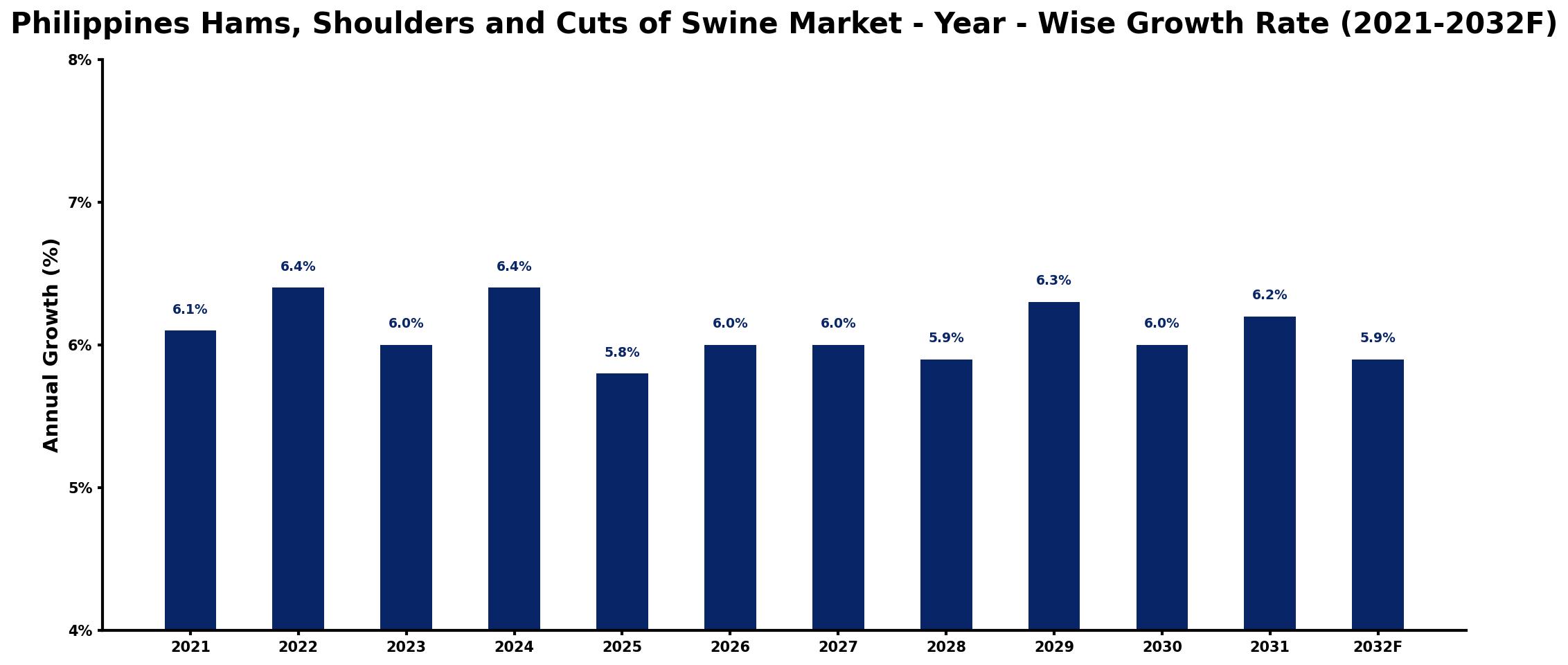
The table below presents the year‑wise growth rates along with the key drivers influencing the market
| Year | Growth Rate | Major Drivers |
| 2021 | 6.1% | Rising consumer demand for protein |
| 2022 | 6.4% | Increased exports to neighboring countries |
| 2023 | 6.0% | Expansion of food service sector |
| 2024 | 6.4% | Growing popularity of processed meats |
| 2025 | 5.8% | Higher disposable income for consumers |
| 2026 | 6.0% | Investment in modern processing facilities |
| 2027 | 6.0% | Strengthening local supply chains |
| 2028 | 5.9% | Innovations in food preservation techniques |
| 2029 | 6.3% | Growing health consciousness among consumers |
| 2030 | 6.0% | Increase in fast food establishments |
| 2031 | 6.2% | growing commercial sector adoption |
| 2032 | 5.9% | Rising trend of home cooking |
Note: Market size estimations and growth projections presented in this report are based on 6Wresearch's proprietary forecasting methodology, utilizing the latest available industry data, government publications, and primary research inputs.
Philippines Hams, Shoulders and Cuts of Swine Market Synopsis
Recent momentum in the Philippines Hams, Shoulders and Cuts of Swine Market reflects a strong recovery from pandemic-induced disruptions. Looking ahead, the market is expected to continue evolving with a focus on product quality and consumer preference diversification, catering to various culinary uses across the archipelago.
As the market matures, the integration of advanced processing techniques alongside traditional practices will be essential in meeting the demand for high-quality pork products. This blend of modernization and cultural respect will likely define the future landscape of this vital segment.
Philippines Hams, Shoulders and Cuts of Swine Market Key Takeaways
- Pork is a cornerstone of Filipino cuisine, driving sustained demand for hams, shoulders, and other cuts.
- The market is projected to grow significantly, indicating robust consumer interest and economic resilience.
- Advanced processing techniques are becoming increasingly important for product safety and quality assurance.
- Regional variations in consumer preferences necessitate tailored product offerings across different markets.
- Increased public interest in processed and packaged meats presents opportunities for innovation and growth.
Evaluation of Restraints in Philippines Hams, Shoulders and Cuts of Swine Market
The Philippines Hams, Shoulders and Cuts of Swine Market faces several restraints that could impede its growth trajectory. Primarily, supply chain disruptions often lead to inconsistencies in product availability. Additionally, disease outbreaks within swine populations pose a risk to production stability. Moreover, the complexity of consumer preferences requires processors to adapt continuously, which can strain operational capabilities. Investments in enhanced processing technology will be vital for quality assurance and meeting diverse market demands.
Philippines Hams, Shoulders and Cuts of Swine Market Trends
Current trends indicate a shift towards more health-conscious pork products, with increased interest in low-fat and organic options. Furthermore, the growing popularity of ready-to-cook and pre-packaged meat items is reshaping consumer purchasing patterns, influenced by busy lifestyles. Digitalization in the supply chain is also gaining traction, helping suppliers adapt to changing consumer behaviors and preferences while ensuring traceability and safety.
Philippines Hams, Shoulders and Cuts of Swine Market Opportunities
Opportunities for growth within the Philippines Hams, Shoulders and Cuts of Swine Market abound, particularly in the development of niche products that cater to evolving health trends. The rising popularity of gourmet and artisanal pork cuts could attract new consumer segments. Additionally, collaboration between local farmers and meat processors can enhance supply chain efficiency and product quality, ultimately benefiting both producers and consumers. Expanding export markets may also present lucrative avenues for local producers.
Government Initiatives in the Philippines Hams, Shoulders and Cuts of Swine Market
The Philippine government has recognized the importance of the pork industry and is implementing several initiatives aimed at bolstering local production. These initiatives often focus on providing financial support for farmers, promoting biosecurity measures, and encouraging modern farming techniques to enhance productivity. Additionally, public campaigns to support local pork consumption reinforce the industry's relevance to the national economy.
Future Insights of the Philippines Hams, Shoulders and Cuts of Swine Market
From 2026 to 2032, the Philippines Hams, Shoulders and Cuts of Swine Market is expected to undergo significant transformation. With consumer preferences leaning towards quality and safety, there will be a heightened emphasis on sustainable practices in pork production. As technology continues to evolve, incorporating digital solutions for traceability and supply chain optimization will be pivotal. Overall, the market appears poised for growth driven by cultural, economic, and technological factors.
Philippines Hams, Shoulders and Cuts of Swine Market Latest Developments (2025 - 2026)
Recent developments in the Philippines Hams, Shoulders and Cuts of Swine Market indicate a strong recovery post-pandemic, with meat processing facilities ramping up production to meet the renewed consumer demand. Innovations in packaging and processing technologies have emerged, improving product shelf life and convenience. Additionally, local businesses are increasingly collaborating to enhance supply chain resilience and ensure the availability of high-quality pork products throughout the region.
Philippines Hams, Shoulders and Cuts of Swine Market - Key Attractiveness of the Report
- 10 Years of Market Numbers
- Historical Data Starting from 2022 to 2025
- Base Year: 2025
- Forecast Data until 2032
- Key Performance Indicators Impacting the Market
- Major Upcoming Developments and Projects
Key Highlights of the Report:
- Philippines Hams, Shoulders and Cuts of Swine Market Outlook
- Market Size of Philippines Hams, Shoulders and Cuts of Swine Market, 2025
- Forecast of Philippines Hams, Shoulders and Cuts of Swine Market, 2032
- Historical Data and Forecast of Philippines Hams, Shoulders and Cuts of Swine Revenues & Volume for the Period 2022-2032F
- Philippines Hams, Shoulders and Cuts of Swine Market Trend Evolution
- Philippines Hams, Shoulders and Cuts of Swine Market Drivers and Challenges
- Philippines Hams, Shoulders and Cuts of Swine Price Trends
- Philippines Hams, Shoulders and Cuts of Swine Porter's Five Forces
- Philippines Hams, Shoulders and Cuts of Swine Industry Life Cycle
- Historical Data and Forecast of Philippines Hams, Shoulders and Cuts of Swine Market Revenues & Volume By Product Type for the Period 2022-2032F
- Historical Data and Forecast of Philippines Hams, Shoulders and Cuts of Swine Market Revenues & Volume By Processed Meat for the Period 2022-2032F
- Historical Data and Forecast of Philippines Hams, Shoulders and Cuts of Swine Market Revenues & Volume By Frozen Meat for the Period 2022-2032F
- Historical Data and Forecast of Philippines Hams, Shoulders and Cuts of Swine Market Revenues & Volume By Chilled Meat for the Period 2022-2032F
- Historical Data and Forecast of Philippines Hams, Shoulders and Cuts of Swine Market Revenues & Volume By Canned Meat for the Period 2022-2032F
- Historical Data and Forecast of Philippines Hams, Shoulders and Cuts of Swine Market Revenues & Volume By Fresh Meat for the Period 2022-2032F
- Historical Data and Forecast of Philippines Hams, Shoulders and Cuts of Swine Market Revenues & Volume By Animal Type for the Period 2022-2032F
- Historical Data and Forecast of Philippines Hams, Shoulders and Cuts of Swine Market Revenues & Volume By Cattle and Buffalo for the Period 2022-2032F
- Historical Data and Forecast of Philippines Hams, Shoulders and Cuts of Swine Market Revenues & Volume By Pig for the Period 2022-2032F
- Historical Data and Forecast of Philippines Hams, Shoulders and Cuts of Swine Market Revenues & Volume By Poultry for the Period 2022-2032F
- Historical Data and Forecast of Philippines Hams, Shoulders and Cuts of Swine Market Revenues & Volume By Sheep and Goat for the Period 2022-2032F
- Historical Data and Forecast of Philippines Hams, Shoulders and Cuts of Swine Market Revenues & Volume By Other Animals for the Period 2022-2032F
- Historical Data and Forecast of Philippines Hams, Shoulders and Cuts of Swine Market Revenues & Volume By Distribution Channel for the Period 2022-2032F
- Historical Data and Forecast of Philippines Hams, Shoulders and Cuts of Swine Market Revenues & Volume By Business to Consumers (B2C) for the Period 2022-2032F
- Historical Data and Forecast of Philippines Hams, Shoulders and Cuts of Swine Market Revenues & Volume By Modern Groceries for the Period 2022-2032F
- Historical Data and Forecast of Philippines Hams, Shoulders and Cuts of Swine Market Revenues & Volume By Wet & Butcher Shops for the Period 2022-2032F
- Historical Data and Forecast of Philippines Hams, Shoulders and Cuts of Swine Market Revenues & Volume By Convenience Stores for the Period 2022-2032F
- Historical Data and Forecast of Philippines Hams, Shoulders and Cuts of Swine Market Revenues & Volume By Business to Business (B2B) for the Period 2022-2032F
- Historical Data and Forecast of Philippines Hams, Shoulders and Cuts of Swine Market Revenues & Volume By Other Channel for the Period 2022-2032F
- Philippines Hams, Shoulders and Cuts of Swine Import Export Trade Statistics
- Market Opportunity Assessment By Product Type
- Market Opportunity Assessment By Animal Type
- Market Opportunity Assessment By Distribution Channel
- Philippines Hams, Shoulders and Cuts of Swine Top Companies Market Share
- Philippines Hams, Shoulders and Cuts of Swine Competitive Benchmarking By Technical and Operational Parameters
- Philippines Hams, Shoulders and Cuts of Swine Company Profiles
- Philippines Hams, Shoulders and Cuts of Swine Key Strategic Recommendations






































