Philippines Higher Education Market Size & Growth Rate (2026-2032)
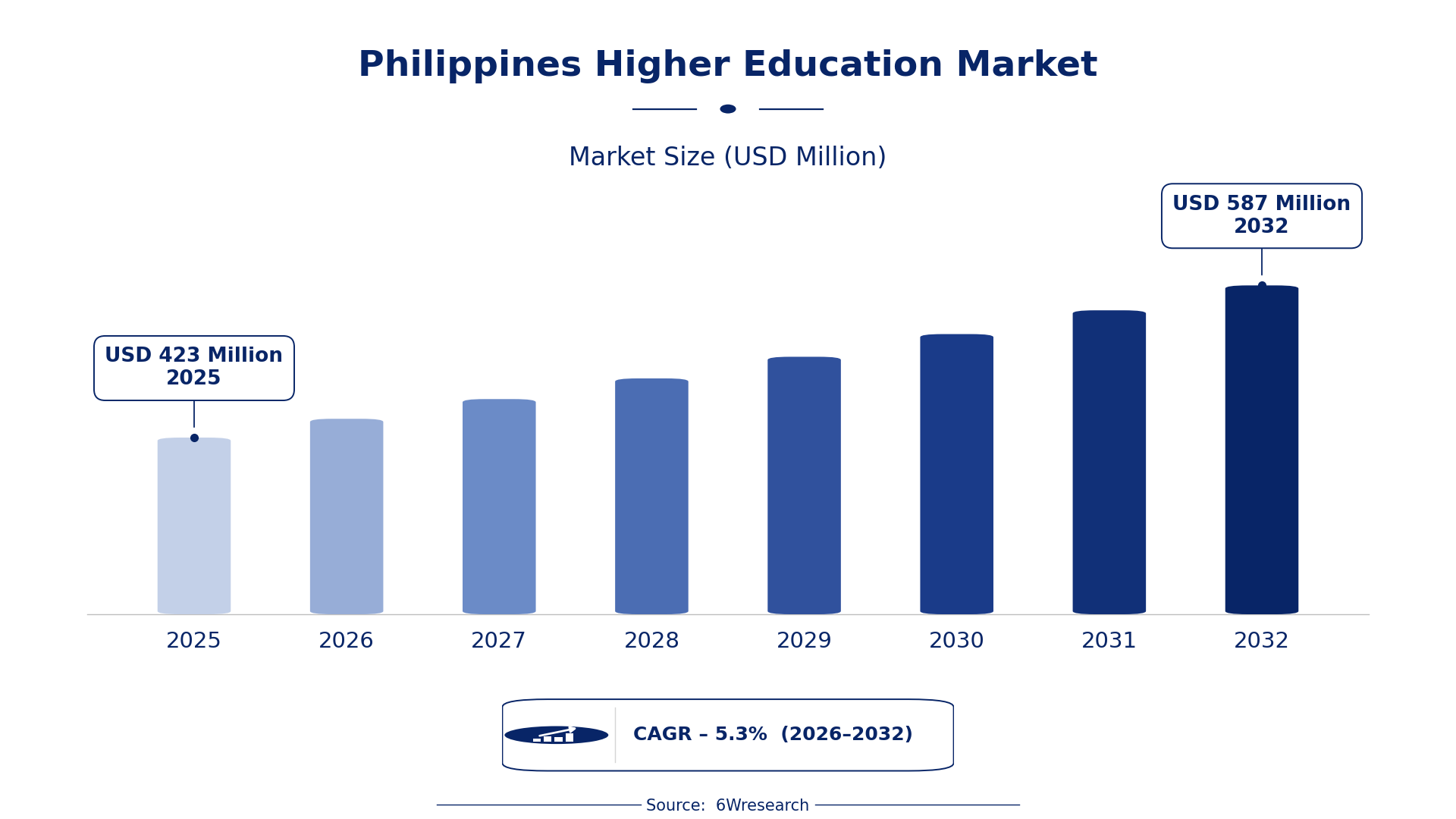
The Philippines Higher Education Market was estimated at USD 423 Million in 2025 and is projected to reach USD 587 Million by 2032, growing at a CAGR of 5.3% from 2026 to 2032.
Philippines Higher Education Market Synopsis
The primary force shaping the Philippines Higher Education Market today is the rapid digitalization of learning platforms. As educational institutions integrate technology into their curricula, students increasingly demand flexible and accessible learning options. This shift is not just about convenience; it reflects a broader change in how education is perceived and delivered across the archipelago.
In tandem with technological advancements, shifting student demographics are influencing the market’s dynamics. A younger, tech-savvy population is seeking education that aligns with global standards and industry requirements, driving institutions to enhance their offerings and adapt to new educational paradigms.
Philippines Higher Education Market Year-wise Growth Rate and Key Drivers
This graph illustrates the annual growth rates of the Philippines Higher Education Market from 2021 to 2032, highlighting a steady upward trajectory and projected expansion over the forecast period.
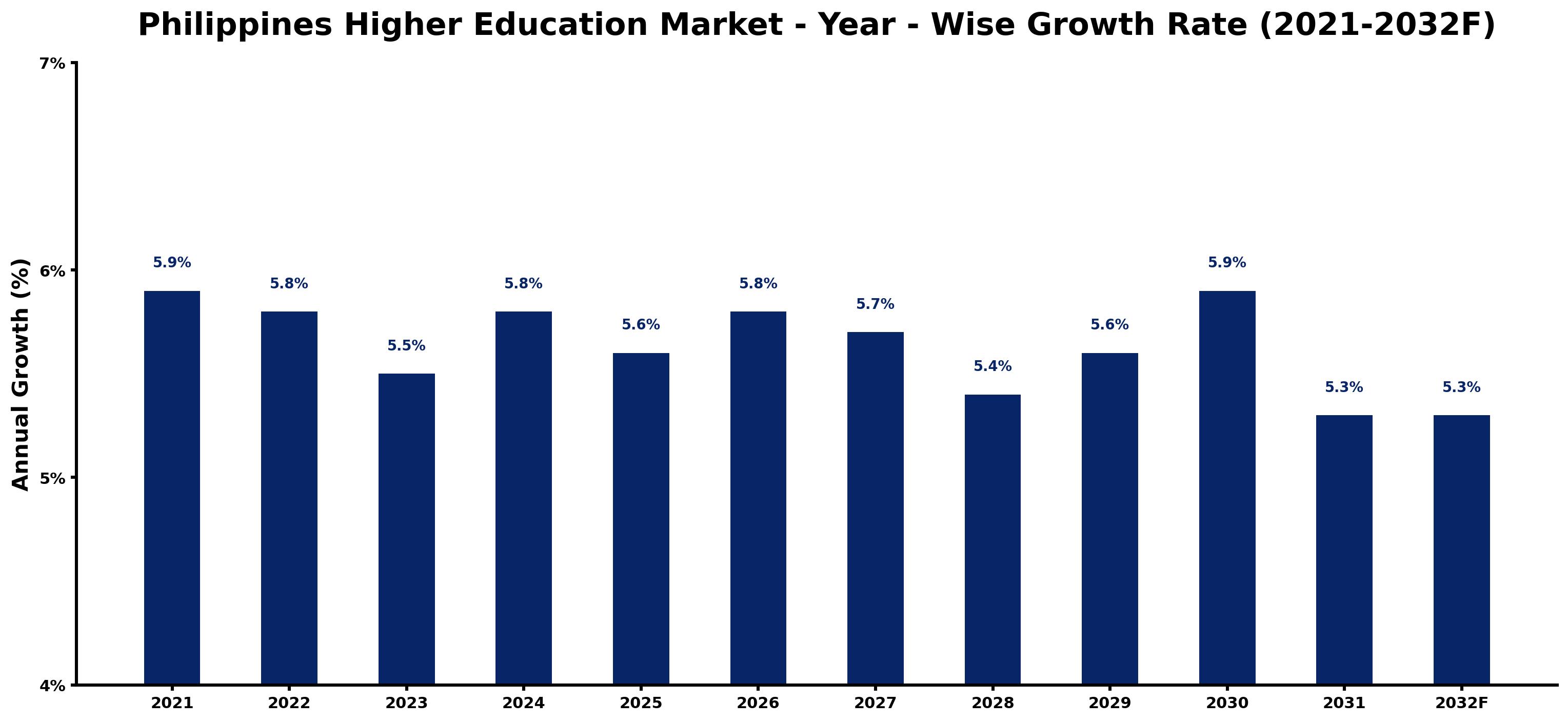
The table below presents the year‑wise growth rates along with the key drivers influencing the market
| Year | Growth Rate | Major Drivers |
| 2021 | 5.9% | Increased government funding for educational infrastructure development. |
| 2022 | 5.8% | Rising enrollment in online education platforms and institutions. |
| 2023 | 5.5% | Higher demand for skilled workers in BPO industry. |
| 2024 | 5.8% | Implementation of K to 12 curriculum enhancing college readiness. |
| 2025 | 5.6% | Growing international partnerships for exchange programs and scholarships. |
| 2026 | 5.8% | Demand for education reforms to align with global standards. |
| 2027 | 5.7% | Increased focus on STEM education by local universities. |
| 2028 | 5.4% | Awareness of lifelong learning in a rapidly changing job market. |
| 2029 | 5.6% | Emerging digital learning technologies improving accessibility and engagement. |
| 2030 | 5.9% | Government initiatives supporting vocational training and skill development. |
| 2031 | 5.3% | Rising interest in environmental and sustainability education programs. |
| 2032 | 5.3% | Strengthened collaborations between universities and industries for talent acquisition. |
Note: Market size estimations and growth projections presented in this report are based on 6Wresearch's proprietary forecasting methodology, utilizing the latest available industry data, government publications, and primary research inputs.
Philippines Higher Education Market Key Takeaways
Below are some of the specific key takeaways from the market, including:
- The push for quality education is a key driver in the market, influenced by competitive job market demands.
- Digital learning platforms are rapidly transforming traditional education methods.
- Access to education remains a challenge, particularly in remote areas, which hinders growth.
- Government policies are evolving to support educational infrastructure and access.
- Investment in e-learning solutions is seen as a significant opportunity for future growth.
Evaluation of Restraints in Philippines Higher Education Market
Access to quality education is a pressing issue, especially in rural and underserved regions. The digital divide exacerbates this problem, leaving many students without reliable internet connectivity or access to necessary technologies. on top of that, socio-economic disparities contribute to unequal educational opportunities, limiting the potential for growth in the sector. These factors collectively act as barriers, preventing the market from reaching its full potential.
Philippines Higher Education Market Trends
Several trends are emerging in the Philippines Higher Education Market. Firstly, there’s an increased focus on STEM (Science, Technology, Engineering, and Mathematics) programs, driven by the demand for skilled professionals in these fields. Secondly, blended learning, which combines traditional classroom methods with online education, is gaining traction, appealing to students’ desire for flexibility. Thirdly, partnerships between institutions and industry players are becoming more common, facilitating curriculum development that meets real-world needs.
Philippines Higher Education Market Opportunities
The landscape is rife with opportunities, particularly in digital education. Investment in technology-enabled learning environments can significantly enhance educational access and quality. on top of that, initiatives aimed at developing vocational training programs can bridge the skills gap in the job market, catering to the needs of both students and employers. As the demand for lifelong learning grows, institutions that adapt quickly will find themselves well-positioned to capitalize on these trends.
Government Initiatives in the Philippines Higher Education Market
The Philippine government is actively shaping the Higher Education Market through various policies aimed at improving educational access and quality. Recent initiatives reflect a commitment to enhance infrastructure, technology integration, and overall educational standards. This regulatory focus is crucial for addressing current challenges and fostering growth in the sector.
- A national digital infrastructure upgrade program was launched to improve connectivity in educational institutions across the country.
- Current initiatives include ongoing training programs for faculty to enhance their digital teaching capabilities.
- A planned public-private partnership is expected to develop vocational education centers by 2028, focusing on skills relevant to local industries.
- The government has introduced a scholarship program aimed at underprivileged students to increase access to higher education.
- Current legislation is being reviewed to streamline the accreditation process for new educational institutions.
Future Insights of the Philippines Higher Education Market
Looking ahead, the Philippines Higher Education Market is expected to continue evolving in response to technological advancements and changing demographic needs. Institutions that embrace digital transformation and prioritize student-centric learning will thrive. The integration of artificial intelligence and data analytics in educational practices will likely enhance personalized learning experiences, positioning the market for sustained growth through 2032 and beyond.
Philippines Higher Education Market Latest Developments
Recent activities within the Philippines Higher Education Market indicate a robust movement towards modernization and innovation. Over the past year, institutions have been actively engaging with technology providers to enhance their educational offerings and student experiences.
- A major technology vendor announced a partnership with several universities to implement an AI-driven learning management system, launched in early 2025 and completed by late 2025.
- An ongoing initiative began in mid-2025 to develop mobile learning applications tailored for remote students.
- A new campus facility focusing on STEM education is planned to open in mid-2026, aiming to enhance practical learning opportunities.
- Several colleges have initiated collaborative programs with international universities to promote exchange programs, which are currently underway.
- A rollout of a nationwide mentorship program for students, expected to begin in Q3 2025, aims to connect learners with industry professionals.
Philippines Higher Education Market - Key Attractiveness of the Report
- 10 Years of Market Numbers
- Historical Data Starting from 2022 to 2025
- Base Year: 2025
- Forecast Data until 2032
- Key Performance Indicators Impacting the Market
- Major Upcoming Developments and Projects
Key Highlights of the Report:
- Philippines Higher Education Market Outlook
- Market Size of Philippines Higher Education Market, 2025
- Forecast of Philippines Higher Education Market, 2032
- Historical Data and Forecast of Philippines Higher Education Revenues & Volume for the Period 2022-2032F
- Philippines Higher Education Market Trend Evolution
- Philippines Higher Education Market Drivers and Challenges
- Philippines Higher Education Price Trends
- Philippines Higher Education Porter's Five Forces
- Philippines Higher Education Industry Life Cycle
- Historical Data and Forecast of Philippines Higher Education Market Revenues & Volume By Component for the Period 2022-2032F
- Historical Data and Forecast of Philippines Higher Education Market Revenues & Volume By Solutions for the Period 2022-2032F
- Historical Data and Forecast of Philippines Higher Education Market Revenues & Volume By Services for the Period 2022-2032F
- Historical Data and Forecast of Philippines Higher Education Market Revenues & Volume By Deployment Type for the Period 2022-2032F
- Historical Data and Forecast of Philippines Higher Education Market Revenues & Volume By On-premises for the Period 2022-2032F
- Historical Data and Forecast of Philippines Higher Education Market Revenues & Volume By Cloud for the Period 2022-2032F
- Historical Data and Forecast of Philippines Higher Education Market Revenues & Volume By Vertical for the Period 2022-2032F
- Historical Data and Forecast of Philippines Higher Education Market Revenues & Volume By State Universities for the Period 2022-2032F
- Historical Data and Forecast of Philippines Higher Education Market Revenues & Volume By Community Colleges for the Period 2022-2032F
- Historical Data and Forecast of Philippines Higher Education Market Revenues & Volume By Private Colleges for the Period 2022-2032F
- Philippines Higher Education Import Export Trade Statistics
- Market Opportunity Assessment By Component
- Market Opportunity Assessment By Deployment Type
- Market Opportunity Assessment By Vertical
- Philippines Higher Education Top Companies Market Share
- Philippines Higher Education Competitive Benchmarking By Technical and Operational Parameters
- Philippines Higher Education Company Profiles
- Philippines Higher Education Key Strategic Recommendations






































