Philippines HR Analytics Market Size & Growth Rate (2026-2032)
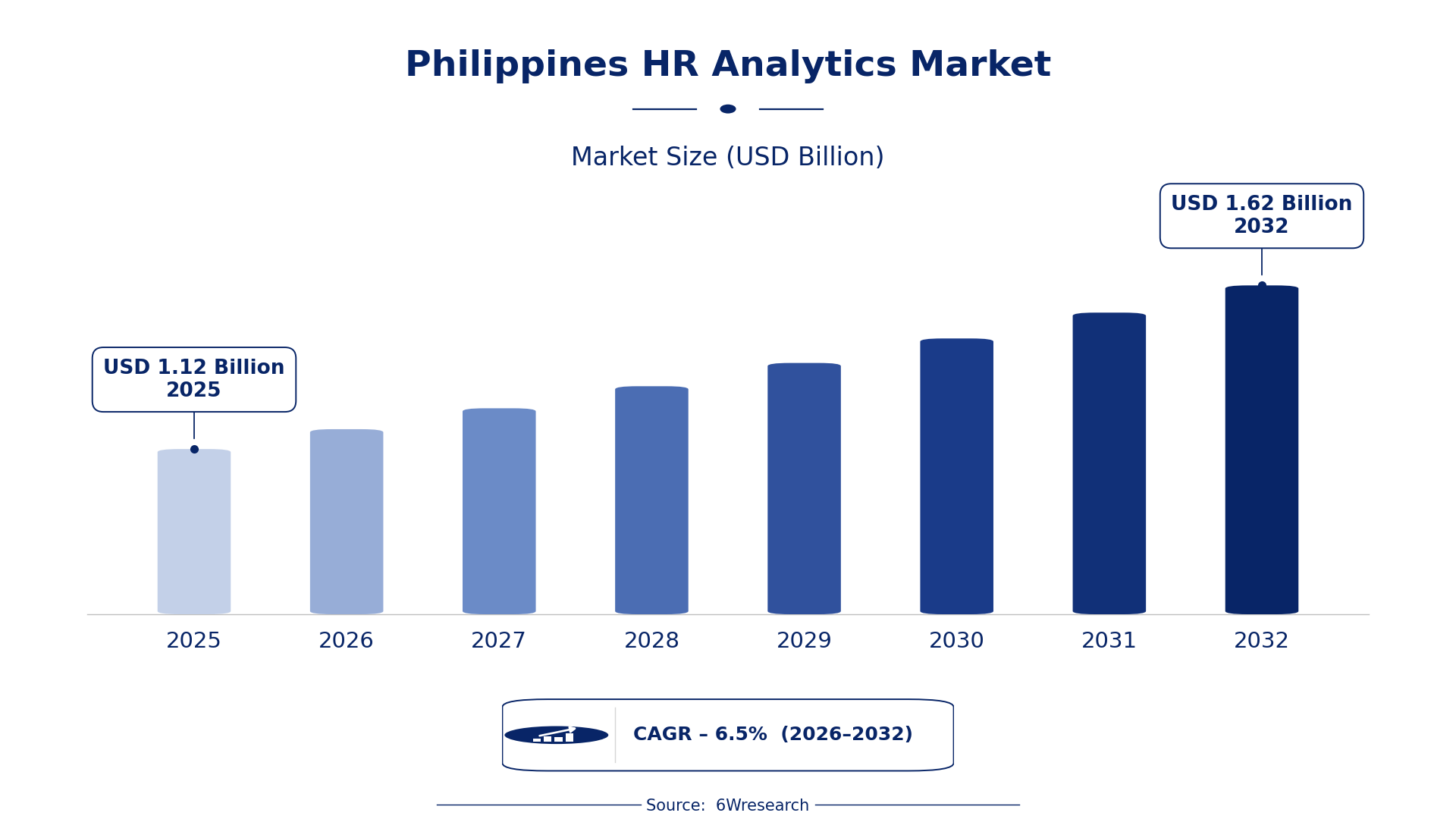
The Philippines HR Analytics Market was estimated at USD 1124 Million in 2025 and is projected to reach USD 1625 Million by 2032, growing at a CAGR of 6.5% from 2026 to 2032.
Philippines HR Analytics Market Synopsis
The demand for HR analytics in the Philippines is surging as organizations increasingly recognize the benefits of data-driven human resource management. Companies are harnessing analytical tools to enhance recruitment processes, boost employee retention rates, and refine workforce planning strategies. This shift not only optimizes talent acquisition but also aligns employee performance with organizational goals.
As the Philippines continues to recover from the impact of the COVID-19 pandemic, the emphasis on employee well-being and productivity monitoring has amplified. Businesses are now more inclined to invest in analytics solutions that provide insights into remote work dynamics, employee engagement, and overall organizational health. This trend is reshaping the HR function, transforming it into a strategic partner in business success.
Philippines HR Analytics Market Year-wise Growth Rate and Key Drivers
This graph illustrates the annual growth rates of the Philippines HR Analytics Market from 2021 to 2032, highlighting a steady upward trajectory and projected expansion over the forecast period.
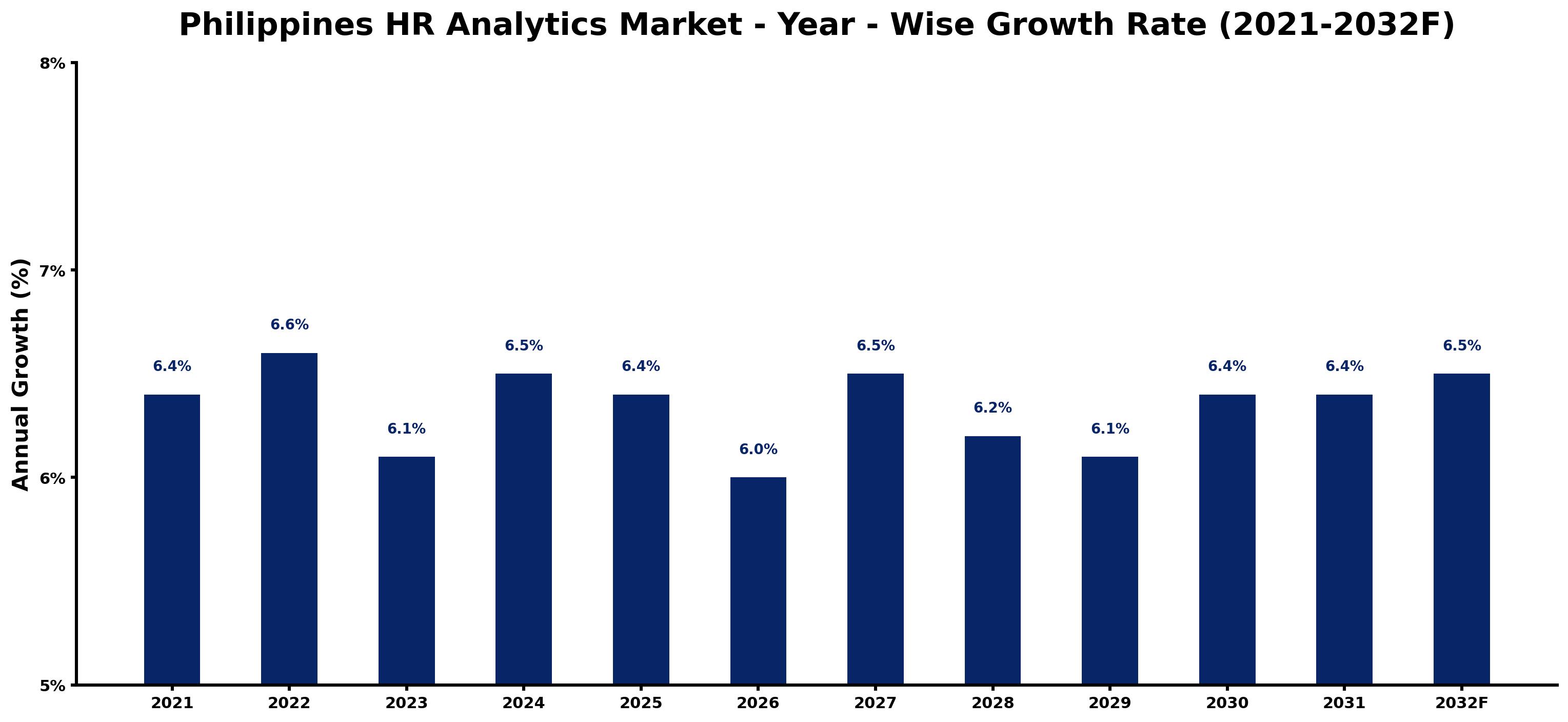
The table below presents the year‑wise growth rates along with the key drivers influencing the market
| Year | Growth Rate | Major Drivers |
| 2021 | 6.4% | Rise in remote work and talent analytics adoption. |
| 2022 | 6.6% | Increased demand for employee engagement insights post-pandemic. |
| 2023 | 6.1% | Government initiatives promoting digital skills in workforce. |
| 2024 | 6.5% | Growing emphasis on data-driven HR decision-making strategies. |
| 2025 | 6.4% | Surge in startups leveraging analytics for talent management. |
| 2026 | 6.0% | Large companies investing in predictive analytics tools. |
| 2027 | 6.5% | Corporate focus on optimizing workforce performance metrics. |
| 2028 | 6.2% | Enhanced connectivity driving demand for HR tech solutions. |
| 2029 | 6.1% | Regulatory compliance requiring advanced employee data tracking. |
| 2030 | 6.4% | Emergence of local HR tech firms innovating analytics services. |
| 2031 | 6.4% | Increased investment in diversity and inclusion analytics. |
| 2032 | 6.5% | Adoption of AI tools to improve recruitment processes. |
Note: Market size estimations and growth projections presented in this report are based on 6Wresearch's proprietary forecasting methodology, utilizing the latest available industry data, government publications, and primary research inputs.
Philippines HR Analytics Market Key Takeaways
Below are some of the specific key takeaways from the market, including:
- Growing recognition of data-driven HR management is fostering market growth.
- Organizations are prioritizing employee engagement and well-being analytics.
- Investment in advanced analytics tools is critical for competitive advantage.
- Remote work analytics are becoming a standard in workforce management.
- Challenges in data quality remain a concern for effective HR analytics implementation.
Evaluation of Restraints in Philippines HR Analytics Market
Despite the promising growth trajectory, the Philippines HR Analytics market faces notable restraints. A significant barrier is the inconsistency in data quality and availability across organizations. Many businesses still lack comprehensive HR data, making it challenging to derive actionable insights. on top of that, aligning analytics tools with existing HR practices and employee privacy concerns adds complexity to the implementation process. This combination of factors can hinder the full potential of HR analytics solutions.
Philippines HR Analytics Market Trends
Several trends are shaping the Philippines HR Analytics market. The integration of artificial intelligence and machine learning into HR analytics tools is gaining traction, allowing for predictive insights that drive strategic decision-making. on top of that, companies are increasingly focusing on diversity and inclusion metrics, utilizing analytics to create equitable workplace environments. The shift towards cloud-based solutions is also noteworthy, as businesses seek scalable and flexible analytics platforms that can adapt to their evolving needs.
Philippines HR Analytics Market Opportunities
The landscape for HR analytics in the Philippines is ripe with opportunities. As organizations continue to embrace digital transformation, there is a growing demand for advanced analytics solutions tailored to local needs. Companies can explore partnerships with tech providers to enhance their analytics capabilities, particularly in areas such as employee engagement and performance management. Additionally, the rising importance of data privacy presents opportunities for developing robust, compliant analytics solutions that address both organizational and employee concerns.
Government Initiatives in the Philippines HR Analytics Market
Government policies are playing a crucial role in shaping the Philippines HR Analytics market. The Philippine government is focusing on enhancing workforce competitiveness through technology adoption in HR practices. Such initiatives aim to bolster the overall economic recovery while ensuring that businesses can effectively manage and analyze workforce data.
- A recently completed initiative involves the establishment of a national digital skills program aimed at equipping HR professionals with essential analytics capabilities.
- Currently underway is a public-private partnership that seeks to develop standards for HR data analytics, ensuring alignment with international best practices.
- A planned upcoming initiative aims to introduce tax incentives for companies investing in advanced HR analytics technologies by 2028.
- Recent regulatory measures have been introduced to improve data privacy compliance in HR analytics, fostering trust among employees.
Future Insights of the Philippines HR Analytics Market
Looking ahead to 2026-2032, the Philippines HR Analytics market is expected to witness continued growth driven by technological advancements and evolving workplace dynamics. Organizations will likely prioritize analytics tools that enhance employee experience and optimize performance. As businesses adapt to hybrid work models, the demand for real-time analytics will intensify, pushing HR departments to become more strategic and proactive in their approach. The integration of advanced technologies will redefine HR functions, transforming them into data-centric powerhouses.
Philippines HR Analytics Market Latest Developments
Recent developments in the Philippines HR Analytics market indicate a growing momentum in technology adoption and strategic partnerships. Organizations are increasingly recognizing the value of data insights in driving workforce management decisions, leading to innovative solutions that cater to this demand.
- A major technology vendor launched a new HR analytics platform in early 2025, designed to enhance predictive capabilities for employee performance.
- An initiative that began in mid-2025 is currently underway to develop a centralized data repository aimed at improving data accessibility for HR analytics.
- A rollout expected to begin in the second half of 2026 focuses on integrating AI-driven insights into existing HR management systems.
- A collaborative project between leading firms aims to establish best practices for employee well-being analytics, set to commence in early 2026.
Philippines HR Analytics Market - Key Attractiveness of the Report
- 10 Years of Market Numbers
- Historical Data Starting from 2022 to 2025
- Base Year: 2025
- Forecast Data until 2032
- Key Performance Indicators Impacting the Market
- Major Upcoming Developments and Projects
Key Highlights of the Report:
- Philippines HR Analytics Market Outlook
- Market Size of Philippines HR Analytics Market, 2025
- Forecast of Philippines HR Analytics Market, 2032
- Historical Data and Forecast of Philippines HR Analytics Revenues & Volume for the Period 2022-2032F
- Philippines HR Analytics Market Trend Evolution
- Philippines HR Analytics Market Drivers and Challenges
- Philippines HR Analytics Price Trends
- Philippines HR Analytics Porter's Five Forces
- Philippines HR Analytics Industry Life Cycle
- Historical Data and Forecast of Philippines HR Analytics Market Revenues & Volume By Application Area for the Period 2022-2032F
- Historical Data and Forecast of Philippines HR Analytics Market Revenues & Volume By Payroll for the Period 2022-2032F
- Historical Data and Forecast of Philippines HR Analytics Market Revenues & Volume By Retention for the Period 2022-2032F
- Historical Data and Forecast of Philippines HR Analytics Market Revenues & Volume By Recruitment for the Period 2022-2032F
- Historical Data and Forecast of Philippines HR Analytics Market Revenues & Volume By Workforce Management for the Period 2022-2032F
- Historical Data and Forecast of Philippines HR Analytics Market Revenues & Volume By Employee Engagement for the Period 2022-2032F
- Historical Data and Forecast of Philippines HR Analytics Market Revenues & Volume By Employee Development for the Period 2022-2032F
- Historical Data and Forecast of Philippines HR Analytics Market Revenues & Volume By Vertical for the Period 2022-2032F
- Historical Data and Forecast of Philippines HR Analytics Market Revenues & Volume By Consumer goods and retail for the Period 2022-2032F
- Historical Data and Forecast of Philippines HR Analytics Market Revenues & Volume By BFSI for the Period 2022-2032F
- Historical Data and Forecast of Philippines HR Analytics Market Revenues & Volume By IT and telecom for the Period 2022-2032F
- Historical Data and Forecast of Philippines HR Analytics Market Revenues & Volume By Manufacturing for the Period 2022-2032F
- Historical Data and Forecast of Philippines HR Analytics Market Revenues & Volume By Healthcare for the Period 2022-2032F
- Historical Data and Forecast of Philippines HR Analytics Market Revenues & Volume By Education for the Period 2022-2032F
- Historical Data and Forecast of Philippines HR Analytics Market Revenues & Volume By Others for the Period 2022-2032F
- Historical Data and Forecast of Philippines HR Analytics Market Revenues & Volume By Component for the Period 2022-2032F
- Historical Data and Forecast of Philippines HR Analytics Market Revenues & Volume By Solutions for the Period 2022-2032F
- Historical Data and Forecast of Philippines HR Analytics Market Revenues & Volume By Service for the Period 2022-2032F
- Historical Data and Forecast of Philippines HR Analytics Market Revenues & Volume By Deployment Type for the Period 2022-2032F
- Historical Data and Forecast of Philippines HR Analytics Market Revenues & Volume By On-premises for the Period 2022-2032F
- Historical Data and Forecast of Philippines HR Analytics Market Revenues & Volume By Cloud for the Period 2022-2032F
- Historical Data and Forecast of Philippines HR Analytics Market Revenues & Volume By Organization Size for the Period 2022-2032F
- Historical Data and Forecast of Philippines HR Analytics Market Revenues & Volume By Large Enterprises for the Period 2022-2032F
- Historical Data and Forecast of Philippines HR Analytics Market Revenues & Volume By Small and Medium-Sized Enterprises (SMEs) for the Period 2022-2032F
- Philippines HR Analytics Import Export Trade Statistics
- Market Opportunity Assessment By Application Area
- Market Opportunity Assessment By Vertical
- Market Opportunity Assessment By Component
- Market Opportunity Assessment By Deployment Type
- Market Opportunity Assessment By Organization Size
- Philippines HR Analytics Top Companies Market Share
- Philippines HR Analytics Competitive Benchmarking By Technical and Operational Parameters
- Philippines HR Analytics Company Profiles
- Philippines HR Analytics Key Strategic Recommendations






































