Philippines Lumber Market Top 5 Importing Countries and Market Competition (HHI) Analysis
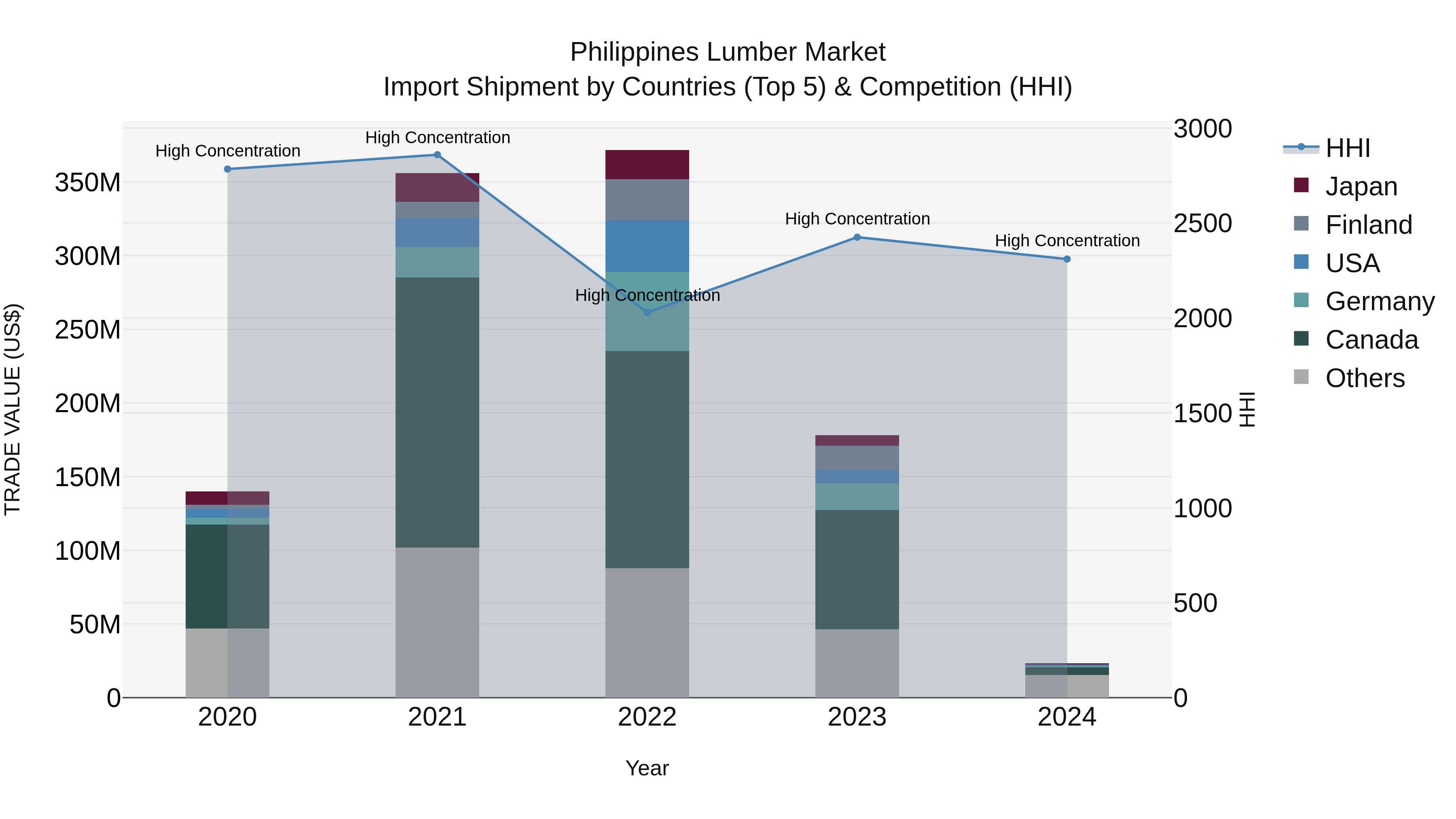
The Philippines lumber import market in 2024 continued to be dominated by key exporters including Malaysia, Gabon, Canada, USA, and Germany. Despite a high concentration with a high Herfindahl-Hirschman Index (HHI), the market experienced a significant decline with a negative Compound Annual Growth Rate (CAGR) of -36.13% from 2020 to 2024. The growth rate from 2023 to 2024 plummeted by -86.91%, indicating a challenging year for lumber imports in the Philippines. This trend suggests a need for further analysis and strategic planning within the industry.
Philippines Lumber Market Growth Rate
According to 6Wresearch internal database and industry insights, the Philippines Lumber Market is projected to grow at a compound annual growth rate (CAGR) of 6.5% during the forecast period (2026-2032).
Topics Covered in the Philippines Lumber Market Report
The Philippines Lumber Market report thoroughly covers the market by types and by application. The market report provides an unbiased and detailed analysis of ongoing market trends, opportunities/high growth areas, and market drivers, which help stakeholders devise and align their market strategies according to the current and future market dynamics.
Philippines Lumber Market Highlights
| Report Name | Philippines Lumber Market |
| Forecast Period | 2026–2032 |
| CAGR | 6.5% |
| Growing Sector | Construction |
Philippines Lumber Market Synopsis
Philippines Lumber Market is marked by its rich biodiversity and huge forest cover, providing a variety of timber species. However, stringent measures have been put in place to ensure that there is proper conservation of the forests, which affects the supply chain of the market. In addition to that, there has been an increase in the demand for lumber within the local and international market, mainly because of the construction and furniture industry. This market has been affected by the push towards legal timber harvesting to balance economic growth with environmental protection.
Evaluation of Growth Drivers in the Philippines Lumber Market
Below mentioned are some prominent drivers and their influence on the market dynamics:
|
Drivers |
Primary Segments Affected |
Why it Matters (Evidence) |
|
Expanding Residential Construction |
Hardwood Lumber, Construction |
Housing development programs increase demand for structural wood materials. |
|
Growth in Furniture Manufacturing |
Hardwood Lumber, Furniture |
Strong domestic and export furniture production drives timber consumption. |
|
Infrastructure Development Projects |
Softwood Lumber, Construction |
Government infrastructure initiatives require large volumes of lumber for frameworks and scaffolding. |
|
Rising Urbanization and Commercial Buildings |
Hardwood Lumber, Flooring & Moldings |
Urban development initiatives (i.e. building new residential homes, apartments, and commercial buildings) require wood for interior wood finishing. |
|
Sustainable Forestry Initiatives |
All Types, All Applications |
Regulations and local governments are promoting sustainable forestry practices such as managed timber harvesting and reforesting. |
Philippines Lumber Market is expected to grow at the CAGR of 6.5% during the forecast period of 2026-2032. Economic growth in the country and the rise of construction projects, both residential and commercial in nature, are the main drivers of the Philippines Lumber Market Growth. Along with this, infrastructure development projects undertaken by the government of the Philippines have also increased the demand for lumber. Besides this, the need for sustainable building materials is also affecting the lumber market.
Evaluation of Restraints in the Philippines Lumber Market
Below mentioned are some major restraints and their influence on the market dynamics:
|
Restraints |
Primary Segments Affected |
What This Means (Evidence) |
|
Deforestation Concerns and Logging Restrictions |
Hardwood Lumber, Construction |
Environmental policies limit excessive timber harvesting. |
|
High Transportation Costs |
All Types, All Applications |
Logistics challenges increase distribution costs for lumber products. |
|
Limited Domestic Timber Supply |
Hardwood Lumber, Furniture |
Dependence on foreign timber affects price stability. |
|
Illegal Logging Activities |
All Types, Construction & Others |
All illegal logging activity significantly impedes a regulated timber trade method from being operationally viable. |
|
Climate Impact on Forestry |
Softwood Lumber, All Applications |
Natural disasters and weather conditions affect forest productivity. |
Philippines Lumber Market Challenges
However, the Philippines lumber industry is facing several challenges. First of all, the issue of illegal logging is still a major problem that may impact the sustainability of the forests. Secondly, the Philippines is prone to natural calamities such as typhoons and earthquakes. This may impact the supply chain, thus resulting in fluctuations in the price of lumber. However, the adoption of sustainable and innovative approaches to the management of the forests has resulted in a wide variety of opportunities for growth. There is also an emerging opportunity for the Philippines to improve the lumber market.
Philippines Lumber Market Trends
Some of the key trends prevailing in the Philippines Lumber Market are as follows:
- Growing Demand for Sustainable Timber: There is an increased awareness among people about the need to protect the environment and hence the demand for sustainable timber products is growing significantly in the Philippines Lumber Market.
- Expansion of Engineered Wood Products: There is a growing demand for engineered lumber products such as laminated timber and plywood substitutes in the Philippines Lumber Market.
- Growing Prefabricated Housing Market: Prefabricated housing is gaining traction in the Philippines Lumber Market, and hence lumber products are being used in large quantities to construct prefabricated homes.
- Growing Demand for Digital Timber Processing: Advanced sawmills are using digital timber processing techniques to enhance efficiency and minimize timber wastage.
Investment Opportunities in the Philippines Lumber Market
Some of the significant opportunities for investment in the Philippines Lumber Market include:
- Sustainable Plantation Management: With the DAO 2026-05 guidelines, investors can now establish voluntary forest carbon credit projects, combining timber revenue with carbon finance.
- Modular Housing Manufacturing: Investing in factories that produce pre-fabricated wood panels for the government’s mass housing projects offers guaranteed long-term demand.
- Supply Chain Traceability Software: There is a growing market for digital platforms that provide real-time traceability and "Security Paper" (SECPA) integration for legal timber.
Top 5 Leading Players in the Philippines Lumber Market
Some prominent companies operating within the Philippines Lumber Market include:
1. West Fraser Timber Co. Ltd.
| Company Name | West Fraser Timber Co. Ltd. |
|---|---|
| Established Year | 1955 |
| Headquarters | Vancouver, Canada |
| Official Website | Click Here |
West Fraser Timber Co. Ltd. produces a wide range of lumber and engineered wood products widely used in construction and industrial applications. The company focuses on sustainable forestry practices and advanced wood processing technologies that support large-scale lumber supply across international markets.
2. Weyerhaeuser Company
| Company Name | Weyerhaeuser Company |
|---|---|
| Established Year | 1900 |
| Headquarters | Washington, United States |
| Official Website | Click Here |
Weyerhaeuser Company operates extensive timberlands and produces high-quality lumber used in construction and furniture industries. The company is recognized for sustainable forest management initiatives and its commitment to responsible timber harvesting and innovative wood product manufacturing.
3. Interfor Corporation
| Company Name | Interfor Corporation |
|---|---|
| Established Year | 1963 |
| Headquarters | Vancouver, Canada |
| Official Website | Click Here |
Interfor Corporation manufactures structural lumber products widely used in residential and commercial construction. The company emphasizes efficient sawmill operations, sustainable forestry sourcing, and consistent product quality to support global timber markets including developing construction economies.
4. Canfor Corporation
| Company Name | Canfor Corporation |
|---|---|
| Established Year | 1938 |
| Headquarters | Vancouver, Canada |
| Official Website | Click Here |
Canfor Corporation is a leading producer of lumber and wood products supplying construction and industrial sectors worldwide. The company invests heavily in forest sustainability, modern wood processing technologies, and supply chain optimization to support reliable lumber distribution.
5. Stora Enso Oyj
| Company Name | Stora Enso Oyj |
|---|---|
| Established Year | 1998 |
| Headquarters | Helsinki, Finland |
| Official Website | Click Here |
Stora Enso manufactures renewable wood products including high-grade lumber and engineered timber materials. The company focuses on sustainable forest resource management and innovative wood solutions designed to support construction and furniture manufacturing industries globally.
Government Regulations Introduced in the Philippines Lumber Market
According to Philippine Government Data, the government of the Philippines has introduced several policies and has launched several schemes that aim to promote sustainable forestry as well as strengthen the local lumber industry on a global level. Some of the policies introduced by the Philippine government include reforestation projects, as well as stricter laws when it comes to logging activities and local lumber industries. One of the policies introduced by the Philippine government is the National Greening Program launched in 2011.
Future Insights of the Philippines Lumber Market
In light of this, it is expected that with the increased global awareness of environmental sustainability, there will be an increased demand for certified and ethically sourced lumber products in the Philippines Lumber Industry. With technology playing a more prominent role in the lumber industry, such as in smart forestry and wood processing, it is also expected to improve productivity and sustainability in the industry.
Moreover, continued government support and investment in research and development are also crucial in overcoming challenges and opportunities in this evolving scenario of the lumber market. Furthermore, another factor that could affect the lumber market in the country is the rise of electronic commerce, where companies in the country’s lumber industry could reach a wider market and directly reach their consumers.
Market Segmentation Analysis
The report offers a comprehensive study of the subsequent market segments and their leading categories:
Hardwood Lumber to Dominate the Market – By Types
According to Anisha, Senior Research Analyst, 6Wresearch, Hardwood Lumber is anticipated to dominate the Philippines Lumber Market due to its extensive application in construction, furniture manufacturing, and high-quality interior woodwork, which significantly contributes to the overall Philippines Lumber Market Share.
Furthermore, the established furniture export market in the country also increases the demand for hardwood lumber, as it is a key component in ensuring that the manufactured products are durable enough to withstand the test of time, thus increasing Philippines Lumber Market Growth in the following years.
Key Attractiveness of the Report
- 10 Years of Market Numbers.
- Historical Data Starting from 2022 to 2025.
- Base Year: 2025.
- Forecast Data until 2032.
- Key Performance Indicators Impacting the Market.
- Major Upcoming Developments and Projects.
Key Highlights of the Report:
- Philippines Lumber Market Outlook
- Market Size of Philippines Lumber Market, 2025
- Forecast of Philippines Lumber Market, 2032
- Historical Data and Forecast of Philippines Lumber Revenues & Volume for the Period 2022-2032
- Philippines Lumber Market Trend Evolution
- Philippines Lumber Market Drivers and Challenges
- Philippines Lumber Price Trends
- Philippines Lumber Porter's Five Forces
- Philippines Lumber Industry Life Cycle
- Historical Data and Forecast of Philippines Lumber Market Revenues & Volume By Types for the Period 2022-2032
- Historical Data and Forecast of Philippines Lumber Market Revenues & Volume By Hardwood Lumber for the Period 2022-2032
- Historical Data and Forecast of Philippines Lumber Market Revenues & Volume By Softwood Lumber for the Period 2022-2032
- Historical Data and Forecast of Philippines Lumber Market Revenues & Volume By Application for the Period 2022-2032
- Historical Data and Forecast of Philippines Lumber Market Revenues & Volume By Construction for the Period 2022-2032
- Historical Data and Forecast of Philippines Lumber Market Revenues & Volume By Furniture for the Period 2022-2032
- Historical Data and Forecast of Philippines Lumber Market Revenues & Volume By Flooring for the Period 2022-2032
- Historical Data and Forecast of Philippines Lumber Market Revenues & Volume By Moldings for the Period 2022-2032
- Historical Data and Forecast of Philippines Lumber Market Revenues & Volume By Others for the Period 2022-2032
- Philippines Lumber Import Export Trade Statistics
- Market Opportunity Assessment By Types
- Market Opportunity Assessment By Application
- Philippines Lumber Top Companies Market Share
- Philippines Lumber Competitive Benchmarking By Technical and Operational Parameters
- Philippines Lumber Company Profiles
- Philippines Lumber Key Strategic Recommendations
Market Covered
The report offers a comprehensive study of the subsequent market segments:
By Types
- Hardwood Lumber
- Softwood Lumber
By Application
- Construction
- Furniture
- Flooring
- Moldings
- Others






































