Philippines Personal computers (PC) Market Summary
The philippines personal computers (pc) market was estimated at USD 359 Million in 2025 and is projected to reach USD 485 Million by 2032, growing at a CAGR of 5.1% from 2026 to 2032.
Philippines Personal computers (PC) Market Year-wise Growth Rate and Key Drivers
This graph highlights how the Philippines Personal computers (PC) Market has steadily grown over the past five years, supported by major growth factors.
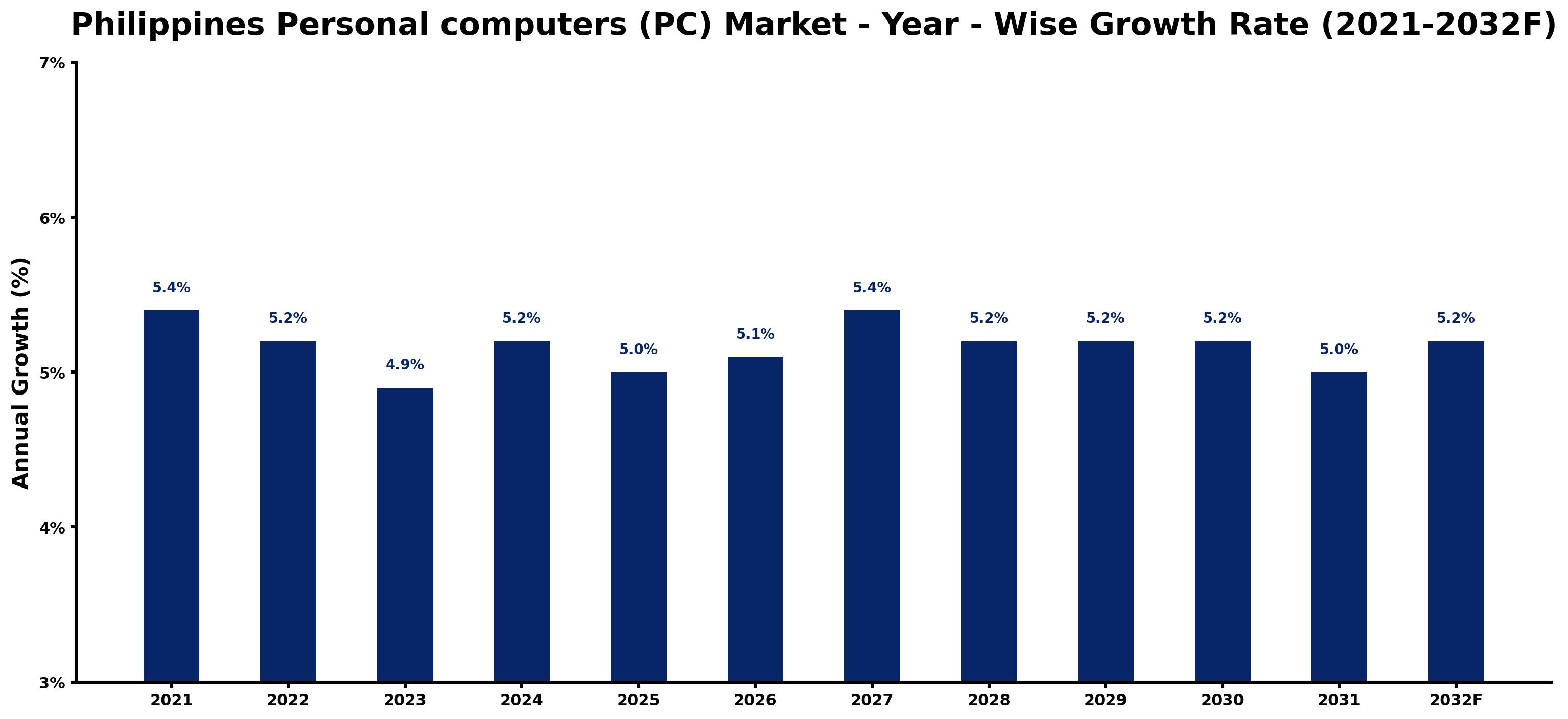
The table below presents the year wise growth rates along with the key drivers influencing the market
| Year | Growth Rate | Major Drivers |
| 2021 | 5.4% | Home office setups became essential, boosting demand for personal computers significantly. |
| 2022 | 5.2% | Education shifted online, prompting investments in personal computing devices nationwide. |
| 2023 | 4.9% | Launch of budget-friendly PCs attracted first-time buyers and tech-savvy students alike. |
| 2024 | 5.2% | E-commerce platforms expanded, facilitating easier access to various computer models. |
| 2025 | 5.0% | Remote work culture entrenched, leading to increased sales of high-performance PCs. |
| 2026 | 5.1% | Localized manufacturing initiatives began enhancing supply chain efficiency for PC components. |
| 2027 | 5.4% | Demand for gaming PCs surged, driven by youth engagement in the gaming ecosystem. |
| 2028 | 5.2% | Corporate sector upgraded IT infrastructure, increasing volume purchases of desktop computers. |
| 2029 | 5.2% | Government projects aimed at digital literacy further stimulated personal computer acquisitions. |
| 2030 | 5.2% | Environmental sustainability trends influenced manufacturers to innovate eco-friendly PC designs. |
| 2031 | 5.0% | Cloud computing services expanded, encouraging more consumers to invest in personal machines. |
| 2032 | 5.2% | Post-pandemic lifestyle changes solidified preferences for versatile personal computing devices. |
Note - Market size estimations and growth projections presented in this report are based on 6Wresearch's advanced forecasting approach, validated with industry datasets as of June 2026.
Philippines Personal computers (PC) Market Synopsis
The Philippines Personal computers (PC) Market is projected to reach 5.1% and witness significant growth during the forecast period (2026-2032). This anticipated growth is fueled predominantly by an increase in laptop and desktop computer demand across the region. Factors such as enhanced internet connectivity, rising disposable incomes, and ongoing technological innovations are contributing to this trend. Furthermore, public initiatives, such as the national broadband plan, are encouraging the population to invest in personal computers. The impact of the Covid-19 pandemic also remains significant, having accelerated the transition to remote work across various sectors, thus increasing the reliance on personal computers.
Philippines Personal computers (PC) Market Growth Drivers
Several factors are driving the growth of the Philippines Personal computers (PC) Market. Key drivers include:
- Increased internet penetration is facilitating greater accessibility to online resources and applications, prompting consumers to seek out personal computers for better connectivity.
- Rising disposable income levels are enabling more households to afford personal computing devices, which in turn is driving overall market demand.
- Technological advancements, particularly in processing power and energy efficiency, are influencing consumer purchases towards the latest PC models.
- The surge in remote work necessitated by the pandemic has led to heightened demand for reliable personal computers, especially among professionals and students.
- Growing preferences for portable computing solutions, such as laptops, are catering to the on-the-go lifestyle of many Filipinos, thus encouraging further market growth.
Philippines Personal computers (PC) Market Trends and Opportunities
The Philippines Personal computers (PC) Market is experiencing notable trends that present various opportunities for growth. Among these trends are:
- The increasing popularity of small form factor PCs, which integrate essential components into compact designs, catering to consumers seeking portability.
- Rising demand for gaming PCs equipped with high-performance components, appealing to an expanding gaming community that requires advanced graphical capabilities.
- The adoption of PCs that support multiple operating systems, enhancing versatility and user preference across diverse computing environments.
- Growing awareness regarding eco-friendly technology is prompting consumers to consider energy-efficient PCs, thus creating an avenue for green product offerings.
- Corporate demand for PCs that support remote working solutions and cloud-based applications is pushing manufacturers to innovate and provide advanced functionalities.
Philippines Personal computers (PC) Market Government Investment and Initiatives
The Philippine government has taken significant steps to promote the adoption of personal computers. Key initiatives include:
- The national broadband plan aims to enhance internet connectivity across the country, facilitating greater access to online educational resources and business tools.
- Investment in technology infrastructure is being prioritized, which will support the growth of the PC market by creating a robust ecosystem for consumers and businesses alike.
- Public programs that provide subsidies or financial incentives for educational institutions and students to acquire personal computers are being developed to increase digital literacy.
- Policies promoting innovation and competitiveness in technology sectors are being emphasized, encouraging local businesses to produce personal computers that cater to consumer needs.
- Government partnerships with private sectors are intended to launch training programs on digital skills, increasing the necessity for personal computers among the workforce.
Philippines Personal computers (PC) Market Latest Developments (May 2025 - June 2026)
Recent developments in the Philippines Personal computers (PC) Market highlight shifts in consumer behavior and industry dynamics. During the period from May 2025 to June 2026, there has been a noticeable increase in demand for hybrid PCs that combine tablet features with traditional laptop functionality, reflecting consumer preferences for versatility. Additionally, advancements in cloud computing solutions have led to a surge in interest and investment in systems capable of handling demanding applications remotely. The market has also seen growing attention towards cybersecurity solutions for personal computers, as rising digital threats necessitate enhanced protection for users. As companies continue to adapt to remote and hybrid working environments, further emphasis on portable solutions is expected, ensuring that personal computers remain at the forefront of technology adoption.
Philippines Personal computers (PC) Market - Key Attractiveness of the Report
- 10 Years of Market Numbers
- Historical Data Starting from 2022 to 2025
- Base Year: 2025
- Forecast Data until 2032
- Key Performance Indicators Impacting the Market
- Major Upcoming Developments and Projects
Key Highlights of the Report:
- Philippines Personal computers (PC) Market Outlook
- Market Size of Philippines Personal computers (PC) Market, 2025
- Forecast of Philippines Personal computers (PC) Market, 2032
- Historical Data and Forecast of Philippines Personal computers (PC) Revenues & Volume for the Period 2022-2032F
- Philippines Personal computers (PC) Market Trend Evolution
- Philippines Personal computers (PC) Market Drivers and Challenges
- Philippines Personal computers (PC) Price Trends
- Philippines Personal computers (PC) Porter's Five Forces
- Philippines Personal computers (PC) Industry Life Cycle
- Historical Data and Forecast of Philippines Personal computers (PC) Market Revenues & Volume By Product for the Period 2022-2032F
- Historical Data and Forecast of Philippines Personal computers (PC) Market Revenues & Volume By Commercial Desktop for the Period 2022-2032F
- Historical Data and Forecast of Philippines Personal computers (PC) Market Revenues & Volume By Commercial Notebook for the Period 2022-2032F
- Historical Data and Forecast of Philippines Personal computers (PC) Market Revenues & Volume By Consumer Desktop for the Period 2022-2032F
- Historical Data and Forecast of Philippines Personal computers (PC) Market Revenues & Volume By Consumer Notebook and Workstation for the Period 2022-2032F
- Historical Data and Forecast of Philippines Personal computers (PC) Market Revenues & Volume By Distribution Channel for the Period 2022-2032F
- Historical Data and Forecast of Philippines Personal computers (PC) Market Revenues & Volume By Online for the Period 2022-2032F
- Historical Data and Forecast of Philippines Personal computers (PC) Market Revenues & Volume By Offline for the Period 2022-2032F
- Philippines Personal computers (PC) Import Export Trade Statistics
- Market Opportunity Assessment By Product
- Market Opportunity Assessment By Distribution Channel
- Philippines Personal computers (PC) Top Companies Market Share
- Philippines Personal computers (PC) Competitive Benchmarking By Technical and Operational Parameters
- Philippines Personal computers (PC) Company Profiles
- Philippines Personal computers (PC) Key Strategic Recommendations






































