Philippines Railway Maintenance Machinery Market Size, Share & Growth Rate
The Philippines Railway Maintenance Machinery Market was estimated at USD 1419 Million in 2025 and is projected to reach USD 2446 Million by 2032, growing at a CAGR of 8.1% from 2026 to 2032. This impressive growth trajectory is primarily fueled by significant government and private investments aimed at enhancing the nation's railway infrastructure. As demand for efficient transport solutions rises, driven by burgeoning industries such as logistics and tourism, the need for advanced railway maintenance machinery will become increasingly critical.
Philippines Railway Maintenance Machinery Market Year-wise Growth Rate and Key Drivers
This graph highlights how the Philippines Railway Maintenance Machinery Market has steadily grown over the years, supported by major growth factors.
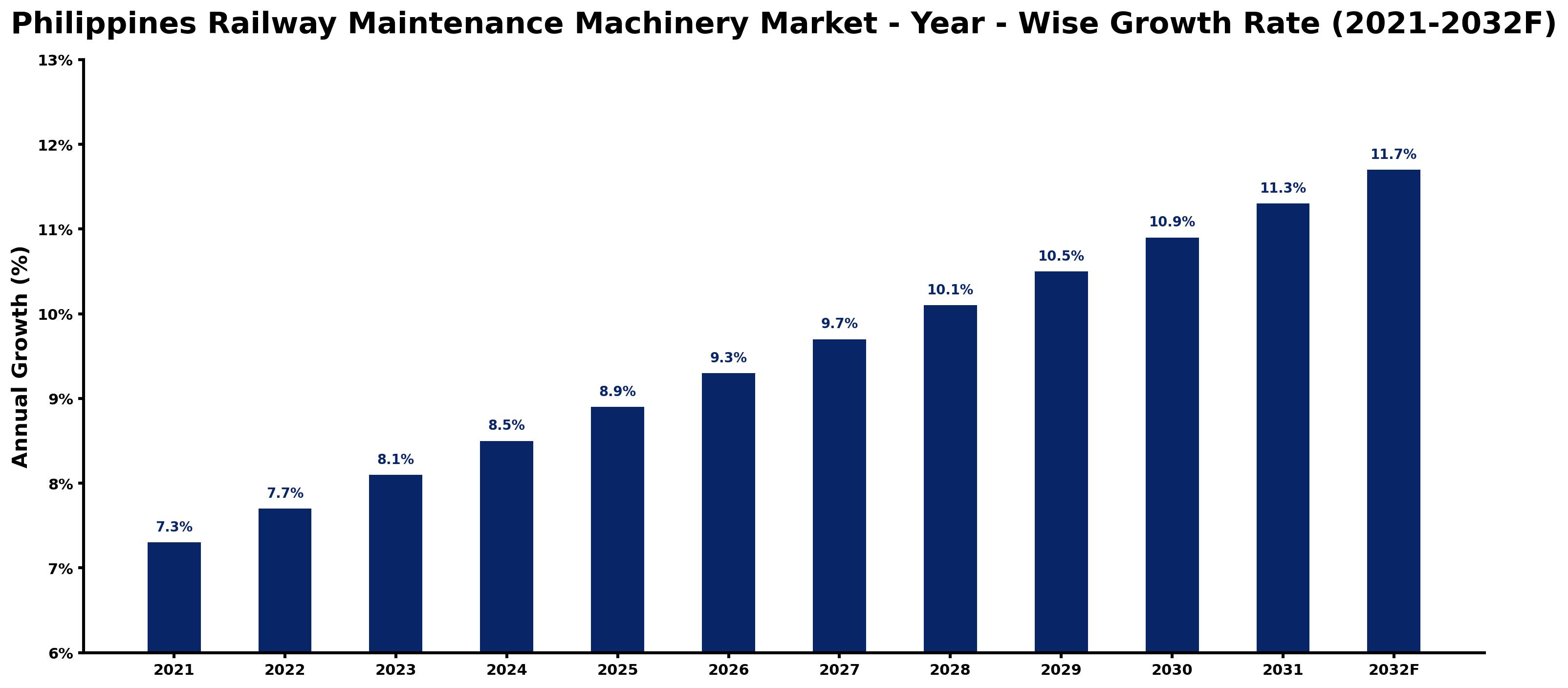
The table below presents the year‑wise growth rates along with the key drivers influencing the market
| Year | Growth Rate | Major Drivers |
| 2021 | 7.3% | Growing renewable energy integration projects |
| 2022 | 7.7% | Increasing industrial infrastructure investments |
| 2023 | 8.1% | Expansion of transportation and logistics networks |
| 2024 | 8.5% | Government infrastructure modernization initiatives |
| 2025 | 8.9% | Expansion of commercial construction activities |
| 2026 | 9.3% | Expansion of transportation and logistics networks |
| 2027 | 9.7% | Expansion of commercial construction activities |
| 2028 | 10.1% | Growing urbanization and commercial development |
| 2029 | 10.5% | Expansion of commercial construction activities |
| 2030 | 10.9% | Growing renewable energy integration projects |
| 2031 | 11.3% | Government infrastructure modernization initiatives |
| 2032 | 11.7% | Increasing industrial infrastructure investments |
Note - Market size estimations and growth projections presented in this report are based on 6Wresearch’s advanced forecasting approach, validated with industry datasets as of June 2026.
Philippines Railway Maintenance Machinery Market Synopsis
In recent years, the Philippines has seen a surge in railway projects aimed at modernizing and expanding its transportation network. This momentum is evident through key initiatives like the Metro Manila Subway Project and the Mindanao Rail Project, both of which underscore the country's commitment to revitalizing rail transport.
As investments pour in, the demand for railway maintenance machinery is set to escalate. Industry stakeholders are likely to benefit from government-backed programs designed to support infrastructure development and ensure the efficient operation of newly constructed railway lines.
Philippines Railway Maintenance Machinery Market Key Takeaways
- Significant investments in railway infrastructure are driving market growth.
- Ongoing projects like the Metro Manila Subway and Mindanao Rail Project will require substantial maintenance machinery.
- Government initiatives such as the "Build Build Build" program are integral to future developments.
- The logistics and transportation sectors' growth is directly influencing the demand for rail transport services.
- Enhanced focus on efficient rail transport is creating lucrative opportunities for machinery and related products.
Evaluation of Restraints in Philippines Railway Maintenance Machinery Market
Despite the growth potential, certain restraints could hinder the market's progress. The fluctuating economic conditions, political instability, and inadequate funding for certain projects may pose challenges to stakeholders. Additionally, the slow pace of policy implementation and regulatory approvals can delay project timelines, thus impacting the demand for maintenance machinery. To navigate these challenges, industry players must remain agile and proactively adapt to the evolving economic landscape.
Philippines Railway Maintenance Machinery Market Trends
The current landscape of the railway maintenance machinery market in the Philippines is characterized by a shift towards the adoption of advanced technologies, including automated and digitally integrated solutions. As rail operators seek to enhance efficiency and reduce downtime, there is an increasing reliance on predictive maintenance systems and IoT-enabled machinery. Furthermore, sustainability initiatives are prompting the development of eco-friendly equipment, aligning with global environmental standards.
Philippines Railway Maintenance Machinery Market Opportunities
With numerous ongoing and upcoming railway projects, significant opportunities for growth and investment are emerging in the Philippines. The expansion of the rail network presents a ripe market for advanced maintenance machinery and services. Moreover, partnerships between government agencies and private entities can further enhance innovation and drive demand for cutting-edge solutions in the maintenance sector, setting the stage for long-term growth.
Government Initiatives in the Philippines Railway Maintenance Machinery Market
The Philippine government has launched several initiatives to bolster the railway sector, with the "Build Build Build" program serving as a cornerstone of these efforts. This ambitious program is designed to enhance infrastructure through substantial investments, improving existing systems and paving the way for new rail lines. Additionally, policies aimed at attracting foreign investments are expected to generate further interest in the railway maintenance machinery sector, creating a conducive environment for growth.
Future Insights of the Philippines Railway Maintenance Machinery Market
Looking ahead to 2026-2032, the Philippines Railway Maintenance Machinery Market is poised for remarkable expansion, primarily driven by infrastructure growth and rising rail transport demand. As projects like the Metro Manila Subway and Mindanao Rail continue to progress, the need for efficient maintenance solutions will remain critical. With a focus on modernization and sustainability, the market is expected to embrace innovative technologies that enhance operational efficiency and service reliability.
Philippines Railway Maintenance Machinery Market Latest Developments (May 2025 - June 2026)
The railway maintenance machinery sector is currently witnessing notable developments as various infrastructure projects gain momentum. This includes the deployment of advanced maintenance technologies designed to improve the longevity and efficiency of railway systems. Additionally, collaborative efforts among industry stakeholders are emerging, aiming to leverage shared resources and expertise to optimize project delivery timelines and enhance equipment performance.
Philippines Railway Maintenance Machinery Market - Key Attractiveness of the Report
- 10 Years of Market Numbers
- Historical Data Starting from 2022 to 2025
- Base Year: 2025
- Forecast Data until 2032
- Key Performance Indicators Impacting the Market
- Major Upcoming Developments and Projects
Key Highlights of the Report:
- Philippines Railway Maintenance Machinery Market Outlook
- Market Size of Philippines Railway Maintenance Machinery Market, 2025
- Forecast of Philippines Railway Maintenance Machinery Market, 2032
- Historical Data and Forecast of Philippines Railway Maintenance Machinery Revenues & Volume for the Period 2022-2032F
- Philippines Railway Maintenance Machinery Market Trend Evolution
- Philippines Railway Maintenance Machinery Market Drivers and Challenges
- Philippines Railway Maintenance Machinery Price Trends
- Philippines Railway Maintenance Machinery Porter's Five Forces
- Philippines Railway Maintenance Machinery Industry Life Cycle
- Historical Data and Forecast of Philippines Railway Maintenance Machinery Market Revenues & Volume By Type for the Period 2022-2032F
- Historical Data and Forecast of Philippines Railway Maintenance Machinery Market Revenues & Volume By Tamping Machine for the Period 2022-2032F
- Historical Data and Forecast of Philippines Railway Maintenance Machinery Market Revenues & Volume By Stabilizing Machinery for the Period 2022-2032F
- Historical Data and Forecast of Philippines Railway Maintenance Machinery Market Revenues & Volume By Rail Handling Machinery for the Period 2022-2032F
- Historical Data and Forecast of Philippines Railway Maintenance Machinery Market Revenues & Volume By Ballast Cleaning Machine for the Period 2022-2032F
- Historical Data and Forecast of Philippines Railway Maintenance Machinery Market Revenues & Volume By Other for the Period 2022-2032F
- Historical Data and Forecast of Philippines Railway Maintenance Machinery Market Revenues & Volume By Applications for the Period 2022-2032F
- Historical Data and Forecast of Philippines Railway Maintenance Machinery Market Revenues & Volume By Ballast Track for the Period 2022-2032F
- Historical Data and Forecast of Philippines Railway Maintenance Machinery Market Revenues & Volume By Ballastless Track for the Period 2022-2032F
- Philippines Railway Maintenance Machinery Import Export Trade Statistics
- Market Opportunity Assessment By Type
- Market Opportunity Assessment By Applications
- Philippines Railway Maintenance Machinery Top Companies Market Share
- Philippines Railway Maintenance Machinery Competitive Benchmarking By Technical and Operational Parameters
- Philippines Railway Maintenance Machinery Company Profiles
- Philippines Railway Maintenance Machinery Key Strategic Recommendations






































