Philippines Toys And Games Market Top 5 Importing Countries and Market Competition (HHI) Analysis
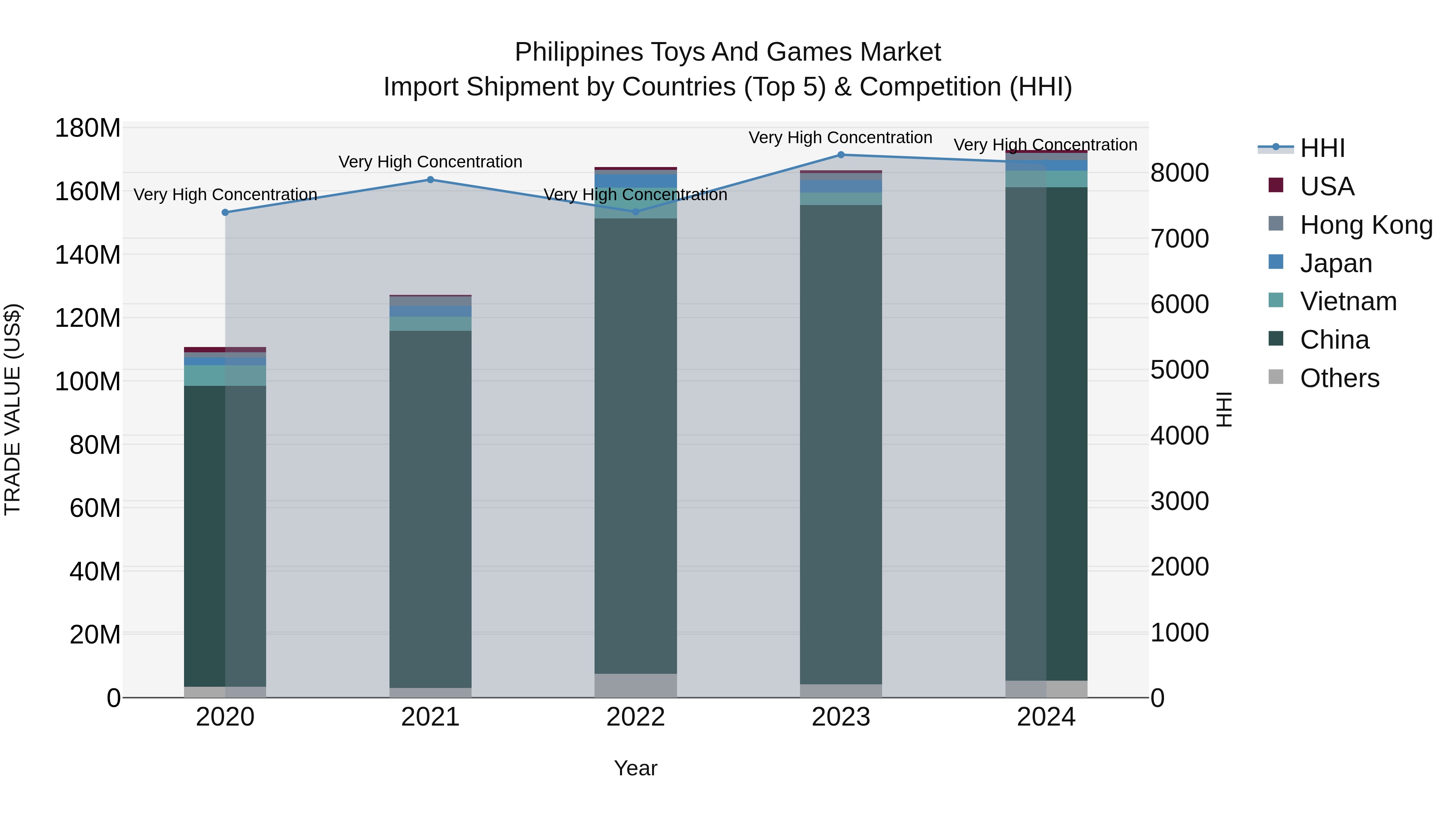
The Philippines continues to see a steady increase in imports of toys and games, with top exporters including China, Vietnam, Japan, Hong Kong, and Indonesia. The high Herfindahl-Hirschman Index (HHI) indicates a concentrated market, while the impressive compound annual growth rate (CAGR) of 11.78% from 2020 to 2024 highlights the sector`s resilience. The growth rate of 3.82% in 2024 signals sustained momentum in the industry, suggesting a positive outlook for the toys and games market in the Philippines.
philippines toysandgames market Synopsis
The Philippines toys and games market is a vibrant and dynamic sector driven by a large population of children and young consumers. The market is characterized by a wide variety of toys, including educational toys, action figures, board games, and video games. In recent years, the growth of e-commerce and online platforms has also significantly contributed to the expansion of the market, allowing consumers to access a broader range of products. The industry data indicates that the toys and games market in the Philippines had a market size of around $700 million, and it is projected to maintain a moderate CAGR of 5%. The increasing disposable income of Filipino families and a growing preference for high-quality and interactive toys are among the factors driving market growth.
Drivers of the Market
The toys and games market in the Philippines is expected to witness consistent growth. Rising disposable income, a young population, and the influence of global entertainment trends contribute to the demand for various toys and games. Traditional toys and electronic games are likely to coexist, driven by changing consumer preferences.
Challenges of the Market
The Philippines toys and games market faces challenges related to changing play preferences influenced by technology and online entertainment. Striking a balance between traditional and digital play experiences, ensuring safety and quality standards, and promoting educational aspects of toys could be key challenges to address for sustained market growth.
COVID-19 Impact on the Market
The Philippines toys and games market underwent a series of shifts due to the COVID-19 pandemic. With children spending more time at home due to school closures and lockdowns, there was a surge in demand for indoor entertainment options. Traditional toys and board games saw a revival, and the market adapted to online sales channels. However, disruptions in global supply chains impacted the availability of certain products. The market`s future will be shaped by its ability to sustain the interest generated during the pandemic and continue leveraging online platforms to reach consumers.
Key Players in the Market
Key players in the Philippines Toys and Games market include Toy Kingdom, Toy Town, and Hobbes and Landes. These retailers offer a diverse range of toys, games, and entertainment products for children of all ages.
Key Highlights of the Report:
- Philippines ToysandGames Market Outlook
- Market Size of Philippines ToysandGames Market, 2024
- Forecast of Philippines ToysandGames Market, 2031
- Historical Data and Forecast of Philippines ToysandGames Revenues & Volume for the Period 2021-2031
- Philippines ToysandGames Market Trend Evolution
- Philippines ToysandGames Market Drivers and Challenges
- Philippines ToysandGames Price Trends
- Philippines ToysandGames Porter's Five Forces
- Philippines ToysandGames Industry Life Cycle
- Historical Data and Forecast of Philippines ToysandGames Market Revenues & Volume By Product Type for the Period 2021-2031
- Historical Data and Forecast of Philippines ToysandGames Market Revenues & Volume By Games and Puzzles for the Period 2021-2031
- Historical Data and Forecast of Philippines ToysandGames Market Revenues & Volume By Video Games for the Period 2021-2031
- Historical Data and Forecast of Philippines ToysandGames Market Revenues & Volume By Construction Toys for the Period 2021-2031
- Historical Data and Forecast of Philippines ToysandGames Market Revenues & Volume By Dolls and Accessories for the Period 2021-2031
- Historical Data and Forecast of Philippines ToysandGames Market Revenues & Volume By Outdoor and Sports Toys for the Period 2021-2031
- Historical Data and Forecast of Philippines ToysandGames Market Revenues & Volume By Other for the Period 2021-2031
- Historical Data and Forecast of Philippines ToysandGames Market Revenues & Volume By Distribution Channel for the Period 2021-2031
- Historical Data and Forecast of Philippines ToysandGames Market Revenues & Volume By Online Channel for the Period 2021-2031
- Historical Data and Forecast of Philippines ToysandGames Market Revenues & Volume By Offline Channel for the Period 2021-2031
- Philippines ToysandGames Import Export Trade Statistics
- Market Opportunity Assessment By Product Type
- Market Opportunity Assessment By Distribution Channel
- Philippines ToysandGames Top Companies Market Share
- Philippines ToysandGames Competitive Benchmarking By Technical and Operational Parameters
- Philippines ToysandGames Company Profiles
- Philippines ToysandGames Key Strategic Recommendations






































