Vietnam Toys and Games Market Size, Share & Growth Rate
The Vietnam Toys and Games Market was estimated at USD 321 Million in 2025 and is projected to reach USD 454 Million by 2032, growing at a CAGR of 5.1% from 2026 to 2032. This trajectory reflects a vibrant sector that has harnessed the growing disposable incomes of families and the shift towards innovative, tech-driven play experiences. As parents increasingly prioritize educational and developmental toys for their children, the demand for both traditional and modern offerings is expected to rise significantly.
Vietnam Toys and Games Market Year-wise Growth Rate and Key Drivers
This graph highlights how the Vietnam Toys and Games Market has steadily grown over the years, supported by major growth factors.
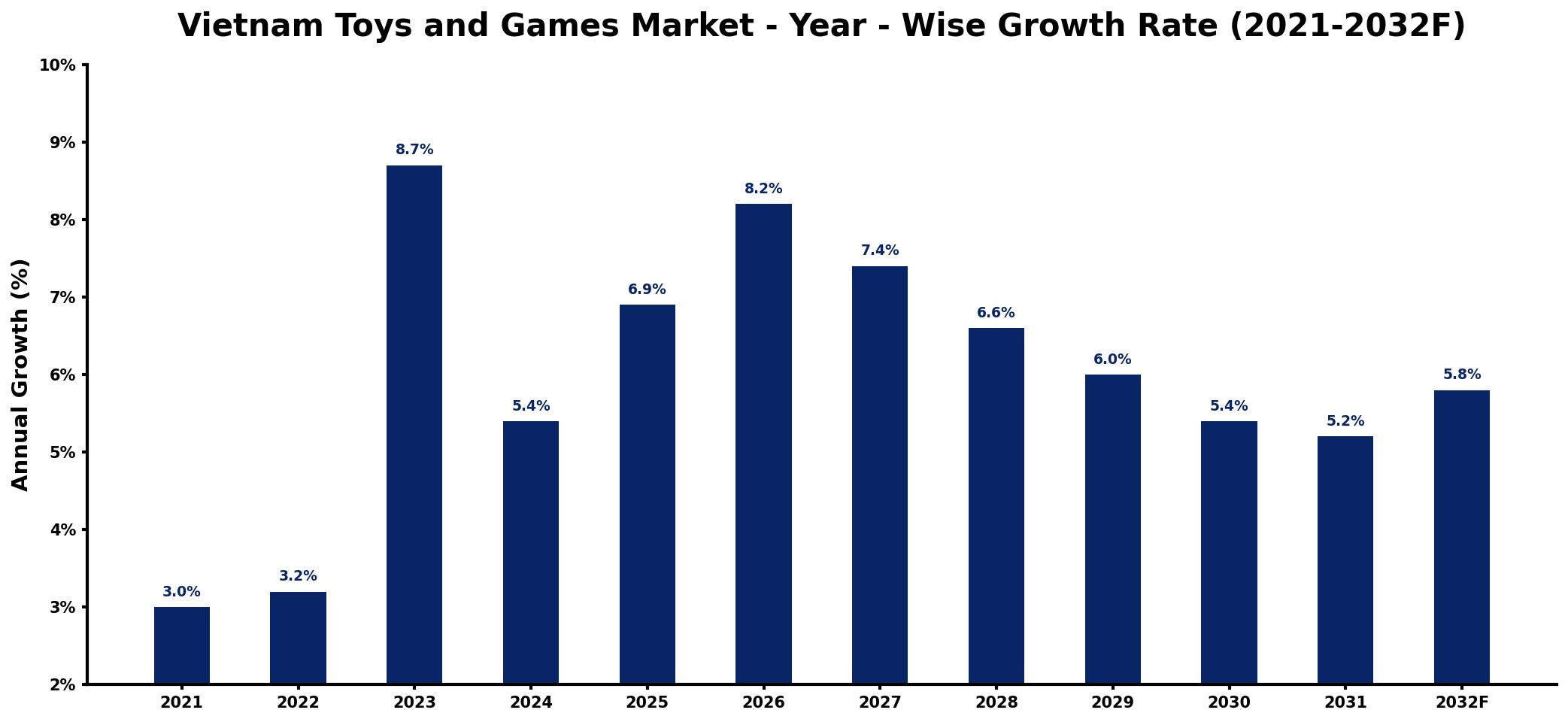
The table below presents the year‑wise growth rates along with the key drivers influencing the market
| Year | Growth Rate | Major Drivers |
| 2021 | 3.0% | Increased consumer spending power |
| 2022 | 3.2% | Emerging middle class expansion |
| 2023 | 8.7% | Growing online retail platforms |
| 2024 | 5.4% | Rise in family entertainment options |
| 2025 | 6.9% | Surge in educational product demand |
| 2026 | 8.2% | Investment in local manufacturing facilities |
| 2027 | 7.4% | Expansion of distribution networks |
| 2028 | 6.6% | Increase in eco-friendly products |
| 2029 | 6.0% | Popularity of interactive experiences |
| 2030 | 5.4% | Diversification of product offerings |
| 2031 | 5.2% | Strengthening of brand loyalty |
| 2032 | 5.8% | Enhanced marketing strategies effectiveness |
Note: Market size estimations and growth projections presented in this report are based on 6Wresearch's proprietary forecasting methodology, utilizing the latest available industry data, government publications, and primary research inputs.
Vietnam Toys and Games Market Synopsis
The Vietnamese toys and games market is a dynamic landscape, rich in variety and competition. From time-honored toys that evoke nostalgia to modern electronic gadgets designed to enhance learning, the industry caters to diverse consumer needs, driven largely by the changing preferences of families across the nation.
Notably, the influence of digital technologies has led to the emergence of unique products that combine entertainment with education. This has not only expanded the appeal of toys and games but has also fostered a growing awareness of child development principles among Vietnamese consumers, shaping their purchasing decisions.
Vietnam Toys and Games Market Key Takeaways
- The market is supported by rising disposable incomes, encouraging families to invest in quality toys.
- There is a strong focus on educational toys, aligning with parents' aspirations for their childrens developmental growth.
- Digital and tech-enabled play experiences are gaining traction, appealing to modern consumers.
- Consumer preferences are rapidly evolving, emphasizing the need for manufacturers to innovate continuously.
- Safety regulations and product quality standards remain critical factors influencing market dynamics.
Evaluation of Restraints in Vietnam Toys and Games Market
The Vietnam toys and games market faces notable challenges stemming from the fast-paced evolution of consumer preferences. Shifts towards digital and interactive gaming experiences can marginalize traditional toys, compelling manufacturers to adapt swiftly. Additionally, safety regulations are becoming increasingly stringent, requiring businesses to invest in compliance, which can strain smaller players. The level of market competition also exerts pressure on pricing strategies, pushing companies to find unique selling propositions that resonate with consumers while ensuring product safety and quality.
Vietnam Toys and Games Market Trends
Current trends in the Vietnam toys and games market indicate a significant shift towards sustainable and eco-friendly products. Parents are increasingly seeking toys made from safe, biodegradable materials, reflecting broader societal values regarding environmental responsibility. Moreover, the integration of technology into play, such as augmented reality and interactive gaming, is becoming a key differentiator for brands. As urbanization continues, demand for compact, space-saving toys that can easily transition between indoor and outdoor environments is also on the rise, adapting to the changing lifestyles of Vietnamese families.
Vietnam Toys and Games Market Opportunities
The landscape presents multiple opportunities for growth, particularly in the realm of educational toys that facilitate learning through play. As parents increasingly value developmental tools, investing in innovative educational products can yield significant returns. Moreover, the expansion of e-commerce channels offers manufacturers a platform to reach wider audiences, particularly in urban areas where online shopping is becoming the norm. Collaborations with educational institutions to create curriculum-aligned toys could also unlock new market segments.
Government Initiatives in the Vietnam Toys and Games Market
The Vietnamese government has recognized the importance of the toy industry in stimulating economic growth and enhancing child development. Various initiatives are focused on promoting local manufacturing while ensuring adherence to safety and quality standards. Investment in infrastructure to support e-commerce is also being prioritized, enabling toy companies to more effectively reach consumers. Programs that encourage innovation and R&D in educational toys are gaining traction, positioning Vietnam as a competitive player in the regional toys and games market.
Future Insights of the Vietnam Toys and Games Market
Looking ahead to 2026-2032, the Vietnam toys and games market is poised for robust expansion, driven by sustained growth in disposable incomes and an increasing emphasis on child development. The influx of new technology in toys promises to reshape consumer expectations, demanding continuous innovation from manufacturers. As the market evolves, companies that prioritize safety, quality, and educational value will likely emerge as leaders, capturing the attention and loyalty of Vietnamese families.
Vietnam Toys and Games Market Latest Developments (2025 - 2026)
In recent months, the Vietnam toys and games market has witnessed a surge in product launches focusing on sustainability and educational value. Manufacturers are increasingly investing in research to align their offerings with educational standards, catering to the informed preferences of parents. The growth of online sales platforms has enabled companies to reach consumers more effectively, transforming traditional sales channels. Concurrently, collaborative efforts between local producers and international partners are emerging, enhancing product diversity and market competitiveness.
Vietnam Toys and Games Market - Key Attractiveness of the Report
- 10 Years of Market Numbers
- Historical Data Starting from 2022 to 2025
- Base Year: 2025
- Forecast Data until 2032
- Key Performance Indicators Impacting the Market
- Major Upcoming Developments and Projects
Key Highlights of the Report:
- Vietnam ToysandGames Market Outlook
- Market Size of Vietnam ToysandGames Market, 2025
- Forecast of Vietnam ToysandGames Market, 2032
- Historical Data and Forecast of Vietnam ToysandGames Revenues & Volume for the Period 2022-2032F
- Vietnam ToysandGames Market Trend Evolution
- Vietnam ToysandGames Market Drivers and Challenges
- Vietnam ToysandGames Price Trends
- Vietnam ToysandGames Porter's Five Forces
- Vietnam ToysandGames Industry Life Cycle
- Historical Data and Forecast of Vietnam ToysandGames Market Revenues & Volume By Product Type for the Period 2022-2032F
- Historical Data and Forecast of Vietnam ToysandGames Market Revenues & Volume By Games and Puzzles for the Period 2022-2032F
- Historical Data and Forecast of Vietnam ToysandGames Market Revenues & Volume By Video Games for the Period 2022-2032F
- Historical Data and Forecast of Vietnam ToysandGames Market Revenues & Volume By Construction Toys for the Period 2022-2032F
- Historical Data and Forecast of Vietnam ToysandGames Market Revenues & Volume By Dolls and Accessories for the Period 2022-2032F
- Historical Data and Forecast of Vietnam ToysandGames Market Revenues & Volume By Outdoor and Sports Toys for the Period 2022-2032F
- Historical Data and Forecast of Vietnam ToysandGames Market Revenues & Volume By Other for the Period 2022-2032F
- Historical Data and Forecast of Vietnam ToysandGames Market Revenues & Volume By Distribution Channel for the Period 2022-2032F
- Historical Data and Forecast of Vietnam ToysandGames Market Revenues & Volume By Online Channel for the Period 2022-2032F
- Historical Data and Forecast of Vietnam ToysandGames Market Revenues & Volume By Offline Channel for the Period 2022-2032F
- Vietnam ToysandGames Import Export Trade Statistics
- Market Opportunity Assessment By Product Type
- Market Opportunity Assessment By Distribution Channel
- Vietnam ToysandGames Top Companies Market Share
- Vietnam ToysandGames Competitive Benchmarking By Technical and Operational Parameters
- Vietnam ToysandGames Company Profiles
- Vietnam ToysandGames Key Strategic Recommendations






































