Qatar Toys and Games Market Size, Share & Growth Rate
The Qatar Toys and Games Market was estimated at USD 520 Million in 2025 and is projected to reach USD 748 Million by 2032, growing at a CAGR of 5.3% from 2026 to 2032. This robust growth is propelled by a rapidly expanding young population, increasing disposable incomes, and a cultural shift towards family-oriented recreational activities. As parents become more engaged in their children's developmental needs, the demand for both educational and entertaining toys will continue to rise.
Qatar Toys and Games Market Year-wise Growth Rate and Key Drivers
This graph highlights how the Qatar Toys and Games Market has steadily grown over the years, supported by major growth factors.
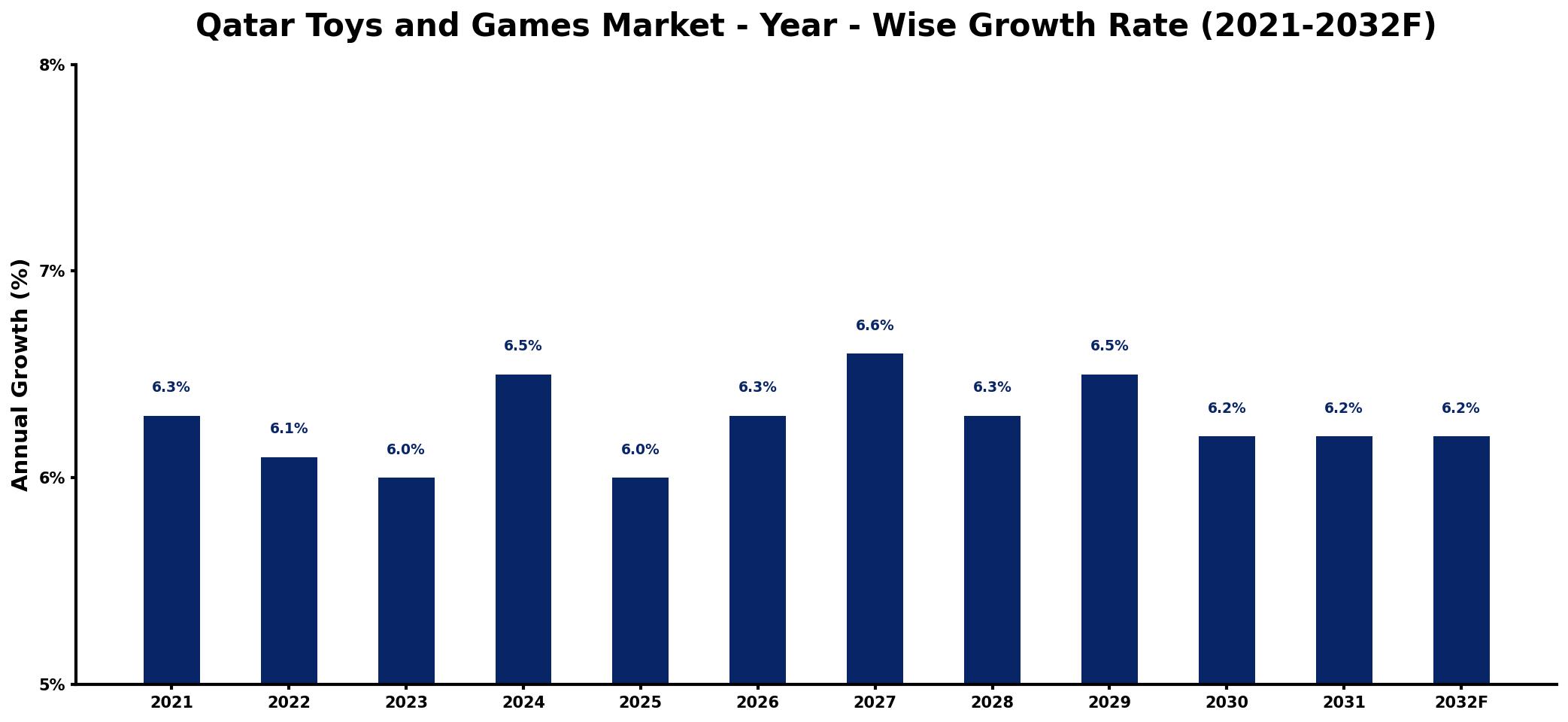
The table below presents the year‑wise growth rates along with the key drivers influencing the market
| Year | Growth Rate | Major Drivers |
| 2021 | 6.3% | Increased consumer spending patterns |
| 2022 | 6.1% | Rise in e-commerce platforms |
| 2023 | 6.0% | Expansion of retail distribution channels |
| 2024 | 6.5% | Growing interest in educational products |
| 2025 | 6.0% | Investment in innovative manufacturing technologies |
| 2026 | 6.3% | Surge in family entertainment options |
| 2027 | 6.6% | Enhanced marketing strategies implemented |
| 2028 | 6.3% | Increase in disposable income levels |
| 2029 | 6.5% | Higher demand for eco-friendly alternatives |
| 2030 | 6.2% | Development of immersive experiences |
| 2031 | 6.2% | Strengthened global supply networks |
| 2032 | 6.2% | Emergence of niche market segments |
Note: Market size estimations and growth projections presented in this report are based on 6Wresearch's proprietary forecasting methodology, utilizing the latest available industry data, government publications, and primary research inputs.
Qatar Toys and Games Market Synopsis
The Qatar toys and games market has recently enjoyed a surge in popularity, partly due to changing consumer habits influenced by the COVID-19 pandemic. As families found themselves spending more time indoors, the demand for toys and games skyrocketed, demonstrating the sector's resilience.
Looking ahead, the market is poised for steady growth as the economy strengthens and family-oriented leisure activities gain traction. As digital entertainment rises, the market must balance innovation in traditional toys with emerging trends to appeal to modern consumers.
Qatar Toys and Games Market Key Takeaways
- The Qatar toys and games market is driven by increasing disposable incomes and a growing focus on child development.
- Challenges include cultural sensitivities that restrict the types of toys available for sale.
- The surge in online shopping has transformed the retail landscape, with e-commerce becoming a vital channel.
- Opportunities lie in adapting product offerings to meet local values while incorporating new technologies.
- Government initiatives are expected to further boost market growth and enhance recreational facilities.
Evaluation of Restraints in Qatar Toys and Games Market
Despite its promising outlook, the Qatar toys and games market is held back by several key constraints. Cultural and religious considerations significantly influence consumer preferences, limiting the types of toys and games that can be marketed and sold. Moreover, the rapid rise of digital gaming poses a formidable challenge to traditional toy sales. Industry players must navigate these complexities while respecting local values, which can slow innovation and deter investments.
Qatar Toys and Games Market Trends
Several trends are currently shaping the Qatar toys and games market landscape. The integration of technology into traditional toys has become increasingly popular, with educational gadgets and interactive games gaining traction. Furthermore, environmentally friendly toys are becoming more sought after as consumers demonstrate a growing preference for sustainable products. Outdoor play equipment is also witnessing a resurgence, reflecting a shift back to physical activities as families seek balance in entertainment options.
Qatar Toys and Games Market Opportunities
There are substantial growth and investment opportunities within the Qatar toys and games market, particularly in the development of new product lines that align with local cultural values. Companies can also explore collaborations with educational institutions to create toys that promote learning and development. Additionally, expanding online platforms can enhance reach to a wider audience, allowing for the introduction of innovative marketing strategies targeting tech-savvy parents.
Government Initiatives in the Qatar Toys and Games Market
The Qatari government is increasingly prioritizing initiatives aimed at enhancing recreational facilities and promoting child development. Public spending on educational and recreational programs is expected to boost demand for toys and games. Furthermore, efforts to improve e-commerce infrastructure will facilitate online sales, making toys and games more accessible to the general public.
Future Insights of the Qatar Toys and Games Market
From 2026 to 2032, the Qatar toys and games market is expected to evolve dynamically, influenced by changing demographics and lifestyle trends. With a focus on integrating educational value into play, companies will likely pivot towards creating products that promote developmental skills. As digital engagement continues to rise, the market will need to adapt, ensuring that both online and traditional toys cater to the diverse interests of families.
Qatar Toys and Games Market Latest Developments (2025 - 2026)
Recent industry developments indicate a pronounced shift towards digitalization within the toys and games market. Companies are investing in e-commerce platforms to enhance user experience, while physical retail stores are beginning to integrate technology into the shopping experience. This evolution reflects the industrys ongoing adaptation to market demands and consumer preferences.
Qatar Toys and Games Market - Key Attractiveness of the Report
- 10 Years of Market Numbers
- Historical Data Starting from 2022 to 2025
- Base Year: 2025
- Forecast Data until 2032
- Key Performance Indicators Impacting the Market
- Major Upcoming Developments and Projects
Key Highlights of the Report:
- Qatar ToysandGames Market Outlook
- Market Size of Qatar ToysandGames Market, 2025
- Forecast of Qatar ToysandGames Market, 2032
- Historical Data and Forecast of Qatar ToysandGames Revenues & Volume for the Period 2022-2032F
- Qatar ToysandGames Market Trend Evolution
- Qatar ToysandGames Market Drivers and Challenges
- Qatar ToysandGames Price Trends
- Qatar ToysandGames Porter's Five Forces
- Qatar ToysandGames Industry Life Cycle
- Historical Data and Forecast of Qatar ToysandGames Market Revenues & Volume By Product Type for the Period 2022-2032F
- Historical Data and Forecast of Qatar ToysandGames Market Revenues & Volume By Games and Puzzles for the Period 2022-2032F
- Historical Data and Forecast of Qatar ToysandGames Market Revenues & Volume By Video Games for the Period 2022-2032F
- Historical Data and Forecast of Qatar ToysandGames Market Revenues & Volume By Construction Toys for the Period 2022-2032F
- Historical Data and Forecast of Qatar ToysandGames Market Revenues & Volume By Dolls and Accessories for the Period 2022-2032F
- Historical Data and Forecast of Qatar ToysandGames Market Revenues & Volume By Outdoor and Sports Toys for the Period 2022-2032F
- Historical Data and Forecast of Qatar ToysandGames Market Revenues & Volume By Other for the Period 2022-2032F
- Historical Data and Forecast of Qatar ToysandGames Market Revenues & Volume By Distribution Channel for the Period 2022-2032F
- Historical Data and Forecast of Qatar ToysandGames Market Revenues & Volume By Online Channel for the Period 2022-2032F
- Historical Data and Forecast of Qatar ToysandGames Market Revenues & Volume By Offline Channel for the Period 2022-2032F
- Qatar ToysandGames Import Export Trade Statistics
- Market Opportunity Assessment By Product Type
- Market Opportunity Assessment By Distribution Channel
- Qatar ToysandGames Top Companies Market Share
- Qatar ToysandGames Competitive Benchmarking By Technical and Operational Parameters
- Qatar ToysandGames Company Profiles
- Qatar ToysandGames Key Strategic Recommendations






































