United Arab Emirates (UAE) Toys and Games Market Size, Share & Growth Rate
The United Arab Emirates (UAE) Toys and Games Market was estimated at USD 371 Million in 2025 and is projected to reach USD 515 Million by 2032, growing at a CAGR of 4.8% from 2026 to 2032. This robust growth trajectory is largely propelled by the rising disposable incomes of families and a burgeoning population of children eager for diverse play options. Additionally, the market's evolution is influenced by a strong cultural inclination toward high-quality, educational toys, aligning with the global trend of prioritizing STEM-related products.
United Arab Emirates (UAE) Toys and Games Market Year-wise Growth Rate and Key Drivers
This graph highlights how the United Arab Emirates (UAE) Toys and Games Market has steadily grown over the years, supported by major growth factors.
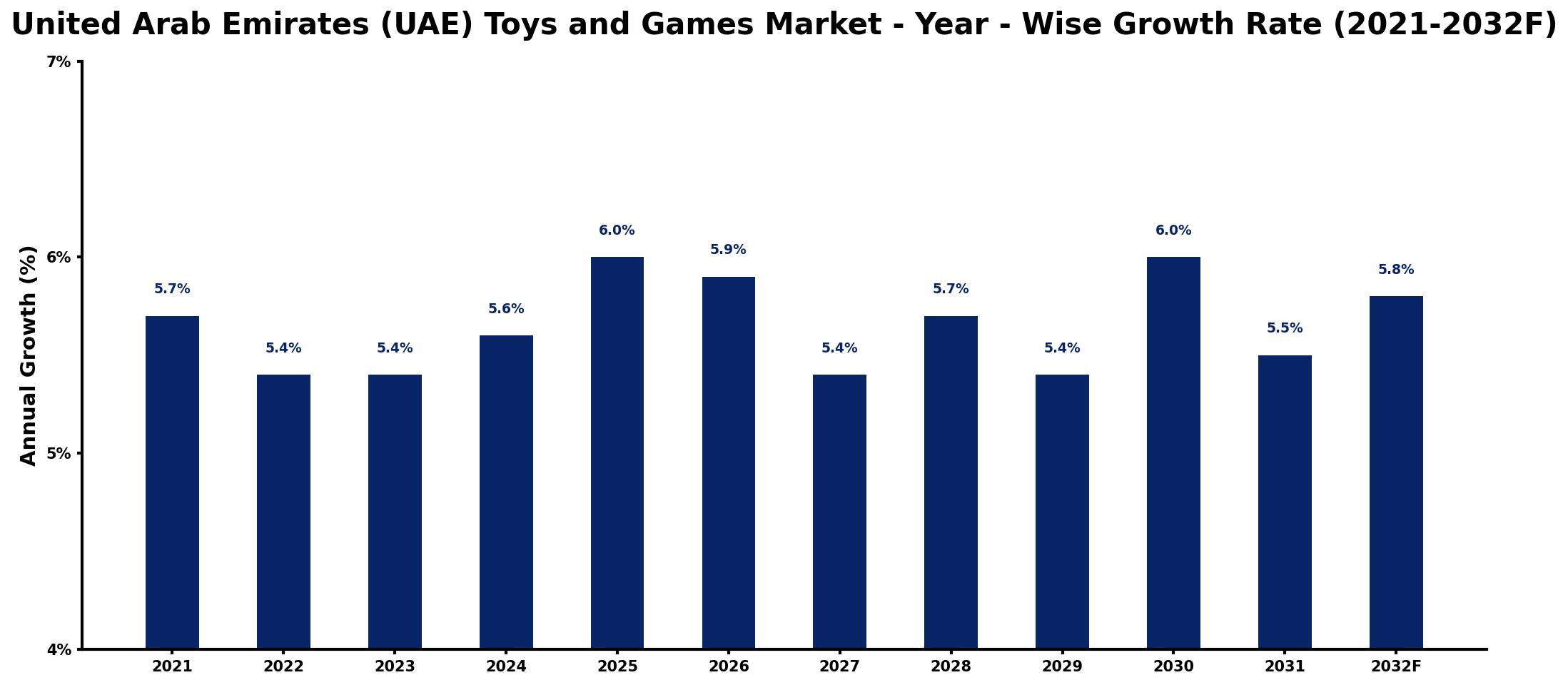
The table below presents the year‑wise growth rates along with the key drivers influencing the market
| Year | Growth Rate | Major Drivers |
| 2021 | 5.7% | Increased family spending habits |
| 2022 | 5.4% | Growing online retail platforms |
| 2023 | 5.4% | Rise in educational initiatives |
| 2024 | 5.6% | Expansion of entertainment sectors |
| 2025 | 6.0% | Higher disposable income levels |
| 2026 | 5.9% | Emergence of innovative technology |
| 2027 | 5.4% | Strengthened cultural events calendar |
| 2028 | 5.7% | Enhanced marketing strategies adopted |
| 2029 | 5.4% | Growing demand for sustainability |
| 2030 | 6.0% | Increased investment in leisure |
| 2031 | 5.5% | Development of local manufacturing |
| 2032 | 5.8% | Surge in community engagement activities |
Note: Market size estimations and growth projections presented in this report are based on 6Wresearch's proprietary forecasting methodology, utilizing the latest available industry data, government publications, and primary research inputs.
United Arab Emirates (UAE) Toys and Games Market Synopsis
The UAE Toys and Games Market is an energetic component of the broader leisure and entertainment landscape. Recent observations indicate a shift in consumer preferences, emphasizing technology-driven play experiences, including interactive and educational toys. This trend is reflecting the changing dynamics of play, where modern parents seek not just entertainment but also developmental benefits for their children.
In addition to technological advancements, cultural influences play a significant role in shaping the market. The UAE's unique blend of traditional and contemporary influences fosters a vibrant ecosystem for both local and international toy brands. As families continue to prioritize quality and educational value in their purchases, the market is poised for sustained growth in the coming years.
United Arab Emirates (UAE) Toys and Games Market Key Takeaways
- The market is experiencing steady growth driven by increasing disposable incomes and a growing population of children.
- There's a notable shift towards high-quality and educational toys, reflecting parents' evolving expectations.
- The influence of popular media franchises is significantly boosting demand for branded toys and games.
- Tourism serves as an additional market driver, as international visitors purchase toys and games as souvenirs.
- Digital and online sales channels are becoming increasingly important, influenced by the COVID-19 pandemic.
Evaluation of Restraints in United Arab Emirates (UAE) Toys and Games Market
Despite its promising growth, the UAE Toys and Games Market faces several constraints. Stringent safety regulations and high compliance costs create significant hurdles for manufacturers, particularly smaller enterprises trying to establish themselves. Furthermore, seasonal demand fluctuations complicate inventory management and forecasting, causing potential losses for businesses that cannot effectively navigate these dynamics. Companies must adapt their strategies to address these challenges while remaining competitive in this vibrant landscape.
United Arab Emirates (UAE) Toys and Games Market Trends
Current trends in the UAE Toys and Games Market indicate a marked shift towards educational and STEM-focused toys. This trend is being driven by a desire among parents to promote cognitive development in their children from an early age. Additionally, technology integration is becoming increasingly prevalent, with augmented reality (AR) and virtual reality (VR) applications enhancing traditional play experiences.
Moreover, sustainability is emerging as a pivotal theme in consumer purchasing decisions. Many families are now actively seeking toys made from environmentally-friendly materials, reflecting broader global trends towards sustainable consumption. This evolution in consumer behavior is encouraging manufacturers to innovate and adopt greener practices in production.
United Arab Emirates (UAE) Toys and Games Market Opportunities
Significant growth and investment opportunities exist in the educational toy sector, particularly those that promote STEM learning. As parents increasingly value educational content, companies that innovate in this area are likely to thrive. Furthermore, leveraging e-commerce platforms presents a unique opportunity to reach a broader consumer base, especially as online shopping trends continue to rise.
Moreover, the potential to collaborate with popular media franchises offers a lucrative avenue for growth. By creating limited edition toys or co-branded products, companies can tap into existing fan bases, driving both awareness and sales. As the tourism sector rebounds, there is also an opportunity to target tourists with unique and culturally relevant products.
Government Initiatives in the United Arab Emirates (UAE) Toys and Games Market
The UAE government has been proactive in promoting the toys and games sector through various initiatives aimed at enhancing consumer safety and encouraging local production. Regulations ensure that imported and locally manufactured toys meet rigorous safety standards, thereby bolstering consumer confidence. Additionally, public investment in educational initiatives and family-centric programs supports the market by creating a favorable environment for the growth of educational toys.
Future Insights of the United Arab Emirates (UAE) Toys and Games Market
Looking ahead to 2026-2032, the UAE Toys and Games Market is expected to continue on its upward trajectory. Factors such as technological advancements, evolving consumer preferences, and sustained population growth will drive this trend. The integration of technology in play is anticipated to create a dynamic landscape where interactive and engaging products dominate. Furthermore, as the market adapts to consumer trends favoring sustainability and educational value, it will attract new players and encourage existing brands to innovate.
United Arab Emirates (UAE) Toys and Games Market Latest Developments (2025 - 2026)
Recent developments in the UAE Toys and Games Market indicate a strong pivot towards online retail, with several brands enhancing their digital platforms to cater to changing consumer shopping habits. This shift has been facilitated by increased demand for home-based entertainment options following the pandemic. Additionally, collaborations between toy manufacturers and educational institutions are becoming more common, aiming to integrate play with learning experiences. As the sector adapts, the innovation of products incorporating the latest technologies remains a key focus for sustained competitiveness.
United Arab Emirates (UAE) Toys and Games Market - Key Attractiveness of the Report
- 10 Years of Market Numbers
- Historical Data Starting from 2022 to 2025
- Base Year: 2025
- Forecast Data until 2032
- Key Performance Indicators Impacting the Market
- Major Upcoming Developments and Projects
Key Highlights of the Report:
- United Arab Emirates (UAE) ToysandGames Market Outlook
- Market Size of United Arab Emirates (UAE) ToysandGames Market, 2025
- Forecast of United Arab Emirates (UAE) ToysandGames Market, 2032
- Historical Data and Forecast of United Arab Emirates (UAE) ToysandGames Revenues & Volume for the Period 2022-2032F
- United Arab Emirates (UAE) ToysandGames Market Trend Evolution
- United Arab Emirates (UAE) ToysandGames Market Drivers and Challenges
- United Arab Emirates (UAE) ToysandGames Price Trends
- United Arab Emirates (UAE) ToysandGames Porter's Five Forces
- United Arab Emirates (UAE) ToysandGames Industry Life Cycle
- Historical Data and Forecast of United Arab Emirates (UAE) ToysandGames Market Revenues & Volume By Product Type for the Period 2022-2032F
- Historical Data and Forecast of United Arab Emirates (UAE) ToysandGames Market Revenues & Volume By Games and Puzzles for the Period 2022-2032F
- Historical Data and Forecast of United Arab Emirates (UAE) ToysandGames Market Revenues & Volume By Video Games for the Period 2022-2032F
- Historical Data and Forecast of United Arab Emirates (UAE) ToysandGames Market Revenues & Volume By Construction Toys for the Period 2022-2032F
- Historical Data and Forecast of United Arab Emirates (UAE) ToysandGames Market Revenues & Volume By Dolls and Accessories for the Period 2022-2032F
- Historical Data and Forecast of United Arab Emirates (UAE) ToysandGames Market Revenues & Volume By Outdoor and Sports Toys for the Period 2022-2032F
- Historical Data and Forecast of United Arab Emirates (UAE) ToysandGames Market Revenues & Volume By Other for the Period 2022-2032F
- Historical Data and Forecast of United Arab Emirates (UAE) ToysandGames Market Revenues & Volume By Distribution Channel for the Period 2022-2032F
- Historical Data and Forecast of United Arab Emirates (UAE) ToysandGames Market Revenues & Volume By Online Channel for the Period 2022-2032F
- Historical Data and Forecast of United Arab Emirates (UAE) ToysandGames Market Revenues & Volume By Offline Channel for the Period 2022-2032F
- United Arab Emirates (UAE) ToysandGames Import Export Trade Statistics
- Market Opportunity Assessment By Product Type
- Market Opportunity Assessment By Distribution Channel
- United Arab Emirates (UAE) ToysandGames Top Companies Market Share
- United Arab Emirates (UAE) ToysandGames Competitive Benchmarking By Technical and Operational Parameters
- United Arab Emirates (UAE) ToysandGames Company Profiles
- United Arab Emirates (UAE) ToysandGames Key Strategic Recommendations






































