Philippines Tripod Jack For Civil Aircraft Market Size, Share & Growth Rate
The Philippines Tripod Jack For Civil Aircraft Market was estimated at USD 509 Million in 2025 and is projected to reach USD 921 Million by 2032, growing at a CAGR of 8.8% from 2026 to 2032. This robust growth trajectory is primarily driven by the increasing demand for civil aviation in the region, supported by rising air travel and the expansion of commercial fleets. Moreover, the ongoing modernization of airport infrastructure and the need for safe aircraft maintenance solutions further enhance the markets positive outlook.
Philippines Tripod Jack For Civil Aircraft Market Year-wise Growth Rate and Key Drivers
This graph highlights how the Philippines Tripod Jack For Civil Aircraft Market has steadily grown over the years, supported by major growth factors.
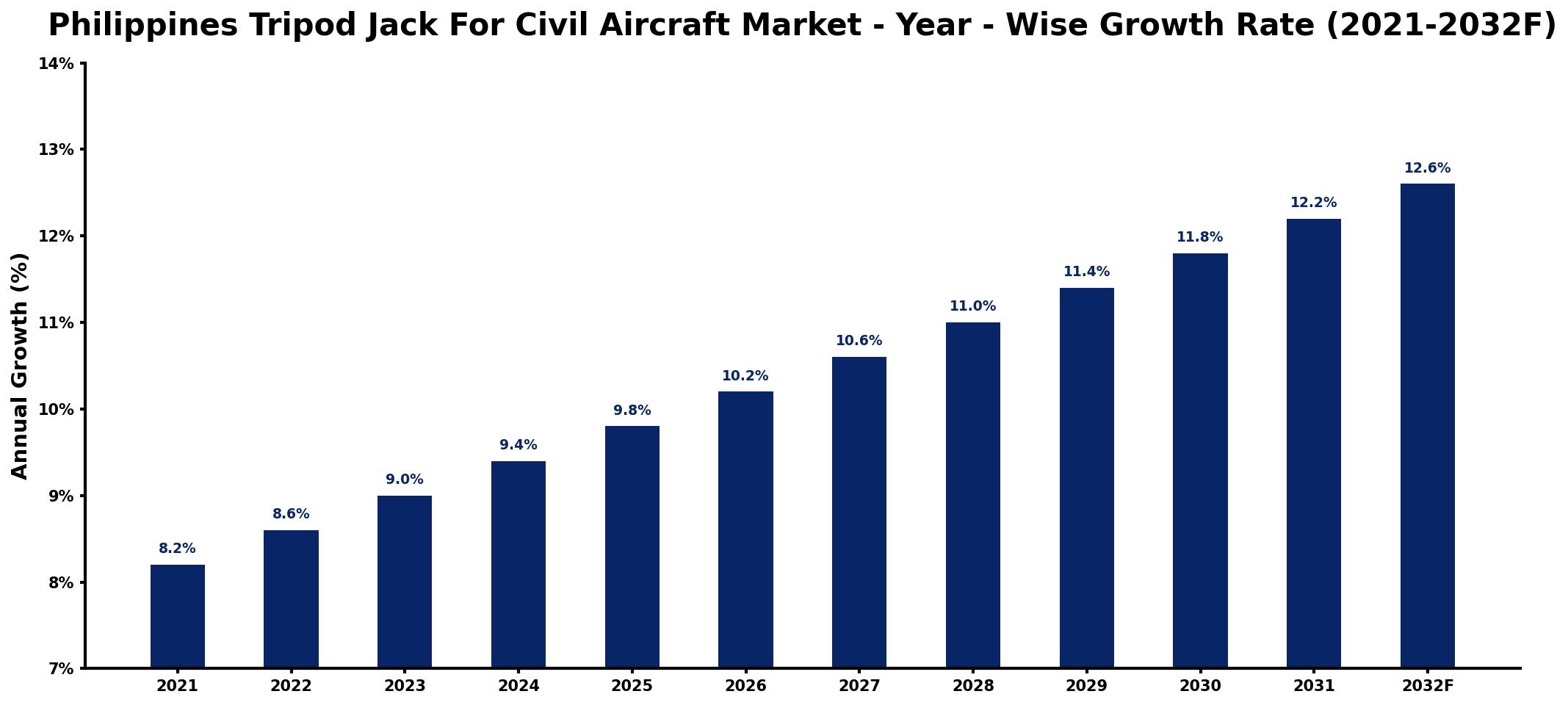
The table below presents the year‑wise growth rates along with the key drivers influencing the market
| Year | Growth Rate | Major Drivers |
| 2021 | 8.2% | Rising demand for maintenance services |
| 2022 | 8.6% | Increased investments in aviation infrastructure |
| 2023 | 9.0% | Growing number of flight operations |
| 2024 | 9.4% | Expansion of regional airline fleets |
| 2025 | 9.8% | Enhanced safety regulations implementation |
| 2026 | 10.2% | Technological advancements in aviation |
| 2027 | 10.6% | Strengthening supply chain logistics |
| 2028 | 11.0% | Surge in aviation training programs |
| 2029 | 11.4% | Emergence of new aviation startups |
| 2030 | 11.8% | Focus on sustainable aviation practices |
| 2031 | 12.2% | Growing tourism and travel demand |
| 2032 | 12.6% | Improvements in air traffic management |
Note: Market size estimations and growth projections presented in this report are based on 6Wresearch's proprietary forecasting methodology, utilizing the latest available industry data, government publications, and primary research inputs.
Philippines Tripod Jack For Civil Aircraft Market Synopsis
In the Philippines, the tripod jack for civil aircraft segment is witnessing an uptick in demand, largely attributed to the countrys burgeoning aviation sector. The government's investment in enhancing air travel infrastructure, coupled with an uptick in tourism and cargo transport, is significantly contributing to the growth of this niche market.
Furthermore, the increasing awareness of safety and maintenance standards within aviation operations has reinforced the necessity for reliable equipment like tripod jacks. As airlines and maintenance organizations prioritize operational efficiency, the uptake of advanced lifting solutions is anticipated to become more pronounced.
Philippines Tripod Jack For Civil Aircraft Market Key Takeaways
- Significant growth driven by increasing demand in the civil aviation sector.
- Modernization of airport infrastructure is enhancing market opportunities.
- Rising awareness of safety and maintenance standards is boosting demand.
- Strong investments in tourism and air travel are propelling market expansion.
- Niche market with potential for technological innovations in lifting equipment.
Evaluation of Restraints in Philippines Tripod Jack For Civil Aircraft Market
Despite the promising growth potential, the Philippines Tripod Jack for Civil Aircraft Market does face certain limitations. One key restraint is the economic fluctuations that could impact government and private investments in aviation infrastructure. Additionally, the limited domestic manufacturing capabilities for specialized aircraft maintenance equipment could lead to dependency on imports, thereby affecting pricing and availability. Furthermore, the challenge of integrating advanced technology into existing maintenance procedures may hinder the swift adoption of innovative tripod jack solutions.
Philippines Tripod Jack For Civil Aircraft Market Trends
The Philippines market is currently influenced by several emerging trends. Firstly, there is a shift towards lightweight and portable tripod jack designs, which enhance maneuverability and reduce labor costs. Additionally, the integration of smart technology and automation in maintenance practices is paving the way for more efficient operations. Environmental sustainability also plays a crucial role as the industry moves towards eco-friendly materials and processes.
Philippines Tripod Jack For Civil Aircraft Market Opportunities
Genuine growth opportunities exist within the Philippines Tripod Jack for Civil Aircraft Market, particularly as airlines and maintenance providers invest in modernizing their facilities. The expansion of regional air travel and a focus on upgrading older aircraft fleets present a ripe environment for tripod jack innovations. Furthermore, as local manufacturers adapt to new technologies, partnerships with global leaders in aircraft maintenance equipment could yield significant market advantages.
Government Initiatives in the Philippines Tripod Jack For Civil Aircraft Market
The Philippine government has taken steps to improve the civil aviation sector through various initiatives aimed at enhancing airport facilities and safety protocols. These include investment in infrastructure development and regulatory frameworks that support the adoption of advanced maintenance equipment. Furthermore, programs encouraging public-private partnerships are fostering growth opportunities for market players looking to invest in sustainable and efficient aircraft maintenance solutions.
Future Insights of the Philippines Tripod Jack For Civil Aircraft Market
Looking ahead to 2026-2032, the Philippines Tripod Jack for Civil Aircraft Market is poised for substantial advancements driven by technological innovation and increasing air traffic. The push for enhanced safety measures will likely lead to higher standards in maintenance practices, including the adoption of advanced lifting equipment. Moreover, the anticipated influx of tourists and freight movement will further necessitate investment in efficient maintenance solutions, making this market an attractive prospect for stakeholders.
Philippines Tripod Jack For Civil Aircraft Market Latest Developments (2025 - 2026)
Recent developments in the Philippines Tripod Jack for Civil Aircraft Market have focused on technological advancements aimed at improving efficiency and safety in aircraft maintenance. There has been an increasing interest in lightweight materials and innovative designs that cater to the unique needs of the regional aviation sector. Additionally, collaboration among aviation stakeholders to enhance training and certification programs is emerging as a pivotal development, ensuring that technicians are well-equipped to handle advanced maintenance equipment.
Philippines Tripod Jack For Civil Aircraft Market - Key Attractiveness of the Report
- 10 Years of Market Numbers
- Historical Data Starting from 2022 to 2025
- Base Year: 2025
- Forecast Data until 2032
- Key Performance Indicators Impacting the Market
- Major Upcoming Developments and Projects
Key Highlights of the Report:
- Philippines Tripod Jack For Civil Aircraft Market Outlook
- Market Size of Philippines Tripod Jack For Civil Aircraft Market, 2025
- Forecast of Philippines Tripod Jack For Civil Aircraft Market, 2032
- Historical Data and Forecast of Philippines Tripod Jack For Civil Aircraft Revenues & Volume for the Period 2022-2032F
- Philippines Tripod Jack For Civil Aircraft Market Trend Evolution
- Philippines Tripod Jack For Civil Aircraft Market Drivers and Challenges
- Philippines Tripod Jack For Civil Aircraft Price Trends
- Philippines Tripod Jack For Civil Aircraft Porter's Five Forces
- Philippines Tripod Jack For Civil Aircraft Industry Life Cycle
- Historical Data and Forecast of Philippines Tripod Jack For Civil Aircraft Market Revenues & Volume By Product for the Period 2022-2032F
- Historical Data and Forecast of Philippines Tripod Jack For Civil Aircraft Market Revenues & Volume By Single Stage for the Period 2022-2032F
- Historical Data and Forecast of Philippines Tripod Jack For Civil Aircraft Market Revenues & Volume By Multi Stage for the Period 2022-2032F
- Historical Data and Forecast of Philippines Tripod Jack For Civil Aircraft Market Revenues & Volume By Application for the Period 2022-2032F
- Historical Data and Forecast of Philippines Tripod Jack For Civil Aircraft Market Revenues & Volume By Jetliners for the Period 2022-2032F
- Historical Data and Forecast of Philippines Tripod Jack For Civil Aircraft Market Revenues & Volume By Business Jet for the Period 2022-2032F
- Historical Data and Forecast of Philippines Tripod Jack For Civil Aircraft Market Revenues & Volume By Regional Aircraft for the Period 2022-2032F
- Historical Data and Forecast of Philippines Tripod Jack For Civil Aircraft Market Revenues & Volume By Commericial Jetliner for the Period 2022-2032F
- Philippines Tripod Jack For Civil Aircraft Import Export Trade Statistics
- Market Opportunity Assessment By Product
- Market Opportunity Assessment By Application
- Philippines Tripod Jack For Civil Aircraft Top Companies Market Share
- Philippines Tripod Jack For Civil Aircraft Competitive Benchmarking By Technical and Operational Parameters
- Philippines Tripod Jack For Civil Aircraft Company Profiles
- Philippines Tripod Jack For Civil Aircraft Key Strategic Recommendations






































