Poland Automotive Fasteners Market: Import Trend Analysis
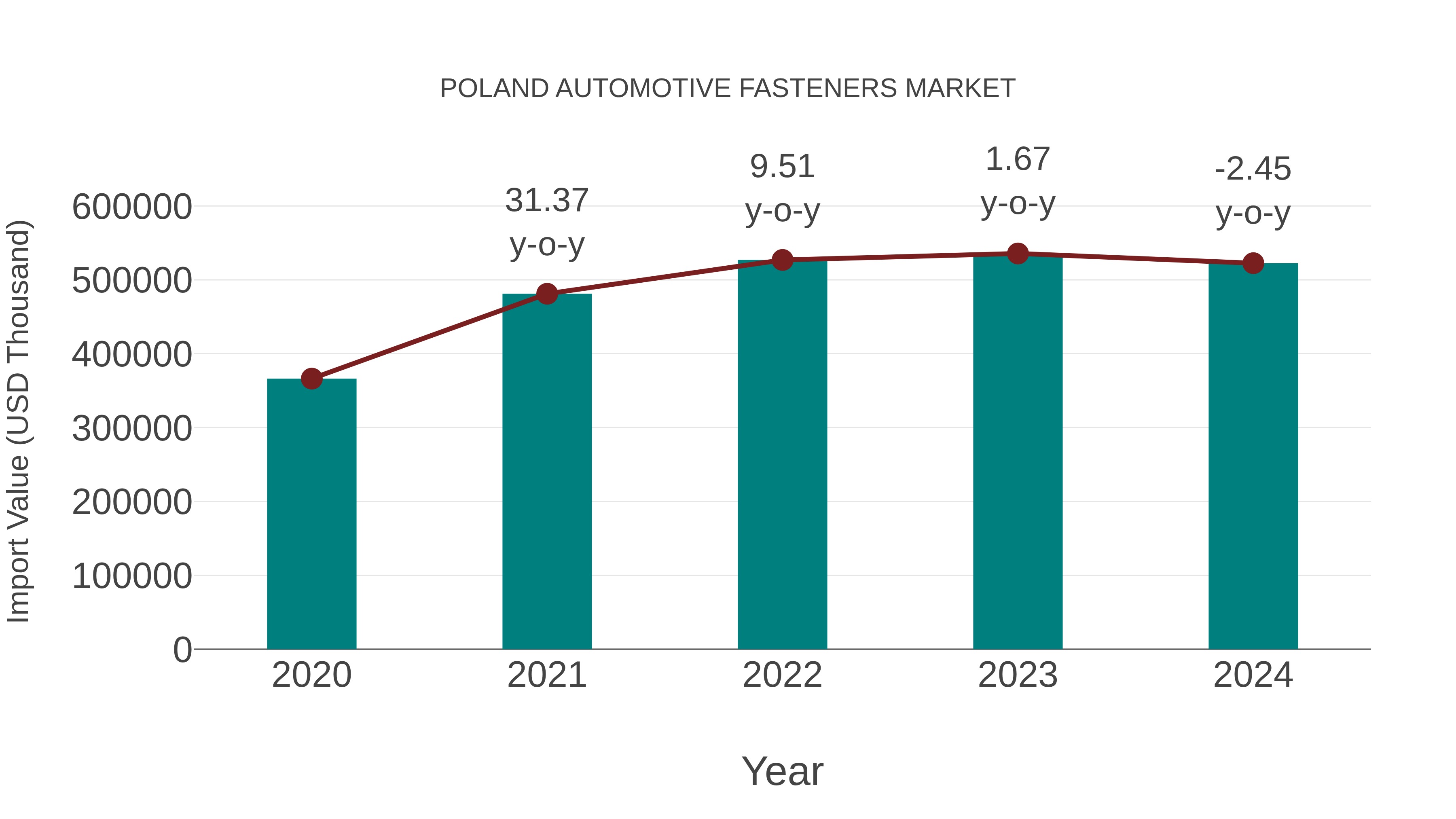
In the Poland automotive fasteners market, the import trend experienced a slight decline from 2023 to 2024, with a growth rate of -2.45%. However, the compound annual growth rate (CAGR) for the period 2020-2024 stood at a notable 9.29%. This dip in import momentum may be attributed to shifts in demand dynamics or changes in market stability during that period.
Poland Automotive Fasteners Market Overview
The Poland Automotive Fasteners Market is witnessing steady growth driven by the expanding automotive industry in the country. The market is characterized by the increasing demand for lightweight and high-performance fasteners to enhance vehicle efficiency and safety. Key players in the market are focusing on product innovation and development of advanced fastening solutions to cater to the changing requirements of automotive manufacturers. The market is also influenced by the growing trend towards electric vehicles, leading to the adoption of specialized fasteners for electric vehicle components. Additionally, stringent regulations related to vehicle safety and emissions are pushing automotive manufacturers to use high-quality fasteners, further boosting market growth. Overall, the Poland Automotive Fasteners Market is poised for continued expansion due to the evolving automotive landscape in the country.
Trends of the Market
The Poland Automotive Fasteners Market is experiencing significant growth due to the increasing demand for vehicles in the country. The market is witnessing a trend towards lightweight and advanced materials in automotive fasteners to improve fuel efficiency and vehicle performance. Manufacturers are focusing on developing innovative fastening solutions to meet the stringent safety and quality standards in the automotive industry. Additionally, the shift towards electric vehicles is driving the adoption of specialized fasteners that can withstand the unique requirements of EVs. Companies are also investing in research and development to introduce sustainable and recyclable fastening solutions to align with the growing environmental concerns. Overall, the Poland Automotive Fasteners Market is poised for continued growth driven by technological advancements and evolving automotive trends.
Challenges of the Market
The Poland Automotive Fasteners Market faces challenges such as increasing competition from low-cost manufacturers in other regions, fluctuating raw material prices, and stringent regulatory requirements related to automotive safety standards. Additionally, the market is experiencing a shift towards electric vehicles, which require different types of fasteners compared to traditional internal combustion engine vehicles. This transition poses a challenge for fastener manufacturers to adapt their products to meet the specific requirements of electric vehicles. Moreover, the ongoing COVID-19 pandemic has disrupted supply chains and manufacturing operations, leading to uncertainties in production schedules and logistics. Overall, the Poland Automotive Fasteners Market must navigate these challenges to remain competitive and meet the evolving demands of the automotive industry.
Investment Opportunities of the market
Investment opportunities in the Poland Automotive Fasteners Market include the potential for growth due to the expanding automotive industry in the region, driven by increasing demand for vehicles. With a focus on lightweight materials and advanced technologies, there is a growing need for high-quality fasteners to ensure vehicle safety and performance. Additionally, the shift towards electric vehicles and the trend of vehicle customization present opportunities for innovative fastening solutions. Investing in research and development to offer specialized fasteners tailored to the evolving needs of the automotive sector could provide a competitive edge. Collaborating with local manufacturers and suppliers to establish a strong presence in the market, along with maintaining high standards of quality and efficiency, can lead to long-term success in this growing industry.
Government Policy of the market
In Poland, government policies related to the Automotive Fasteners Market focus on promoting innovation, sustainability, and competitiveness within the industry. The government provides support for research and development activities to encourage the adoption of advanced technologies and materials in fastener production. Additionally, there are regulations in place to ensure the quality and safety of automotive fasteners, with standards set by organizations such as the Polish Committee for Standardization. The government also emphasizes the importance of environmental sustainability, promoting the use of eco-friendly materials and production processes in line with European Union directives. Overall, these policies aim to drive growth and efficiency in the Poland Automotive Fasteners Market while ensuring compliance with international standards and environmental responsibilities.
Future Outlook of the market
The Poland Automotive Fasteners Market is expected to witness steady growth in the coming years due to increasing automotive production and demand for lightweight and fuel-efficient vehicles. The market is likely to be driven by advancements in automotive technology, stringent regulations promoting the use of lightweight materials, and the rising focus on vehicle safety. Additionally, the growing trend of electric vehicles and the shift towards sustainable manufacturing practices are anticipated to create new opportunities for fastener manufacturers in the automotive sector. However, factors such as fluctuating raw material prices and intense competition among market players may pose challenges to the market growth. Overall, the Poland Automotive Fasteners Market is poised for growth, supported by the expanding automotive industry and evolving consumer preferences.
Key Highlights of the Report:
- Poland Automotive Fasteners Market Outlook
- Market Size of Poland Automotive Fasteners Market, 2025
- Forecast of Poland Automotive Fasteners Market, 2032
- Historical Data and Forecast of Poland Automotive Fasteners Revenues & Volume for the Period 2022-2032F
- Poland Automotive Fasteners Market Trend Evolution
- Poland Automotive Fasteners Market Drivers and Challenges
- Poland Automotive Fasteners Price Trends
- Poland Automotive Fasteners Porter's Five Forces
- Poland Automotive Fasteners Industry Life Cycle
- Historical Data and Forecast of Poland Automotive Fasteners Market Revenues & Volume By Material Type for the Period 2022-2032F
- Historical Data and Forecast of Poland Automotive Fasteners Market Revenues & Volume By Steel Fasteners for the Period 2022-2032F
- Historical Data and Forecast of Poland Automotive Fasteners Market Revenues & Volume By Aluminum Fasteners for the Period 2022-2032F
- Historical Data and Forecast of Poland Automotive Fasteners Market Revenues & Volume By Plastic Fasteners for the Period 2022-2032F
- Historical Data and Forecast of Poland Automotive Fasteners Market Revenues & Volume By Titanium Fasteners for the Period 2022-2032F
- Historical Data and Forecast of Poland Automotive Fasteners Market Revenues & Volume By Coating for the Period 2022-2032F
- Historical Data and Forecast of Poland Automotive Fasteners Market Revenues & Volume By Zinc Coated for the Period 2022-2032F
- Historical Data and Forecast of Poland Automotive Fasteners Market Revenues & Volume By Nickel Coated for the Period 2022-2032F
- Historical Data and Forecast of Poland Automotive Fasteners Market Revenues & Volume By Chrome Plated for the Period 2022-2032F
- Historical Data and Forecast of Poland Automotive Fasteners Market Revenues & Volume By Anti-Corrosive Coating for the Period 2022-2032F
- Historical Data and Forecast of Poland Automotive Fasteners Market Revenues & Volume By Vehicle Type for the Period 2022-2032F
- Historical Data and Forecast of Poland Automotive Fasteners Market Revenues & Volume By Passenger Cars for the Period 2022-2032F
- Historical Data and Forecast of Poland Automotive Fasteners Market Revenues & Volume By Commercial Vehicles for the Period 2022-2032F
- Historical Data and Forecast of Poland Automotive Fasteners Market Revenues & Volume By Electric Vehicles for the Period 2022-2032F
- Historical Data and Forecast of Poland Automotive Fasteners Market Revenues & Volume By Luxury Vehicles for the Period 2022-2032F
- Poland Automotive Fasteners Import Export Trade Statistics
- Market Opportunity Assessment By Material Type
- Market Opportunity Assessment By Coating
- Market Opportunity Assessment By Vehicle Type
- Poland Automotive Fasteners Top Companies Market Share
- Poland Automotive Fasteners Competitive Benchmarking By Technical and Operational Parameters
- Poland Automotive Fasteners Company Profiles
- Poland Automotive Fasteners Key Strategic Recommendations






































