Poland Railway Maintenance Machinery Market Size, Share & Growth Rate
The Poland Railway Maintenance Machinery Market was estimated at USD 734 Million in 2025 and is projected to reach USD 1217 Million by 2032, growing at a CAGR of 7.5% from 2026 to 2032. This trajectory is fueled by the government's unwavering commitment to enhancing railway infrastructure, alongside a surge in urbanization and demand for efficient, reliable transport solutions. As Poland continues to modernize its rail networks, investments in advanced maintenance machinery have become essential to meet operational and safety standards.
Poland Railway Maintenance Machinery Market Year-wise Growth Rate and Key Drivers
This graph highlights how the Poland Railway Maintenance Machinery Market has steadily grown over the years, supported by major growth factors.
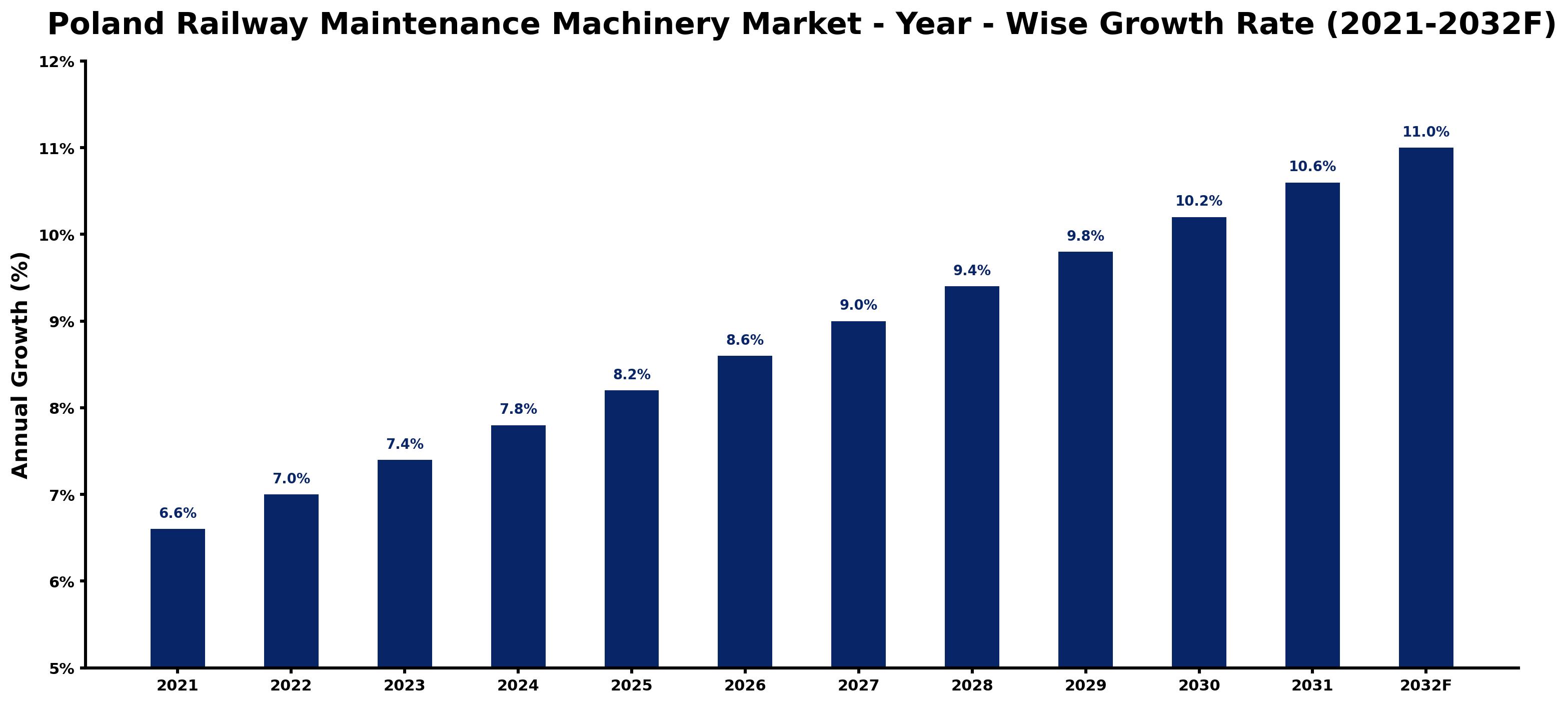
The table below presents the year‑wise growth rates along with the key drivers influencing the market
| Year | Growth Rate | Major Drivers |
| 2021 | 6.6% | Increasing smart city development projects |
| 2022 | 7.0% | Rapid growth in telecom and data center sectors |
| 2023 | 7.4% | Expansion of transportation and logistics networks |
| 2024 | 7.8% | Growing urbanization and commercial development |
| 2025 | 8.2% | Increasing adoption of advanced technologies |
| 2026 | 8.6% | Increasing industrial infrastructure investments |
| 2027 | 9.0% | Expansion of transportation and logistics networks |
| 2028 | 9.4% | Increasing smart city development projects |
| 2029 | 9.8% | Rising electricity demand across industries |
| 2030 | 10.2% | Government infrastructure modernization initiatives |
| 2031 | 10.6% | Increasing industrial automation investments |
| 2032 | 11.0% | Expansion of transportation and logistics networks |
Note - Market size estimations and growth projections presented in this report are based on 6Wresearch’s advanced forecasting approach, validated with industry datasets as of June 2026.
Poland Railway Maintenance Machinery Market Synopsis
The most significant force currently shaping the Poland Railway Maintenance Machinery Market is the ongoing investment in railway infrastructure upgrades. Government initiatives aimed at improving the efficiency and safety of rail operations are spurring demand for innovative maintenance solutions. This focus not only enhances operational efficiency but also addresses the pressing need for sustainable practices within the sector.
Another crucial aspect is the shift towards integrating advanced technologies such as IoT and automation. These advancements promise to transform traditional maintenance processes by increasing precision, reducing downtime, and improving overall safety in railway operations. As these technologies become more mainstream, they are likely to redefine how maintenance machinery is utilized across the sector.
Poland Railway Maintenance Machinery Market Key Takeaways
- The market is projected to grow significantly, reaching USD 1217 Million by 2032.
- Government investments in railway infrastructure are a primary growth driver.
- Advanced technologies, including IoT and automation, are increasingly adopted.
- There is a rising emphasis on sustainable practices and eco-friendly machinery.
- Investment opportunities abound, especially in specialized maintenance equipment.
Evaluation of Restraints in Poland Railway Maintenance Machinery Market
Despite its robust growth, the Poland Railway Maintenance Machinery Market faces certain restraints. The rapid evolution of technology necessitates continuous updates and enhancements to machinery, which can strain financial resources and strategic planning. Furthermore, the demand for skilled labor to operate sophisticated equipment remains a challenge; companies often grapple with recruitment and training, impacting operational efficiency. Regulatory compliance and budget constraints further complicate investment decisions, requiring a delicate balance for market players aiming to stay competitive in this dynamic landscape.
Poland Railway Maintenance Machinery Market Trends
The market is increasingly gravitating towards smart technologies that facilitate predictive maintenance and real-time monitoring. This shift is driven by a collective industry focus on minimizing operational downtime and enhancing maintenance efficiency. Additionally, there is a growing trend towards the deployment of eco-friendly machinery, aligning with the global push for sustainability. The integration of automation in maintenance processes not only boosts efficiency but also reduces human error, furthering safety and reliability across railway operations.
Poland Railway Maintenance Machinery Market Opportunities
Investors are presented with numerous opportunities within the Poland Railway Maintenance Machinery Market. With Poland's extensive railway network in constant need of modernization and upgrades, opportunities for specialized machinery such as rail grinders and track inspection vehicles are abundant. The increasing emphasis on sustainability opens pathways for investments in eco-friendly maintenance equipment. Additionally, the rise of predictive maintenance technologies and digital tools offers promising avenues for growth, as operators seek to enhance efficiency and reduce maintenance costs.
Government Initiatives in the Poland Railway Maintenance Machinery Market
Poland's government has introduced several initiatives aimed at revitalizing the railway sector, focusing on both modernization and safety. Investments in advanced maintenance equipment and technology are prioritized to uphold the reliability of the railway network. Furthermore, regulations promoting environmentally friendly maintenance solutions align with Poland's sustainability goals, creating favorable conditions for companies producing innovative machinery. These government policies foster a supportive environment for both domestic and international suppliers in the market.
Future Insights of the Poland Railway Maintenance Machinery Market
Looking ahead to 2026-2032, the Poland Railway Maintenance Machinery Market is poised for continued growth. The ongoing construction of new rail lines and the enhancement of existing infrastructure will create sustained demand for advanced maintenance machinery. Technological advancements, particularly in predictive maintenance and automated systems, are expected to play a pivotal role in market evolution. As the industry embraces a culture of safety and operational efficiency, stakeholders providing innovative and cost-effective solutions will be well-positioned for success.
Poland Railway Maintenance Machinery Market Latest Developments (May 2025 - June 2026)
In recent months, the industry has witnessed a surge in collaborations between technology providers and machinery manufacturers aimed at integrating advanced digital solutions into traditional maintenance practices. Additionally, several key players are focusing on developing machinery with enhanced eco-friendly features to align with regulatory changes and sustainability trends. Overall, the market is trending towards greater innovation as it adapts to the evolving needs of the railway sector.
Poland Railway Maintenance Machinery Market - Key Attractiveness of the Report
- 10 Years of Market Numbers
- Historical Data Starting from 2022 to 2025
- Base Year: 2025
- Forecast Data until 2032
- Key Performance Indicators Impacting the Market
- Major Upcoming Developments and Projects
Key Highlights of the Report:
- Poland Railway Maintenance Machinery Market Outlook
- Market Size of Poland Railway Maintenance Machinery Market, 2025
- Forecast of Poland Railway Maintenance Machinery Market, 2032
- Historical Data and Forecast of Poland Railway Maintenance Machinery Revenues & Volume for the Period 2022-2032F
- Poland Railway Maintenance Machinery Market Trend Evolution
- Poland Railway Maintenance Machinery Market Drivers and Challenges
- Poland Railway Maintenance Machinery Price Trends
- Poland Railway Maintenance Machinery Porter's Five Forces
- Poland Railway Maintenance Machinery Industry Life Cycle
- Historical Data and Forecast of Poland Railway Maintenance Machinery Market Revenues & Volume By Type for the Period 2022-2032F
- Historical Data and Forecast of Poland Railway Maintenance Machinery Market Revenues & Volume By Tamping Machine for the Period 2022-2032F
- Historical Data and Forecast of Poland Railway Maintenance Machinery Market Revenues & Volume By Stabilizing Machinery for the Period 2022-2032F
- Historical Data and Forecast of Poland Railway Maintenance Machinery Market Revenues & Volume By Rail Handling Machinery for the Period 2022-2032F
- Historical Data and Forecast of Poland Railway Maintenance Machinery Market Revenues & Volume By Ballast Cleaning Machine for the Period 2022-2032F
- Historical Data and Forecast of Poland Railway Maintenance Machinery Market Revenues & Volume By Other for the Period 2022-2032F
- Historical Data and Forecast of Poland Railway Maintenance Machinery Market Revenues & Volume By Applications for the Period 2022-2032F
- Historical Data and Forecast of Poland Railway Maintenance Machinery Market Revenues & Volume By Ballast Track for the Period 2022-2032F
- Historical Data and Forecast of Poland Railway Maintenance Machinery Market Revenues & Volume By Ballastless Track for the Period 2022-2032F
- Poland Railway Maintenance Machinery Import Export Trade Statistics
- Market Opportunity Assessment By Type
- Market Opportunity Assessment By Applications
- Poland Railway Maintenance Machinery Top Companies Market Share
- Poland Railway Maintenance Machinery Competitive Benchmarking By Technical and Operational Parameters
- Poland Railway Maintenance Machinery Company Profiles
- Poland Railway Maintenance Machinery Key Strategic Recommendations






































