Poland Smart Building Market Size, Share & Growth Rate
The Poland Smart Building Market was estimated at USD 806 Million in 2025 and is projected to reach USD 1475 Million by 2032, growing at a CAGR of 9.0% from 2026 to 2032. This substantial growth is propelled by increased investments in smart infrastructure, coupled with a burgeoning focus on energy efficiency and sustainability. The adoption of IoT technologies within the construction sector further enhances operational efficiencies, setting the stage for an evolving landscape of intelligent buildings.
Poland Smart Building Market Year-wise Growth Rate and Key Drivers
This graph highlights how the Poland Smart Building Market has steadily grown over the years, supported by major growth factors.
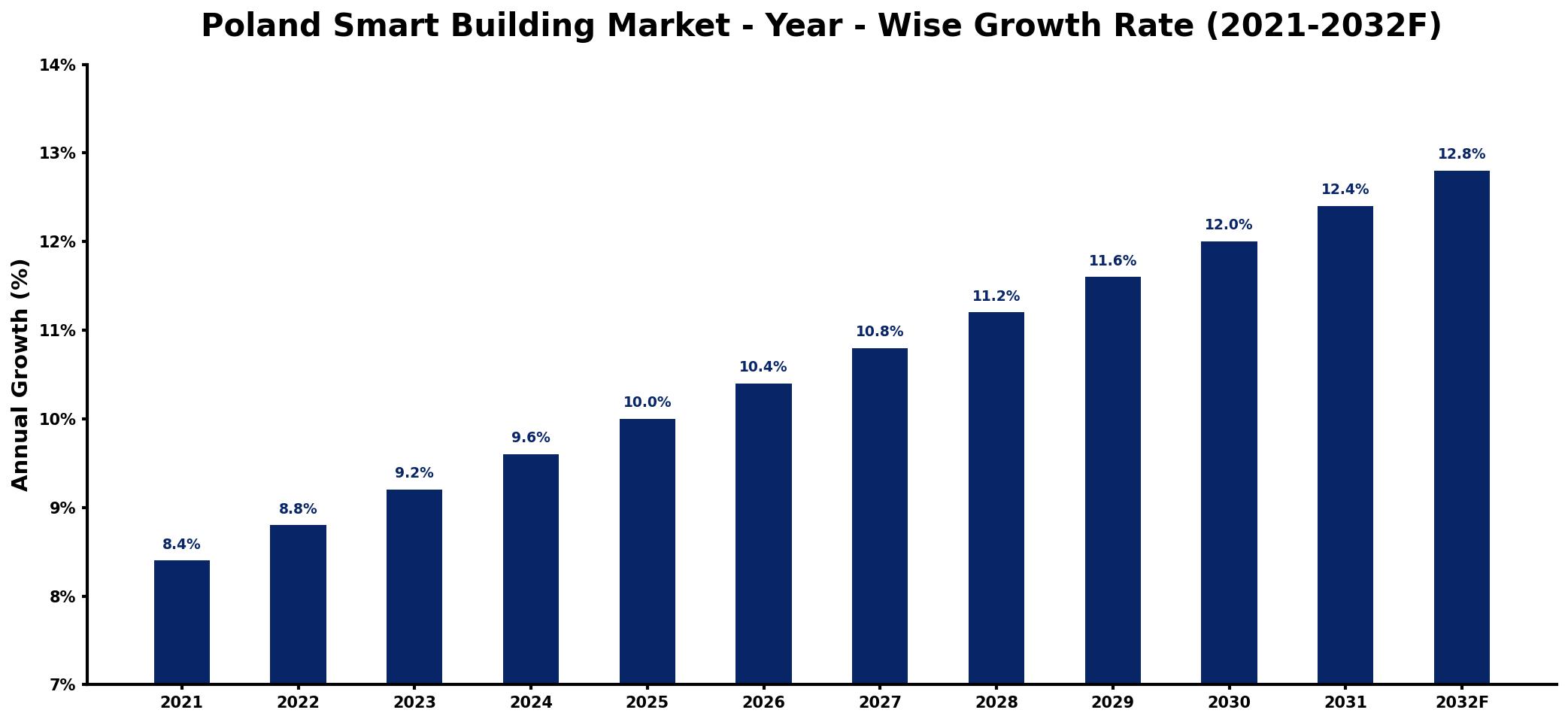
The table below presents the year‑wise growth rates along with the key drivers influencing the market
| Year | Growth Rate | Major Drivers |
| 2021 | 8.4% | Rising demand for automation solutions |
| 2022 | 8.8% | Increased investment in IoT technologies |
| 2023 | 9.2% | Growing focus on energy efficiency |
| 2024 | 9.6% | Expansion of urban infrastructure projects |
| 2025 | 10.0% | Surge in remote monitoring applications |
| 2026 | 10.4% | Advancements in AI integration |
| 2027 | 10.8% | Higher consumer awareness on sustainability |
| 2028 | 11.2% | growing commercial sector adoption |
| 2029 | 11.6% | Boost in regulatory support frameworks |
| 2030 | 12.0% | Rise in digital transformation efforts |
| 2031 | 12.4% | Increased partnerships within technology sectors |
| 2032 | 12.8% | Growing influence of data analytics |
Note: Market size estimations and growth projections presented in this report are based on 6Wresearch's proprietary forecasting methodology, utilizing the latest available industry data, government publications, and primary research inputs.
Poland Smart Building Market Synopsis
The strongest force currently shaping the Poland Smart Building Market is the integration of advanced building automation systems and smart energy management solutions. These technologies are crucial in optimizing energy consumption and improving occupant comfort, thus addressing the rising demand for sustainable building practices.
The market is also significantly influenced by government initiatives aimed at promoting smart building technologies. As Poland continues to invest in smart cities and sustainable urban development, the appetite for innovative building solutions grows, paving the way for increased market penetration and the expansion of smart building projects across various sectors.
Poland Smart Building Market Key Takeaways
- The market is driven by government policies promoting energy efficiency and smart infrastructure.
- Integration of IoT technologies is reshaping building management and operational efficiency.
- There is increasing demand for smart energy management systems and automation technologies.
- Sustainability is a key focus, aligning with global trends towards green building practices.
- Investment opportunities are broadening across various sectors, including commercial and residential markets.
Evaluation of Restraints in Poland Smart Building Market
Despite its promising trajectory, the Poland Smart Building Market faces certain restraints that could temper growth. High initial investment costs associated with smart technologies deter some potential adopters, particularly smaller developers and property owners. Additionally, the absence of standardized regulations and guidelines creates uncertainty, leading to interoperability issues between various systems. Compounding these concerns are data privacy and security risks, as increasing system connectivity introduces vulnerabilities. The slower adoption rate relative to other European markets also presents a challenge that industry stakeholders must address to achieve widespread market acceptance.
Poland Smart Building Market Trends
The market is currently witnessing key trends that are shaping demand. The integration of artificial intelligence and machine learning into smart building solutions is enhancing operational efficiencies while improving user experiences. There's a growing preference for remote monitoring and control capabilities through smart building automation systems, which leverage data analytics and sensors to bolster performance. Moreover, the shift towards energy-efficient technologies is not just a passing trend but a necessity, driven by regulatory frameworks and market demand.
Poland Smart Building Market Opportunities
The Poland Smart Building Market is ripe with investment opportunities, particularly in areas such as smart lighting, energy management systems, and advanced security technologies. The increasing focus on sustainable building practices presents avenues for innovation in energy optimization and automation solutions. Partnerships with developers and contractors engaged in smart building projects can also provide lucrative pathways for market entry and expansion. As the demand for intelligent building solutions grows, investors can leverage these trends to capitalize on emerging opportunities.
Government Initiatives in the Poland Smart Building Market
The Polish government is actively promoting smart buildings through various policies and initiatives designed to enhance energy efficiency and sustainable development. The National Energy Efficiency Action Plan aims to elevate energy performance standards for buildings, providing financial incentives for energy-efficient renovations. Additionally, the Smart Development Program supports funding for projects that integrate advanced technologies, further solidifying the government's commitment to fostering a smart building environment. These initiatives reflect a broader strategy to transition towards sustainable urban living and intelligent infrastructure.
Future Insights of the Poland Smart Building Market
Looking ahead, the Poland Smart Building Market is poised for significant growth through 2026-2032, underpinned by the continuous evolution of IoT technologies and increasing societal awareness of sustainability. The market landscape will be influenced by rising government support for smart city initiatives and ongoing investments in energy-efficient building solutions. As key stakeholders focus on innovation and developing responsive systems, the integration of advanced automation and data analytics will be central to enhancing building performance and occupant satisfaction. This trend indicates a forward momentum that is likely to redefine how buildings operate in urban settings.
Poland Smart Building Market Latest Developments (2025 - 2026)
Recent developments within the Poland Smart Building Market reflect a shift towards embracing innovative technologies and sustainable practices. Stakeholders are increasingly collaborating on initiatives that incorporate smart technologies into existing infrastructure, enhancing their operational efficiency and appeal. Meanwhile, pilot projects showcasing the effectiveness of advanced building management systems are being launched, setting benchmarks for future smart building endeavors. This momentum indicates a collective move towards reimagining building operations for the future.
Poland Smart Building Market - Key Attractiveness of the Report
- 10 Years of Market Numbers
- Historical Data Starting from 2022 to 2025
- Base Year: 2025
- Forecast Data until 2032
- Key Performance Indicators Impacting the Market
- Major Upcoming Developments and Projects
Key Highlights of the Report:
- Poland Smart Building Market Outlook
- Market Size of Poland Smart Building Market, 2025
- Forecast of Poland Smart Building Market, 2032
- Historical Data and Forecast of Poland Smart Building Revenues & Volume for the Period 2022-2032F
- Poland Smart Building Market Trend Evolution
- Poland Smart Building Market Drivers and Challenges
- Poland Smart Building Price Trends
- Poland Smart Building Porter's Five Forces
- Poland Smart Building Industry Life Cycle
- Historical Data and Forecast of Poland Smart Building Market Revenues & Volume By Component for the Period 2022-2032F
- Historical Data and Forecast of Poland Smart Building Market Revenues & Volume By Solution for the Period 2022-2032F
- Historical Data and Forecast of Poland Smart Building Market Revenues & Volume By Services for the Period 2022-2032F
- Historical Data and Forecast of Poland Smart Building Market Revenues & Volume By Application for the Period 2022-2032F
- Historical Data and Forecast of Poland Smart Building Market Revenues & Volume By Residential for the Period 2022-2032F
- Historical Data and Forecast of Poland Smart Building Market Revenues & Volume By Commercial for the Period 2022-2032F
- Poland Smart Building Import Export Trade Statistics
- Market Opportunity Assessment By Component
- Market Opportunity Assessment By Application
- Poland Smart Building Top Companies Market Share
- Poland Smart Building Competitive Benchmarking By Technical and Operational Parameters
- Poland Smart Building Company Profiles
- Poland Smart Building Key Strategic Recommendations






































