Portugal Bicycle Lights Market Size (2020-2030)
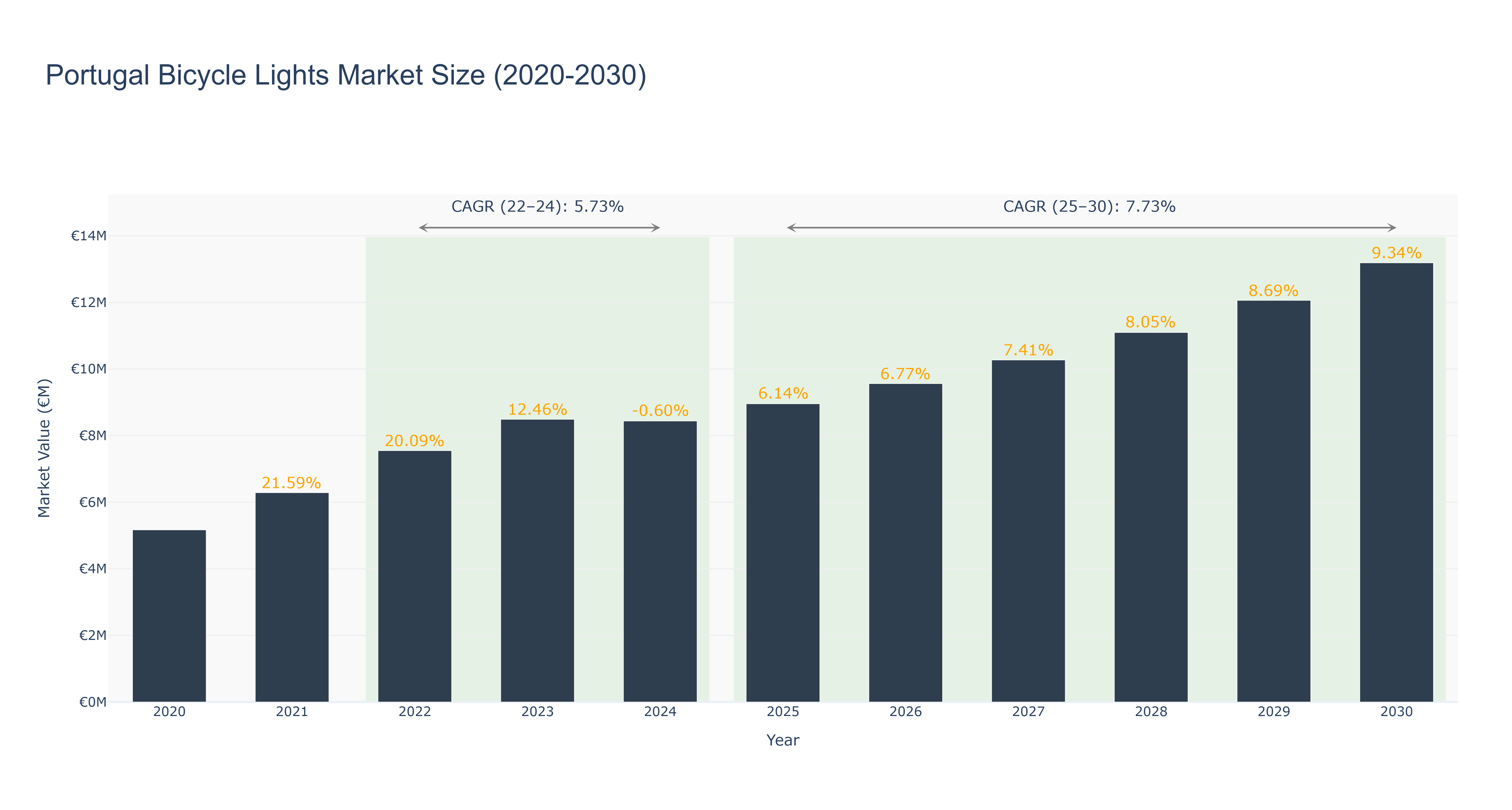
The Portugal Bicycle Lights Market has demonstrated significant growth, peaking at €8.49 million in 2023, following a robust increase from €7.55 million in 2022, marking a growth rate of 12.46%. However, the market experienced a slight downturn in 2024, with a marginal decline to €8.44 million. Over the actual period from 2022 to 2024, the compound annual growth rate (CAGR) stands at 5.73%. Looking ahead, the forecasted period from 2025 to 2030 indicates a more optimistic trajectory, with the market projected to reach €13.19 million by 2030, representing a CAGR of 7.73%. This growth will likely be driven by increasing urban cycling infrastructure, rising environmental awareness, and advancements in LED technology, enhancing product appeal. As Portugal continues to prioritize sustainable transportation, the bicycle lights market is expected to benefit from these macro trends, fostering further innovation and consumer adoption.
Portugal Bicycle Lights Market: Production & Trade Performance (2019-2025)
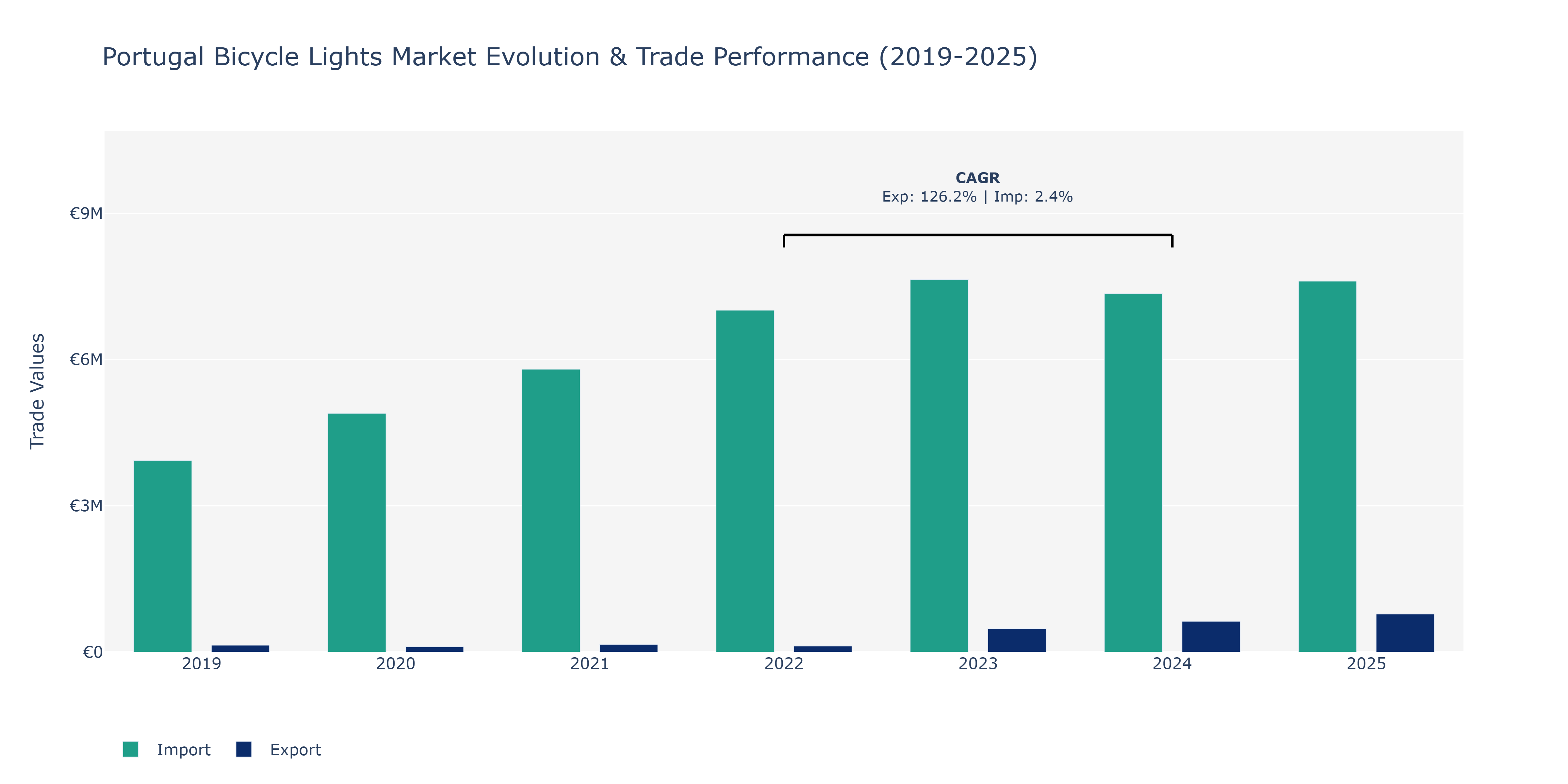
The Portugal Bicycle Lights Market witnessed notable fluctuations in both Exports and Imports from 2019 to 2025. Exports started at €141.33 thousand in 2019, experienced a decline in 2020 to €108.98 thousand, followed by a steady increase in subsequent years, reaching €780.11 thousand in 2025. Conversely, Imports began at a much higher level of €3.93 million in 2019, increased in 2020 to €4.9 million, and continued to rise gradually, peaking at €7.61 million in 2025. The surge in Exports can be attributed to the market's growing reputation for producing high-quality bicycle lights, thus increasing demand internationally. On the other hand, the rise in Imports may reflect the market's reliance on certain components or raw materials sourced from overseas suppliers to meet domestic demand. The CAGR for Exports from 2022 to 2024 was notably high at 126.16%, indicating strong market expansion efforts in that period. To maintain this growth trajectory, market players could focus on innovation, sustainability, and strategic partnerships to capitalize on the increasing global interest in eco-friendly transportation solutions, aligning with the broader industry trends towards sustainability and green technologies.
Key Highlights of the Report:
- Portugal Bicycle Lights Market Outlook
- Market Size of Portugal Bicycle Lights Market, 2025
- Forecast of Portugal Bicycle Lights Market, 2032
- Historical Data and Forecast of Portugal Bicycle Lights Revenues & Volume for the Period 2022 - 2032F
- Portugal Bicycle Lights Market Trend Evolution
- Portugal Bicycle Lights Market Drivers and Challenges
- Portugal Bicycle Lights Price Trends
- Portugal Bicycle Lights Porter`s Five Forces
- Portugal Bicycle Lights Industry Life Cycle
- Historical Data and Forecast of Portugal Bicycle Lights Market Revenues & Volume By Product Type for the Period 2022 - 2032F
- Historical Data and Forecast of Portugal Bicycle Lights Market Revenues & Volume By Headlight for the Period 2022 - 2032F
- Historical Data and Forecast of Portugal Bicycle Lights Market Revenues & Volume By Taillight for the Period 2022 - 2032F
- Historical Data and Forecast of Portugal Bicycle Lights Market Revenues & Volume By Application for the Period 2022 - 2032F
- Historical Data and Forecast of Portugal Bicycle Lights Market Revenues & Volume By Mountain Bicycle for the Period 2022 - 2032F
- Historical Data and Forecast of Portugal Bicycle Lights Market Revenues & Volume By Road Bicycle for the Period 2022 - 2032F
- Historical Data and Forecast of Portugal Bicycle Lights Market Revenues & Volume By Commuting Bicycle for the Period 2022 - 2032F
- Portugal Bicycle Lights Import Export Trade Statistics
- Market Opportunity Assessment By Product Type
- Market Opportunity Assessment By Application
- Portugal Bicycle Lights Top Companies Market Share
- Portugal Bicycle Lights Competitive Benchmarking By Technical and Operational Parameters
- Portugal Bicycle Lights Company Profiles
- Portugal Bicycle Lights Key Strategic Recommendations






































