Qatar 5G Core Market Size, Share & Growth Rate
The Qatar 5G Core Market was estimated at USD 174 Million in 2025 and is projected to reach USD 231 Million by 2032, growing at a CAGR of 4.1% from 2026 to 2032. This growth trajectory is propelled by increasing investments from telecom operators aimed at modernizing infrastructure, as well as the country's commitment to implementing advanced technologies. The rising demand for high-speed data and low-latency connectivity, particularly for IoT and augmented reality applications, is significantly influencing this dynamic market landscape.
Qatar 5G Core Market Year-wise Growth Rate and Key Drivers
This graph highlights how the Qatar 5G Core Market has steadily grown over the years, supported by major growth factors.
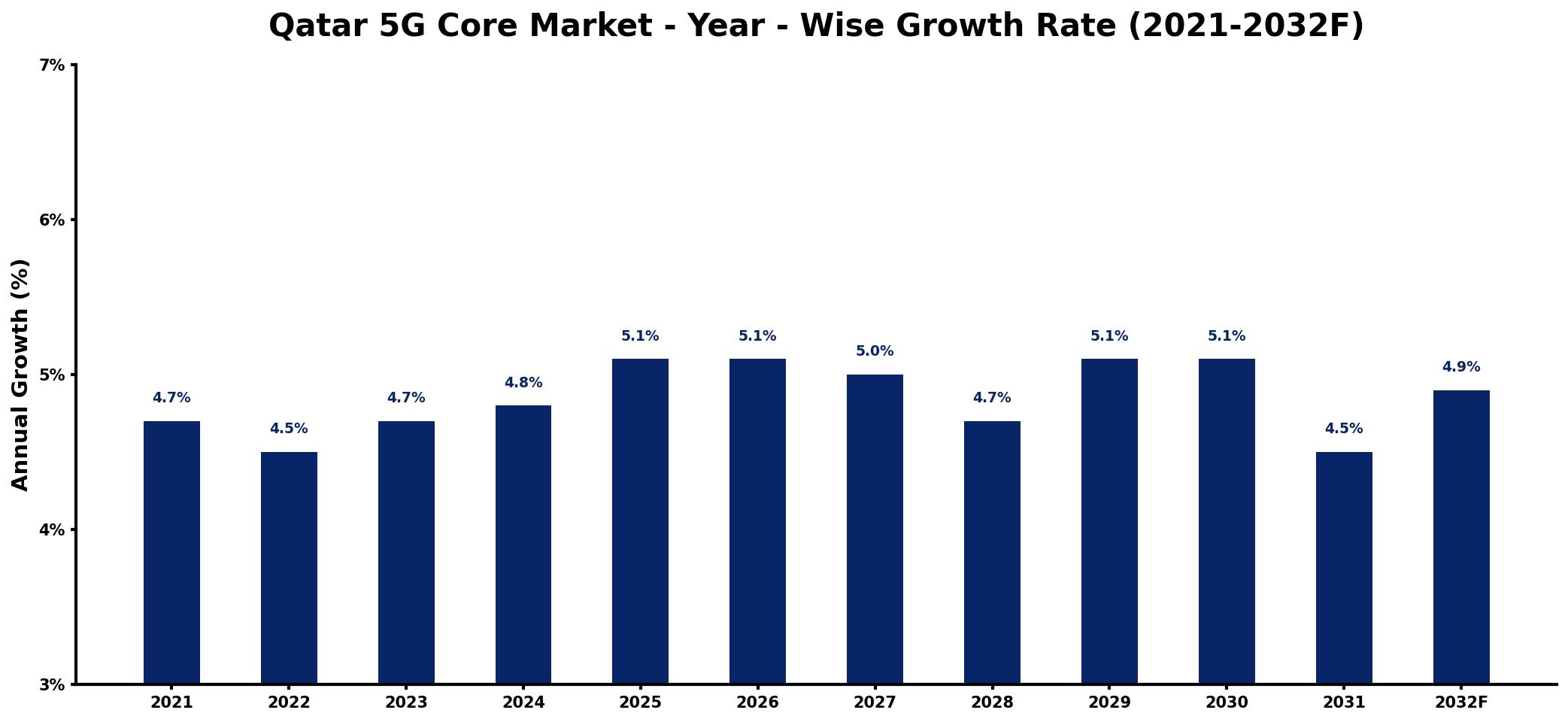
The table below presents the year‑wise growth rates along with the key drivers influencing the market
| Year | Growth Rate | Major Drivers |
| 2021 | 4.7% | Rising demand for mobile connectivity |
| 2022 | 4.5% | Increased investments in telecommunications infrastructure |
| 2023 | 4.7% | Expansion of IoT applications adoption |
| 2024 | 4.8% | Growth in smart city initiatives |
| 2025 | 5.1% | Surge in cloud computing services |
| 2026 | 5.1% | Development of enhanced mobile broadband |
| 2027 | 5.0% | Growing interest in edge computing |
| 2028 | 4.7% | Emergence of new digital services |
| 2029 | 5.1% | Investments in advanced network technologies |
| 2030 | 5.1% | Adoption of augmented reality solutions |
| 2031 | 4.5% | Enhanced focus on cybersecurity measures |
| 2032 | 4.9% | increased pharmaceutical industry usage |
Note: Market size estimations and growth projections presented in this report are based on 6Wresearch's proprietary forecasting methodology, utilizing the latest available industry data, government publications, and primary research inputs.
Qatar 5G Core Market Synopsis
As Qatar positions itself as a leader in telecommunications innovation, the 5G Core market stands at the center of this evolution. The burgeoning demand for ultra-reliable connectivity solutions has led to a robust focus on developing scalable core network architectures that can accommodate the requirements of modern digital services.
Recent trends indicate that the integration of diverse technologies and enhanced network capabilities are essential for ensuring a seamless transition to 5G. This development is vital not only for the consumer sector but also for critical industries such as healthcare and transportation, which increasingly rely on advanced networking solutions.
Qatar 5G Core Market Key Takeaways
- Substantial growth projected due to increased telecom investments and infrastructure upgrades.
- Heightened demand for low-latency connectivity across various sectors, including IoT and augmented reality.
- Focus on developing resilient and scalable core network solutions to facilitate 5G deployment.
- Challenges related to investment and interoperability must be strategically addressed.
- Government initiatives play a crucial role in shaping the regulatory environment and fostering innovation.
Evaluation of Restraints in Qatar 5G Core Market
Despite its promising outlook, the Qatar 5G Core market faces certain restraints that could impede its growth trajectory. A significant barrier is the high capital investment required for building and maintaining a robust 5G infrastructure. Telecom operators must allocate considerable resources not only to hardware but also to advanced software solutions and skilled workforce training. Moreover, achieving seamless interoperability with existing legacy systems poses challenges that necessitate meticulous planning and execution.
Qatar 5G Core Market Trends
The demand for network slicing has gained momentum in Qatar's 5G Core market, enabling telecom providers to deliver tailored services to specific industries such as healthcare and education. Furthermore, the evolution of smart cities is driving investment in technologies that support connectivity for numerous devices simultaneously, emphasizing the need for efficient data management strategies. These trends indicate a movement towards more customized and efficient service offerings in the telecommunications sector.
Qatar 5G Core Market Opportunities
The opportunities for growth in the Qatar 5G Core market are vast. With the continued emphasis on digital transformation, sectors like logistics, entertainment, and public safety are increasingly seeking advanced connectivity solutions. Additionally, as businesses ramp up efforts to incorporate IoT into their operations, the demand for sophisticated core network capabilities is expected to rise, presenting a lucrative avenue for service providers and technology developers alike.
Government Initiatives in the Qatar 5G Core Market
The Qatari government is actively fostering the growth of the 5G Core market through a variety of initiatives aimed at enhancing technological infrastructure. Public spending on digital innovation and smart city projects is a key part of national strategy, aimed at attracting investment and facilitating partnerships across sectors. Furthermore, regulatory frameworks are being developed to streamline the deployment of advanced telecommunications solutions, ensuring that Qatar remains competitive on a global scale.
Future Insights of the Qatar 5G Core Market
Looking ahead to 2026-2032, the Qatar 5G Core market is poised for significant advancements driven by technological evolution and shifting consumer expectations. Continued investment in next-generation infrastructure will be crucial in supporting the anticipated rise in data consumption and connected devices. Furthermore, strategic collaborations between public and private sectors are likely to emerge, enhancing Qatar's position as a hub for 5G innovation and leading to the creation of new, transformative services.
Qatar 5G Core Market Latest Developments (2025 - 2026)
Recent developments in the Qatar 5G Core market have focused on enhancing network resilience and service customization. Telecom operators are increasingly adopting cutting-edge technologies to enable real-time data management and optimize service delivery. Moreover, initiatives aimed at expanding coverage in urban and rural areas are gaining traction, enhancing accessibility to high-speed connectivity across the nation. These moves are indicative of the ongoing commitment to foster a robust telecommunications environment.
Qatar 5G Core Market - Key Attractiveness of the Report
- 10 Years of Market Numbers
- Historical Data Starting from 2022 to 2025
- Base Year: 2025
- Forecast Data until 2032
- Key Performance Indicators Impacting the Market
- Major Upcoming Developments and Projects
Key Highlights of the Report:
- Qatar 5G Core Market Outlook
- Market Size of Qatar 5G Core Market, 2025
- Forecast of Qatar 5G Core Market, 2032
- Historical Data and Forecast of Qatar 5G Core Revenues & Volume for the Period 2022-2032F
- Qatar 5G Core Market Trend Evolution
- Qatar 5G Core Market Drivers and Challenges
- Qatar 5G Core Price Trends
- Qatar 5G Core Porter's Five Forces
- Qatar 5G Core Industry Life Cycle
- Historical Data and Forecast of Qatar 5G Core Market Revenues & Volume By Component for the Period 2022-2032F
- Historical Data and Forecast of Qatar 5G Core Market Revenues & Volume By Solutions for the Period 2022-2032F
- Historical Data and Forecast of Qatar 5G Core Market Revenues & Volume By Services for the Period 2022-2032F
- Historical Data and Forecast of Qatar 5G Core Market Revenues & Volume By Network Function for the Period 2022-2032F
- Historical Data and Forecast of Qatar 5G Core Market Revenues & Volume By Access for the Period 2022-2032F
- Historical Data and Forecast of Qatar 5G Core Market Revenues & Volume By Mobility Management Function for the Period 2022-2032F
- Historical Data and Forecast of Qatar 5G Core Market Revenues & Volume By Policy Control Function for the Period 2022-2032F
- Historical Data and Forecast of Qatar 5G Core Market Revenues & Volume By Unified Data Management for the Period 2022-2032F
- Historical Data and Forecast of Qatar 5G Core Market Revenues & Volume By Deployment Model for the Period 2022-2032F
- Historical Data and Forecast of Qatar 5G Core Market Revenues & Volume By Cloud for the Period 2022-2032F
- Historical Data and Forecast of Qatar 5G Core Market Revenues & Volume By On-premises for the Period 2022-2032F
- Historical Data and Forecast of Qatar 5G Core Market Revenues & Volume By End User for the Period 2022-2032F
- Historical Data and Forecast of Qatar 5G Core Market Revenues & Volume By Telecom Operators for the Period 2022-2032F
- Historical Data and Forecast of Qatar 5G Core Market Revenues & Volume By Enterprises for the Period 2022-2032F
- Qatar 5G Core Import Export Trade Statistics
- Market Opportunity Assessment By Component
- Market Opportunity Assessment By Network Function
- Market Opportunity Assessment By Deployment Model
- Market Opportunity Assessment By End User
- Qatar 5G Core Top Companies Market Share
- Qatar 5G Core Competitive Benchmarking By Technical and Operational Parameters
- Qatar 5G Core Company Profiles
- Qatar 5G Core Key Strategic Recommendations






































