Qatar Acetate Yarn Market Size, Share & Growth Rate
The Qatar Acetate Yarn Market was estimated at USD 972 Million in 2025 and is projected to reach USD 1412 Million by 2032, growing at a CAGR of 5.5% from 2026 to 2032. This promising growth trajectory is fueled by Qatar's fashion-conscious population, which increasingly favors high-quality textiles, particularly those that offer a luxurious feel. The expansion of small-scale textile manufacturing, coupled with ongoing innovation within the industry, further solidifies the market's growth prospects.
Qatar Acetate Yarn Market Year-wise Growth Rate and Key Drivers
This graph highlights how the Qatar Acetate Yarn Market has steadily grown over the years, supported by major growth factors.
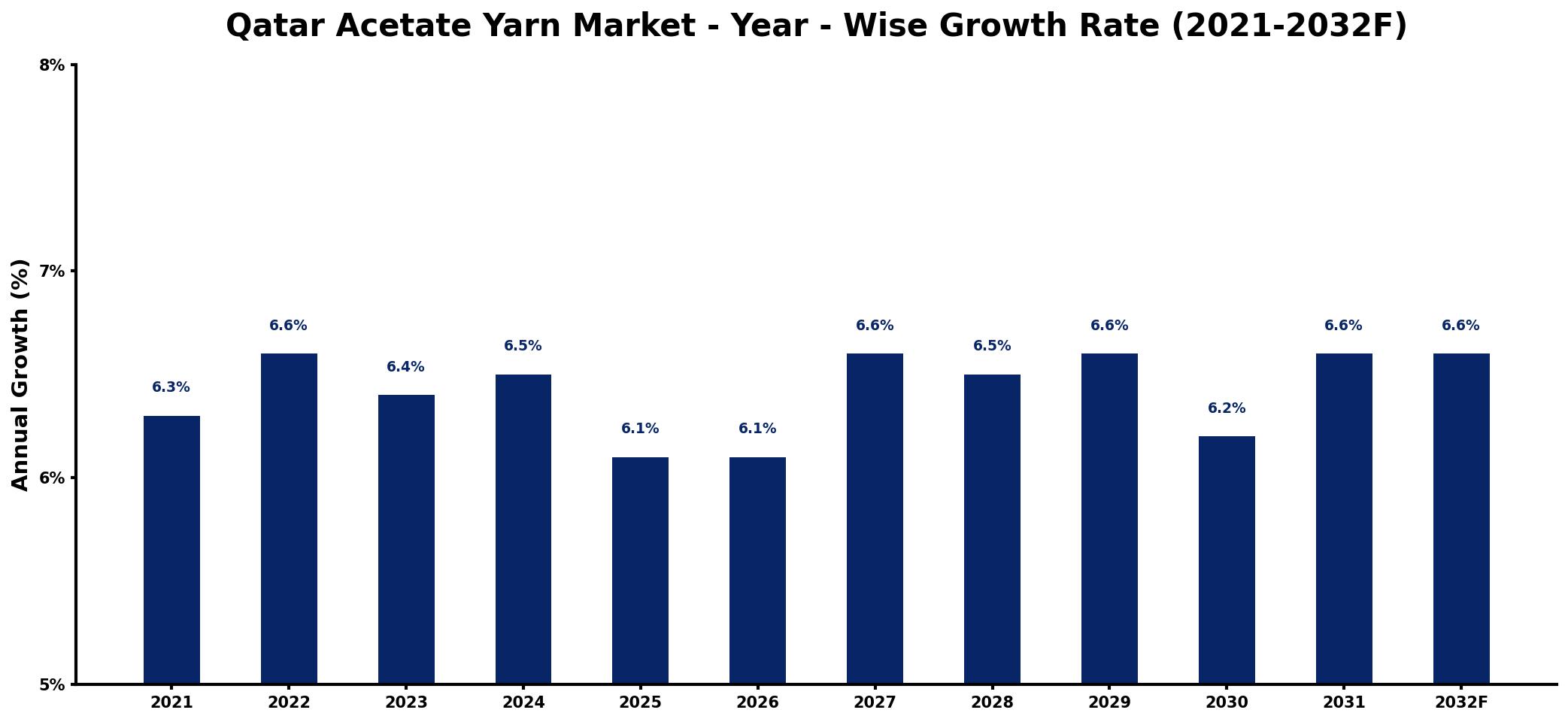
The table below presents the year‑wise growth rates along with the key drivers influencing the market
| Year | Growth Rate | Major Drivers |
| 2021 | 6.3% | Rising demand from fashion industry |
| 2022 | 6.6% | Increased investment in textiles sector |
| 2023 | 6.4% | Growth in home textile applications |
| 2024 | 6.5% | Expansion of eco-friendly materials |
| 2025 | 6.1% | Higher consumer spending on apparel |
| 2026 | 6.1% | Emergence of sustainable production methods |
| 2027 | 6.6% | Increased popularity of activewear |
| 2028 | 6.5% | rising export shipment volumes |
| 2029 | 6.6% | Rising exports to global markets |
| 2030 | 6.2% | Emerging trends in interior design |
| 2031 | 6.6% | Increased use in automotive sector |
| 2032 | 6.6% | increased production capacity utilization |
Note: Market size estimations and growth projections presented in this report are based on 6Wresearch's proprietary forecasting methodology, utilizing the latest available industry data, government publications, and primary research inputs.
Qatar Acetate Yarn Market Synopsis
The Qatar acetate yarn market is characterized by a robust demand stemming from the textile and fashion sectors. With its silky texture and appealing aesthetics, acetate yarn is a favored choice among designers and consumers seeking quality clothing and accessories. As Qatar continues to embrace fashion-forward trends, the appetite for luxurious fabrics remains strong.
Moreover, the industry is witnessing a significant push from local manufacturers who are increasingly diversifying their product offerings. This trend is particularly vital as it promotes the use of acetate yarn in innovative blends and applications, catering to a market that values both style and substance.
Qatar Acetate Yarn Market Key Takeaways
- The market is experiencing steady growth driven by increasing consumer demand for luxurious textiles.
- Local manufacturing initiatives are on the rise, enhancing the supply chain for acetate yarn in Qatar.
- Innovative blends and applications are being developed to meet the evolving tastes of fashion-conscious consumers.
- Challenges relating to sustainability are prompting manufacturers to explore eco-friendly alternatives.
- The ongoing economic diversification efforts in Qatar are positively impacting the textile and fashion sectors.
Evaluation of Restraints in Qatar Acetate Yarn Market
While the Qatar acetate yarn market is poised for growth, it faces significant restraints linked to shifting consumer preferences toward sustainable materials. As awareness of environmental issues rises, there is a palpable resistance to synthetic options, which raises the urgency for manufacturers to pivot towards environmentally friendly alternatives. Furthermore, Qatar's smaller market size presents additional challenges, as achieving competitive pricing against larger global players becomes increasingly difficult.
Qatar Acetate Yarn Market Trends
Current trends in the Qatar acetate yarn market indicate a shift toward more sustainable practices, with manufacturers seeking innovative solutions that align with eco-conscious consumer values. Additionally, the fusion of traditional textiles with modern design elements is gaining traction, showcasing a blend of heritage and contemporary style. This trend not only enhances market appeal but also fosters local artisanship.
Qatar Acetate Yarn Market Opportunities
The prospects for growth in the Qatar acetate yarn market are substantial, particularly within niche segments that prioritize luxury and sustainability. By investing in research and development, companies can explore eco-friendly blends and establish a unique market position. Furthermore, the burgeoning interest in high-quality local textiles presents a ripe opportunity for manufacturers to cater to the domestic fashion industry.
Government Initiatives in the Qatar Acetate Yarn Market
Qatar's government is actively promoting initiatives to diversify the economy, which include support for the textile sector. This includes investment in local manufacturing capabilities, infrastructure development, and training programs aimed at enhancing skills within the industry. Such efforts are designed to create a more robust textile ecosystem, encouraging the growth of businesses engaged in the acetate yarn market.
Future Insights of the Qatar Acetate Yarn Market
Looking ahead to 2026-2032, the Qatar acetate yarn market is expected to evolve significantly as consumer preferences shift further towards luxury and sustainability. The continued development of local manufacturing capabilities will play a critical role in meeting this demand. As companies increasingly adopt innovative practices and technologies, the market is likely to witness a renaissance that positions Qatar as a key player in the acetate yarn industry.
Qatar Acetate Yarn Market Latest Developments (2025 - 2026)
Recent developments in the Qatar acetate yarn market suggest a growing focus on sustainability and innovation. Local manufacturers are beginning to experiment with new eco-friendly blends, responding to market demands for greener textiles. Additionally, collaborations between designers and fabric producers are emerging, aiming to create unique offerings that resonate with Qatars fashion-forward populace.
Qatar Acetate Yarn Market - Key Attractiveness of the Report
- 10 Years of Market Numbers
- Historical Data Starting from 2022 to 2025
- Base Year: 2025
- Forecast Data until 2032
- Key Performance Indicators Impacting the Market
- Major Upcoming Developments and Projects
Key Highlights of the Report:
- Qatar Acetate Yarn Market Outlook
- Market Size of Qatar Acetate Yarn Market, 2025
- Forecast of Qatar Acetate Yarn Market, 2032
- Historical Data and Forecast of Qatar Acetate Yarn Revenues & Volume for the Period 2022-2032F
- Qatar Acetate Yarn Market Trend Evolution
- Qatar Acetate Yarn Market Drivers and Challenges
- Qatar Acetate Yarn Price Trends
- Qatar Acetate Yarn Porter's Five Forces
- Qatar Acetate Yarn Industry Life Cycle
- Historical Data and Forecast of Qatar Acetate Yarn Market Revenues & Volume By Type for the Period 2022-2032F
- Historical Data and Forecast of Qatar Acetate Yarn Market Revenues & Volume By Triacetate Fiber for the Period 2022-2032F
- Historical Data and Forecast of Qatar Acetate Yarn Market Revenues & Volume By Diacetate Fiber for the Period 2022-2032F
- Historical Data and Forecast of Qatar Acetate Yarn Market Revenues & Volume By Application for the Period 2022-2032F
- Historical Data and Forecast of Qatar Acetate Yarn Market Revenues & Volume By Ladies Clothing for the Period 2022-2032F
- Historical Data and Forecast of Qatar Acetate Yarn Market Revenues & Volume By Clothes Lining for the Period 2022-2032F
- Historical Data and Forecast of Qatar Acetate Yarn Market Revenues & Volume By Pajamas for the Period 2022-2032F
- Historical Data and Forecast of Qatar Acetate Yarn Market Revenues & Volume By Label for the Period 2022-2032F
- Historical Data and Forecast of Qatar Acetate Yarn Market Revenues & Volume By Others for the Period 2022-2032F
- Qatar Acetate Yarn Import Export Trade Statistics
- Market Opportunity Assessment By Type
- Market Opportunity Assessment By Application
- Qatar Acetate Yarn Top Companies Market Share
- Qatar Acetate Yarn Competitive Benchmarking By Technical and Operational Parameters
- Qatar Acetate Yarn Company Profiles
- Qatar Acetate Yarn Key Strategic Recommendations






































