Qatar Agricultural Film Market Size & Growth Rate
According to 6Wresearch internal database and industry insights, the Qatar Agricultural Film Market was valued at USD 15 Million in 2025 and is projected to reach USD 24.24 Million by 2032, growing at a CAGR of approximately 7.1% during 2026–2032.
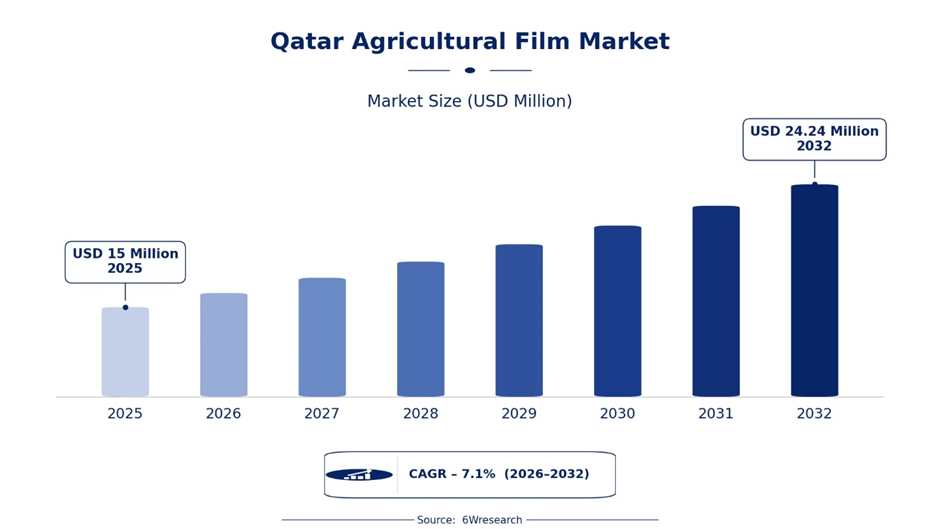
Qatar Agricultural Film Market Highlights
|
Report Metric |
Details |
|
Report Name |
Qatar Agricultural Film Market (2026-2032) |
|
Market Size 2025 |
USD 15 Million |
|
Market Size 2032 |
USD 24.24 Million |
|
Absolute Growth 2025–2032 |
USD 9.24 Million |
|
CAGR 2026–2032 |
7.1% |
|
Peak Annual Growth |
8.3% in 2029 |
|
Forecast Period |
2026–2032 |
|
Historical Data |
2022–2025 |
|
Base Year |
2025 |
|
Leading Product Type, 2025 |
Polyethylene Films (62% share) |
|
Fastest-Growing Product Type |
Biodegradable Films (11.2% CAGR) |
|
Leading Application, 2025 |
Greenhouse Films (46% share) |
|
Fastest-Growing Application |
Mulch Films (8.3% CAGR) |
|
Leading End User, 2025 |
Farmers (58% share) |
|
Fastest-Growing End User |
Agricultural Contractors (8.6% CAGR) |
|
Growing Sector |
Protected vegetable cultivation |
|
Key End Users |
Commercial vegetable farms, greenhouse developers and installation contractors, horticultural growers, livestock and fodder operators |
Qatar Agricultural Film Market Year-wise Growth Rate and Key Drivers (2022–2032)
This graph illustrates the annual growth rates of the market from 2022 to 2032, highlighting a steady upward trajectory and projected market expansion over the forecast period.
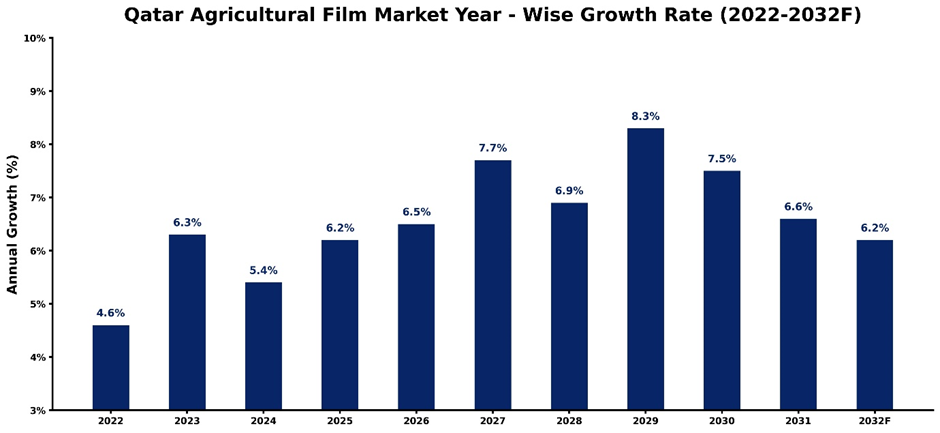
The following table presents the estimated annual growth rates of the market for each year, along with the key factors influencing market performance during the respective period.
| Year | Estimated Annual Growth (%) | Market Rationale |
| 2022 | 4.6% | Higher resin and freight costs in 2022 constrained film purchases despite strong fresh produce demand during the FIFA World Cup. |
| 2023 | 6.3% | Farms completing the National Food Security Strategy 2018–2023 cycle replaced worn covers and expanded their protected cultivation area. |
| 2024 | 5.4% | Growth eased in 2024 as farmers delayed new installations until the next national food security strategy was finalised. |
| 2025 | 6.2% | The National Food Security Strategy 2030 launch and 8,420 greenhouse units in 2025 supported stronger film demand. |
| 2026 | 6.5% | Greenhouse capacity additions by private operators are expected to lift installation demand for covering films from 2026. |
| 2027 | 7.7% | Agricultural extension support is expected to improve film selection and raise adoption of higher-value products in 2027. |
| 2028 | 6.9% | Growth is expected to ease as early installers complete their initial covers and film purchases shifts increasingly towards replacement volumes. |
| 2029 | 8.3% | Rising preference for biodegradable mulch films across vegetable farms is expected to accelerate premium film adoption in 2029. |
| 2030 | 7.5% | Progress towards Qatar’s 2030 vegetable self-sufficiency target is expected to slow the expansion of new agricultural areas and reduce demand for agricultural films. |
| 2031 | 6.6% | Increased imports of lower-cost films from Asian and European producers are expected to temper value growth. |
| 2032 | 6.2% | Wider recycling and longer-life film formulations are expected to reduce replacement frequency and volume growth by 2032. |
Note: Market size estimations and growth projections presented in this report are based on 6Wresearch’s proprietary forecasting methodology, utilizing the latest available industry data, government publications, and primary research inputs.
Qatar Agricultural Film Market Synopsis
The Qatar Agricultural Film Market is expected to grow at a rapid pace during 2026-2032, driven by the National Food Security Strategy 2030, an expanding base of climate-controlled production units, an organised network for marketing local vegetables, and domestic polyethylene supply from Mesaieed-based petrochemical producers. Agricultural Film is a thin plastic sheet used in farming to protect crops, improve growing conditions, conserve water, and increase agricultural productivity. It is commonly made from polyethylene (PE) and other specialized plastic materials.
Market Dynamics Impact Analysis (2026–2032)
|
Factor |
Type |
Impact |
Primary Segment Affected |
|
Expansion of protected cultivation under national food security goals |
Driver |
High |
Greenhouse Films |
|
Domestic polyethylene resin availability and local film conversion |
Driver |
Medium |
Polyethylene Films |
|
Rising demand for compostable mulch among sustainability-focused growers |
Opportunity |
High |
Biodegradable Films |
|
Installation and re-covering service contracts for commercial farms |
Opportunity |
Medium |
Greenhouse Films |
|
Rapid UV and heat degradation of covers in summer |
Restraint |
High |
Polyethylene Films |
|
Dependence on imported speciality and EVA grades |
Restraint |
Medium |
EVA (Ethylene-Vinyl Acetate) Films |
|
Limited recycling and disposal infrastructure for used films |
Challenge |
Medium |
Silage Films |
|
Winter-concentrated production limiting year-round film use |
Challenge |
Medium |
Mulch Films |
Evaluation of Drivers in Qatar Agricultural Film Market (2026–2032)
Below mentioned are some major drivers and their influence on market dynamics:
|
Drivers |
Primary Segment Affected |
Why It Matters (Evidence) |
|
Expansion of climate-controlled cultivation |
Greenhouse Films |
Each new protected-cultivation unit needs a polymer cover that is replaced every few seasons, so installed capacity converts directly into recurring film demand, and greenhouse units reached 8,420 in 2025. |
|
Vegetable self-sufficiency target |
Mulch Films |
Raising vegetable self-sufficiency from 39% in 2024 towards 55% by 2030 requires higher yield per hectare, which increases use of ground cover films that conserve soil moisture and suppress weeds. |
|
Organised marketing of local produce |
Horticulturalists |
A reliable domestic sales channel gives growers confidence to invest in covered cultivation, and Mahaseel Company marketed over 26 million kilograms of local vegetables in 2024. |
|
Larger base of commercial farms |
Farmers |
More operating farms widen the pool of buyers placing repeat seasonal orders for covers and ground films. |
|
Growth in organic cultivation |
Biodegradable Films |
Organic growers seek residue-free ground cover that can be tilled into soil, which favours compostable film. |
Qatar Agricultural Film Market Growth is supported by a resident population of about 3 million with rising per-capita consumption of fresh produce, which widens the addressable base for locally grown vegetables. Additionally, growing private capital in controlled-environment agriculture and agri-technology is adding cultivation capacity, and improvements in multilayer, UV-stabilised film formulations extend cover life and improve yield per unit of land. Moreover, rising adoption of water-efficient irrigation and fertigation systems, together with better cold-chain and logistics capacity, supports higher output and wider distribution of domestic harvests.
Evaluation of Restraints in Qatar Agricultural Film Market
Below mentioned are some major restraints and their influence on market dynamics:
|
Market Restraint |
Primary Segment Affected |
Why It Matters (Evidence) |
|
UV and heat degradation of covers |
Polyethylene Films |
Summer temperatures in Qatar regularly exceed 45°C, and intense UV radiation breaks down polymer covers faster, forcing early replacement and raising the cost per growing season. |
|
Reliance on imports for speciality grades |
EVA (Ethylene-Vinyl Acetate) Films |
Local converting centres on commodity polyethylene products such as packaging and general-purpose films, so EVA and multilayer grades are imported, which lengthens lead times and exposes buyers to freight swings. |
|
Winter-concentrated production cycle |
Mulch Films |
Vegetable production is concentrated in the winter season, so film purchases compress into a few months and distributors carry unused stock through summer. |
|
Premium pricing of compostable films |
Biodegradable Films |
Certified compostable films are priced well above conventional polyethylene, which slows adoption among cost-sensitive growers who compare cover cost per square metre. |
|
Scarce arable land and groundwater |
Farmers |
Only a small share of national land is arable and groundwater is limited, which caps the area that can be brought under cultivation and the film volumes attached to it. |
Qatar Agricultural Film Market Challenges
The Qatar Agricultural Film Industry goes through many hindrances. Used covers carry soil and agrochemical residues, and Qatar has little dedicated agricultural plastic recycling, so suppliers face pressure to offer take-back schemes ahead of 2030 sustainability goals. Additionally, installation skills are also limited, since tensioning and anti-drip selection errors can cut film life by one to two seasons and erode grower confidence in premium products. Moreover, buying behaviour remains price-led, with many growers choosing thin 100-micron rolls to cut upfront outlay even though thicker multi-season films cost less over their lifetime.
Trends in the Qatar Agricultural Film Market
Emerging trends shaping the Qatar Agricultural Film Market include the following:
- Transition from Conventional to Compostable Mulch: Growers in Qatar are moving from polyethylene mulch that must be lifted and discarded each season towards compostable films that can be tilled into the soil, driven by sustainability preferences and labour effort in disposal. Early trial demand is visible on winter vegetable plots. Suppliers with certified compostable products and agronomy support are best placed to convert early adopters.
- Soil-Less Cultivation Emerging as a Mainstream Production Method: Hydroponic and soil-less systems are gaining ground in Qatar as they conserve scarce groundwater and allow year-round output, and Qatar has chaired GCC discussions on hydroponic standards. These systems use gully, substrate-covering and reflective films alongside greenhouse covers. Suppliers able to offer purpose-made hydroponic films can add a higher-margin line to their range.
- Shift from Open Feed Storage to Film-Protected Silage and Sheds: Dairy and poultry production has sustained about 98% self-sufficiency for several years, and large livestock operations need feed that stays dry and uncontaminated in extreme heat. Wrapped silage and film-covered sheds protect stored fodder and housing from dust, moisture and sun. This favours suppliers of wide-width silage and shed cover films with proven UV life.
Investment Opportunities in the Qatar Agricultural Film Market
Major investment opportunities in the Qatar Agricultural Film Market are presented below:
- Certified Compostable Mulch Film Distribution: Demand for compostable ground cover is rising among sustainability-focused growers, and local availability of certified products is limited. Investors can import or convert certified rolls in drip-bed widths and sell through agricultural input traders, supported by demonstration plots on commercial farms. Certification to a recognised standard such as EN 17033 is the main entry requirement.
- Greenhouse Re-Covering and Maintenance Services: A growing installed base of greenhouses is reaching re-covering age, creating recurring service work every few seasons. Investors can set up mobile crews with tensioning equipment, spare fittings and repair films. Entry is through service contracts with greenhouse developers such as Naas Group and Pergola Contracting & Green Houses, or directly with large commercial farms.
- Agricultural Film Collection and Recycling Capacity: Qatar has limited dedicated recycling for used agricultural films, and local converters already process polyethylene at Mesaieed. Investors can build washing and pelletising lines that turn collected covers into recycled resin for non-food films and bags. Entry is through take-back agreements with large farms and offtake contracts with domestic converters.
Leading Players in Qatar Agricultural Film Market
A detailed compilation of major companies active in the Qatar Agricultural Film Market is presented below:
1. Qatar Plastic Products Company
|
Company Name |
Qatar Plastic Products Company |
|---|---|
|
Established Year |
1998 |
|
Headquarters |
Mesaieed, Qatar |
|
Official Website |
Qatar Plastic Products Company is a domestic polyethylene converter producing flexible packaging, shrink films and greenhouse and agricultural films. It supplies mainly the local market from its facility in Mesaieed Industrial City.
2. Qatar Petrochemical Company (QAPCO)
|
Company Name |
Qatar Petrochemical Company (QAPCO) |
|---|---|
|
Established Year |
1974 |
|
Headquarters |
Doha, Qatar |
|
Official Website |
QAPCO is a national petrochemical producer of polyethylene resins. Its output underpins raw material availability for local film converters serving the agricultural sector.
3. National Plastic Factory
|
Company Name |
National Plastic Factory |
|---|---|
|
Established Year |
1977 |
|
Headquarters |
Doha, Qatar |
|
Official Website |
National Plastic Factory manufactures stretch, wrap and food packaging films together with agricultural silage film. It serves domestic buyers with locally produced polyethylene film products.
4. RKW Group
|
Company Name |
RKW Group |
|---|---|
|
Established Year |
1957 |
|
Headquarters |
Frankfurt am Main, Germany |
|
Official Website |
RKW Group is an international manufacturer of technical plastic films, including agricultural and greenhouse films. It serves Gulf buyers as a source of advanced multilayer film grades.
5. Plastika Kritis
|
Company Name |
Plastika Kritis |
|---|---|
|
Established Year |
1970 |
|
Headquarters |
Heraklion, Greece |
|
Official Website |
Plastika Kritis is a European producer of greenhouse, mulch and other agricultural films. It supplies export markets including the Gulf region, where it competes in speciality cover grades.
Government Initiatives in the Qatar Agricultural Film Market
According to Qatar’s government data, Qatar’s agricultural policy is anchored in the Qatar National Vision 2030 and the Third National Development Strategy launched in 2024, which prioritise sustainable agricultural technology and efficient resource use. The National Food Security Strategy 2030, launched in December 2024 with 17 initiatives, targets 55% self-sufficiency in vegetables and a 50% rise in agricultural land productivity, directly supporting protected cultivation and film consumption.
Implementation rests with the Ministry of Municipality, whose Agricultural Affairs Department provides technical assistance to farms. The Strategic Food Security Facilities at Hamad Port are designed to store rice, sugar and edible oil for three million people for two years, while public-private partnerships bring private operators into greenhouse vegetable, livestock fattening and aquaculture projects. The same strategy aims to cut food waste by 50% by 2030.
Future Insight of the Qatar Agricultural Film Market
Future growth of the Qatar Agricultural Film Market looks promising through 2032. Technology adoption will shape the next phase, as sensor-based climate control raise the value of high-performance covering materials. Additionally, continued public programmes for domestic food production will keep new cultivation projects in the pipeline, with national targets of 70% self-sufficiency in eggs and 30% in sheep and goat meat by 2030. Expanding private investment in agri-technology will add production capacity, and tighter sustainability expectations are likely to favour recyclable and longer-life film formulations across new installations and replacement cycles.
Market Segmentation Analysis
The report offers a comprehensive study of the market across its key segments. The chart below highlights the leading segment by market share in 2025 and the fastest-growing segment by CAGR over 2026–2032, followed by a detailed analysis of each segment:
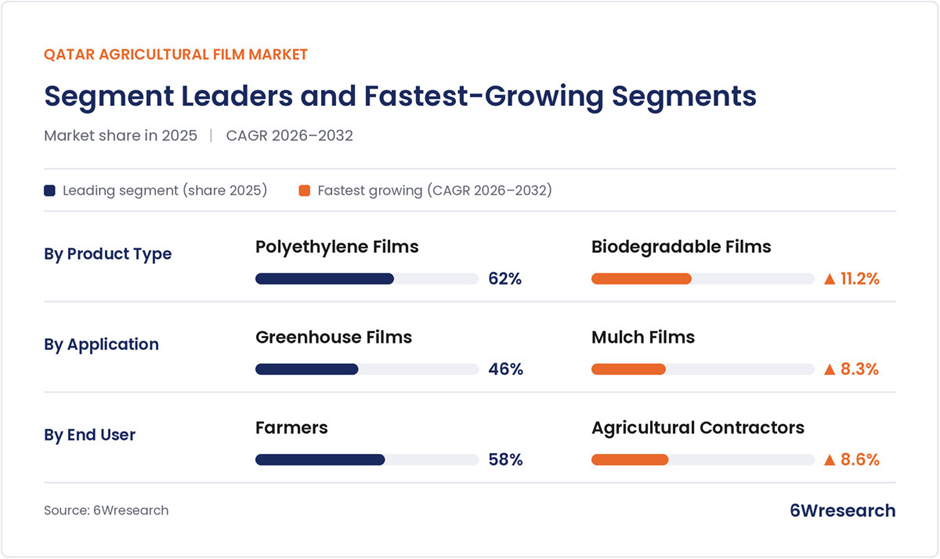
By Product Type – Polyethylene Films Leads, Biodegradable Films Expected to Grow Fastest
According to Sachin Kumar Rai, Senior Research Analyst at 6Wresearch, Polyethylene Films led the market with a 62% Qatar Agricultural Film Market Share in 2025, supported by low-cost domestic resin availability and local converting capacity at Mesaieed. At the same time, Biodegradable Films are expected to grow fastest at a CAGR of 11.2% during 2026–2032, as the expansion of organic cultivation and the need for residue-free ground cover raise demand for compostable products.
By Application – Greenhouse Films Leads, Mulch Films Expected to Grow Fastest
Greenhouse Films represented the largest application in 2025 with a 46% industry share, as climate-controlled cultivation expands and covers need periodic replacement under intense summer sun. Meanwhile, Mulch Films are projected to record the fastest CAGR of 8.3% during 2026–2032, driven by the national push for higher vegetable output per hectare and water conservation in drip-irrigated beds.
By End User – Farmers Leads, Agricultural Contractors Expected to Grow Fastest
In 2025, Farmers accounted for 58% of demand, owing to the number of commercial and smallholder operations that buy film directly for seasonal cultivation across Qatar. In parallel, Agricultural Contractors are expected to record the fastest CAGR of 8.6% during 2026–2032, as larger protected-farming projects increasingly outsource covering, installation and replacement to specialist crews.
Key Attractiveness of the Report
- 10 Years of Market Numbers
- Historical Data Starting from 2022 to 2025
- Base Year 2025
- Forecast Data until 2032
- Key Performance Indicators Impacting the Market
- Major Upcoming Developments and Projects
Key Highlights of the Report:
- Qatar Agricultural Film Market Outlook
- Market Size of Qatar Agricultural Film Market, 2025
- Forecast of Qatar Agricultural Film Market, 2032
- Historical Data and Forecast of Qatar Agricultural Film Revenues & Volume for the Period 2022-2032
- Qatar Agricultural Film Market Trend Evolution
- Qatar Agricultural Film Market Drivers and Challenges
- Qatar Agricultural Film Price Trends
- Qatar Agricultural Film Porter's Five Forces
- Qatar Agricultural Film Industry Life Cycle
- Historical Data and Forecast of Qatar Agricultural Film Market Revenues & Volume By Product Type for the Period 2022-2032
- Historical Data and Forecast of Qatar Agricultural Film Market Revenues & Volume By Polyethylene Films for the Period 2022-2032
- Historical Data and Forecast of Qatar Agricultural Film Market Revenues & Volume By Polypropylene Films for the Period 2022-2032
- Historical Data and Forecast of Qatar Agricultural Film Market Revenues & Volume By EVA (Ethylene-Vinyl Acetate) Films for the Period 2022-2032
- Historical Data and Forecast of Qatar Agricultural Film Market Revenues & Volume By Biodegradable Films for the Period 2022-2032
- Historical Data and Forecast of Qatar Agricultural Film Market Revenues & Volume By Application for the Period 2022-2032
- Historical Data and Forecast of Qatar Agricultural Film Market Revenues & Volume By Greenhouse Films for the Period 2022-2032
- Historical Data and Forecast of Qatar Agricultural Film Market Revenues & Volume By Mulch Films for the Period 2022-2032
- Historical Data and Forecast of Qatar Agricultural Film Market Revenues & Volume By Silage Films for the Period 2022-2032
- Historical Data and Forecast of Qatar Agricultural Film Market Revenues & Volume By Shed Covers for the Period 2022-2032
- Historical Data and Forecast of Qatar Agricultural Film Market Revenues & Volume By End User for the Period 2022-2032
- Historical Data and Forecast of Qatar Agricultural Film Market Revenues & Volume By Farmers for the Period 2022-2032
- Historical Data and Forecast of Qatar Agricultural Film Market Revenues & Volume By Agricultural Contractors for the Period 2022-2032
- Historical Data and Forecast of Qatar Agricultural Film Market Revenues & Volume By Horticulturalists for the Period 2022-2032
- Qatar Agricultural Film Import Export Trade Statistics
- Market Opportunity Assessment By Product Type
- Market Opportunity Assessment By Application
- Market Opportunity Assessment By End User
- Qatar Agricultural Film Top Companies Market Share
- Qatar Agricultural Film Competitive Benchmarking By Technical and Operational Parameters
- Qatar Agricultural Film Company Profiles
- Qatar Agricultural Film Key Strategic Recommendations
Market Covered
The report offers an extensive study of the following market segments.
By Product Type
- Polyethylene Films
- Polypropylene Films
- EVA (Ethylene-Vinyl Acetate) Films
- Biodegradable Films
By Application
- Greenhouse Films
- Mulch Films
- Silage Films
- Shed Covers
By End User
- Farmers
- Agricultural Contractors
- Horticulturalists






































