Qatar Agriculture Market Size, Share & Growth Rate
The Qatar Agriculture Market was estimated at USD 227 Million in 2025 and is projected to reach USD 297 Million by 2032, growing at a CAGR of 3.9% from 2026 to 2032. This growth trajectory is largely driven by Qatar's unwavering commitment to enhancing food security and reducing reliance on agricultural imports. Investments in innovative farming technologies, including hydroponics and vertical farming, are progressively shaping the domestic agricultural landscape.
Qatar Agriculture Market Year-wise Growth Rate and Key Drivers
This graph highlights how the Qatar Agriculture Market has steadily grown over the years, supported by major growth factors.
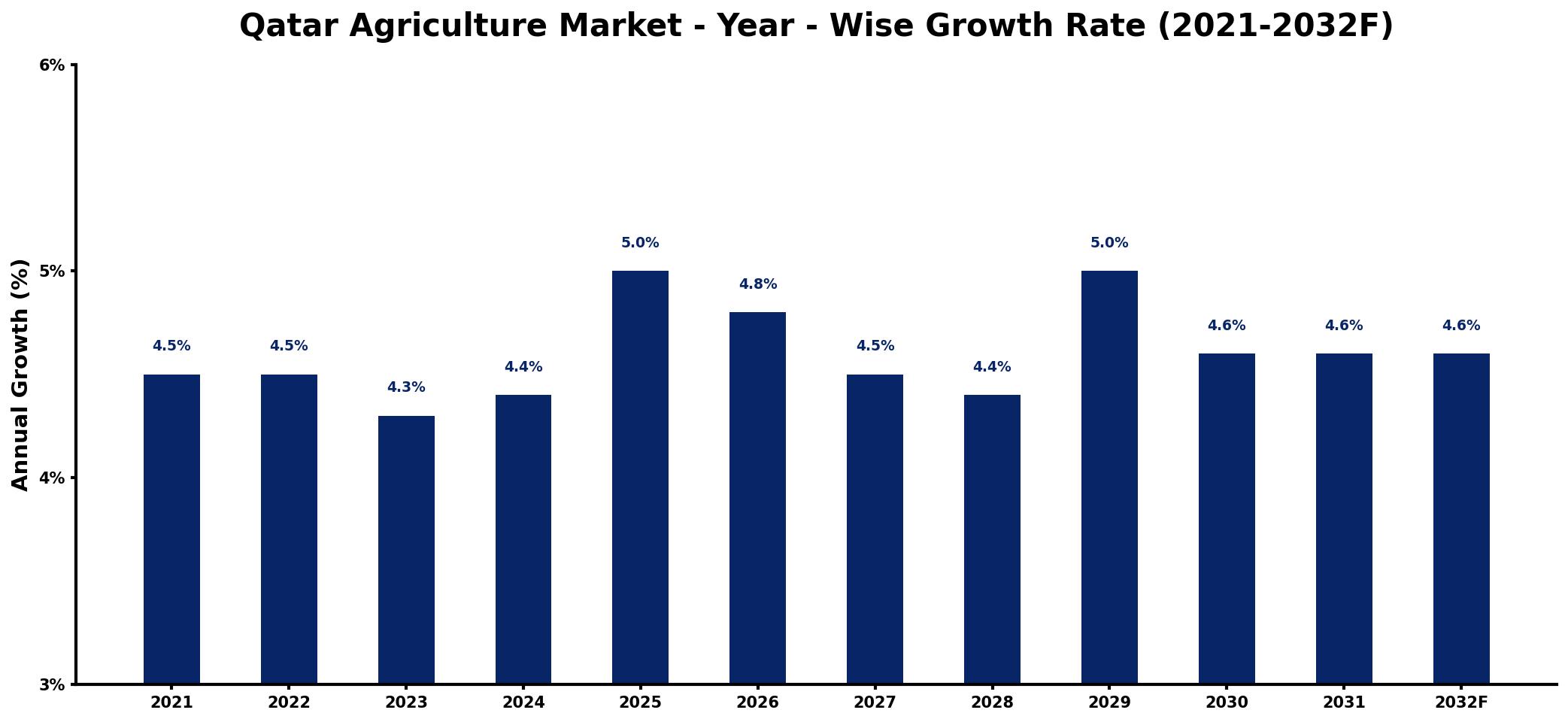
The table below presents the year‑wise growth rates along with the key drivers influencing the market
| Year | Growth Rate | Major Drivers |
| 2021 | 4.5% | rising consumer health consciousness |
| 2022 | 4.5% | increased investment in technology |
| 2023 | 4.3% | growing demand for organic products |
| 2024 | 4.4% | expansion of local farming initiatives |
| 2025 | 5.0% | enhanced supply chain efficiencies |
| 2026 | 4.8% | stronger focus on sustainability practices |
| 2027 | 4.5% | increased government support programs |
| 2028 | 4.4% | growing interest in urban farming |
| 2029 | 5.0% | rising export opportunities for products |
| 2030 | 4.6% | increased collaboration with universities |
| 2031 | 4.6% | stronger distribution network expansion |
| 2032 | 4.6% | growing consumer preference for local |
Note: Market size estimations and growth projections presented in this report are based on 6Wresearch's proprietary forecasting methodology, utilizing the latest available industry data, government publications, and primary research inputs.
Qatar Agriculture Market Synopsis
In response to the challenges posed by its arid climate, Qatar has increasingly turned to innovative farming methods to boost local agricultural production. The country's shift towards controlled environment agriculture is emblematic of its desire to achieve self-sufficiency in food supply.
With the growing interest in organic farming and sustainable practices, Qatar is not only addressing immediate food security concerns but is also aligning itself with global trends focused on eco-friendly agricultural solutions. This dual approach underscores the significance of the agriculture sector in Qatar's long-term economic strategy.
Qatar Agriculture Market Key Takeaways
- The market is poised for steady growth, driven by advances in agricultural technologies and sustainable practices.
- Government initiatives are increasingly supporting local farmers, enhancing productivity and innovation.
- Water management remains a critical focus due to the country's inherent water scarcity issues.
- The adoption of organic farming practices is gaining traction, reflecting changing consumer preferences.
- Controlled environment agriculture is emerging as a solution to local climatic challenges, fostering higher crop yields.
Evaluation of Restraints in Qatar Agriculture Market
Water scarcity presents a formidable challenge to the agriculture market in Qatar. The nations limited freshwater resources compel a reliance on advanced irrigation techniques, which, while effective, require significant investment and ongoing management. Moreover, the need for continuous research and development to cultivate drought-resistant crops is paramount for sustainable growth. These factors highlight the urgency for adaptive practices and technologies that can effectively bridge the gaps in Qatar's agricultural framework.
Qatar Agriculture Market Trends
Several noteworthy trends are shaping the Qatar Agriculture Market. The rise of hydroponic and vertical farming systems exemplifies a shift towards resource-efficient practices, enabling farmers to maximize yields while minimizing water usage. Additionally, the increasing consumer demand for organic produce is steering local farmers towards more sustainable and environmentally friendly methods. The integration of smart technology in farming operations, such as AI-driven crop monitoring, is also gaining momentum, further enhancing productivity and efficiency.
Qatar Agriculture Market Opportunities
The Qatar Agriculture Market presents significant growth and investment opportunities, particularly in the realms of sustainable farming technologies and organic agriculture. As the government continues to bolster local food production through various initiatives, there is an encouraging landscape for investors interested in agricultural technology start-ups and innovative farming practices. Furthermore, the integration of renewable energy solutions in agricultural operations is poised to attract investment and contribute to sustainable agricultural development.
Government Initiatives in the Qatar Agriculture Market
The Qatari government is actively investing in agricultural advancements to achieve food security and sustainability. Initiatives include providing subsidies to local farmers, establishing agricultural research centers, and promoting innovative technologies that enhance productivity. These government policies aim to create a conducive environment for the agricultural sector's growth while supporting local farming communities.
Future Insights of the Qatar Agriculture Market
Looking ahead to the period from 2026 to 2032, the Qatar Agriculture Market is expected to witness transformative changes. As water-efficient technologies and sustainable practices gain traction, the market's growth will likely accelerate, driven by ongoing government support and investments in modern agricultural methods. With the increasing emphasis on food security, coupled with consumers' growing preference for organic produce, the sector is set to evolve in ways that reinforce both economic stability and environmental sustainability.
Qatar Agriculture Market Latest Developments (2025 - 2026)
Recent developments in the Qatar agriculture sector have focused on enhancing local food production capabilities and promoting sustainable practices. The adoption of advanced agricultural technologies, such as smart irrigation systems and precision farming techniques, has gained momentum. Additionally, public initiatives aimed at increasing awareness and education around organic farming are fostering a community of environmentally conscious consumers and producers.
Qatar Agriculture Market - Key Attractiveness of the Report
- 10 Years of Market Numbers
- Historical Data Starting from 2022 to 2025
- Base Year: 2025
- Forecast Data until 2032
- Key Performance Indicators Impacting the Market
- Major Upcoming Developments and Projects
Key Highlights of the Report:
- Qatar Agriculture Market Outlook
- Market Size of Qatar Agriculture Market, 2025
- Forecast of Qatar Agriculture Market, 2032
- Historical Data and Forecast of Qatar Agriculture Revenues & Volume for the Period 2022-2032F
- Qatar Agriculture Market Trend Evolution
- Qatar Agriculture Market Drivers and Challenges
- Qatar Agriculture Price Trends
- Qatar Agriculture Porter's Five Forces
- Qatar Agriculture Industry Life Cycle
- Historical Data and Forecast of Qatar Agriculture Market Revenues & Volume By Type for the Period 2022-2032F
- Historical Data and Forecast of Qatar Agriculture Market Revenues & Volume By Animal Produce for the Period 2022-2032F
- Historical Data and Forecast of Qatar Agriculture Market Revenues & Volume By Crop Production for the Period 2022-2032F
- Historical Data and Forecast of Qatar Agriculture Market Revenues & Volume By Distribution Channel for the Period 2022-2032F
- Historical Data and Forecast of Qatar Agriculture Market Revenues & Volume By Supermarkets/Hypermarkets for the Period 2022-2032F
- Historical Data and Forecast of Qatar Agriculture Market Revenues & Volume By Convenience Stores for the Period 2022-2032F
- Historical Data and Forecast of Qatar Agriculture Market Revenues & Volume By E-Commerce for the Period 2022-2032F
- Historical Data and Forecast of Qatar Agriculture Market Revenues & Volume By Others for the Period 2022-2032F
- Historical Data and Forecast of Qatar Agriculture Market Revenues & Volume By Nature for the Period 2022-2032F
- Historical Data and Forecast of Qatar Agriculture Market Revenues & Volume By Organic for the Period 2022-2032F
- Historical Data and Forecast of Qatar Agriculture Market Revenues & Volume By Conventional for the Period 2022-2032F
- Qatar Agriculture Import Export Trade Statistics
- Market Opportunity Assessment By Type
- Market Opportunity Assessment By Distribution Channel
- Market Opportunity Assessment By Nature
- Qatar Agriculture Top Companies Market Share
- Qatar Agriculture Competitive Benchmarking By Technical and Operational Parameters
- Qatar Agriculture Company Profiles
- Qatar Agriculture Key Strategic Recommendations






































