Qatar Aircraft Seat Upholstery Market Size, Share & Growth Rate
The Qatar Aircraft Seat Upholstery Market was estimated at USD 1095 Million in 2025 and is projected to reach USD 1950 Million by 2032, growing at a CAGR of 8.6% from 2026 to 2032. This upward trajectory is driven primarily by the expansion of the aviation sector in Qatar, spearheaded by Qatar Airways' strategic growth and increased passenger expectations for enhanced comfort and luxury. The emphasis on modern and aesthetically appealing aircraft interiors is pushing airlines to prioritize high-quality upholstery solutions, ensuring a superior travel experience.
Qatar Aircraft Seat Upholstery Market Year-wise Growth Rate and Key Drivers
This graph highlights how the Qatar Aircraft Seat Upholstery Market has steadily grown over the years, supported by major growth factors.
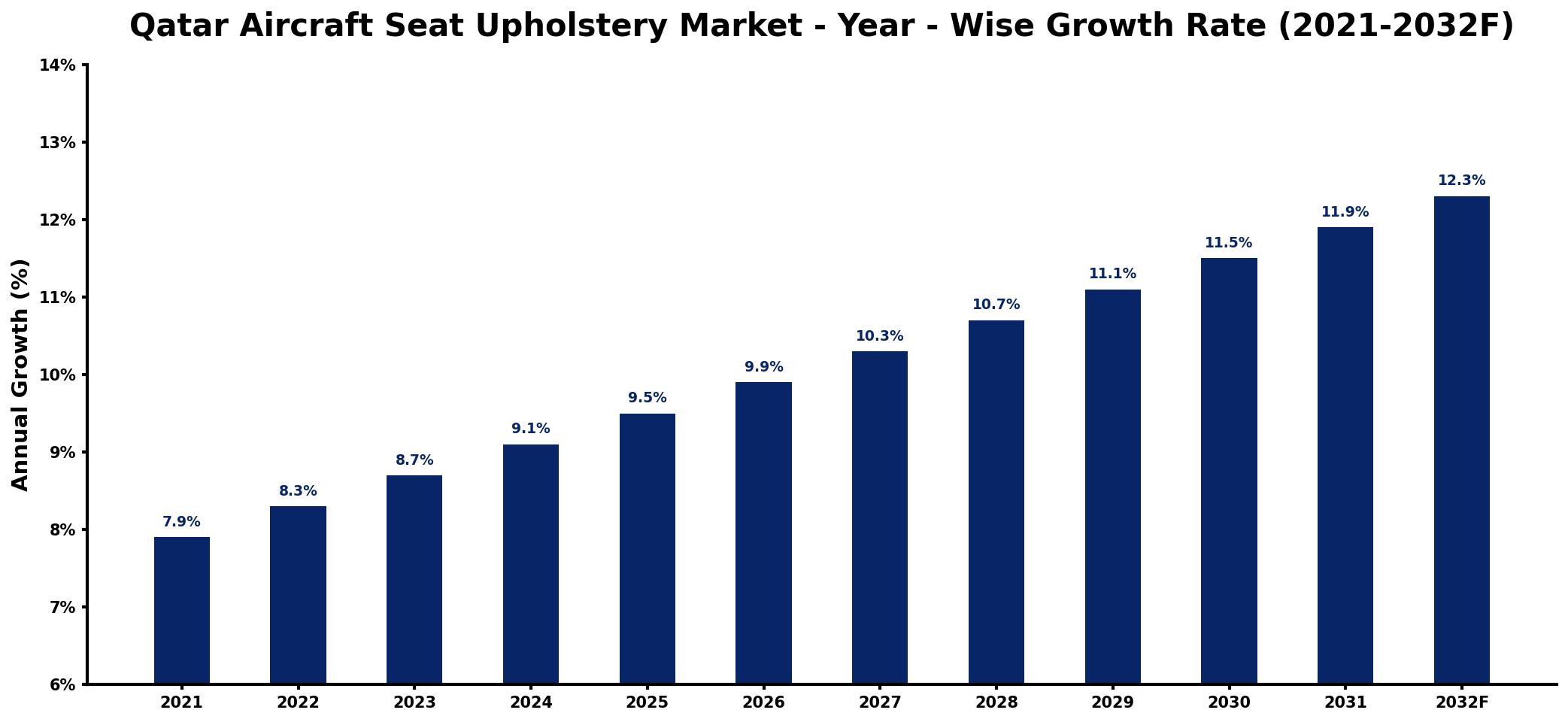
The table below presents the year‑wise growth rates along with the key drivers influencing the market
| Year | Growth Rate | Major Drivers |
| 2021 | 7.9% | Rising aviation passenger numbers |
| 2022 | 8.3% | Increased airline fleet expansions |
| 2023 | 8.7% | Growing emphasis on comfort |
| 2024 | 9.1% | Expansion of regional airlines |
| 2025 | 9.5% | Technological advancements in materials |
| 2026 | 9.9% | Sustainability trends in manufacturing |
| 2027 | 10.3% | Investment in aviation infrastructure |
| 2028 | 10.7% | Higher disposable income levels |
| 2029 | 11.1% | Demand for premium travel experiences |
| 2030 | 11.5% | Regulatory support for upgrades |
| 2031 | 11.9% | Emerging markets enhancing services |
| 2032 | 12.3% | Focus on passenger wellness initiatives |
Note: Market size estimations and growth projections presented in this report are based on 6Wresearch's proprietary forecasting methodology, utilizing the latest available industry data, government publications, and primary research inputs.
Qatar Aircraft Seat Upholstery Market Synopsis
The most significant force currently shaping the Qatar Aircraft Seat Upholstery Market is the strong demand for elevated passenger experiences. As Qatar Airways expands its fleet and routes, the need for luxurious and comfortable interiors has intensified, creating an urgent market for quality upholstery.
Simultaneously, innovations in materials and design are revolutionizing the market. With advancements leading to lightweight and durable upholstery options, manufacturers are better equipped to meet the evolving demands of airlines, thus positioning themselves favorably in this competitive landscape.
Qatar Aircraft Seat Upholstery Market Key Takeaways
- The market is projected to grow significantly, driven by increasing airline routes and passenger comfort expectations.
- Qatar Airways is a key player, fueling demand for high-quality upholstery solutions.
- Innovative materials and designs are enhancing the aesthetic and functional appeal of aircraft interiors.
- The market must navigate stringent safety and quality standards to maintain competitiveness.
- COVID-19 has temporarily affected demand, but recovery is anticipated as air travel resumes.
Evaluation of Restraints in Qatar Aircraft Seat Upholstery Market
The Qatar Aircraft Seat Upholstery Market faces several restraints that could hinder its growth. Stringent safety and quality regulations pose significant challenges for manufacturers, as upholstery materials must comply with rigorous fire resistance and durability standards. These requirements often complicate production processes and inflate costs. Additionally, fluctuations in air travel demand, driven by broader economic factors, can impact purchasing decisions by airlines, leading to unpredictable market dynamics. Local manufacturers also contend with competition from international suppliers while striving to maintain high standards of quality, further complicating their market positioning.
Qatar Aircraft Seat Upholstery Market Trends
Current trends shaping the Qatar Aircraft Seat Upholstery Market include a strong focus on sustainability and eco-friendliness. As environmental awareness grows, manufacturers are increasingly adopting sustainable materials and production practices. Furthermore, advancements in digital technologies are enabling custom designs that enhance passenger experience while maintaining safety standards. The preference for personalized aesthetics in aircraft interiors is becoming more pronounced, driving demand for innovative upholstery solutions that reflect the airline's brand identity.
Qatar Aircraft Seat Upholstery Market Opportunities
The Qatar Aircraft Seat Upholstery Market is ripe with opportunities for growth and investment. The ongoing expansion of Qatar's aviation sector, particularly in the context of international tourism and business travel, provides a solid foundation for upholstery suppliers. Moreover, the rising trend toward retrofit programs and cabin upgrades presents avenues for upholstery providers to offer their products. There is also potential for strategic partnerships between local manufacturers and international suppliers to innovate and enhance product offerings, tapping into the evolving needs of airlines.
Government Initiatives in the Qatar Aircraft Seat Upholstery Market
The Qatari government has been proactive in fostering a conducive environment for the aviation industry, which indirectly supports the aircraft seat upholstery market. Strategic public spending on airport infrastructure and airline expansion initiatives, alongside favorable regulations that encourage foreign investment, demonstrate a commitment to modernizing the aviation sector. Such measures create opportunities for upholstery manufacturers and suppliers to engage in the expanding market while contributing to the nation's vision of becoming a global aviation hub.
Future Insights of the Qatar Aircraft Seat Upholstery Market
Looking ahead to 2026-2032, the Qatar Aircraft Seat Upholstery Market is set to continue its upward trajectory, driven by sustained demand for quality and comfort in air travel. The potential for growth will be supported by ongoing investments in the aviation sector and a gradual recovery from the impacts of COVID-19. As airlines increasingly prioritize the passenger experience, upholstery manufacturers are likely to benefit from innovations in materials and designs that enhance both aesthetics and functionality. The market's landscape will be shaped by the continued evolution of consumer expectations and technological advancements.
Qatar Aircraft Seat Upholstery Market Latest Developments (2025 - 2026)
The Qatar Aircraft Seat Upholstery Market has witnessed notable developments in recent months, with an emphasis on innovation and sustainability. Companies are launching new product lines that integrate eco-friendly materials and advanced design features to meet the changing preferences of airlines and passengers. There has also been a noticeable increase in collaborations between upholstery manufacturers and airlines aimed at co-developing customized solutions that enhance passenger comfort while aligning with brand identities. This trend indicates a shift toward more personalized and adaptable upholstery options.
Qatar Aircraft Seat Upholstery Market - Key Attractiveness of the Report
- 10 Years of Market Numbers
- Historical Data Starting from 2022 to 2025
- Base Year: 2025
- Forecast Data until 2032
- Key Performance Indicators Impacting the Market
- Major Upcoming Developments and Projects
Key Highlights of the Report:
- Qatar Aircraft Seat Upholstery Market Outlook
- Market Size of Qatar Aircraft Seat Upholstery Market, 2025
- Forecast of Qatar Aircraft Seat Upholstery Market, 2032
- Historical Data and Forecast of Qatar Aircraft Seat Upholstery Revenues & Volume for the Period 2022-2032F
- Qatar Aircraft Seat Upholstery Market Trend Evolution
- Qatar Aircraft Seat Upholstery Market Drivers and Challenges
- Qatar Aircraft Seat Upholstery Price Trends
- Qatar Aircraft Seat Upholstery Porter's Five Forces
- Qatar Aircraft Seat Upholstery Industry Life Cycle
- Historical Data and Forecast of Qatar Aircraft Seat Upholstery Market Revenues & Volume By Material Type for the Period 2022-2032F
- Historical Data and Forecast of Qatar Aircraft Seat Upholstery Market Revenues & Volume By Fabric for the Period 2022-2032F
- Historical Data and Forecast of Qatar Aircraft Seat Upholstery Market Revenues & Volume By Leather for the Period 2022-2032F
- Historical Data and Forecast of Qatar Aircraft Seat Upholstery Market Revenues & Volume By Vinyl for the Period 2022-2032F
- Historical Data and Forecast of Qatar Aircraft Seat Upholstery Market Revenues & Volume By Seat Cover Type for the Period 2022-2032F
- Historical Data and Forecast of Qatar Aircraft Seat Upholstery Market Revenues & Volume By Bottom Covers for the Period 2022-2032F
- Historical Data and Forecast of Qatar Aircraft Seat Upholstery Market Revenues & Volume By Back Rest for the Period 2022-2032F
- Historical Data and Forecast of Qatar Aircraft Seat Upholstery Market Revenues & Volume By Armrests for the Period 2022-2032F
- Historical Data and Forecast of Qatar Aircraft Seat Upholstery Market Revenues & Volume By Headrests for the Period 2022-2032F
- Historical Data and Forecast of Qatar Aircraft Seat Upholstery Market Revenues & Volume By Seat Rear Pockets for the Period 2022-2032F
- Historical Data and Forecast of Qatar Aircraft Seat Upholstery Market Revenues & Volume By Seat Type for the Period 2022-2032F
- Historical Data and Forecast of Qatar Aircraft Seat Upholstery Market Revenues & Volume By First Class for the Period 2022-2032F
- Historical Data and Forecast of Qatar Aircraft Seat Upholstery Market Revenues & Volume By Business Class for the Period 2022-2032F
- Historical Data and Forecast of Qatar Aircraft Seat Upholstery Market Revenues & Volume By Premium Economy Class for the Period 2022-2032F
- Historical Data and Forecast of Qatar Aircraft Seat Upholstery Market Revenues & Volume By Economy Class for the Period 2022-2032F
- Historical Data and Forecast of Qatar Aircraft Seat Upholstery Market Revenues & Volume By Aircraft Type for the Period 2022-2032F
- Historical Data and Forecast of Qatar Aircraft Seat Upholstery Market Revenues & Volume By Narrow-body Aircraft for the Period 2022-2032F
- Historical Data and Forecast of Qatar Aircraft Seat Upholstery Market Revenues & Volume By Wide-body Aircraft for the Period 2022-2032F
- Historical Data and Forecast of Qatar Aircraft Seat Upholstery Market Revenues & Volume By Very Large Aircraft for the Period 2022-2032F
- Historical Data and Forecast of Qatar Aircraft Seat Upholstery Market Revenues & Volume By Regional Transport Aircraft for the Period 2022-2032F
- Historical Data and Forecast of Qatar Aircraft Seat Upholstery Market Revenues & Volume By Business Jets for the Period 2022-2032F
- Historical Data and Forecast of Qatar Aircraft Seat Upholstery Market Revenues & Volume By General Aviation Aircraft for the Period 2022-2032F
- Historical Data and Forecast of Qatar Aircraft Seat Upholstery Market Revenues & Volume By Helicopters for the Period 2022-2032F
- Qatar Aircraft Seat Upholstery Import Export Trade Statistics
- Market Opportunity Assessment By Material Type
- Market Opportunity Assessment By Seat Cover Type
- Market Opportunity Assessment By Seat Type
- Market Opportunity Assessment By Aircraft Type
- Qatar Aircraft Seat Upholstery Top Companies Market Share
- Qatar Aircraft Seat Upholstery Competitive Benchmarking By Technical and Operational Parameters
- Qatar Aircraft Seat Upholstery Company Profiles
- Qatar Aircraft Seat Upholstery Key Strategic Recommendations






































