Qatar Alternative Building Materials Market Size, Share & Growth Rate
The Qatar Alternative Building Materials Market was estimated at USD 420 Million in 2025 and is projected to reach USD 601 Million by 2032, growing at a CAGR of 5.3% from 2026 to 2032. This projected growth is largely driven by Qatar's increasing emphasis on sustainable construction practices and regulatory frameworks aimed at reducing the environmental impact of building activities. As local authorities ramp up their support for eco-friendly materials and techniques, the adoption of alternative building materials is becoming a crucial strategy for contractors and developers across the region.
Qatar Alternative Building Materials Market Year-wise Growth Rate and Key Drivers
This graph highlights how the Qatar Alternative Building Materials Market has steadily grown over the years, supported by major growth factors.
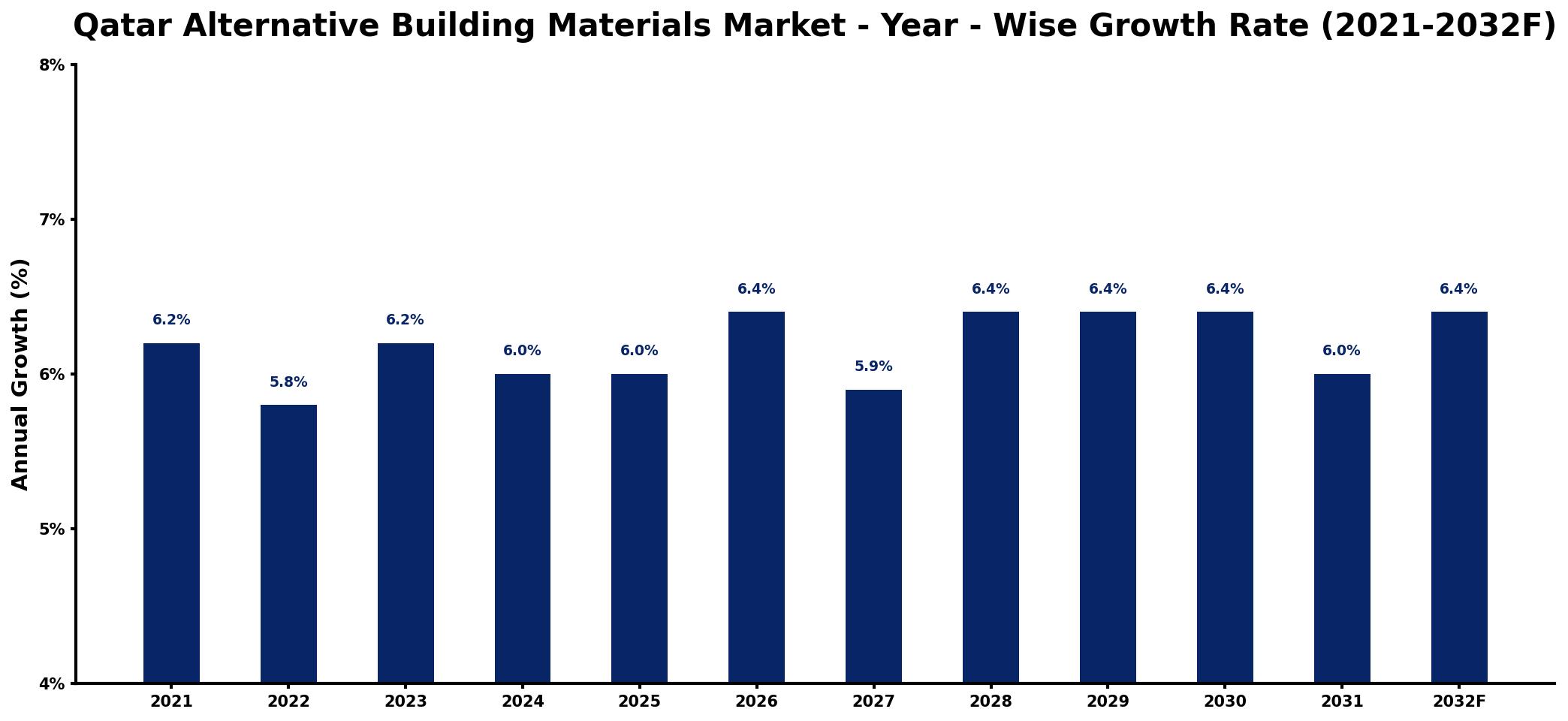
The table below presents the year‑wise growth rates along with the key drivers influencing the market
| Year | Growth Rate | Major Drivers |
| 2021 | 6.2% | increased construction sector investments |
| 2022 | 5.8% | growing environmental sustainability focus |
| 2023 | 6.2% | rising demand for innovative solutions |
| 2024 | 6.0% | increased domestic production output |
| 2025 | 6.0% | increased government infrastructure spending |
| 2026 | 6.4% | heightened awareness of energy efficiency |
| 2027 | 5.9% | growing urbanization and population pressure |
| 2028 | 6.4% | expansion of renewable energy projects |
| 2029 | 6.4% | increased private sector investments |
| 2030 | 6.4% | development of smart city projects |
| 2031 | 6.0% | growing interest in eco-friendly practices |
| 2032 | 6.4% | increased collaboration with global partners |
Note: Market size estimations and growth projections presented in this report are based on 6Wresearch's proprietary forecasting methodology, utilizing the latest available industry data, government publications, and primary research inputs.
Qatar Alternative Building Materials Market Synopsis
Sustainability is the most powerful force shaping the alternative building materials market in Qatar today. The construction sector is increasingly turning to recycled and innovative materials, aligning with the nation's broader goals of resource conservation and reduced carbon emissions. This shift is reflected not only in project designs but also in the policies enacted by the government to promote green building practices.
In light of Qatar's ambitious National Vision 2030, there is a pronounced focus on enhancing the built environment. This emphasis has led to a burgeoning interest in alternative materials, which are recognized for their capacity to improve energy efficiency and overall sustainability in construction. Key industry stakeholders are adapting to this transformative landscape, integrating these solutions into their operations to maintain competitiveness.
Qatar Alternative Building Materials Market Key Takeaways
- The market is poised for substantial growth driven by sustainability demands and regulatory support.
- Energy-efficient and eco-friendly construction solutions are becoming increasingly sought after.
- Challenges such as initial costs and supply chain limitations remain but are being actively addressed.
- Government initiatives are playing a crucial role in fostering market expansion and innovation.
- Leading construction firms are recognizing the long-term benefits of integrating alternative materials.
Evaluation of Restraints in Qatar Alternative Building Materials Market
Despite its potential, the Qatar alternative building materials market faces several noteworthy constraints that could impede its rapid growth. One prominent issue is the high initial cost associated with many eco-friendly materials, which can deter builders from making the switch from conventional options. This is often coupled with the limited availability of quality alternative materials, affecting construction timelines and project feasibility. Additionally, regulatory and certification processes may create further hurdles, alongside a pressing need for skilled labor trained specifically in these innovative materials, which limits widespread adoption.
Qatar Alternative Building Materials Market Trends
Current trends in the Qatar alternative building materials market point towards a surge in the adoption of recycled materials and engineered products. Increasing awareness of energy efficiency is driving the demand for insulation materials and innovative building techniques, while biocomposite materials are also gaining traction. Moreover, digital technology is beginning to play a role in optimizing construction processes and enhancing material efficiency, paving the way for smarter building practices that marry sustainability with advanced technology.
Qatar Alternative Building Materials Market Opportunities
There exists a wealth of opportunities within the Qatar alternative building materials market. The ongoing shift towards green construction practices creates avenues for innovation in product development. Investment in local production capabilities for alternative materials can address supply chain challenges while ensuring sustainability at a national level. Additionally, aligning with international sustainability certifications can provide competitive advantages for firms willing to expand their offerings in eco-friendly building solutions.
Government Initiatives in the Qatar Alternative Building Materials Market
The Qatari government is actively promoting sustainability within the construction sector through various initiatives. This includes the establishment of regulations designed to support green building practices and incentives for developers who adopt environmentally friendly materials. Furthermore, public spending on infrastructure projects is increasingly prioritizing the use of alternative building materials, fostering a conducive environment for innovation and market growth. Such efforts align closely with Qatar's long-term vision for sustainable development and urban planning.
Future Insights of the Qatar Alternative Building Materials Market
Looking ahead to 2026-2032, the Qatar alternative building materials market is on an upward trajectory. As regulatory frameworks become more stringent and sustainability goals gain prominence, market players are expected to pivot more towards adopting and developing alternative materials. The combination of rising public awareness regarding environmental impacts and government incentives will likely fuel continuous innovation and market expansion, making the future landscape of construction in Qatar increasingly green and resource-efficient.
Qatar Alternative Building Materials Market Latest Developments (2025 - 2026)
Recent developments in the Qatar alternative building materials market indicate a shift towards more collaborative efforts between public and private sectors. There is a growing emphasis on research and development aimed at creating locally sourced alternative materials, which is expected to significantly enhance market resilience. Additionally, partnerships are emerging to streamline certification processes, thereby easing the transition for construction firms looking to adopt these innovative solutions.
Qatar Alternative Building Materials Market - Key Attractiveness of the Report
- 10 Years of Market Numbers
- Historical Data Starting from 2022 to 2025
- Base Year: 2025
- Forecast Data until 2032
- Key Performance Indicators Impacting the Market
- Major Upcoming Developments and Projects
Key Highlights of the Report:
- Qatar Alternative Building Materials Market Outlook
- Market Size of Qatar Alternative Building Materials Market, 2025
- Forecast of Qatar Alternative Building Materials Market, 2032
- Historical Data and Forecast of Qatar Alternative Building Materials Revenues & Volume for the Period 2022-2032F
- Qatar Alternative Building Materials Market Trend Evolution
- Qatar Alternative Building Materials Market Drivers and Challenges
- Qatar Alternative Building Materials Price Trends
- Qatar Alternative Building Materials Porter's Five Forces
- Qatar Alternative Building Materials Industry Life Cycle
- Historical Data and Forecast of Qatar Alternative Building Materials Market Revenues & Volume By Material for the Period 2022-2032F
- Historical Data and Forecast of Qatar Alternative Building Materials Market Revenues & Volume By Bamboo for the Period 2022-2032F
- Historical Data and Forecast of Qatar Alternative Building Materials Market Revenues & Volume By Recycled Plastic for the Period 2022-2032F
- Historical Data and Forecast of Qatar Alternative Building Materials Market Revenues & Volume By Wood for the Period 2022-2032F
- Historical Data and Forecast of Qatar Alternative Building Materials Market Revenues & Volume By Others for the Period 2022-2032F
- Historical Data and Forecast of Qatar Alternative Building Materials Market Revenues & Volume By End User for the Period 2022-2032F
- Historical Data and Forecast of Qatar Alternative Building Materials Market Revenues & Volume By Residential for the Period 2022-2032F
- Historical Data and Forecast of Qatar Alternative Building Materials Market Revenues & Volume By Non-residential for the Period 2022-2032F
- Historical Data and Forecast of Qatar Alternative Building Materials Market Revenues & Volume By Application for the Period 2022-2032F
- Historical Data and Forecast of Qatar Alternative Building Materials Market Revenues & Volume By Construction for the Period 2022-2032F
- Historical Data and Forecast of Qatar Alternative Building Materials Market Revenues & Volume By Furniture for the Period 2022-2032F
- Historical Data and Forecast of Qatar Alternative Building Materials Market Revenues & Volume By Flooring for the Period 2022-2032F
- Qatar Alternative Building Materials Import Export Trade Statistics
- Market Opportunity Assessment By Material
- Market Opportunity Assessment By End User
- Market Opportunity Assessment By Application
- Qatar Alternative Building Materials Top Companies Market Share
- Qatar Alternative Building Materials Competitive Benchmarking By Technical and Operational Parameters
- Qatar Alternative Building Materials Company Profiles
- Qatar Alternative Building Materials Key Strategic Recommendations






































