Qatar Aquaculture & Marine Products Market Size, Share & Growth Rate
The Qatar Aquaculture & Marine Products Market was estimated at USD 1422 Million in 2025 and is projected to reach USD 2033 Million by 2032, growing at a CAGR of 5.2% from 2026 to 2032. This remarkable growth is primarily driven by rising disposable incomes and an increasing consumer awareness of the health benefits associated with seafood. Furthermore, the Qatari governments strategic initiatives towards enhancing local food production and sustainability are propelling investments into the aquaculture sector.
Qatar Aquaculture & Marine Products Market Year-wise Growth Rate and Key Drivers
This graph highlights how the Qatar Aquaculture & Marine Products Market has steadily grown over the years, supported by major growth factors.
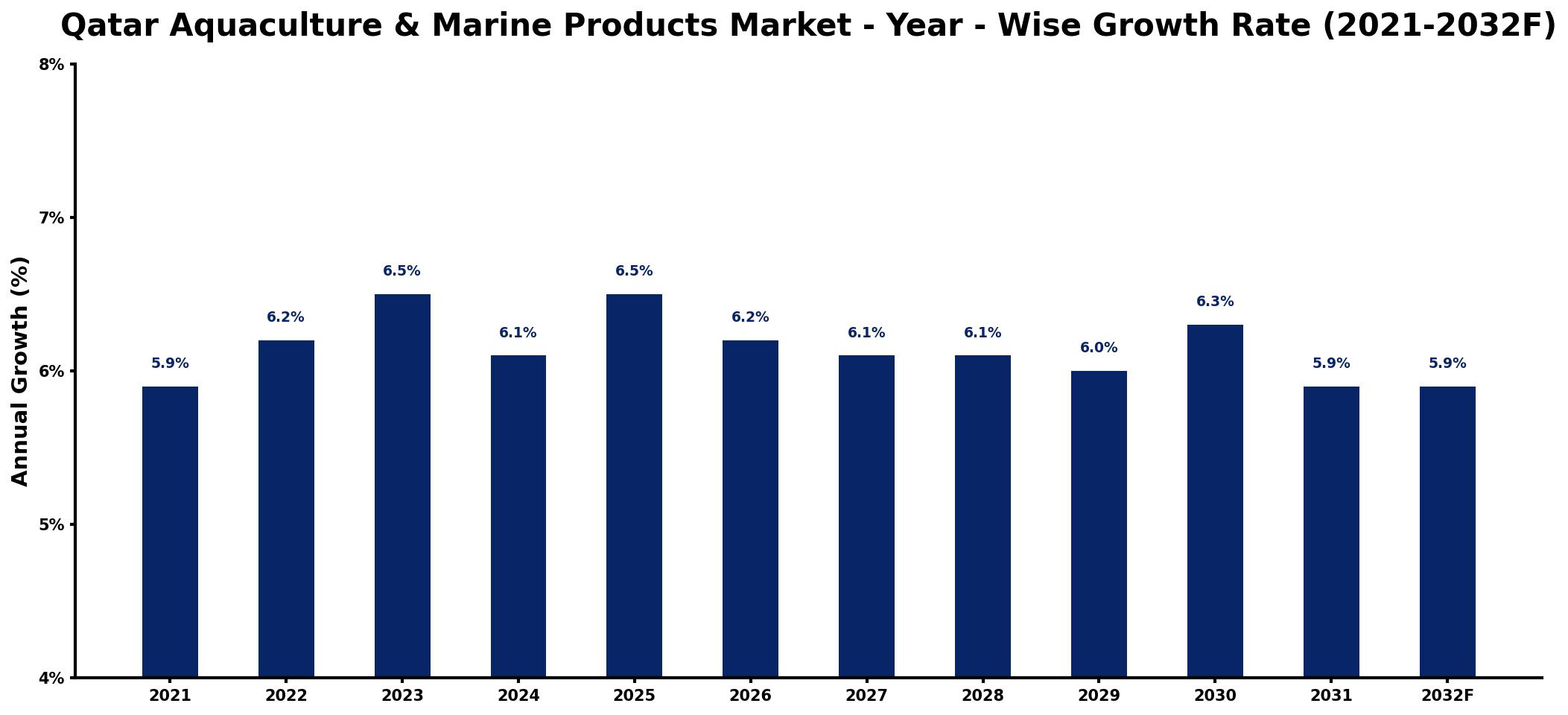
The table below presents the year‑wise growth rates along with the key drivers influencing the market
| Year | Growth Rate | Major Drivers |
| 2021 | 5.9% | Increased consumer health consciousness |
| 2022 | 6.2% | Growing demand for sustainable sourcing |
| 2023 | 6.5% | Expansion of local processing facilities |
| 2024 | 6.1% | Rise in export opportunities abroad |
| 2025 | 6.5% | Investment in technological advancements |
| 2026 | 6.2% | Enhanced distribution network efficiency |
| 2027 | 6.1% | Surge in domestic consumption levels |
| 2028 | 6.1% | Supportive government policies emerging |
| 2029 | 6.0% | Development of innovative farming techniques |
| 2030 | 6.3% | Collaboration with international partners |
| 2031 | 5.9% | Strengthened supply chain resilience |
| 2032 | 5.9% | Increased focus on eco-friendly practices |
Note: Market size estimations and growth projections presented in this report are based on 6Wresearch's proprietary forecasting methodology, utilizing the latest available industry data, government publications, and primary research inputs.
Qatar Aquaculture & Marine Products Market Synopsis
The demand for high-quality, locally-produced seafood in Qatar is witnessing a significant uptick, leading to robust growth in the aquaculture segment. As consumers prioritize health-conscious diets, the seafood market has become a focal point for both domestic and international suppliers.
Innovations in sustainable farming practices are becoming increasingly prevalent, ensuring the availability of a diverse range of marine products, including fish, shrimp, and shellfish. These advancements not only cater to local tastes but also contribute to the nations food security objectives.
- The aquaculture sector is increasingly seen as a pillar for Qatar's food security initiatives.
- Consumer preferences are shifting towards sustainably sourced seafood, driving innovation in the sector.
- Government policies and investments are fostering a conducive environment for market growth.
- Technological advancements are enhancing production efficiency and sustainability in aquaculture practices.
- Key marine species being cultivated include various fish, shrimp, and shellfish, reflecting diverse consumer preferences.
The growth of the Qatar aquaculture marine products market faces challenges primarily related to its geographical and environmental limitations. The scarcity of suitable land and freshwater resources hampers the establishment of extensive aquaculture facilities. Moreover, the Gulf region's susceptibility to environmental issues such as pollution and harmful algal blooms poses risks to the health of marine species. Ensuring responsible aquaculture practices is vital to mitigate these concerns, presenting a continuous challenge for industry stakeholders.
Current trends show a marked shift towards the adoption of advanced aquaculture technologies, including recirculating aquaculture systems (RAS) and integrated multi-trophic aquaculture (IMTA). These methods promote sustainable production while minimizing environmental impact. Additionally, there is a growing trend towards aquaponics systems, integrating fish farming with plant cultivation, to maximize resource efficiency. As consumer preferences evolve, the focus on traceability and quality assurance in seafood products continues to gain traction, influencing procurement strategies across the market.
Significant growth and investment opportunities are emerging in niche segments of the aquaculture market, such as organic seafood production and value-added marine products. The increasing demand for gourmet and specialty seafood items presents avenues for local producers to differentiate their offerings. Moreover, partnerships with international experts and institutions can help facilitate technology transfer, enhancing the sector's competitiveness and sustainability. Additionally, local initiatives that promote aquaculture education and awareness will bolster consumer confidence in locally sourced products.
The Qatari government has been proactive in promoting aquaculture through various policies and investments aimed at diversifying food sources and enhancing local production capabilities. Programs focusing on research and development in sustainable aquaculture practices have gained traction, alongside regulatory support that facilitates easier market access for aquaculture producers. Public spending on infrastructure improvements is also key in addressing challenges related to water and land use, further supporting the market's growth.
Looking ahead to 2026-2032, the Qatar aquaculture marine products market is poised for expansion, supported by a robust framework of government initiatives and increasing consumer demand for local seafood. As technological innovations continue to advance and sustainability practices become more ingrained, the sector's resilience will be bolstered, offering a reliable alternative to traditional seafood supply chains. Enhanced focus on sustainable practices will ensure that the market not only meets current demand but also aligns with future environmental and economic goals.
Recent developments within the Qatar aquaculture marine products market indicate a growing emphasis on sustainable practices and innovations in production technologies. Various initiatives are underway to improve efficiency in aquaculture operations and enhance product quality. Additionally, partnerships with international research institutions are being explored to drive advancements in aquaculture techniques, contributing to the sector's long-term viability and success.
- 10 Years of Market Numbers
- Historical Data Starting from 2022 to 2025
- Base Year: 2025
- Forecast Data until 2032
- Key Performance Indicators Impacting the Market
- Major Upcoming Developments and Projects
Key Highlights of the Report:
- Qatar Aquaculture & Marine Products Market Outlook
- Market Size of Qatar Aquaculture & Marine Products Market, 2025
- Forecast of Qatar Aquaculture & Marine Products Market, 2032
- Historical Data and Forecast of Qatar Aquaculture & Marine Products Revenues & Volume for the Period 2022-2032F
- Qatar Aquaculture & Marine Products Market Trend Evolution
- Qatar Aquaculture & Marine Products Market Drivers and Challenges
- Qatar Aquaculture & Marine Products Price Trends
- Qatar Aquaculture & Marine Products Porter's Five Forces
- Qatar Aquaculture & Marine Products Industry Life Cycle
- Historical Data and Forecast of Qatar Aquaculture & Marine Products Market Revenues & Volume By Rearing Product Type for the Period 2022-2032F
- Historical Data and Forecast of Qatar Aquaculture & Marine Products Market Revenues & Volume By Equipment for the Period 2022-2032F
- Historical Data and Forecast of Qatar Aquaculture & Marine Products Market Revenues & Volume By Chemicals for the Period 2022-2032F
- Historical Data and Forecast of Qatar Aquaculture & Marine Products Market Revenues & Volume By Pharmaceuticals for the Period 2022-2032F
- Historical Data and Forecast of Qatar Aquaculture & Marine Products Market Revenues & Volume By Fertilizers for the Period 2022-2032F
- Historical Data and Forecast of Qatar Aquaculture & Marine Products Market Revenues & Volume By Others for the Period 2022-2032F
- Historical Data and Forecast of Qatar Aquaculture & Marine Products Market Revenues & Volume By Type for the Period 2022-2032F
- Historical Data and Forecast of Qatar Aquaculture & Marine Products Market Revenues & Volume By Fisheries for the Period 2022-2032F
- Historical Data and Forecast of Qatar Aquaculture & Marine Products Market Revenues & Volume By Seaweeds for the Period 2022-2032F
- Historical Data and Forecast of Qatar Aquaculture & Marine Products Market Revenues & Volume By Microalgae for the Period 2022-2032F
- Historical Data and Forecast of Qatar Aquaculture & Marine Products Market Revenues & Volume By Crustaceans for the Period 2022-2032F
- Historical Data and Forecast of Qatar Aquaculture & Marine Products Market Revenues & Volume By Molluscs for the Period 2022-2032F
- Historical Data and Forecast of Qatar Aquaculture & Marine Products Market Revenues & Volume By Others for the Period 2022-2032F
- Historical Data and Forecast of Qatar Aquaculture & Marine Products Market Revenues & Volume By Production Type for the Period 2022-2032F
- Historical Data and Forecast of Qatar Aquaculture & Marine Products Market Revenues & Volume By Small-Scale for the Period 2022-2032F
- Historical Data and Forecast of Qatar Aquaculture & Marine Products Market Revenues & Volume By Medium & Large Scale for the Period 2022-2032F
- Historical Data and Forecast of Qatar Aquaculture & Marine Products Market Revenues & Volume By Culture for the Period 2022-2032F
- Historical Data and Forecast of Qatar Aquaculture & Marine Products Market Revenues & Volume By Freshwater for the Period 2022-2032F
- Historical Data and Forecast of Qatar Aquaculture & Marine Products Market Revenues & Volume By Brackish Water for the Period 2022-2032F
- Historical Data and Forecast of Qatar Aquaculture & Marine Products Market Revenues & Volume By Marine for the Period 2022-2032F
- Qatar Aquaculture & Marine Products Import Export Trade Statistics
- Market Opportunity Assessment By Rearing Product Type
- Market Opportunity Assessment By Type
- Market Opportunity Assessment By Production Type
- Market Opportunity Assessment By Culture
- Qatar Aquaculture & Marine Products Top Companies Market Share
- Qatar Aquaculture & Marine Products Competitive Benchmarking By Technical and Operational Parameters
- Qatar Aquaculture & Marine Products Company Profiles
- Qatar Aquaculture & Marine Products Key Strategic Recommendations






































