Qatar Cloud ERP Market Size & Growth Rate (2026-2032)
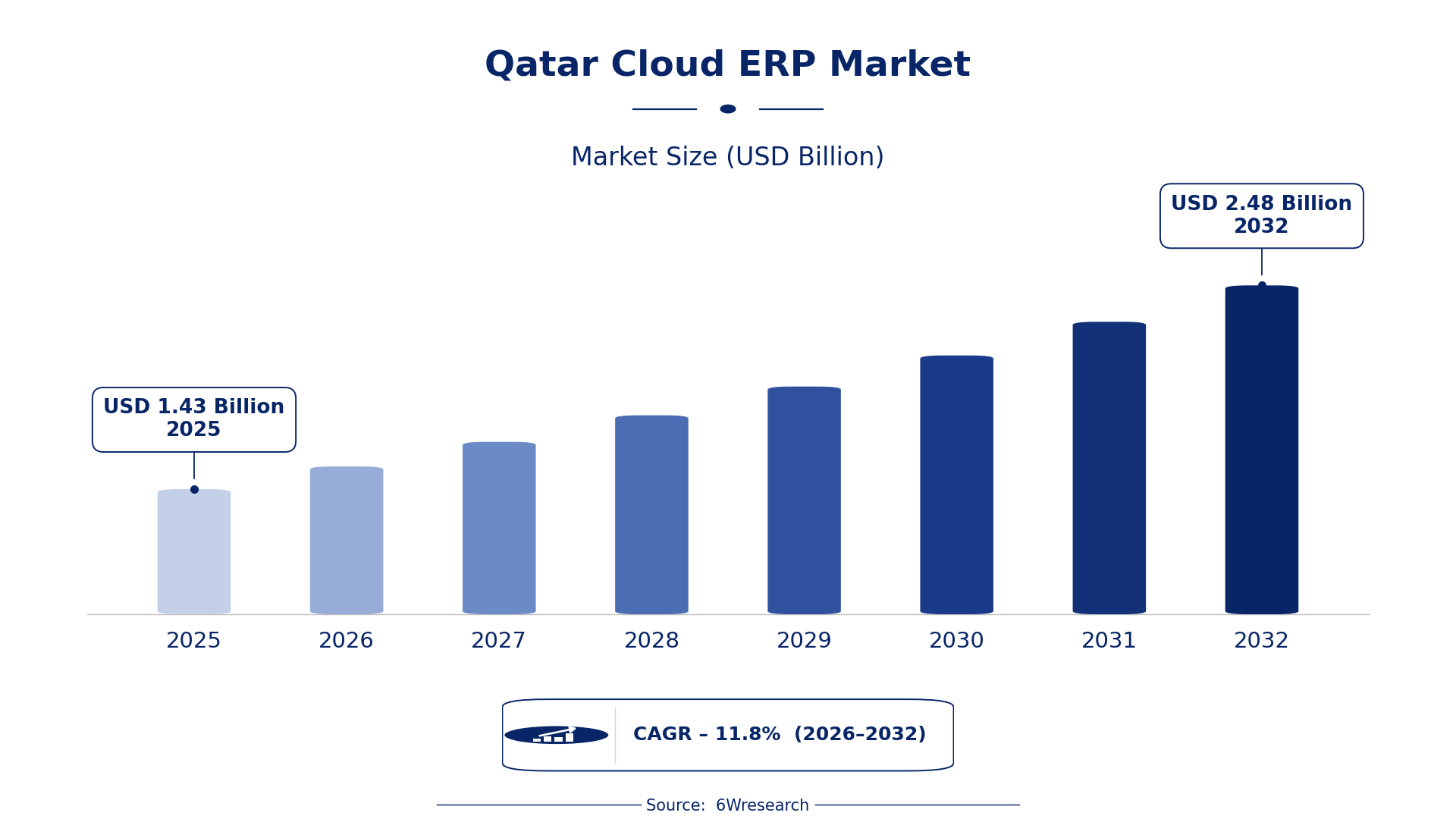
The Qatar Cloud ERP Market was estimated at USD 1431 Million in 2025 and is projected to reach USD 2480 Million by 2032, growing at a CAGR of 11.8% from 2026 to 2032.
Qatar Cloud ERP Market Synopsis
The Cloud ERP market in Qatar is currently experiencing a pivotal shift as organizations increasingly recognize the benefits of cloud-based solutions over traditional systems. This transition is not merely a trend; it reflects a deeper understanding of operational efficiency, cost management, and business agility.
As businesses across various sectors adopt these solutions, the demand for industry-specific customizations is rising. This trend emphasizes the importance of user-friendly interfaces and real-time data access, allowing organizations to make informed decisions swiftly and effectively.
Qatar Cloud ERP Market Year-wise Growth Rate and Key Drivers
This graph illustrates the annual growth rates of the Qatar Cloud ERP Market from 2021 to 2032, highlighting a steady upward trajectory and projected expansion over the forecast period.
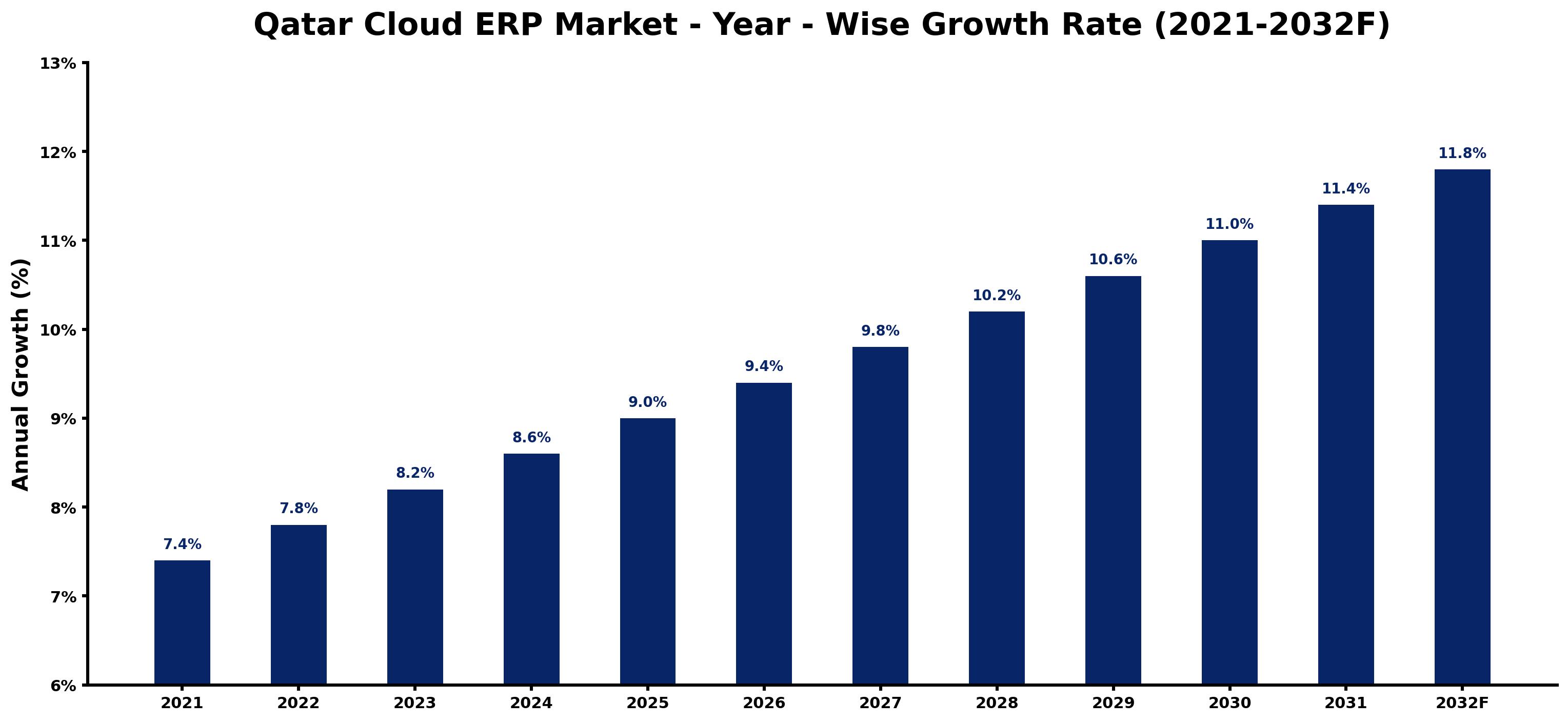
The table below presents the year‑wise growth rates along with the key drivers influencing the market
| Year | Growth Rate | Major Drivers |
| 2021 | 7.4% | Qatar Central Bank's fintech regulations encourage ERP implementation. |
| 2022 | 7.8% | Boost in government cloud computing initiatives for businesses. |
| 2023 | 8.2% | Growing interest in remote work enhancing software demand. |
| 2024 | 8.6% | Hosting of FIFA World Cup spurs digital infrastructure investments. |
| 2025 | 9.0% | Increased focus on cybersecurity mandates for business operations. |
| 2026 | 9.4% | Local firms optimizing operations through integrated ERP solutions. |
| 2027 | 9.8% | Shift towards e-governance driving cloud service adoption. |
| 2028 | 10.2% | Young workforce favors tech-driven workplace solutions. |
| 2029 | 10.6% | Qatari startups increasingly leveraging ERP for scalability. |
| 2030 | 11.0% | Government support for innovative tech startups fosters growth. |
| 2031 | 11.4% | Healthcare sector's digitalization demands advanced ERP systems. |
| 2032 | 11.8% | Increased collaboration between tech firms boosts ERP market. |
Note: Market size estimations and growth projections presented in this report are based on 6Wresearch's proprietary forecasting methodology, utilizing the latest available industry data, government publications, and primary research inputs.
Qatar Cloud ERP Market Key Takeaways
Below are some of the specific key takeaways from the market, including:
- Cloud ERP solutions are gaining traction due to their scalability and cost-effectiveness.
- Organizations are increasingly prioritizing real-time data access to enhance decision-making.
- The integration of AI and ML technologies is becoming a staple in modern Cloud ERP solutions.
- Data security and privacy concerns remain significant challenges for businesses adopting cloud solutions.
- COVID-19 accelerated the shift towards cloud solutions as firms adapted to remote operations.
Evaluation of Restraints in Qatar Cloud ERP Market
Despite the positive momentum in the Qatar Cloud ERP market, several restraints impede its full potential. Data security and privacy concerns are at the forefront, as companies hesitate to entrust sensitive information to cloud systems. This caution is compounded by the need for compliance with local regulations, which varies across sectors. Service providers must navigate these hurdles effectively to gain the trust of potential users and accelerate market adoption.
Qatar Cloud ERP Market Trends
The market is witnessing a surge in demand for tailored ERP solutions designed for specific industries. Companies are looking for more than just standard offerings; they want systems that cater to their unique operational needs. Additionally, the integration of advanced technologies such as AI and machine learning is not just a luxury but a necessity for organizations aiming to enhance their operational efficiency.
Another trend is the emphasis on user-friendly interfaces. Businesses want systems that their employees can navigate easily without extensive training. This focus on usability is driving the development of more intuitive Cloud ERP solutions.
Qatar Cloud ERP Market Opportunities
The potential for growth in the Qatar Cloud ERP market is substantial. Companies looking to invest in cloud solutions can capitalize on the rising demand for integrated systems that enhance operational efficiency. There’s also an opportunity for service providers to differentiate themselves through specialized solutions tailored to specific industry needs. As the market matures, the focus on data security and compliance will create openings for vendors who can offer robust security features alongside their ERP solutions.
Government Initiatives in the Qatar Cloud ERP Market
The Qatari government is actively shaping the Cloud ERP market through various initiatives aimed at digital transformation and regulatory compliance. This focus reflects a broader commitment to enhancing the technological capabilities of businesses across the nation. Regulatory frameworks are being established to ensure that cloud solutions meet local data protection standards, fostering a secure environment for businesses to adopt these technologies.
- A national digital infrastructure upgrade programme initiated in early 2023 is enhancing cloud capabilities for businesses.
- A regulatory framework introduced in 2024 mandates compliance with data protection standards for all cloud service providers.
- Currently underway is a public-private initiative aimed at increasing access to cloud-based services for small and medium enterprises.
- Planned for 2025 is a national awareness campaign focused on educating businesses about the benefits of Cloud ERP solutions.
Future Insights of the Qatar Cloud ERP Market
Looking ahead to 2026-2032, the Qatar Cloud ERP market is set for significant evolution. With technology advancing rapidly, businesses will seek out solutions that not only streamline operations but also provide insights through analytics. The integration of AI and ML will play a crucial role, allowing organizations to predict trends and make proactive decisions. As data security becomes increasingly paramount, solutions that prioritize privacy will likely gain traction, shaping the future of cloud ERP in Qatar.
Qatar Cloud ERP Market Latest Developments
In the past year, the Qatar Cloud ERP market has seen a flurry of activity as businesses accelerate their digital transformation efforts. Service providers are responding to the evolving demands of organizations by introducing innovative features and capabilities. This trend indicates a vibrant competitive environment where agility and responsiveness are key.
- A leading technology vendor launched an updated version of its Cloud ERP solution in early 2023, featuring enhanced AI capabilities.
- An ongoing initiative that began in late 2022 focuses on integrating machine learning tools into existing ERP systems to boost efficiency.
- A major partnership was announced in Q3 2023 aimed at improving data analytics capabilities within cloud ERP systems.
- Upcoming in mid-2024 is a rollout of new regulatory compliance features designed to help businesses meet the latest data protection standards.
Qatar Cloud ERP Market - Key Attractiveness of the Report
- 10 Years of Market Numbers
- Historical Data Starting from 2022 to 2025
- Base Year: 2025
- Forecast Data until 2032
- Key Performance Indicators Impacting the Market
- Major Upcoming Developments and Projects
Key Highlights of the Report:
- Qatar Cloud ERP Market Outlook
- Market Size of Qatar Cloud ERP Market, 2025
- Forecast of Qatar Cloud ERP Market, 2032
- Historical Data and Forecast of Qatar Cloud ERP Revenues & Volume for the Period 2022-2032F
- Qatar Cloud ERP Market Trend Evolution
- Qatar Cloud ERP Market Drivers and Challenges
- Qatar Cloud ERP Price Trends
- Qatar Cloud ERP Porter's Five Forces
- Qatar Cloud ERP Industry Life Cycle
- Historical Data and Forecast of Qatar Cloud ERP Market Revenues & Volume By Component for the Period 2022-2032F
- Historical Data and Forecast of Qatar Cloud ERP Market Revenues & Volume By Solution for the Period 2022-2032F
- Historical Data and Forecast of Qatar Cloud ERP Market Revenues & Volume By Services for the Period 2022-2032F
- Historical Data and Forecast of Qatar Cloud ERP Market Revenues & Volume By Vertical for the Period 2022-2032F
- Historical Data and Forecast of Qatar Cloud ERP Market Revenues & Volume By BFSI for the Period 2022-2032F
- Historical Data and Forecast of Qatar Cloud ERP Market Revenues & Volume By Manufacturing for the Period 2022-2032F
- Historical Data and Forecast of Qatar Cloud ERP Market Revenues & Volume By IT and Telecom for the Period 2022-2032F
- Historical Data and Forecast of Qatar Cloud ERP Market Revenues & Volume By Business Function for the Period 2022-2032F
- Historical Data and Forecast of Qatar Cloud ERP Market Revenues & Volume By Accounting and Finance for the Period 2022-2032F
- Historical Data and Forecast of Qatar Cloud ERP Market Revenues & Volume By Sales and Marketing for the Period 2022-2032F
- Historical Data and Forecast of Qatar Cloud ERP Market Revenues & Volume By Inventory and Order Management for the Period 2022-2032F
- Historical Data and Forecast of Qatar Cloud ERP Market Revenues & Volume By Organization Size for the Period 2022-2032F
- Historical Data and Forecast of Qatar Cloud ERP Market Revenues & Volume By SMEs for the Period 2022-2032F
- Historical Data and Forecast of Qatar Cloud ERP Market Revenues & Volume By Large Enterprises for the Period 2022-2032F
- Qatar Cloud ERP Import Export Trade Statistics
- Market Opportunity Assessment By Component
- Market Opportunity Assessment By Vertical
- Market Opportunity Assessment By Business Function
- Market Opportunity Assessment By Organization Size
- Qatar Cloud ERP Top Companies Market Share
- Qatar Cloud ERP Competitive Benchmarking By Technical and Operational Parameters
- Qatar Cloud ERP Company Profiles
- Qatar Cloud ERP Key Strategic Recommendations






































