United States (US) Cloud ERP Market Size & Growth Rate (2026-2032)
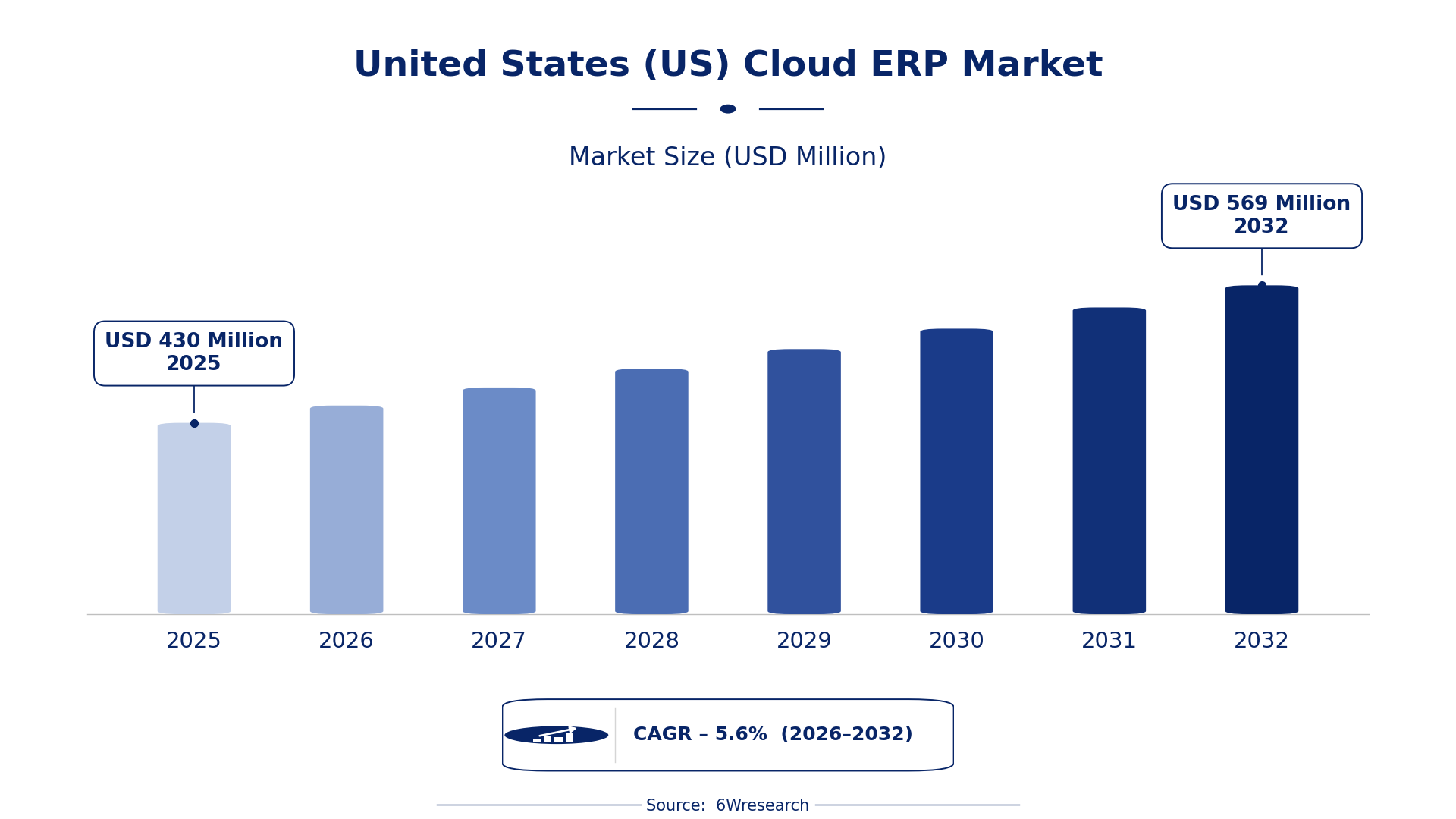
The United States (US) Cloud ERP Market was estimated at USD 430 Million in 2025 and is projected to reach USD 569 Million by 2032, growing at a CAGR of 5.6% from 2026 to 2032.
United States (US) Cloud ERP Market Synopsis
The demand for cloud ERP solutions in the United States is surging as organizations increasingly recognize the need for operational agility and streamlined processes. Businesses are migrating from traditional on-premises systems to cloud-based platforms to leverage advanced features and improve collaboration across teams.
Industries such as manufacturing, retail, healthcare, and finance are leading this transition, driven by the desire for real-time data access and enhanced analytical capabilities. As the market evolves, companies are seeking tailored solutions that meet their specific operational requirements, further fueling the growth of cloud ERP systems.
United States (US) Cloud ERP Market Year-wise Growth Rate and Key Drivers
This graph illustrates the annual growth rates of the United States (US) Cloud ERP Market from 2021 to 2032, highlighting a steady upward trajectory and projected expansion over the forecast period.
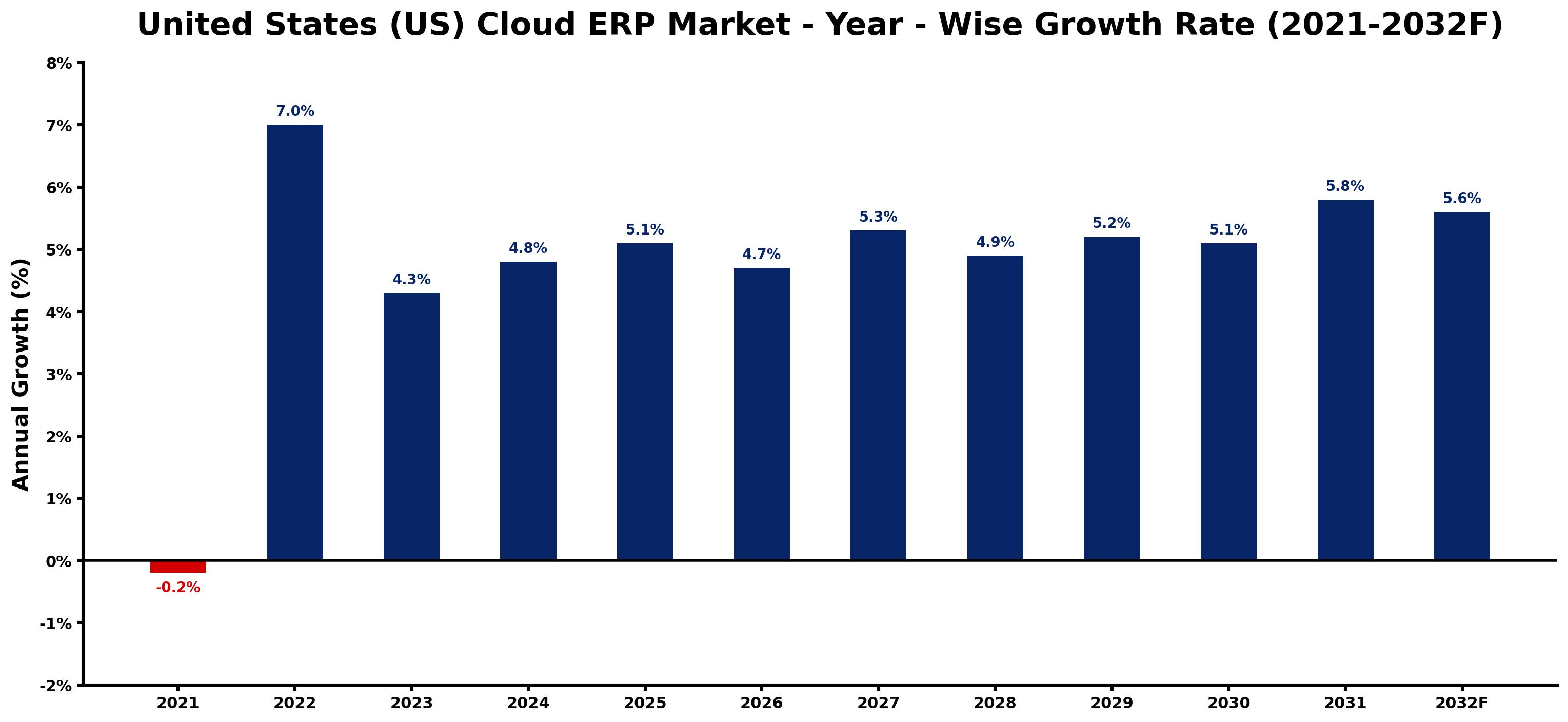
The table below presents the year‑wise growth rates along with the key drivers influencing the market
| Year | Growth Rate | Major Drivers |
| 2021 | -0.2% | Rising inflation impacting IT budget allocations. |
| 2022 | 7.0% | IRS grants incentives for cloud-based accounting systems |
| 2023 | 4.3% | Surge in cloud compliance requirements across various sectors |
| 2024 | 4.8% | Increased focus on real-time data analytics capabilities |
| 2025 | 5.1% | Proliferation of AI-driven business intelligence solutions |
| 2026 | 4.7% | Local startups adopt hybrid cloud solutions for efficiency |
| 2027 | 5.3% | Rise of cybersecurity regulations pushing ERP upgrades |
| 2028 | 4.9% | Adoption of ERP solutions in U.S. manufacturing sectors |
| 2029 | 5.2% | Financial services invest in multi-cloud ERP integration |
| 2030 | 5.1% | Federal grants supporting cloud ERP for small businesses |
| 2031 | 5.8% | Growing trend of sustainable business practices influencing ERP |
| 2032 | 5.6% | Increased demand for supply chain visibility through ERP |
Note: Market size estimations and growth projections presented in this report are based on 6Wresearch's proprietary forecasting methodology, utilizing the latest available industry data, government publications, and primary research inputs.
United States (US) Cloud ERP Market Key Takeaways
Below are some of the specific key takeaways from the market, including:
- The increasing reliance on cloud technology is reshaping business processes across various sectors.
- Real-time analytics and data-driven decision-making are becoming essential for competitive advantage.
- Industry-specific cloud ERP solutions are gaining traction as businesses seek customized functionalities.
- Investment in AI and machine learning technologies is enhancing the capabilities of cloud ERP systems.
- Data security concerns remain a critical factor influencing cloud ERP adoption strategies.
Evaluation of Restraints in United States (US) Cloud ERP Market
Despite the market's positive trajectory, several restraints inhibit its growth. Data security concerns loom large, particularly for organizations handling sensitive information. The potential for data breaches can deter companies from fully committing to cloud solutions. on top of that, the complexity involved in migrating legacy systems to the cloud poses substantial challenges, often leading to increased costs and extended timelines. Integrating cloud ERP with existing software is another hurdle, as businesses grapple with compatibility issues and the need for cohesive systems. Addressing these challenges requires a strategic approach, focusing on cybersecurity and careful planning to ensure a smooth transition.
United States (US) Cloud ERP Market Trends
A few key trends are emerging in the US Cloud ERP market. The integration of artificial intelligence and machine learning capabilities is not just a buzzword but a growing necessity for enhancing automation and predictive analytics. Additionally, the focus on data security and compliance is intensifying, with organizations seeking solutions that align with stringent regulations.
Another trend is the rising demand for industry-specific ERP solutions, as businesses recognize that a one-size-fits-all approach often falls short. Tailored solutions that address unique operational needs are becoming the standard. The push for real-time data access continues to drive innovation within cloud ERP, making it a critical component of digital transformation strategies.
United States (US) Cloud ERP Market Opportunities
The United States Cloud ERP Market is rich with investment opportunities, particularly as more businesses embrace cloud technologies. Solutions that offer scalability and cost-efficiency are in high demand. on top of that, there’s a notable shift towards investing in value-added services such as consulting and implementation support, as organizations seek to maximize the benefits of their cloud ERP systems.
Innovative technologies that enhance cloud ERP functionalities, particularly in areas like data analytics and automation, present avenues for significant returns. As companies prioritize digital transformation, the appetite for advanced, industry-specific cloud ERP solutions will likely expand, creating a fertile ground for investors.
Government Initiatives in the United States (US) Cloud ERP Market
Government policies are increasingly influencing the direction of the Cloud ERP market in the United States. With a focus on data privacy and security, regulatory frameworks are shaping how organizations manage sensitive information within cloud environments. The government is promoting the adoption of cloud solutions to improve efficiency in public sector operations, which has a direct impact on private sector trends.
- A recently completed initiative focused on enhancing cybersecurity standards for cloud services used by federal agencies, reinforcing data protection measures.
- A current program is underway to streamline federal procurement processes, encouraging agencies to transition to cloud-based ERP solutions for better operational efficiency.
- Upcoming legislation is planned to establish a framework for the interoperability of cloud systems, facilitating data exchange across different platforms.
- A recently launched public awareness campaign aims to educate businesses on the benefits of cloud ERP adoption, particularly in data management and security.
Future Insights of the United States (US) Cloud ERP Market
Looking ahead to 2026-2032, the United States Cloud ERP Market is set for substantial growth. The ongoing shift toward cloud technology will drive demand as organizations prioritize scalability and flexibility in their operations. As remote work continues to gain traction, cloud ERP systems will play a critical role in ensuring business continuity and collaboration.
The integration of advanced technologies like AI and machine learning will further enhance cloud ERP capabilities, allowing businesses to harness data for better decision-making. Companies will increasingly seek solutions that not only meet their current needs but also adapt to future challenges, positioning the cloud ERP market for ongoing expansion.
United States (US) Cloud ERP Market Latest Developments
In the last 12-14 months, the United States Cloud ERP Market has seen notable activity as businesses strive to enhance operational efficiency. Companies are increasingly investing in technology upgrades to remain competitive and responsive to market demands.
- A leading regional operator launched a new cloud ERP platform in early 2025, aimed at small to medium-sized enterprises seeking affordable solutions.
- Ongoing partnerships between cloud ERP providers and data security firms are enhancing security features, focusing on compliance with evolving regulatory standards.
- Major technology vendors are currently rolling out updates to their cloud ERP systems, incorporating advanced analytics and user-friendly interfaces.
- A planned expansion initiative expected to begin in late 2026 aims to enhance cloud infrastructure across various sectors, improving service delivery.
United States (US) Cloud ERP Market - Key Attractiveness of the Report
- 10 Years of Market Numbers
- Historical Data Starting from 2022 to 2025
- Base Year: 2025
- Forecast Data until 2032
- Key Performance Indicators Impacting the Market
- Major Upcoming Developments and Projects
Key Highlights of the Report:
- United States (US) Cloud ERP Market Outlook
- Market Size of United States (US) Cloud ERP Market, 2025
- Forecast of United States (US) Cloud ERP Market, 2032
- Historical Data and Forecast of United States (US) Cloud ERP Revenues & Volume for the Period 2022-2032F
- United States (US) Cloud ERP Market Trend Evolution
- United States (US) Cloud ERP Market Drivers and Challenges
- United States (US) Cloud ERP Price Trends
- United States (US) Cloud ERP Porter's Five Forces
- United States (US) Cloud ERP Industry Life Cycle
- Historical Data and Forecast of United States (US) Cloud ERP Market Revenues & Volume By Component for the Period 2022-2032F
- Historical Data and Forecast of United States (US) Cloud ERP Market Revenues & Volume By Solution for the Period 2022-2032F
- Historical Data and Forecast of United States (US) Cloud ERP Market Revenues & Volume By Services for the Period 2022-2032F
- Historical Data and Forecast of United States (US) Cloud ERP Market Revenues & Volume By Vertical for the Period 2022-2032F
- Historical Data and Forecast of United States (US) Cloud ERP Market Revenues & Volume By BFSI for the Period 2022-2032F
- Historical Data and Forecast of United States (US) Cloud ERP Market Revenues & Volume By Manufacturing for the Period 2022-2032F
- Historical Data and Forecast of United States (US) Cloud ERP Market Revenues & Volume By IT and Telecom for the Period 2022-2032F
- Historical Data and Forecast of United States (US) Cloud ERP Market Revenues & Volume By Business Function for the Period 2022-2032F
- Historical Data and Forecast of United States (US) Cloud ERP Market Revenues & Volume By Accounting and Finance for the Period 2022-2032F
- Historical Data and Forecast of United States (US) Cloud ERP Market Revenues & Volume By Sales and Marketing for the Period 2022-2032F
- Historical Data and Forecast of United States (US) Cloud ERP Market Revenues & Volume By Inventory and Order Management for the Period 2022-2032F
- Historical Data and Forecast of United States (US) Cloud ERP Market Revenues & Volume By Organization Size for the Period 2022-2032F
- Historical Data and Forecast of United States (US) Cloud ERP Market Revenues & Volume By SMEs for the Period 2022-2032F
- Historical Data and Forecast of United States (US) Cloud ERP Market Revenues & Volume By Large Enterprises for the Period 2022-2032F
- United States (US) Cloud ERP Import Export Trade Statistics
- Market Opportunity Assessment By Component
- Market Opportunity Assessment By Vertical
- Market Opportunity Assessment By Business Function
- Market Opportunity Assessment By Organization Size
- United States (US) Cloud ERP Top Companies Market Share
- United States (US) Cloud ERP Competitive Benchmarking By Technical and Operational Parameters
- United States (US) Cloud ERP Company Profiles
- United States (US) Cloud ERP Key Strategic Recommendations






































