Venezuela Cloud ERP Market Size & Growth Rate (2026-2032)
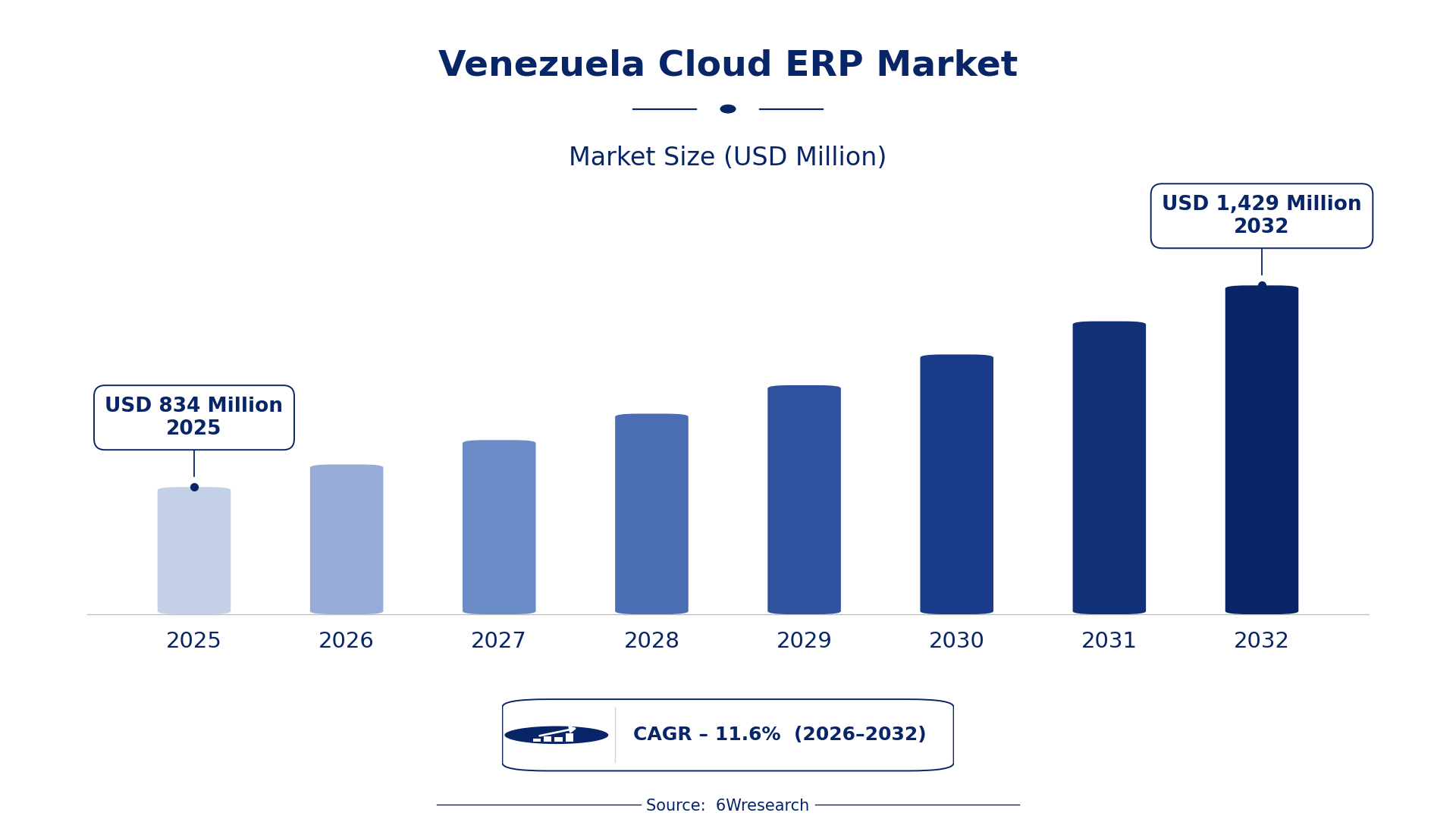
The Venezuela Cloud ERP Market was estimated at USD 834 Million in 2025 and is projected to reach USD 1429 Million by 2032, growing at a CAGR of 11.6% from 2026 to 2032.
Venezuela Cloud ERP Market Synopsis
The Venezuela Cloud ERP market is currently witnessing a dynamic shift as businesses increasingly embrace cloud technologies to enhance their operational efficiency. This momentum, driven by the need for cost-effective and scalable solutions, marks a significant departure from traditional on-premises systems that have dominated the landscape for years.
As we look ahead, the demand for cloud ERP solutions is expected to accelerate further. Small and medium-sized enterprises (SMEs) are leading the charge, seeking innovative ways to modernize their processes and maintain competitiveness in a challenging economic environment. This trend suggests a bright outlook for the market, despite existing hurdles.
Venezuela Cloud ERP Market Year-wise Growth Rate and Key Drivers
This graph illustrates the annual growth rates of the Venezuela Cloud ERP Market from 2021 to 2032, highlighting a steady upward trajectory and projected expansion over the forecast period.
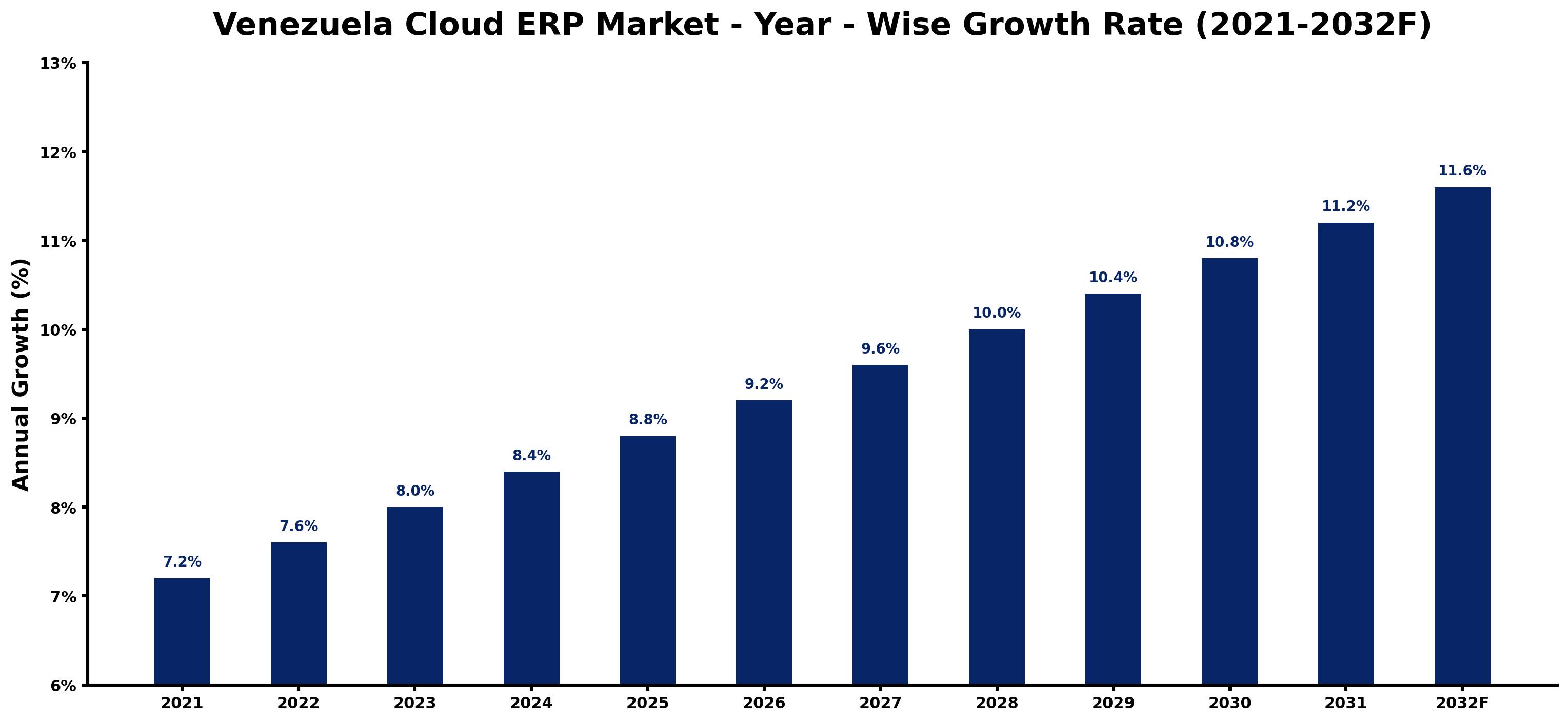
The table below presents the year‑wise growth rates along with the key drivers influencing the market
| Year | Growth Rate | Major Drivers |
| 2021 | 7.2% | Increased remote work driving cloud software adoption. |
| 2022 | 7.6% | Local startups leveraging ERP to enhance productivity. |
| 2023 | 8.0% | Government tax reforms favoring digital solutions implementation. |
| 2024 | 8.4% | Greater internet penetration stimulating cloud services growth. |
| 2025 | 8.8% | Rising competition among SMEs adopting cloud ERP solutions. |
| 2026 | 9.2% | Investment in public Wi-Fi increasing access to technology. |
| 2027 | 9.6% | Local universities promoting ERP training and partnerships. |
| 2028 | 10.0% | Venezuelan firms seeking cost-effective cloud solutions. |
| 2029 | 10.4% | Enhanced mobile connectivity driving cloud ERP interest. |
| 2030 | 10.8% | Increased regulatory focus on data management compliance. |
| 2031 | 11.2% | Growing awareness of operational efficiencies from ERP systems. |
| 2032 | 11.6% | Emerging fintech collaborations with cloud ERP providers. |
Note: Market size estimations and growth projections presented in this report are based on 6Wresearch's proprietary forecasting methodology, utilizing the latest available industry data, government publications, and primary research inputs.
Venezuela Cloud ERP Market Key Takeaways
Below are some of the specific key takeaways from the market, including:
- The increasing need for digital transformation is a driving force behind cloud ERP adoption in Venezuela.
- SMEs are particularly focused on leveraging cloud solutions to enhance operational efficiency and reduce costs.
- Localization and compliance with local regulations are becoming critical requirements for cloud ERP offerings.
- Despite economic challenges, the market is positioned for steady growth, driven by evolving business needs.
- Investment opportunities exist in developing tailored solutions that cater to the unique demands of Venezuelan businesses.
Evaluation of Restraints in Venezuela Cloud ERP Market
The Venezuela Cloud ERP market grapples with several significant restraints that hinder its growth. Economic instability and political uncertainty create an unpredictable environment for investment, complicating decisions for businesses considering cloud solutions. The fluctuating currency exchange rates further complicate the procurement of cloud ERP services, which are typically priced in foreign currencies.
Infrastructure challenges, such as unreliable internet access and frequent power outages, pose additional barriers to effective cloud ERP implementation. These factors collectively undermine confidence in cloud security and data privacy, making organizations hesitant to fully embrace cloud solutions. Addressing these issues will be essential for unlocking the market's potential.
Venezuela Cloud ERP Market Trends
A notable trend within the Venezuela Cloud ERP market is the growing preference for remote access capabilities. Businesses increasingly recognize the benefits of cloud-based systems in enabling real-time collaboration and operational flexibility. This shift is being driven by the need for organizations to adapt quickly to changing market conditions and improve decision-making processes.
on top of that, there is a noticeable demand for ERP solutions that incorporate localization features, allowing them to address the specific needs of Venezuelan businesses. This includes compliance with local regulations and the ability to support multi-currency transactions, all of which are vital in a market characterized by economic volatility.
Venezuela Cloud ERP Market Opportunities
The Venezuela Cloud ERP market presents various growth opportunities for savvy investors. As companies prioritize digital transformation, there is a pressing need for tailored cloud ERP solutions that can effectively streamline operations and enhance productivity. Developing solutions that are specifically designed for the unique challenges faced by Venezuelan businesses can yield substantial returns.
on top of that, collaborating with local firms to provide implementation and support services can create a sustainable revenue stream while fostering trust within the market. Research and development efforts aimed at enhancing features like compliance and Spanish-language support will also be pivotal in establishing a competitive advantage.
Government Initiatives in the Venezuela Cloud ERP Market
Government policies significantly impact the Venezuela Cloud ERP market, particularly amid ongoing political and economic challenges. The regulatory framework is characterized by strict controls and interventionist measures, affecting how cloud providers operate. Understanding these dynamics is crucial for companies looking to establish a foothold in this sector.
- A recent initiative focused on upgrading digital infrastructure, aimed at improving internet reliability for businesses, was completed in early 2023.
- Current measures include the enforcement of data privacy regulations that affect cloud storage solutions, ensuring compliance with local standards.
- A planned public-private partnership expected to launch in mid-2024 aims to expand access to cloud services in rural areas.
- Upcoming legislation will mandate transparency in billing for cloud services, promoting fair competition among providers.
- The government is currently exploring incentives for businesses that adopt cloud technologies to bolster productivity.
Future Insights of the Venezuela Cloud ERP Market
Looking toward the future, the Venezuela Cloud ERP market is set to evolve in response to the shifting demands of businesses. The push for digital transformation is expected to sustain momentum, with more organizations recognizing the value of cloud solutions in improving operational efficiency. While economic uncertainties pose challenges, the growing awareness of cloud ERP benefits will drive market expansion.
Investors and providers that focus on localizing their offerings and addressing the specific needs of Venezuelan companies will likely find success. As businesses increasingly seek to modernize their operations, the opportunities for innovative cloud ERP solutions will continue to proliferate.
Venezuela Cloud ERP Market Latest Developments
Recent activity within the Venezuela Cloud ERP market indicates a trend towards increasing innovation and investment. Over the past year, businesses have intensified their focus on cloud solutions, prompted by ongoing economic challenges. This has spurred several initiatives aimed at enhancing the capabilities and accessibility of cloud ERP systems.
- A major technology vendor launched a new cloud ERP solution tailored for the Venezuelan market in Q1 2023, addressing localization needs.
- In mid-2023, a local provider began a campaign to enhance customer support services for cloud ERP users, focusing on training and implementation.
- An initiative currently underway aims to integrate advanced security features into cloud ERP systems, expected to be completed by late 2024.
- A public-private partnership is set to expand cloud service offerings to underserved regions, with a rollout anticipated by early 2025.
- Upcoming product enhancements in Q3 2024 will introduce multi-currency support features to facilitate transactions in the volatile market.
Venezuela Cloud ERP Market - Key Attractiveness of the Report
- 10 Years of Market Numbers
- Historical Data Starting from 2022 to 2025
- Base Year: 2025
- Forecast Data until 2032
- Key Performance Indicators Impacting the Market
- Major Upcoming Developments and Projects
Key Highlights of the Report:
- Venezuela Cloud ERP Market Outlook
- Market Size of Venezuela Cloud ERP Market, 2025
- Forecast of Venezuela Cloud ERP Market, 2032
- Historical Data and Forecast of Venezuela Cloud ERP Revenues & Volume for the Period 2022-2032F
- Venezuela Cloud ERP Market Trend Evolution
- Venezuela Cloud ERP Market Drivers and Challenges
- Venezuela Cloud ERP Price Trends
- Venezuela Cloud ERP Porter's Five Forces
- Venezuela Cloud ERP Industry Life Cycle
- Historical Data and Forecast of Venezuela Cloud ERP Market Revenues & Volume By Component for the Period 2022-2032F
- Historical Data and Forecast of Venezuela Cloud ERP Market Revenues & Volume By Solution for the Period 2022-2032F
- Historical Data and Forecast of Venezuela Cloud ERP Market Revenues & Volume By Services for the Period 2022-2032F
- Historical Data and Forecast of Venezuela Cloud ERP Market Revenues & Volume By Vertical for the Period 2022-2032F
- Historical Data and Forecast of Venezuela Cloud ERP Market Revenues & Volume By BFSI for the Period 2022-2032F
- Historical Data and Forecast of Venezuela Cloud ERP Market Revenues & Volume By Manufacturing for the Period 2022-2032F
- Historical Data and Forecast of Venezuela Cloud ERP Market Revenues & Volume By IT and Telecom for the Period 2022-2032F
- Historical Data and Forecast of Venezuela Cloud ERP Market Revenues & Volume By Business Function for the Period 2022-2032F
- Historical Data and Forecast of Venezuela Cloud ERP Market Revenues & Volume By Accounting and Finance for the Period 2022-2032F
- Historical Data and Forecast of Venezuela Cloud ERP Market Revenues & Volume By Sales and Marketing for the Period 2022-2032F
- Historical Data and Forecast of Venezuela Cloud ERP Market Revenues & Volume By Inventory and Order Management for the Period 2022-2032F
- Historical Data and Forecast of Venezuela Cloud ERP Market Revenues & Volume By Organization Size for the Period 2022-2032F
- Historical Data and Forecast of Venezuela Cloud ERP Market Revenues & Volume By SMEs for the Period 2022-2032F
- Historical Data and Forecast of Venezuela Cloud ERP Market Revenues & Volume By Large Enterprises for the Period 2022-2032F
- Venezuela Cloud ERP Import Export Trade Statistics
- Market Opportunity Assessment By Component
- Market Opportunity Assessment By Vertical
- Market Opportunity Assessment By Business Function
- Market Opportunity Assessment By Organization Size
- Venezuela Cloud ERP Top Companies Market Share
- Venezuela Cloud ERP Competitive Benchmarking By Technical and Operational Parameters
- Venezuela Cloud ERP Company Profiles
- Venezuela Cloud ERP Key Strategic Recommendations






































