Qatar Construction and Mining Equipment Market Size, Share & Growth Rate
The Qatar Construction and Mining Equipment Market was estimated at USD 293 Million in 2025 and is projected to reach USD 404 Million by 2032, growing at a CAGR of 4.7% from 2026 to 2032. This growth trajectory is primarily fueled by Qatars ambitious infrastructure development plans aimed at diversifying its economy and enhancing its transportation networks. Coupled with expanding mining activities, these initiatives necessitate a significant increase in demand for heavy machinery and specialized equipment.
Qatar Construction and Mining Equipment Market Year-wise Growth Rate and Key Drivers
This graph highlights how the Qatar Construction and Mining Equipment Market has steadily grown over the years, supported by major growth factors.
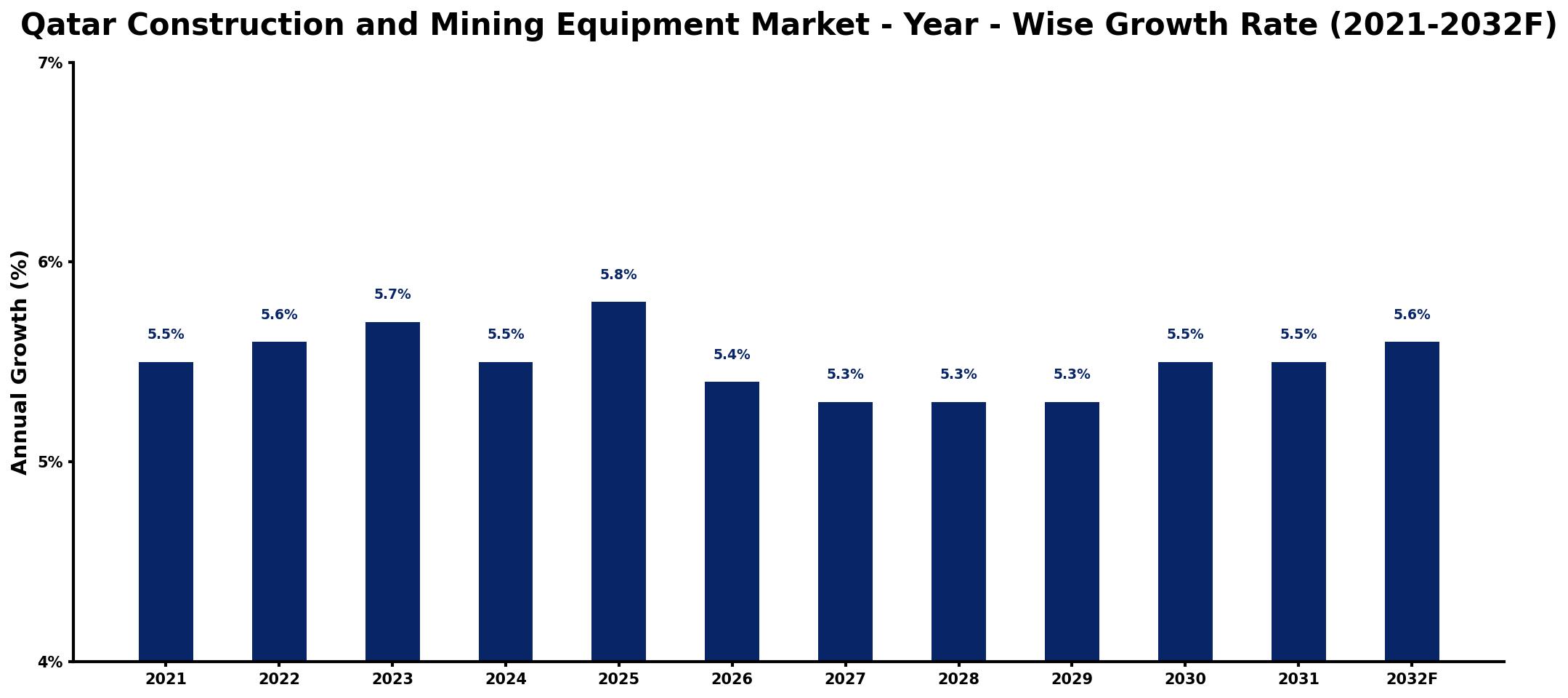
The table below presents the year‑wise growth rates along with the key drivers influencing the market
| Year | Growth Rate | Major Drivers |
| 2021 | 5.5% | increased infrastructure development projects |
| 2022 | 5.6% | growing urban population demands solutions |
| 2023 | 5.7% | expansion of renewable energy initiatives |
| 2024 | 5.5% | rising private sector investments |
| 2025 | 5.8% | enhanced government spending programs |
| 2026 | 5.4% | growing focus on sustainability practices |
| 2027 | 5.3% | emergence of smart city projects |
| 2028 | 5.3% | increased foreign direct investments |
| 2029 | 5.3% | strong demand for residential buildings |
| 2030 | 5.5% | development of transportation networks |
| 2031 | 5.5% | rising demand for eco-friendly solutions |
| 2032 | 5.6% | strengthening international trade flows |
Note: Market size estimations and growth projections presented in this report are based on 6Wresearch's proprietary forecasting methodology, utilizing the latest available industry data, government publications, and primary research inputs.
Qatar Construction and Mining Equipment Market Synopsis
The strongest force currently shaping the Qatar Construction and Mining Equipment Market is the government's commitment to infrastructure development. Major projects such as new roads, ports, and airports are pivotal to facilitating economic diversification and are driving a need for advanced construction machinery.
Simultaneously, Qatar's mining sector is witnessing expansion, necessitating specialized equipment to support the exploration and extraction of natural resources. This dual focus on construction and mining illustrates a comprehensive approach to economic growth and machinery demand.
Qatar Construction and Mining Equipment Market Key Takeaways
- The market is poised for steady growth due to ongoing infrastructure projects and mining expansions.
- Robust government investment in transportation and logistics is a key driver of machinery demand.
- Manufacturers must navigate the cyclicality and maintenance challenges inherent in this sector.
- Adapting to evolving safety and environmental regulations will be critical for future competitiveness.
- The market is rebounding from COVID-19 disruptions, with renewed activity expected in the coming years.
Evaluation of Restraints in Qatar Construction and Mining Equipment Market
Despite its promising growth outlook, the Qatar Construction and Mining Equipment Market faces certain restraints. The cyclic nature of the construction and mining industries often leads to fluctuations in demand for machinery, presenting challenges for manufacturers and suppliers. Furthermore, the harsh operational environments in Qatar necessitate rigorous maintenance and repair protocols for heavy machinery, which can complicate logistical operations. Lastly, adherence to stringent safety and environmental regulations will require ongoing investment in technology and training, potentially impacting profitability.
Qatar Construction and Mining Equipment Market Trends
Current trends indicate a significant push towards the adoption of smart technologies within construction and mining equipment. The integration of automation and telematics into heavy machinery is enhancing operational efficiency and safety. Additionally, a growing emphasis on sustainability is driving demand for equipment that meets eco-friendly standards. As Qatar focuses on reducing its carbon footprint, the trend towards electric and hybrid machinery is expected to gain momentum.
Qatar Construction and Mining Equipment Market Opportunities
Opportunities for growth within the Qatar Construction and Mining Equipment Market abound, particularly in the realm of technological advancements. Innovations in equipment design and functionality, including enhanced automation and energy efficiency, present avenues for investment. Moreover, as Qatar continues its infrastructure initiatives, there is potential for the introduction of new equipment types specifically tailored for the unique demands of local projects. Additionally, establishing partnerships with local firms can facilitate market entry for international players, enhancing competitive dynamics.
Government Initiatives in the Qatar Construction and Mining Equipment Market
The Qatari government is actively investing in infrastructure projects to stimulate economic diversification, making significant public spending a cornerstone of market growth. Programs aimed at enhancing transportation networks and logistics capabilities are currently a priority. Furthermore, the government is fostering a business-friendly environment through various incentives and policy frameworks, ensuring that both local and international players can participate effectively in the construction and mining sectors.
Future Insights of the Qatar Construction and Mining Equipment Market
Looking ahead to the years 2026-2032, the Qatar Construction and Mining Equipment Market is expected to maintain its upward trajectory. As infrastructure development continues to be a strategic priority, investments in both construction and mining sectors will expand. The growing trend towards advanced technology adoption will likely transform equipment operations, making them more efficient and sustainable. This evolution, combined with a steady economic recovery post-COVID-19, positions the market for sustained growth.
Qatar Construction and Mining Equipment Market Latest Developments (2025 - 2026)
Recent developments in the Qatar Construction and Mining Equipment Market reflect a resurgence in activity as new projects are launched. Companies are increasingly focusing on integrating cutting-edge technology to enhance equipment capabilities, while also responding to growing safety and environmental standards. Strategic partnerships between local and international firms are becoming more common, reflecting a collaborative approach to meeting the demands of the rapidly evolving market landscape.
Qatar Construction and Mining Equipment Market - Key Attractiveness of the Report
- 10 Years of Market Numbers
- Historical Data Starting from 2022 to 2025
- Base Year: 2025
- Forecast Data until 2032
- Key Performance Indicators Impacting the Market
- Major Upcoming Developments and Projects
Key Highlights of the Report:
- Qatar Construction and Mining Equipment Market Outlook
- Market Size of Qatar Construction and Mining Equipment Market, 2025
- Forecast of Qatar Construction and Mining Equipment Market, 2032
- Historical Data and Forecast of Qatar Construction and Mining Equipment Revenues & Volume for the Period 2022-2032F
- Qatar Construction and Mining Equipment Market Trend Evolution
- Qatar Construction and Mining Equipment Market Drivers and Challenges
- Qatar Construction and Mining Equipment Price Trends
- Qatar Construction and Mining Equipment Porter's Five Forces
- Qatar Construction and Mining Equipment Industry Life Cycle
- Historical Data and Forecast of Qatar Construction and Mining Equipment Market Revenues & Volume By Product Type for the Period 2022-2032F
- Historical Data and Forecast of Qatar Construction and Mining Equipment Market Revenues & Volume By Loaders for the Period 2022-2032F
- Historical Data and Forecast of Qatar Construction and Mining Equipment Market Revenues & Volume By Dozers for the Period 2022-2032F
- Historical Data and Forecast of Qatar Construction and Mining Equipment Market Revenues & Volume By Excavators for the Period 2022-2032F
- Historical Data and Forecast of Qatar Construction and Mining Equipment Market Revenues & Volume By Crushing for the Period 2022-2032F
- Historical Data and Forecast of Qatar Construction and Mining Equipment Market Revenues & Volume By Pulverizing & Screening Equipment for the Period 2022-2032F
- Historical Data and Forecast of Qatar Construction and Mining Equipment Market Revenues & Volume By Others for the Period 2022-2032F
- Historical Data and Forecast of Qatar Construction and Mining Equipment Market Revenues & Volume By Application for the Period 2022-2032F
- Historical Data and Forecast of Qatar Construction and Mining Equipment Market Revenues & Volume By Infrastructure for the Period 2022-2032F
- Historical Data and Forecast of Qatar Construction and Mining Equipment Market Revenues & Volume By Mineral Mining for the Period 2022-2032F
- Historical Data and Forecast of Qatar Construction and Mining Equipment Market Revenues & Volume By Residential Building for the Period 2022-2032F
- Historical Data and Forecast of Qatar Construction and Mining Equipment Market Revenues & Volume By Metal Mining for the Period 2022-2032F
- Historical Data and Forecast of Qatar Construction and Mining Equipment Market Revenues & Volume By Others for the Period 2022-2032F
- Qatar Construction and Mining Equipment Import Export Trade Statistics
- Market Opportunity Assessment By Product Type
- Market Opportunity Assessment By Application
- Qatar Construction and Mining Equipment Top Companies Market Share
- Qatar Construction and Mining Equipment Competitive Benchmarking By Technical and Operational Parameters
- Qatar Construction and Mining Equipment Company Profiles
- Qatar Construction and Mining Equipment Key Strategic Recommendations






































