Brazil Construction and Mining Equipment Market Size, Share & Growth Rate
The Brazil Construction and Mining Equipment Market was estimated at USD 286 Million in 2025 and is projected to reach USD 345 Million by 2032, growing at a CAGR of 2.7% from 2026 to 2032. This growth trajectory is primarily driven by significant government investments in infrastructure projects aimed at enhancing the country's transport and energy networks. Coupled with Brazil's vast mineral reserves, the demand for advanced machinery in both construction and mining activities is expected to escalate.
Brazil Construction and Mining Equipment Market Year-wise Growth Rate and Key Drivers
This graph highlights how the Brazil Construction and Mining Equipment Market has steadily grown over the years, supported by major growth factors.
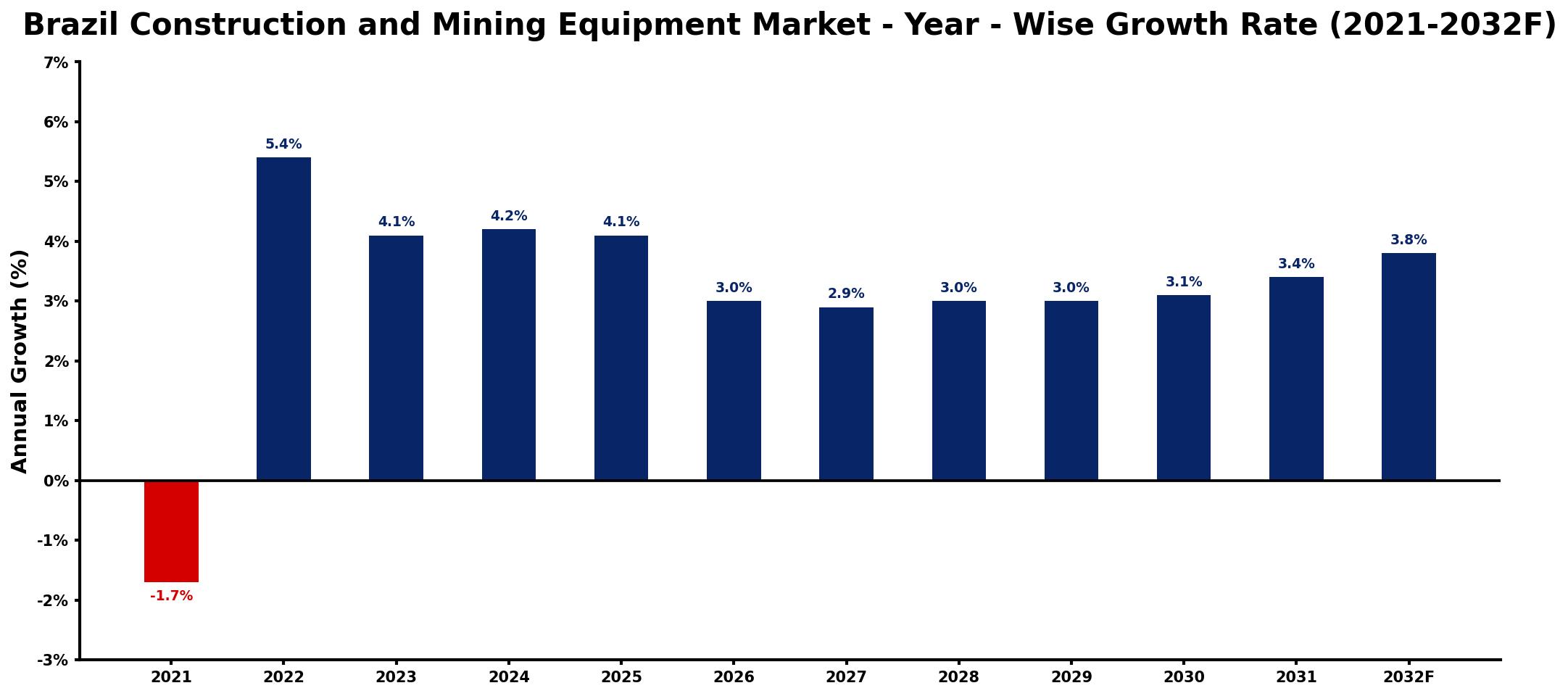
The table below presents the year‑wise growth rates along with the key drivers influencing the market
| Year | Growth Rate | Major Drivers |
| 2021 | -1.7% | Decreased infrastructure project investments |
| 2022 | 5.4% | Rising urban development activities |
| 2023 | 4.1% | Increased government infrastructure spending |
| 2024 | 4.2% | Expansion of renewable energy projects |
| 2025 | 4.1% | improved raw material availability |
| 2026 | 3.0% | Boost in public-private partnerships |
| 2027 | 2.9% | rising demand from electronics |
| 2028 | 3.0% | Increasing demand for road upgrades |
| 2029 | 3.0% | Rise in agricultural infrastructure projects |
| 2030 | 3.1% | Enhancement of logistics infrastructure networks |
| 2031 | 3.4% | Growing focus on sustainable practices |
| 2032 | 3.8% | increased production capacity utilization |
Note: Market size estimations and growth projections presented in this report are based on 6Wresearch's proprietary forecasting methodology, utilizing the latest available industry data, government publications, and primary research inputs.
Brazil Construction and Mining Equipment Market Synopsis
Infrastructure development is the strongest force currently shaping the Brazil Construction and Mining Equipment Market. As the nation embarks on revitalizing its urban landscapes and expanding rural connectivity, the demand for high-performance construction machinery is witnessing a marked increase.
Furthermore, Brazil's extensive mineral wealth significantly fuels mining operations, necessitating advanced drilling and extraction equipment. As these sectors thrive, opportunities abound for manufacturers and service providers to innovate and meet the evolving needs of construction and mining professionals.
Brazil Construction and Mining Equipment Market Key Takeaways
- Infrastructure investment is a primary growth driver for the market.
- Technological advancements in equipment design enhance operational efficiency.
- Government policies are increasingly focused on environmental sustainability.
- Brazil's rich mineral resources create ongoing demand for mining equipment.
- Market participants face competitive pressures from international manufacturers.
Evaluation of Restraints in Brazil Construction and Mining Equipment Market
Despite the promising growth outlook, certain restraints threaten to limit the market's potential. Fluctuations in global commodity prices can lead to decreased investment in mining operations, which directly impacts equipment sales. Additionally, navigating the stringent environmental regulations can pose challenges for manufacturers, requiring continuous investment in compliance and adaptation. Furthermore, the need for substantial financing can hinder smaller players from entering the market or scaling operations effectively, creating a landscape dominated by established firms.
Brazil Construction and Mining Equipment Market Trends
Current trends indicate a shift towards the adoption of smart technologies in construction and mining equipment. Features such as telematics and automation are gaining traction, enhancing safety and efficiency on job sites. Another significant trend is the emphasis on eco-friendly solutions, with manufacturers increasingly prioritizing sustainability in their designs to align with stringent government regulations and growing public demand for greener practices.
Brazil Construction and Mining Equipment Market Opportunities
There are substantial opportunities in Brazil's construction and mining equipment market as urbanization continues to surge. The demand for innovative and efficient machinery is not merely a trend but a necessity to keep pace with the fast-evolving infrastructure landscape. Investment in high-tech solutions, such as electric and hybrid construction equipment, is also gaining momentum, providing a potential avenue for growth as stakeholders seek to reduce their carbon footprints.
Government Initiatives in the Brazil Construction and Mining Equipment Market
Government initiatives play a crucial role in shaping the Brazil Construction and Mining Equipment Market. Through investments in large-scale infrastructure projects, the Brazilian government is actively promoting modernization in the construction sector. Additionally, policies focusing on safety regulations and environmental standards are pushing equipment manufacturers to innovate, thereby enhancing the overall market landscape. These initiatives not only ensure compliance but also foster public trust and accountability.
Future Insights of the Brazil Construction and Mining Equipment Market
Looking ahead to the period from 2026 to 2032, the Brazil Construction and Mining Equipment Market is poised for steady growth. As government infrastructure projects gain momentum, the demand for diverse construction and mining machinery will increase. Additionally, ongoing technological advancements will likely further enhance operational efficiencies. A focus on sustainable practices and the integration of smart technologies will shape the competitive landscape, ensuring that companies that innovate and adapt will thrive in the evolving market.
Brazil Construction and Mining Equipment Market Latest Developments (2025 - 2026)
The Brazilian construction and mining equipment landscape is seeing significant developments as companies invest in research and development to enhance product offerings. There is a marked shift towards digital solutions, with companies introducing equipment that utilizes advanced connectivity features to improve monitoring and performance. Meanwhile, regulatory bodies continue to refine standards around safety and environmental impact, ensuring that the market aligns with global best practices.
Brazil Construction and Mining Equipment Market - Key Attractiveness of the Report
- 10 Years of Market Numbers
- Historical Data Starting from 2022 to 2025
- Base Year: 2025
- Forecast Data until 2032
- Key Performance Indicators Impacting the Market
- Major Upcoming Developments and Projects
Key Highlights of the Report:
- Brazil Construction and Mining Equipment Market Outlook
- Market Size of Brazil Construction and Mining Equipment Market, 2025
- Forecast of Brazil Construction and Mining Equipment Market, 2032
- Historical Data and Forecast of Brazil Construction and Mining Equipment Revenues & Volume for the Period 2022-2032F
- Brazil Construction and Mining Equipment Market Trend Evolution
- Brazil Construction and Mining Equipment Market Drivers and Challenges
- Brazil Construction and Mining Equipment Price Trends
- Brazil Construction and Mining Equipment Porter's Five Forces
- Brazil Construction and Mining Equipment Industry Life Cycle
- Historical Data and Forecast of Brazil Construction and Mining Equipment Market Revenues & Volume By Product Type for the Period 2022-2032F
- Historical Data and Forecast of Brazil Construction and Mining Equipment Market Revenues & Volume By Loaders for the Period 2022-2032F
- Historical Data and Forecast of Brazil Construction and Mining Equipment Market Revenues & Volume By Dozers for the Period 2022-2032F
- Historical Data and Forecast of Brazil Construction and Mining Equipment Market Revenues & Volume By Excavators for the Period 2022-2032F
- Historical Data and Forecast of Brazil Construction and Mining Equipment Market Revenues & Volume By Crushing for the Period 2022-2032F
- Historical Data and Forecast of Brazil Construction and Mining Equipment Market Revenues & Volume By Pulverizing & Screening Equipment for the Period 2022-2032F
- Historical Data and Forecast of Brazil Construction and Mining Equipment Market Revenues & Volume By Others for the Period 2022-2032F
- Historical Data and Forecast of Brazil Construction and Mining Equipment Market Revenues & Volume By Application for the Period 2022-2032F
- Historical Data and Forecast of Brazil Construction and Mining Equipment Market Revenues & Volume By Infrastructure for the Period 2022-2032F
- Historical Data and Forecast of Brazil Construction and Mining Equipment Market Revenues & Volume By Mineral Mining for the Period 2022-2032F
- Historical Data and Forecast of Brazil Construction and Mining Equipment Market Revenues & Volume By Residential Building for the Period 2022-2032F
- Historical Data and Forecast of Brazil Construction and Mining Equipment Market Revenues & Volume By Metal Mining for the Period 2022-2032F
- Historical Data and Forecast of Brazil Construction and Mining Equipment Market Revenues & Volume By Others for the Period 2022-2032F
- Brazil Construction and Mining Equipment Import Export Trade Statistics
- Market Opportunity Assessment By Product Type
- Market Opportunity Assessment By Application
- Brazil Construction and Mining Equipment Top Companies Market Share
- Brazil Construction and Mining Equipment Competitive Benchmarking By Technical and Operational Parameters
- Brazil Construction and Mining Equipment Company Profiles
- Brazil Construction and Mining Equipment Key Strategic Recommendations






































