United States (US) Construction and Mining Equipment Market Size, Share & Growth Rate
The United States (US) Construction and Mining Equipment Market was estimated at USD 491 Million in 2025 and is projected to reach USD 587 Million by 2032, growing at a CAGR of 2.6% from 2026 to 2032. This growth trajectory is fueled by significant infrastructure investments and a robust uptick in mining activities across various states. Furthermore, the increasing demand for advanced technology solutions in machinery is propelling the market forward, as companies seek to improve operational efficiencies and safety standards.
United States (US) Construction and Mining Equipment Market Year-wise Growth Rate and Key Drivers
This graph highlights how the United States (US) Construction and Mining Equipment Market has steadily grown over the years, supported by major growth factors.
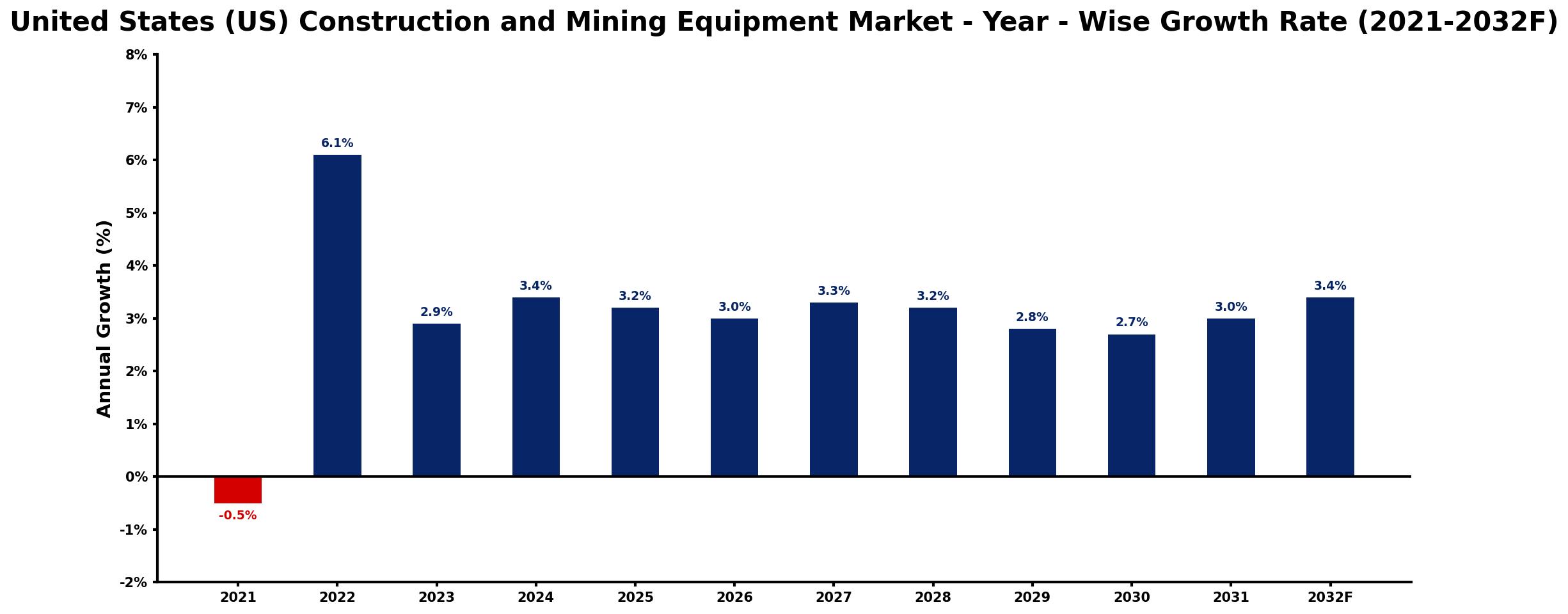
The table below presents the year‑wise growth rates along with the key drivers influencing the market
| Year | Growth Rate | Major Drivers |
| 2021 | -0.5% | decreased investment in infrastructure projects |
| 2022 | 6.1% | increased demand for residential development |
| 2023 | 2.9% | growth in renewable energy projects |
| 2024 | 3.4% | expansion of urban development initiatives |
| 2025 | 3.2% | rising demand from electronics |
| 2026 | 3.0% | enhanced government infrastructure funding |
| 2027 | 3.3% | surge in public works projects |
| 2028 | 3.2% | growing focus on sustainable practices |
| 2029 | 2.8% | increased pharmaceutical industry usage |
| 2030 | 2.7% | development of smart city initiatives |
| 2031 | 3.0% | growing regional consumption patterns |
| 2032 | 3.4% | increased production capacity utilization |
Note: Market size estimations and growth projections presented in this report are based on 6Wresearch's proprietary forecasting methodology, utilizing the latest available industry data, government publications, and primary research inputs.
United States (US) Construction and Mining Equipment Market Synopsis
As urbanization accelerates and infrastructure projects proliferate, the demand for construction and mining equipment in the United States is stronger than ever. With a keen focus on sustainability and efficiency, industry players are innovating to meet the evolving needs of their clientele.
Technological advancements such as telematics and automation are redefining equipment capabilities, providing opportunities for enhanced productivity and safety. This dynamic landscape is set against a backdrop of both challenges and opportunities, making it an intriguing market for stakeholders.
United States (US) Construction and Mining Equipment Market Key Takeaways
- The market shows a promising growth trajectory, driven by infrastructure investments and mining expansion.
- Technological innovations, including autonomous machinery, are significantly impacting operational efficiency.
- A shift towards eco-friendly equipment is shaping purchasing decisions and manufacturing practices.
- Rental and leasing services are becoming increasingly preferred, offering flexibility and cost-effectiveness.
- The focus on data analytics and telematics is optimizing equipment utilization and maintenance processes.
Evaluation of Restraints in United States (US) Construction and Mining Equipment Market
The United States construction and mining equipment market faces various obstacles that could hinder its growth. Chief among these are the unpredictable fluctuations in raw material prices, which directly affect manufacturing costs and profit margins. The stringent environmental regulations imposed by government bodies further complicate operations, increasing compliance costs for manufacturers. Additionally, the competitive landscape is intensifying with both established entities and emerging players vying for market share. This high competition, coupled with cyclical economic demand, creates uncertainties in forecasting sales and production levels. Moreover, challenges such as skilled labor shortages and global trade dynamics contribute to the complex operational environment within the industry.
United States (US) Construction and Mining Equipment Market Trends
Current trends in the US construction and mining equipment market highlight a clear shift towards innovation. The demand for autonomous vehicles and drones is on the rise, reflecting a broader push to enhance safety and efficiency on job sites. Sustainability is another dominant trend; manufacturers are increasingly developing eco-friendly machinery to address environmental concerns. The rental market is also evolving, with businesses opting for flexible, cost-effective equipment leasing solutions to respond to varying project needs. Finally, the incorporation of data analytics and telematics is revolutionizing the way companies manage equipment maintenance and usage, ultimately driving performance improvements.
United States (US) Construction and Mining Equipment Market Opportunities
Investment opportunities abound in the US construction and mining equipment market, particularly as infrastructure development projects ramp up across the country. Companies that produce innovative, technologically advanced machinery stand to benefit significantly. Furthermore, the burgeoning rental sector presents lucrative prospects for service providers, allowing them to capitalize on shifting consumer preferences for flexible ownership models. Additionally, firms that specialize in solutions aimed at sustainability and efficiency will likely attract investments as the industry continues to prioritize environmentally responsible practices. All these factors combine to create a fertile landscape for growth and expansion.
Government Initiatives in the United States (US) Construction and Mining Equipment Market
Government initiatives play a pivotal role in shaping the dynamics of the United States construction and mining equipment market. Regulations targeting emissions and safety standards set forth by agencies such as the Environmental Protection Agency (EPA) and the Occupational Safety and Health Administration (OSHA) are critical in guiding industry practices. Furthermore, public investment in infrastructure projects serves as a catalyst for equipment demand, as government funding often supports construction and mining activities. By fostering a regulatory environment that prioritizes sustainability and safety, the government aims to enhance operational efficiency while also addressing the pressing concerns of environmental impact.
Future Insights of the United States (US) Construction and Mining Equipment Market
Looking ahead to 2026-2032, the United States construction and mining equipment market is set to experience steady growth driven by persistent infrastructure development and the ongoing adoption of technological innovations. As government investments bolster construction and mining activities, the demand for advanced machinery is expected to surge. Automation and telematics will continue to gain traction, promoting not only safety but also operational efficiency. However, stakeholders must remain vigilant, navigating challenges such as fluctuating material costs and regulatory changes, while leveraging emerging opportunities to maintain their competitive advantage.
United States (US) Construction and Mining Equipment Market Latest Developments (2025 - 2026)
Recent developments in the United States construction and mining equipment market indicate a clear trend towards modernization. Companies are investing heavily in research and development to create more efficient, technologically sophisticated machinery. The integration of telematics in construction vehicles is becoming commonplace, allowing for real-time tracking of performance and maintenance needs. Furthermore, as the rental market continues to expand, more firms are exploring partnerships to provide flexible equipment solutions, thereby enhancing their service offerings. The focus on sustainability remains a top priority, with manufacturers introducing greener alternatives to traditional equipment.
United States (US) Construction and Mining Equipment Market - Key Attractiveness of the Report
- 10 Years of Market Numbers
- Historical Data Starting from 2022 to 2025
- Base Year: 2025
- Forecast Data until 2032
- Key Performance Indicators Impacting the Market
- Major Upcoming Developments and Projects
Key Highlights of the Report:
- United States (US) Construction and Mining Equipment Market Outlook
- Market Size of United States (US) Construction and Mining Equipment Market, 2025
- Forecast of United States (US) Construction and Mining Equipment Market, 2032
- Historical Data and Forecast of United States (US) Construction and Mining Equipment Revenues & Volume for the Period 2022-2032F
- United States (US) Construction and Mining Equipment Market Trend Evolution
- United States (US) Construction and Mining Equipment Market Drivers and Challenges
- United States (US) Construction and Mining Equipment Price Trends
- United States (US) Construction and Mining Equipment Porter's Five Forces
- United States (US) Construction and Mining Equipment Industry Life Cycle
- Historical Data and Forecast of United States (US) Construction and Mining Equipment Market Revenues & Volume By Product Type for the Period 2022-2032F
- Historical Data and Forecast of United States (US) Construction and Mining Equipment Market Revenues & Volume By Loaders for the Period 2022-2032F
- Historical Data and Forecast of United States (US) Construction and Mining Equipment Market Revenues & Volume By Dozers for the Period 2022-2032F
- Historical Data and Forecast of United States (US) Construction and Mining Equipment Market Revenues & Volume By Excavators for the Period 2022-2032F
- Historical Data and Forecast of United States (US) Construction and Mining Equipment Market Revenues & Volume By Crushing for the Period 2022-2032F
- Historical Data and Forecast of United States (US) Construction and Mining Equipment Market Revenues & Volume By Pulverizing & Screening Equipment for the Period 2022-2032F
- Historical Data and Forecast of United States (US) Construction and Mining Equipment Market Revenues & Volume By Others for the Period 2022-2032F
- Historical Data and Forecast of United States (US) Construction and Mining Equipment Market Revenues & Volume By Application for the Period 2022-2032F
- Historical Data and Forecast of United States (US) Construction and Mining Equipment Market Revenues & Volume By Infrastructure for the Period 2022-2032F
- Historical Data and Forecast of United States (US) Construction and Mining Equipment Market Revenues & Volume By Mineral Mining for the Period 2022-2032F
- Historical Data and Forecast of United States (US) Construction and Mining Equipment Market Revenues & Volume By Residential Building for the Period 2022-2032F
- Historical Data and Forecast of United States (US) Construction and Mining Equipment Market Revenues & Volume By Metal Mining for the Period 2022-2032F
- Historical Data and Forecast of United States (US) Construction and Mining Equipment Market Revenues & Volume By Others for the Period 2022-2032F
- United States (US) Construction and Mining Equipment Import Export Trade Statistics
- Market Opportunity Assessment By Product Type
- Market Opportunity Assessment By Application
- United States (US) Construction and Mining Equipment Top Companies Market Share
- United States (US) Construction and Mining Equipment Competitive Benchmarking By Technical and Operational Parameters
- United States (US) Construction and Mining Equipment Company Profiles
- United States (US) Construction and Mining Equipment Key Strategic Recommendations






































