Qatar Electrical Equipment Market Summary
The qatar electrical equipment market was estimated at USD 436 Million in 2025 and is projected to reach USD 580 Million by 2032, growing at a CAGR of 4.6% from 2026 to 2032.
Qatar Electrical Equipment Market Year-wise Growth Rate and Key Drivers
This graph highlights how the Qatar Electrical Equipment Market has steadily grown over the past five years, supported by major growth factors.
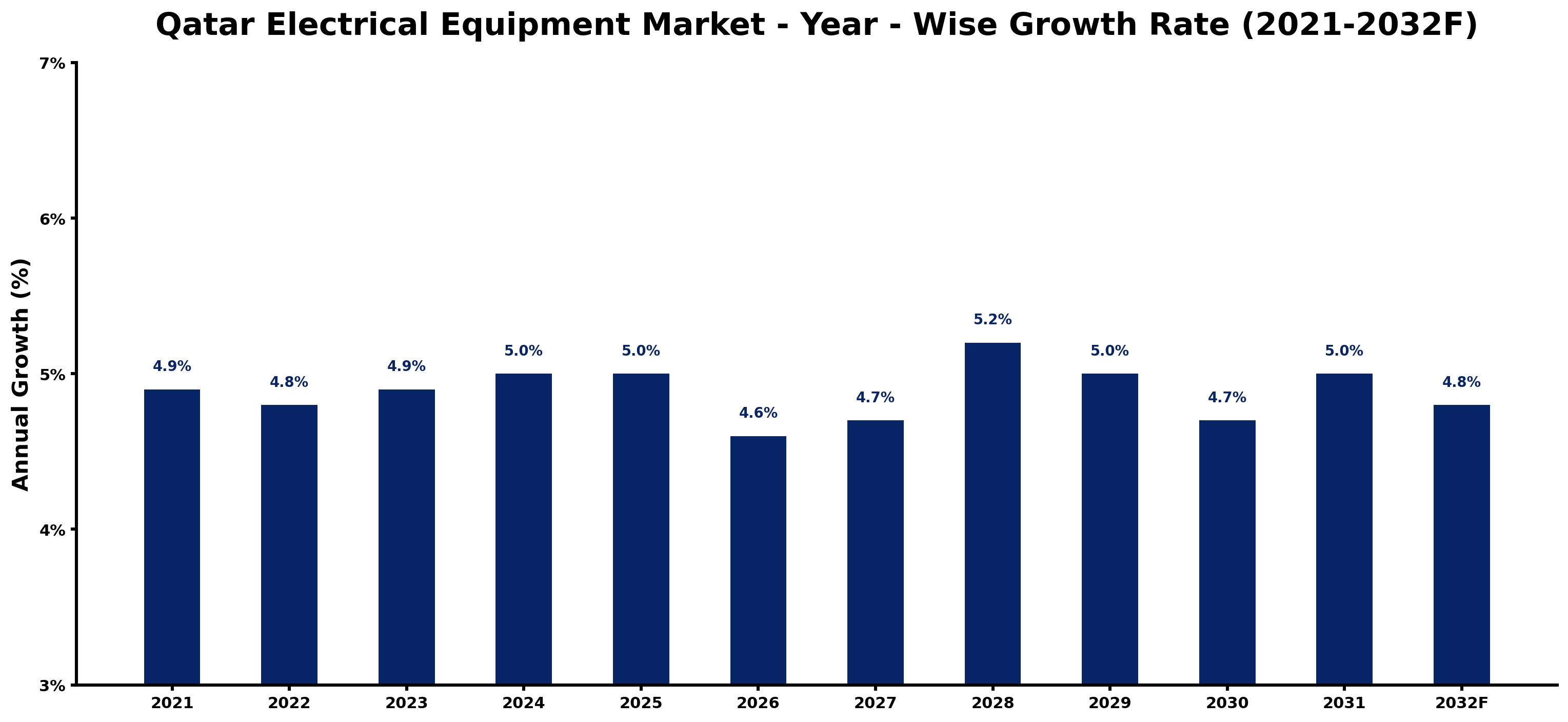
The table below presents the year wise growth rates along with the key drivers influencing the market
| Year | Growth Rate | Major Drivers |
| 2021 | 4.9% | Post-lockdown retail projects revealed substantial need for electrical infrastructure upgrades. |
| 2022 | 4.8% | Construction activity surged, particularly in hospitality and commercial sectors across Qatar. |
| 2023 | 4.9% | Continued investment in smart city initiatives increased demand for advanced electrical equipment. |
| 2024 | 5.0% | Legacy copper grid failures prompted investments in modern electric distribution technologies. |
| 2025 | 5.0% | Enterprise budgets prioritizing sustainability led to greater demand for energy-efficient solutions. |
| 2026 | 4.6% | The expansion of renewable energy sources required innovative electrical management systems. |
| 2027 | 4.7% | Technological integration in construction emphasized the need for automation in electrical installations. |
| 2028 | 5.2% | Regional dynamics highlighted increased localization in supply chains for electrical components. |
| 2029 | 5.0% | Urban population growth intensified the need for reliable electrical infrastructure solutions. |
| 2030 | 4.7% | Collaborations with international firms brought cutting-edge technology to the local market. |
| 2031 | 5.0% | Public-private partnerships catalyzed new projects focusing on resilient electrical frameworks. |
| 2032 | 4.8% | Emerging trends in electric vehicles demanded substantial upgrades in charging infrastructure. |
Note - Market size estimations and growth projections presented in this report are based on 6Wresearch's advanced forecasting approach, validated with industry datasets as of June 2026.
Qatar Electrical Equipment Market Synopsis
The Qatar Electrical Equipment Market is projected to reach 4.6% and witness significant growth during the forecast period (2026-2032). This market encompasses a diverse range of products essential for electrical power generation, distribution, and consumption. Key components of the Qatar Electrical Equipment Market include electrical machinery, lighting fixtures, cables, transformers, switchgear, and control panels, all of which are integral to various industrial and residential applications.
Qatar Electrical Equipment Market Growth Drivers
Several pivotal factors are driving the growth of the Qatar Electrical Equipment Market. Firstly, substantial investments in infrastructure projects have become a cornerstone of Qatar's economic strategy, fostering a robust demand for electrical equipment. The construction of new buildings, expansive transportation networks, and industrial facilities necessitates high-quality electrical solutions.
- Rapid urbanization is a key element contributing to market demand. The ongoing expansion of urban areas increases the need for electrical equipment in residential, commercial, and public spaces, thereby enhancing overall energy consumption.
- Moreover, Qatar's commitment to expand its energy sector, particularly through renewable energy initiatives, plays a crucial role in stimulating demand for electrical equipment. Projects focusing on solar and wind energy highlight the growing reliance on modern technologies.
- Technological advancements further amplify market growth. Innovations such as smart grids and energy-efficient lighting solutions present significant opportunities for enhancing efficiency within the electrical sector.
- The increasing trend towards automation in various industries also boosts demand for sophisticated electrical products, as companies seek to optimize performance and reduce operational costs.
- Government policies promoting energy efficiency and sustainability are expected to further support the market, aligning with global environmental standards.
Qatar Electrical Equipment Market Challenges and Restraints
Despite the growth potential, the Qatar Electrical Equipment Market faces several challenges. Supply chain disruptions have emerged as a significant concern, impacting the timely availability of essential components. Transportation delays can exacerbate these issues, leading to project delays and increased costs.
- Material shortages pose another challenge, particularly for specialized electrical components essential for advanced technologies such as renewable energy systems.
- The initial costs associated with advanced electrical equipment, especially in the context of renewable energy, may deter some potential buyers, creating a barrier to widespread adoption.
- Competition from imported electrical equipment also presents a challenge, as products from other countries may offer lower price points, prompting local businesses to adapt their strategies.
- Additionally, environmental sustainability and energy efficiency considerations can affect demand for certain products, with buyers increasingly looking for solutions that align with best practices in sustainability.
- Lastly, potential fluctuations in economic conditions can influence overall investment levels in the electrical sector, shaping the trajectory of market growth.
Qatar Electrical Equipment Market Government Investment and Initiatives
The Qatari government has been proactive in fostering growth within the electrical equipment sector through various investment initiatives and development plans. Emphasizing infrastructure development, the government allocates substantial funding towards national projects, encouraging advancements in electrical utilities and technologies.
- Public spending on infrastructure is strategically directed toward building smart cities, enhancing public transportation, and upgrading power generation facilities, which inherently increases the need for electrical equipment.
- The government's National Vision 2030 framework outlines long-term objectives that prioritize sustainable development and diversification of the economy, leading to consistent investments in energy projects.
- Incentives for adopting renewable energy technologies, such as favorable tariffs and grants, aim to promote local production and deployment of electrical solutions that meet global sustainability standards.
- Moreover, partnerships between public and private sectors are encouraged to facilitate knowledge transfer and foster innovation in the electrical equipment space.
- These government-led initiatives create a conducive environment for market players, fostering confidence and encouraging investment in the Qatar Electrical Equipment Market.
Qatar Electrical Equipment Market Latest Developments (May 2025 - June 2026)
In the period from May 2025 to June 2026, the Qatar Electrical Equipment Market has experienced notable developments. The ongoing recovery from the Covid-19 pandemic has led to increased investments in infrastructure, contributing positively to market dynamics. Enhanced focus on energy efficiency and renewable projects has driven a surge in demand for innovative electrical equipment, with stakeholders aligning their strategies to capitalize on these trends.
- Many major projects launched during this period emphasize smart technology adoption in electrical systems, positioning the market for future growth and enhanced operational efficiency.
- Increased public-private partnerships have emerged, aimed at developing advanced electrical solutions, reflecting a collaborative approach to addressing market challenges.
- Furthermore, the ongoing efforts towards environmental sustainability have prompted stakeholders to explore alternative materials and production methods within the electrical equipment space.
- Regulatory bodies have begun to implement stricter guidelines focusing on energy efficiency standards, shaping the market landscape and influencing product development.
- As a result, the market is evolving towards a more sustainable and technology-driven future, aligning with Qatar's broad economic goals.
Qatar Electrical Equipment Market - Key Attractiveness of the Report
- 10 Years of Market Numbers
- Historical Data Starting from 2022 to 2025
- Base Year: 2025
- Forecast Data until 2032
- Key Performance Indicators Impacting the Market
- Major Upcoming Developments and Projects
Key Highlights of the Report:
- Qatar Electrical Equipment Market Outlook
- Market Size of Qatar Electrical Equipment Market, 2025
- Forecast of Qatar Electrical Equipment Market, 2032
- Historical Data and Forecast of Qatar Electrical Equipment Revenues & Volume for the Period 2022-2032F
- Qatar Electrical Equipment Market Trend Evolution
- Qatar Electrical Equipment Market Drivers and Challenges
- Qatar Electrical Equipment Price Trends
- Qatar Electrical Equipment Porter's Five Forces
- Qatar Electrical Equipment Industry Life Cycle
- Historical Data and Forecast of Qatar Electrical Equipment Market Revenues & Volume By Types for the Period 2022-2032F
- Historical Data and Forecast of Qatar Electrical Equipment Market Revenues & Volume By Electronic and electrical wires and cables for the Period 2022-2032F
- Historical Data and Forecast of Qatar Electrical Equipment Market Revenues & Volume By Batteries and accumulators for the Period 2022-2032F
- Historical Data and Forecast of Qatar Electrical Equipment Market Revenues & Volume By Wiring devices for the Period 2022-2032F
- Historical Data and Forecast of Qatar Electrical Equipment Market Revenues & Volume By Electric lighting equipment for the Period 2022-2032F
- Historical Data and Forecast of Qatar Electrical Equipment Market Revenues & Volume By Others for the Period 2022-2032F
- Historical Data and Forecast of Qatar Electrical Equipment Market Revenues & Volume By Applications for the Period 2022-2032F
- Historical Data and Forecast of Qatar Electrical Equipment Market Revenues & Volume By Residential end-users for the Period 2022-2032F
- Historical Data and Forecast of Qatar Electrical Equipment Market Revenues & Volume By Non-residential end-users for the Period 2022-2032F
- Qatar Electrical Equipment Import Export Trade Statistics
- Market Opportunity Assessment By Types
- Market Opportunity Assessment By Applications
- Qatar Electrical Equipment Top Companies Market Share
- Qatar Electrical Equipment Competitive Benchmarking By Technical and Operational Parameters
- Qatar Electrical Equipment Company Profiles
- Qatar Electrical Equipment Key Strategic Recommendations






































