United States (US) Electrical Equipment Market Summary
The united states (us) electrical equipment market was estimated at USD 142 Million in 2025 and is projected to reach USD 166 Million by 2032, growing at a CAGR of 2.4% from 2026 to 2032.
United States (US) Electrical Equipment Market Year-wise Growth Rate and Key Drivers
This graph highlights how the United States (US) Electrical Equipment Market has steadily grown over the past five years, supported by major growth factors.
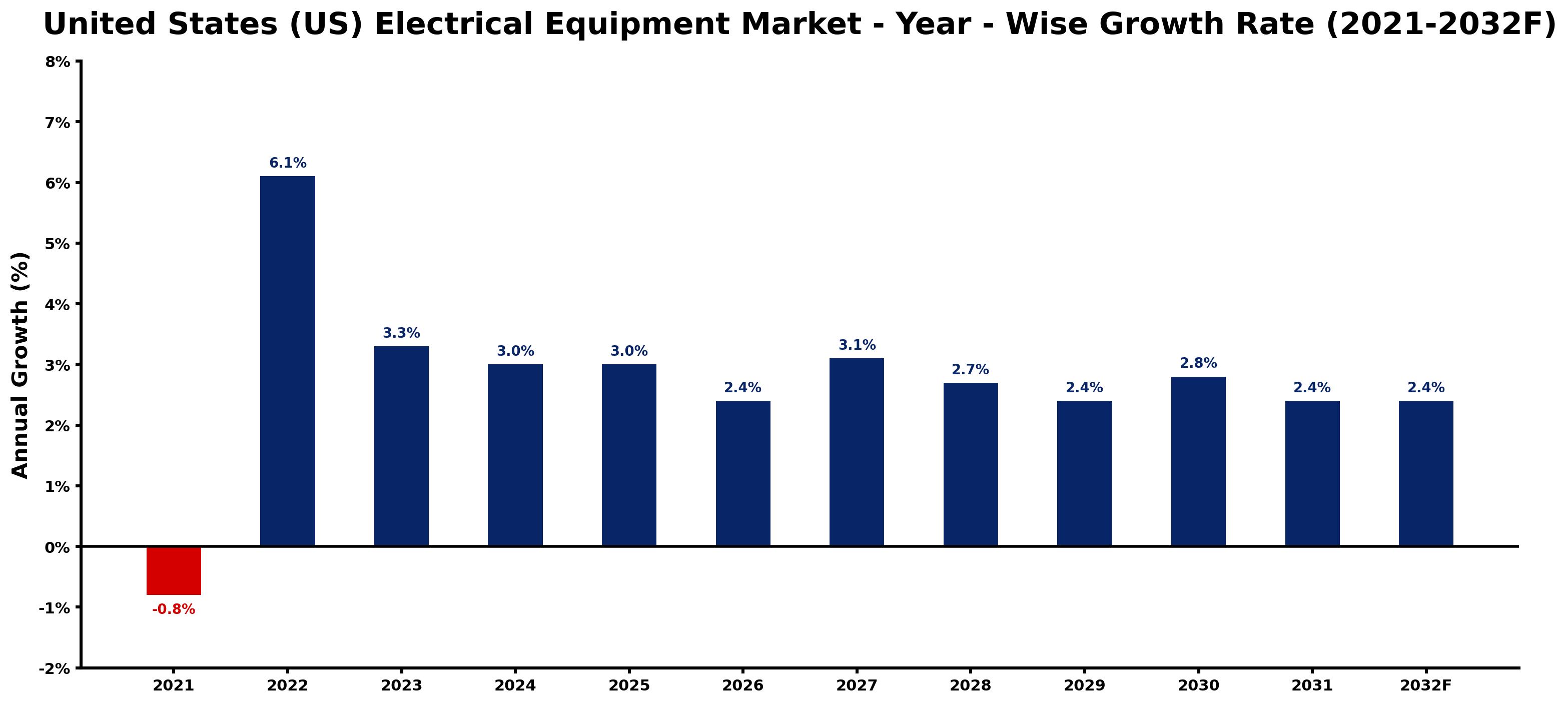
The table below presents the year wise growth rates along with the key drivers influencing the market
| Year | Growth Rate | Major Drivers |
| 2021 | -0.8% | Supply chain disruptions hindered manufacturing efficiency, leading to delays in product availability and decreased sales. |
| 2022 | 6.1% | Legacy copper grid failures prompted utility companies to explore innovative electrical solutions. |
| 2023 | 3.3% | Enterprise budgets prioritizing energy efficiency have stimulated investment in modern equipment. |
| 2024 | 3.0% | Sustainability goals have driven manufacturers towards greener and more efficient technologies. |
| 2025 | 3.0% | The booming renewable energy sector is creating a surge in equipment needs. |
| 2026 | 2.4% | Smart home technology's popularity is transforming residential electrical systems and appliances. |
| 2027 | 3.1% | Increased infrastructure funding is fostering extensive upgrades across urban electrical grids. |
| 2028 | 2.7% | Technological advancements in electric vehicles are impacting charging station demands significantly. |
| 2029 | 2.4% | Decentralization of power generation is reshaping traditional market dynamics and player strategies. |
| 2030 | 2.8% | Industrial automation technologies are enhancing efficiency, increasing demand for specialized equipment. |
| 2031 | 2.4% | Emerging markets are investing heavily in modernization of electrical infrastructures profoundly. |
| 2032 | 2.4% | Focus on climate resilience is reshaping regulations, necessitating updates across electrical solutions. |
Note - Market size estimations and growth projections presented in this report are based on 6Wresearch's advanced forecasting approach, validated with industry datasets as of June 2026.
United States (US) Electrical Equipment Market Synopsis
The United States (US) Electrical Equipment Market is projected to reach 2.4% and witness significant growth during the forecast period (2026-2032). This sector is characterized by a comprehensive range of electrical products, including wiring devices, lighting systems, electrical components, and industrial control systems. The market's expansion is largely attributed to advancing technologies, a rising emphasis on energy efficiency, and ongoing developments within the construction and manufacturing industries, all of which are driving increased demand for innovative electrical solutions.
United States (US) Electrical Equipment Market Growth Drivers
Several key factors are propelling the growth of the United States (US) Electrical Equipment Market. Firstly, technological advancements play a pivotal role in introducing more sophisticated electrical components that enhance functionality and efficiency. Secondly, the growing concern for environmental sustainability is pushing consumers and businesses to adopt energy-efficient products, which has spurred innovation in this sector. Thirdly, the construction boom across various regions within the US has driven demand for electrical equipment as new buildings require extensive installations. Additionally, the sustained growth in manufacturing activities contributes to the rising requirement for advanced industrial controls and electrical components. Lastly, the increasing integration of renewable energy sources into the national grid necessitates efficient electrical solutions, further stimulating market growth.
United States (US) Electrical Equipment Market Trends and Opportunities
Current trends in the United States (US) Electrical Equipment Market reveal a significant consumer shift towards energy-efficient and sustainable products. This is largely influenced by government regulations aimed at reducing carbon footprints and promoting green technologies. As a result, companies are increasingly developing products that incorporate smart grid technologies and energy storage systems. Another notable trend is the integration of IoT and AI technologies into electrical equipment, enhancing their interoperability and functionality. The rising adoption of electric vehicles further presents opportunities for companies that specialize in electric vehicle charging infrastructure, responding to the growing need for efficient charging solutions. Additionally, as renewable energy sources such as solar and wind power gain traction, there is a corresponding increase in the demand for relevant electrical equipment designed to harness these resources effectively.
United States (US) Electrical Equipment Market Challenges and Restraints
Despite the robust growth potential, several challenges hinder the United States (US) Electrical Equipment Market. The fierce competition among domestic and international manufacturers leads to price wars and inhibits profit margins. Additionally, the rapid pace of technological change requires companies to invest heavily in research and development in order to keep up with market demands. Furthermore, strict regulatory frameworks surrounding safety and environmental standards pose significant compliance challenges for manufacturers. Fluctuations in raw material prices also create unpredictability in production costs, which can affect pricing strategies. Lastly, economic uncertainties, including inflation and supply chain disruptions, can hinder growth potential and impact overall market stability.
United States (US) Electrical Equipment Market Investment Opportunities
The United States (US) Electrical Equipment Market presents numerous investment opportunities driven by the escalating demand for advanced electrical products. Investors may find potential in companies specializing in innovative electrical solutions, particularly those that address the growing need for energy-efficient equipment across various sectors. The construction industry, in particular, remains a key area for investment, as infrastructure projects continue to expand. Additionally, the rising focus on sustainability opens avenues for investment in eco-friendly electrical technologies. Opportunities also exist in the burgeoning electric vehicle sector, with companies involved in developing charging infrastructure poised to benefit from increased adoption rates. Overall, the market's dynamic nature positions it favorably for investors looking to capitalize on ongoing trends towards sustainability and technological advancement.
United States (US) Electrical Equipment Market Government Investment and Initiatives
Government policies significantly influence the United States (US) Electrical Equipment Market by promoting sustainability, innovation, and safety standards. The Department of Energy (DOE) plays a crucial role in establishing energy efficiency benchmarks for electrical products, facilitating programs that encourage the adoption of energy-efficient appliances and lighting. Additionally, the Federal Energy Regulatory Commission (FERC) oversees the electricity transmission and wholesale markets, ensuring equitable practices and reliable service. Safety regulations enforced by the Occupational Safety and Health Administration (OSHA) provide crucial guidelines for workers involved in the production and installation of electrical equipment. Furthermore, governmental R&D grants aim to foster innovation within the sector, stimulating advancements that bolster the nation's global competitiveness. Such initiatives illustrate the government's commitment to modernizing the electrical infrastructure while prioritizing safety and sustainability.
United States (US) Electrical Equipment Market Latest Developments (May 2025 - June 2026)
Recent developments in the United States (US) Electrical Equipment Market from May 2025 to June 2026 indicate a shift towards more integrated and sustainable electrical solutions. Industry stakeholders have been increasingly focusing on the incorporation of smart technologies within electrical equipment, enhancing system efficiency and user experience. Additionally, there has been a notable uptick in partnerships between technology firms and electrical equipment manufacturers, aiming to accelerate the deployment of innovative solutions such as advanced energy storage systems and smart grid applications. The regulatory landscape has also evolved, with new mandates aimed at boosting energy efficiency further influencing product development and market strategies. Moreover, the ongoing emphasis on electrification in the transportation sector is driving investments in supporting infrastructure, particularly in electric vehicle charging stations, further shaping the market's direction.
United States (US) Electrical Equipment Market - Key Attractiveness of the Report
- 10 Years of Market Numbers
- Historical Data Starting from 2022 to 2025
- Base Year: 2025
- Forecast Data until 2032
- Key Performance Indicators Impacting the Market
- Major Upcoming Developments and Projects
Key Highlights of the Report:
- United States (US) Electrical Equipment Market Outlook
- Market Size of United States (US) Electrical Equipment Market, 2025
- Forecast of United States (US) Electrical Equipment Market, 2032F
- Historical Data and Forecast of United States (US) Electrical Equipment Revenues & Volume for the Period 2022-2032F
- United States (US) Electrical Equipment Market Trend Evolution
- United States (US) Electrical Equipment Market Drivers and Challenges
- United States (US) Electrical Equipment Price Trends
- United States (US) Electrical Equipment Porter's Five Forces
- United States (US) Electrical Equipment Industry Life Cycle
- Historical Data and Forecast of United States (US) Electrical Equipment Market Revenues & Volume By Types for the Period 2022-2032F
- Historical Data and Forecast of United States (US) Electrical Equipment Market Revenues & Volume By Electronic and electrical wires and cables for the Period 2022-2032F
- Historical Data and Forecast of United States (US) Electrical Equipment Market Revenues & Volume By Batteries and accumulators for the Period 2022-2032F
- Historical Data and Forecast of United States (US) Electrical Equipment Market Revenues & Volume By Wiring devices for the Period 2022-2032F
- Historical Data and Forecast of United States (US) Electrical Equipment Market Revenues & Volume By Electric lighting equipment for the Period 2022-2032F
- Historical Data and Forecast of United States (US) Electrical Equipment Market Revenues & Volume By Others for the Period 2022-2032F
- Historical Data and Forecast of United States (US) Electrical Equipment Market Revenues & Volume By Applications for the Period 2022-2032F
- Historical Data and Forecast of United States (US) Electrical Equipment Market Revenues & Volume By Residential end-users for the Period 2022-2032F
- Historical Data and Forecast of United States (US) Electrical Equipment Market Revenues & Volume By Non-residential end-users for the Period 2022-2032F
- United States (US) Electrical Equipment Import Export Trade Statistics
- Market Opportunity Assessment By Types
- Market Opportunity Assessment By Applications
- United States (US) Electrical Equipment Top Companies Market Share
- United States (US) Electrical Equipment Competitive Benchmarking By Technical and Operational Parameters
- United States (US) Electrical Equipment Company Profiles
- United States (US) Electrical Equipment Key Strategic Recommendations






































