Qatar Fish Market Size, Share & Growth Rate
The Qatar Fish Market was estimated at USD 480 Million in 2025 and is projected to reach USD 679 Million by 2032, growing at a CAGR of 5.1% from 2026 to 2032. This growth trajectory is primarily driven by the rising domestic demand for fresh seafood, fueled by a growing population and increasing tourism. Moreover, enhanced investments in aquaculture and modern fish market infrastructures are further propelling the sector.
Qatar Fish Market Year-wise Growth Rate and Key Drivers
This graph highlights how the Qatar Fish Market has steadily grown over the years, supported by major growth factors.
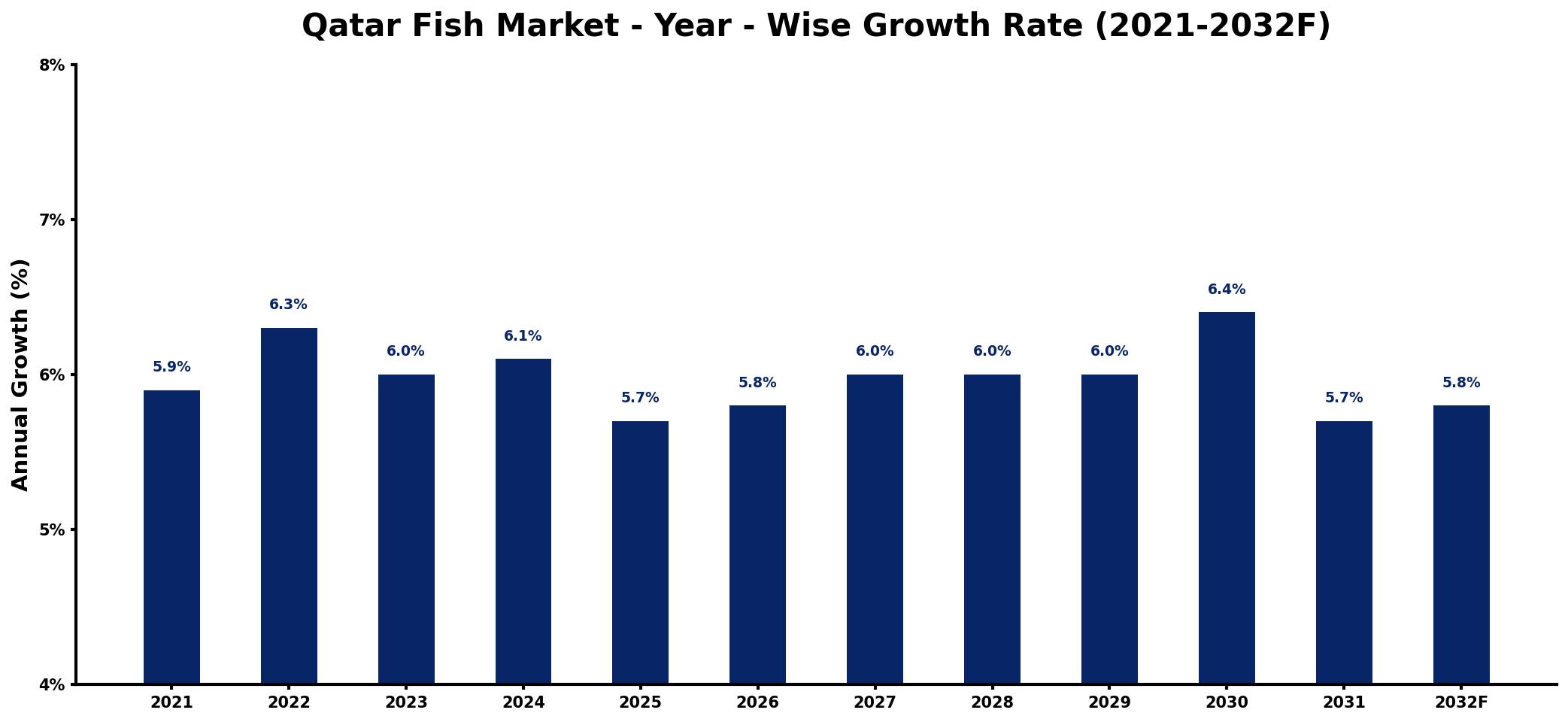
The table below presents the year‑wise growth rates along with the key drivers influencing the market
| Year | Growth Rate | Major Drivers |
| 2021 | 5.9% | Rising consumer health consciousness |
| 2022 | 6.3% | Increased culinary tourism interest |
| 2023 | 6.0% | Expansion of local aquaculture initiatives |
| 2024 | 6.1% | Growing export market opportunities |
| 2025 | 5.7% | Emerging sustainable sourcing practices |
| 2026 | 5.8% | Investment in cold chain logistics |
| 2027 | 6.0% | Enhanced distribution network efficiency |
| 2028 | 6.0% | Popularity of home cooking trends |
| 2029 | 6.0% | Strong demand for organic options |
| 2030 | 6.4% | Development of innovative processing technologies |
| 2031 | 5.7% | Strengthening regional trade agreements |
| 2032 | 5.8% | Increased awareness of nutritional benefits |
Note: Market size estimations and growth projections presented in this report are based on 6Wresearch's proprietary forecasting methodology, utilizing the latest available industry data, government publications, and primary research inputs.
Qatar Fish Market Synopsis
The fish market in Qatar is integral to the nations food supply, driven by local preferences for seafood. This is accentuated by Qatar's strategic location along the Arabian Gulf, which provides access to a rich variety of marine life.
Emphasizing sustainability, the Qatar Fish Market is seeing a paradigm shift toward responsible fishing practices and aquaculture. This evolution aims to balance the increasing demand for seafood with the necessity of conserving local fish stocks for future generations.
Qatar Fish Market Key Takeaways
- The market is poised for consistent growth, driven by rising local and tourist demand.
- Sustainable practices are becoming a priority, shaping both policy and operational decisions.
- Investments in modern infrastructure are essential to meet the anticipated surge in consumption.
- Technological integration in processing and distribution is set to enhance efficiency.
- The market is increasingly adapting to changing consumer preferences, including a focus on quality and local sourcing.
Evaluation of Restraints in Qatar Fish Market
While the Qatar Fish Market enjoys robust demand, it faces significant constraints that could impede its growth. Overfishing and rising sea temperatures pose serious threats to sustainable management of local fisheries, making it imperative for stakeholders to adopt effective conservation strategies. Additionally, ensuring the safety and quality of fish products through stringent inspection measures is vital to maintain consumer trust. The challenge of competing with imported seafood further complicates the landscape, necessitating strategic initiatives to promote locally sourced fish.
Qatar Fish Market Trends
Several trends are currently shaping the Qatar Fish Market. The increasing emphasis on sustainability is pushing market participants toward responsible fishing and aquaculture. Additionally, technological advancements are improving supply chain efficiencies, ensuring that fresh seafood is available to consumers more quickly and safely. The rise in health-conscious eating habits among the populace is also driving demand for seafood, as consumers seek nutritious options.
Qatar Fish Market Opportunities
The Qatar Fish Market presents numerous growth and investment opportunities. Expanding local aquaculture initiatives are poised to reduce dependency on imports and enhance food security. Additionally, investments in modern cold storage and distribution facilities can facilitate better market access and product quality. The growing tourism sector also offers lucrative avenues for seafood suppliers catering to hospitality needs, making it a pivotal area for future growth.
Government Initiatives in the Qatar Fish Market
The Qatari government is actively promoting sustainable fishing practices through various policies and initiatives. Programs aimed at enhancing food security and supporting local fisheries are critical to the market's development. Public spending on infrastructure improvements, including fish markets and aquaculture facilities, aligns with the government's vision to strengthen the local seafood supply chain, thereby ensuring quality and availability.
Future Insights of the Qatar Fish Market
Looking ahead to 2026-2032, the Qatar Fish Market is likely to experience substantial transformation. With continued investment in sustainability and technology, the market can expect to see a steady increase in domestic production capacity. Furthermore, as consumer preferences evolve towards quality and sustainability, local fisheries will need to adapt to meet these demands effectively. The government's commitment to reducing import dependency will also drive innovation and expansion within the sector.
Qatar Fish Market Latest Developments (2025 - 2026)
Recent developments in the Qatar Fish Market include a heightened focus on aquaculture projects aimed at boosting domestic production. Investments in modern fish processing technologies have also accelerated, enhancing product quality and safety. Additionally, the government is expected to announce new sustainability initiatives aimed at protecting local fish stocks while promoting responsible consumption among consumers.
Qatar Fish Market - Key Attractiveness of the Report
- 10 Years of Market Numbers
- Historical Data Starting from 2022 to 2025
- Base Year: 2025
- Forecast Data until 2032
- Key Performance Indicators Impacting the Market
- Major Upcoming Developments and Projects
Key Highlights of the Report:
- Qatar Fish Market Outlook
- Market Size of Qatar Fish Market, 2025
- Forecast of Qatar Fish Market, 2032
- Historical Data and Forecast of Qatar Fish Revenues & Volume for the Period 2022-2032F
- Qatar Fish Market Trend Evolution
- Qatar Fish Market Drivers and Challenges
- Qatar Fish Price Trends
- Qatar Fish Porter's Five Forces
- Qatar Fish Industry Life Cycle
- Historical Data and Forecast of Qatar Fish Market Revenues & Volume By Fish Type for the Period 2022-2032F
- Historical Data and Forecast of Qatar Fish Market Revenues & Volume By Inland Fishes for the Period 2022-2032F
- Historical Data and Forecast of Qatar Fish Market Revenues & Volume By Marine Fishes for the Period 2022-2032F
- Historical Data and Forecast of Qatar Fish Market Revenues & Volume By Shrimps for the Period 2022-2032F
- Historical Data and Forecast of Qatar Fish Market Revenues & Volume By Scampi for the Period 2022-2032F
- Historical Data and Forecast of Qatar Fish Market Revenues & Volume By Product Type for the Period 2022-2032F
- Historical Data and Forecast of Qatar Fish Market Revenues & Volume By Fresh for the Period 2022-2032F
- Historical Data and Forecast of Qatar Fish Market Revenues & Volume By Frozen for the Period 2022-2032F
- Historical Data and Forecast of Qatar Fish Market Revenues & Volume By Canned for the Period 2022-2032F
- Historical Data and Forecast of Qatar Fish Market Revenues & Volume By Others for the Period 2022-2032F
- Historical Data and Forecast of Qatar Fish Market Revenues & Volume By Distribution Channel for the Period 2022-2032F
- Historical Data and Forecast of Qatar Fish Market Revenues & Volume By Retail for the Period 2022-2032F
- Historical Data and Forecast of Qatar Fish Market Revenues & Volume By Institutional for the Period 2022-2032F
- Historical Data and Forecast of Qatar Fish Market Revenues & Volume By Sector for the Period 2022-2032F
- Historical Data and Forecast of Qatar Fish Market Revenues & Volume By Organised for the Period 2022-2032F
- Historical Data and Forecast of Qatar Fish Market Revenues & Volume By Unorganised for the Period 2022-2032F
- Qatar Fish Import Export Trade Statistics
- Market Opportunity Assessment By Fish Type
- Market Opportunity Assessment By Product Type
- Market Opportunity Assessment By Distribution Channel
- Market Opportunity Assessment By Sector
- Qatar Fish Top Companies Market Share
- Qatar Fish Competitive Benchmarking By Technical and Operational Parameters
- Qatar Fish Company Profiles
- Qatar Fish Key Strategic Recommendations






































