Qatar Flooring, roofing and wall coverings Market Summary
The qatar flooring, roofing and wall coverings market was estimated at USD 481 Million in 2025 and is projected to reach USD 666 Million by 2032, growing at a CAGR of 5.8% from 2026 to 2032.
Qatar Flooring, roofing and wall coverings Market Year-wise Growth Rate and Key Drivers
This graph highlights how the Qatar Flooring, roofing and wall coverings Market has steadily grown over the past five years, supported by major growth factors.
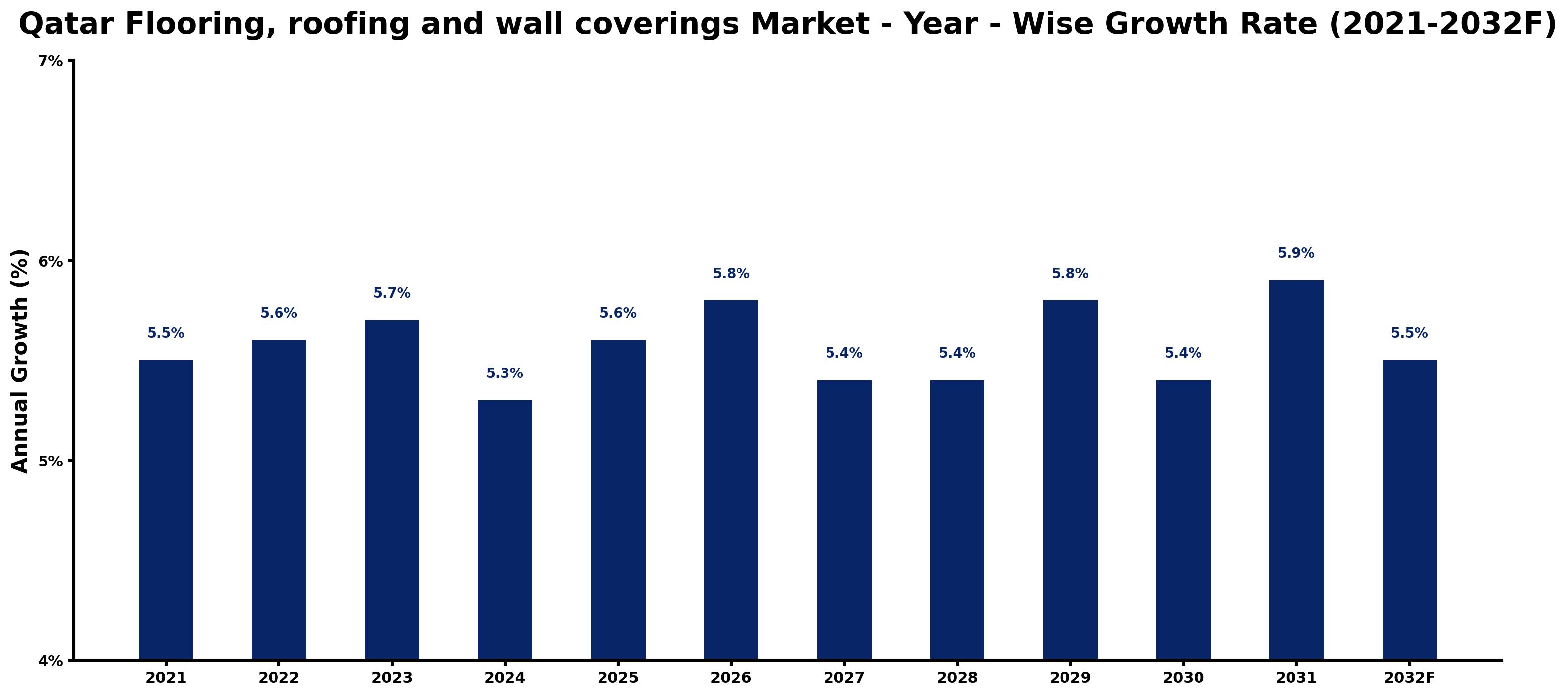
The table below presents the year wise growth rates along with the key drivers influencing the market
| Year | Growth Rate | Major Drivers |
| 2021 | 5.5% | Post-lockdown retail projects increased marketplace activity, boosting flooring installation services. |
| 2022 | 5.6% | Emerging residential developments prioritized innovative wall covering materials for aesthetic appeal. |
| 2023 | 5.7% | High-profile events challenged infrastructure, creating opportunities for roofing system upgrades. |
| 2024 | 5.3% | Local manufacturers enhanced production capabilities to meet rising demand for flooring solutions. |
| 2025 | 5.6% | Sustainability became a focal point, influencing material choices in wall coverings significantly. |
| 2026 | 5.8% | Collaborations between architects and contractors improved design integration for roofing materials. |
| 2027 | 5.4% | Smart home technology integration prompted upgrades in flooring for energy efficiency and convenience. |
| 2028 | 5.4% | Qatar's urban expansion projects drove the need for durable and fire-resistant wall coverings. |
| 2029 | 5.8% | Tourism resurgence led to heightened competition in hospitality, necessitating innovative flooring solutions. |
| 2030 | 5.4% | Demand for multifunctional spaces pushed for versatile wall covering materials in urban areas. |
| 2031 | 5.9% | Increased construction activity in industrial sectors raised expectations for roofing durability. |
| 2032 | 5.5% | Evolving consumer preferences influenced the shift to eco-friendly materials in flooring products. |
Note - Market size estimations and growth projections presented in this report are based on 6Wresearch's advanced forecasting approach, validated with industry datasets as of June 2026.
Qatar Flooring, roofing and wall coverings Market Synopsis
The Qatar Flooring, roofing and wall coverings Market is projected to reach 5.8% and witness significant growth during the forecast period (2026-2032). The economic landscape of Qatar has been greatly influenced by its rich resources in oil and gas, allowing substantial investments in construction and real estate. The rising demand for flooring, roofing, and wall coverings is a direct reflection of this growth, driven by extensive urban development and infrastructural advancements.
Qatar Flooring, roofing and wall coverings Market Growth Drivers
Several key factors are propelling the expansion of the Qatar flooring, roofing and wall coverings market. One of the primary drivers is the increase in disposable incomes among the Qatari population. As individuals and families have more spending power, they are more inclined to invest in quality flooring and wall covering options that enhance their living and working environments. Furthermore, the rapid influx of expatriates has contributed to a booming real estate sector, necessitating more residential and commercial projects.
- The booming construction industry is continuously generating demand for various flooring and wall covering materials.
- Government incentives and tax exemptions for foreign investors are boosting real estate projects, further driving market demand.
- Growing awareness of environmental sustainability is leading to a preference for eco-friendly and recycled materials in construction.
- Increased availability of innovative materials and technologies in flooring, roofing, and wall coverings is appealing to both consumers and contractors.
- The ongoing trend towards luxurious interior designs is pushing consumers to opt for high-end flooring options, thus enhancing market potential.
Qatar Flooring, roofing and wall coverings Market Challenges and Restraints
Despite its promising growth trajectory, the Qatar flooring, roofing and wall coverings market faces several challenges. One significant obstacle is the shortage of skilled labor, which complicates the installation processes for various materials. Many contractors are struggling to find professionals who can deliver quality workmanship while minimizing waste during installation. Additionally, the market is facing fierce price competition from low-cost imports, particularly from countries such as China and India.
- Price volatility due to fluctuating exchange rates can hinder planning and forecasting for contractors and suppliers.
- External geopolitical factors can disrupt supply chains, impacting the availability of raw materials.
- The reliance on imported materials increases vulnerability to global market fluctuations, affecting pricing strategies.
- Adhering to environmental regulations can increase costs for manufacturers looking to produce sustainable products.
- Potential economic downturns or instability in the region can adversely affect consumer spending on home improvements.
Qatar Flooring, roofing and wall coverings Market Government Investment and Initiatives
The Qatari government plays a pivotal role in shaping the flooring, roofing and wall coverings market through various investment initiatives and development policies. Public spending on infrastructure has been consistently high, with an emphasis on creating sustainable urban environments. Initiatives aimed at promoting green building practices have seen a rise in demand for environmentally friendly materials, aligning with Qatar's vision for sustainable development. The government also encourages foreign investment in real estate, offering favorable regulations and tax exemptions that support the growth of this market segment.
Qatar Flooring, roofing and wall coverings Market Latest Developments (May 2025 - June 2026)
Recent developments within the Qatar flooring, roofing and wall coverings market suggest a dynamic shift toward sustainability and innovation. Manufacturers are increasingly focusing on the production and promotion of eco-friendly products, reflecting a broader trend in the construction sector. New partnerships between local producers and international brands are emerging, aimed at enhancing product offerings and reaching diverse customer bases. Moreover, advancements in technology are streamlining manufacturing processes, which are expected to reduce costs and improve product quality moving forward. These industry trends underscore the market's evolution, paving the way for future growth opportunities.
Qatar Flooring, roofing and wall coverings Market - Key Attractiveness of the Report
- 10 Years of Market Numbers
- Historical Data Starting from 2022 to 2025
- Base Year: 2025
- Forecast Data until 2032
- Key Performance Indicators Impacting the Market
- Major Upcoming Developments and Projects
Key Highlights of the Report:
- Qatar Flooring, roofing and wall coverings Market Outlook
- Market Size of Qatar Flooring, roofing and wall coverings Market, 2025
- Forecast of Qatar Flooring, roofing and wall coverings Market, 2032
- Historical Data and Forecast of Qatar Flooring, roofing and wall coverings Revenues & Volume for the Period 2022-2032F
- Qatar Flooring, roofing and wall coverings Market Trend Evolution
- Qatar Flooring, roofing and wall coverings Market Drivers and Challenges
- Qatar Flooring, roofing and wall coverings Price Trends
- Qatar Flooring, roofing and wall coverings Porter's Five Forces
- Qatar Flooring, roofing and wall coverings Industry Life Cycle
- Historical Data and Forecast of Qatar Flooring, roofing and wall coverings Market Revenues & Volume By Types for the Period 2022-2032F
- Historical Data and Forecast of Qatar Flooring, roofing and wall coverings Market Revenues & Volume By Floor Covering for the Period 2022-2032F
- Historical Data and Forecast of Qatar Flooring, roofing and wall coverings Market Revenues & Volume By Roof Covering for the Period 2022-2032F
- Historical Data and Forecast of Qatar Flooring, roofing and wall coverings Market Revenues & Volume By Wall Covering for the Period 2022-2032F
- Historical Data and Forecast of Qatar Flooring, roofing and wall coverings Market Revenues & Volume By Distribution Channel for the Period 2022-2032F
- Historical Data and Forecast of Qatar Flooring, roofing and wall coverings Market Revenues & Volume By Contractors for the Period 2022-2032F
- Historical Data and Forecast of Qatar Flooring, roofing and wall coverings Market Revenues & Volume By Specialty Stores for the Period 2022-2032F
- Historical Data and Forecast of Qatar Flooring, roofing and wall coverings Market Revenues & Volume By Home Centers for the Period 2022-2032F
- Historical Data and Forecast of Qatar Flooring, roofing and wall coverings Market Revenues & Volume By Others for the Period 2022-2032F
- Historical Data and Forecast of Qatar Flooring, roofing and wall coverings Market Revenues & Volume By End-Users for the Period 2022-2032F
- Historical Data and Forecast of Qatar Flooring, roofing and wall coverings Market Revenues & Volume By Residential Replacement for the Period 2022-2032F
- Historical Data and Forecast of Qatar Flooring, roofing and wall coverings Market Revenues & Volume By Commercial for the Period 2022-2032F
- Historical Data and Forecast of Qatar Flooring, roofing and wall coverings Market Revenues & Volume By Builder for the Period 2022-2032F
- Qatar Flooring, roofing and wall coverings Import Export Trade Statistics
- Market Opportunity Assessment By Types
- Market Opportunity Assessment By Distribution Channel
- Market Opportunity Assessment By End-Users
- Qatar Flooring, roofing and wall coverings Top Companies Market Share
- Qatar Flooring, roofing and wall coverings Competitive Benchmarking By Technical and Operational Parameters
- Qatar Flooring, roofing and wall coverings Company Profiles
- Qatar Flooring, roofing and wall coverings Key Strategic Recommendations






































