Qatar Fruit Powder Market Size, Share & Growth Rate
The Qatar Fruit Powder Market was estimated at USD 281 Million in 2025 and is projected to reach USD 382 Million by 2032, growing at a CAGR of 4.5% from 2026 to 2032. This positive growth trajectory is propelled by a rising consumer inclination towards convenient and nutritious food alternatives. As health-consciousness continues to dictate consumer behavior, fruit powders are increasingly favored for their extended shelf life and retained nutritional benefits, which are essential in today's dynamic food landscape.
Qatar Fruit Powder Market Year-wise Growth Rate and Key Drivers
This graph highlights how the Qatar Fruit Powder Market has steadily grown over the years, supported by major growth factors.
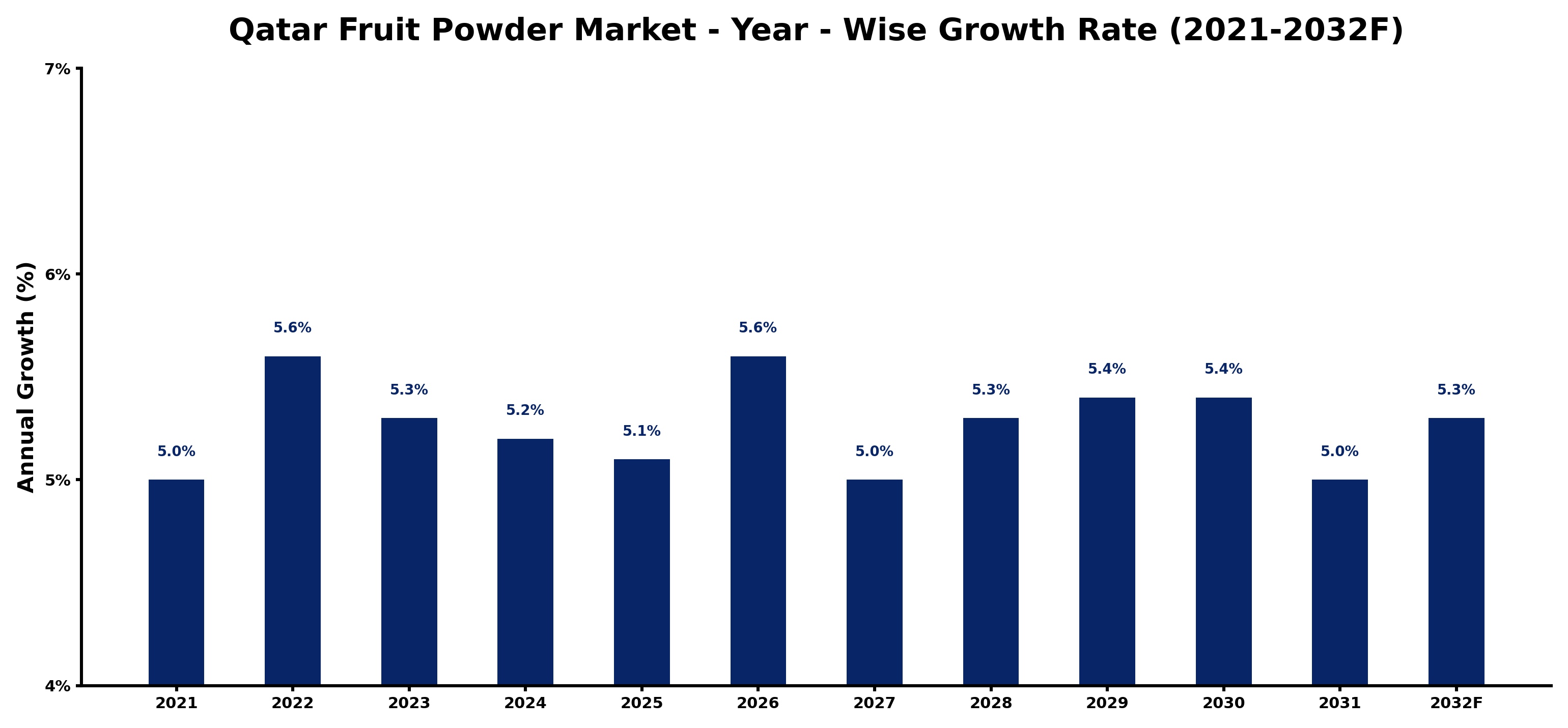
The table below presents the year‑wise growth rates along with the key drivers influencing the market
| Year | Growth Rate | Major Drivers |
| 2021 | 5.0% | Export driven fruit powder processing upgrades enhanced production efficiency |
| 2022 | 5.6% | Higher demand for fruit powder drives local manufacturing investments |
| 2023 | 5.3% | Fruit powder manufacturing investments enhance capacity utilization and export potential |
| 2024 | 5.2% | Export driven fruit powder production boosts local agricultural investment |
| 2025 | 5.1% | Fruit powder production investments align with expanding beverage manufacturing needs |
| 2026 | 5.6% | Fruit powder production scales up amid construction sector revitalization |
| 2027 | 5.0% | Fruit powder manufacturing investments boost local supply chain capacity |
| 2028 | 5.3% | Export driven fruit processing facilities enhanced local sourcing capabilities |
| 2029 | 5.4% | Fruit powder manufacturers optimize processes to boost production efficiency |
| 2030 | 5.4% | Export driven fruit powder production demands modern processing technologies |
| 2031 | 5.0% | Smart manufacturing technologies boost efficiency in fruit powder processing |
| 2032 | 5.3% | Improved logistics efficiency boosted fruit powder export capabilities |
Note - Market size estimations and growth projections presented in this report are based on 6Wresearch’s advanced forecasting approach, validated with industry datasets as of June 2026.
Qatar Fruit Powder Market Synopsis
In Qatar, the fruit powder market is bolstered by a thriving food and beverage industry, where innovative product offerings are a key focal point. The growing usage of fruit powders in diverse applications, such as beverages, snacks, and baked goods, reflects a broader trend towards healthful ingredients in culinary practices.
Moreover, the increasing availability of high-quality fruit powders, thanks to advancements in processing technologies, allows manufacturers to meet evolving consumer preferences for natural and organic options. This alignment with consumer demands further enhances the market's potential for growth.
Qatar Fruit Powder Market Key Takeaways
- The market is witnessing a robust shift towards nutritious and convenient food solutions.
- Fruit powders are being integrated across a wide range of food and beverage products.
- Advancements in processing technologies are improving product quality and variety.
- Health trends are driving consumer preferences toward natural and organic fruit powders.
- Despite challenges, the market is expected to rebound strongly post-COVID-19.
Evaluation of Restraints in Qatar Fruit Powder Market
The Qatar fruit powder market faces several genuine constraints that could hinder its growth. Maintaining consistent product quality is a significant challenge, particularly in preserving the nutritional value, flavor, and vibrant color of fruit powders during processing and storage. Variability in raw material quality further complicates this issue, potentially impacting the end product. Additionally, logistical challenges related to supply chain management, including the sourcing of quality fruits and the distribution of finished powders, present ongoing hurdles for market participants. To thrive, stakeholders must adapt to these complexities while addressing evolving consumer demands for transparency and sustainability in food sourcing.
Qatar Fruit Powder Market Trends
Current trends in the Qatar fruit powder market reflect a growing preference for health-oriented food products. Consumers are increasingly seeking natural ingredients and authentic flavors, with fruit powders seen as an appealing alternative to artificial additives. There is also a noticeable shift towards plant-based diets, which further enhances the appeal of fruit powders as versatile ingredients in vegan and vegetarian culinary creations. Additionally, the rise of e-commerce platforms is reshaping the distribution landscape, providing consumers with easier access to a variety of fruit powder products.
Qatar Fruit Powder Market Opportunities
Genuine growth and investment opportunities in the Qatar fruit powder market lie in product innovation and diversification. Developing novel blends that combine different fruit powders can cater to specific dietary preferences and health goals, tapping into niche markets. Furthermore, the expanding hospitality and foodservice sector in Qatar offers a fertile ground for bulk supply contracts, enabling fruit powder manufacturers to forge strategic partnerships and drive volume sales. Investment in advanced processing technology is also key to improving product offerings, thereby attracting a broader consumer base.
Government Initiatives in the Qatar Fruit Powder Market
The Qatari government has taken proactive steps to enhance the local food industry, which indirectly supports the fruit powder market. Initiatives aimed at promoting food security and sustainability include investments in agricultural practices and food processing technology. Furthermore, public spending on infrastructure improvements facilitates better supply chain management, encouraging companies to optimize their operations and align with the nation's vision for economic diversification. Such government support creates a favorable environment for growth in the fruit powder sector.
Future Insights of the Qatar Fruit Powder Market
Looking ahead to 2026-2032, the Qatar fruit powder market is poised for significant advancements. As consumer trends increasingly favor health and wellness, the demand for fruit powders is set to rise. Innovations in production techniques will likely improve product quality and affordability, making fruit powders more accessible to a wider audience. Additionally, with the expected recovery of the hospitality sector, market participants can anticipate enhanced demand for their products in both commercial and retail channels, ultimately driving growth across the entire industry.
Qatar Fruit Powder Market Latest Developments (May 2025 - June 2026)
Recent developments in the Qatar fruit powder market indicate a renewed focus on health and wellness product lines, with many manufacturers diversifying their portfolios to include organic options. Collaborations between food and beverage companies to create innovative products incorporating fruit powders are becoming increasingly common. Additionally, investments in supply chain enhancements are evident, as companies seek to mitigate disruptions and ensure quality raw material availability. The integration of digital technologies in marketing and distribution is also transforming how fruit powders reach consumers.
Qatar Fruit Powder Market - Key Attractiveness of the Report
- 10 Years of Market Numbers
- Historical Data Starting from 2022 to 2025
- Base Year: 2025
- Forecast Data until 2032
- Key Performance Indicators Impacting the Market
- Major Upcoming Developments and Projects
Key Highlights of the Report:
- Qatar Fruit Powder Market Outlook
- Market Size of Qatar Fruit Powder Market, 2025
- Forecast of Qatar Fruit Powder Market, 2032
- Historical Data and Forecast of Qatar Fruit Powder Revenues & Volume for the Period 2022-2032F
- Qatar Fruit Powder Market Trend Evolution
- Qatar Fruit Powder Market Drivers and Challenges
- Qatar Fruit Powder Price Trends
- Qatar Fruit Powder Porter's Five Forces
- Qatar Fruit Powder Industry Life Cycle
- Historical Data and Forecast of Qatar Fruit Powder Market Revenues & Volume By Type for the Period 2022-2032F
- Historical Data and Forecast of Qatar Fruit Powder Market Revenues & Volume By Banana for the Period 2022-2032F
- Historical Data and Forecast of Qatar Fruit Powder Market Revenues & Volume By Grapes for the Period 2022-2032F
- Historical Data and Forecast of Qatar Fruit Powder Market Revenues & Volume By Blueberry for the Period 2022-2032F
- Historical Data and Forecast of Qatar Fruit Powder Market Revenues & Volume By Mango for the Period 2022-2032F
- Historical Data and Forecast of Qatar Fruit Powder Market Revenues & Volume By others for the Period 2022-2032F
- Historical Data and Forecast of Qatar Fruit Powder Market Revenues & Volume By Application for the Period 2022-2032F
- Historical Data and Forecast of Qatar Fruit Powder Market Revenues & Volume By Bakery & Confectionery for the Period 2022-2032F
- Historical Data and Forecast of Qatar Fruit Powder Market Revenues & Volume By Dairy & Frozen Desserts for the Period 2022-2032F
- Historical Data and Forecast of Qatar Fruit Powder Market Revenues & Volume By Beverages for the Period 2022-2032F
- Historical Data and Forecast of Qatar Fruit Powder Market Revenues & Volume By Food Supplements for the Period 2022-2032F
- Historical Data and Forecast of Qatar Fruit Powder Market Revenues & Volume By others for the Period 2022-2032F
- Qatar Fruit Powder Import Export Trade Statistics
- Market Opportunity Assessment By Type
- Market Opportunity Assessment By Application
- Qatar Fruit Powder Top Companies Market Share
- Qatar Fruit Powder Competitive Benchmarking By Technical and Operational Parameters
- Qatar Fruit Powder Company Profiles
- Qatar Fruit Powder Key Strategic Recommendations






































