Qatar Gum And Wood Chemicals Market Size, Share & Growth Rate
The Qatar Gum And Wood Chemicals Market was estimated at USD 1265 Million in 2025 and is projected to reach USD 1813 Million by 2032, growing at a CAGR of 5.3% from 2026 to 2032. This robust growth is fueled by a surge in demand across various industrial sectors, particularly construction and food and beverage, which increasingly rely on gum and wood-derived chemicals. Additionally, the shift towards bio-based solutions is shaping new opportunities and expanding the market's breadth.
Qatar Gum And Wood Chemicals Market Year-wise Growth Rate and Key Drivers
This graph highlights how the Qatar Gum And Wood Chemicals Market has steadily grown over the years, supported by major growth factors.
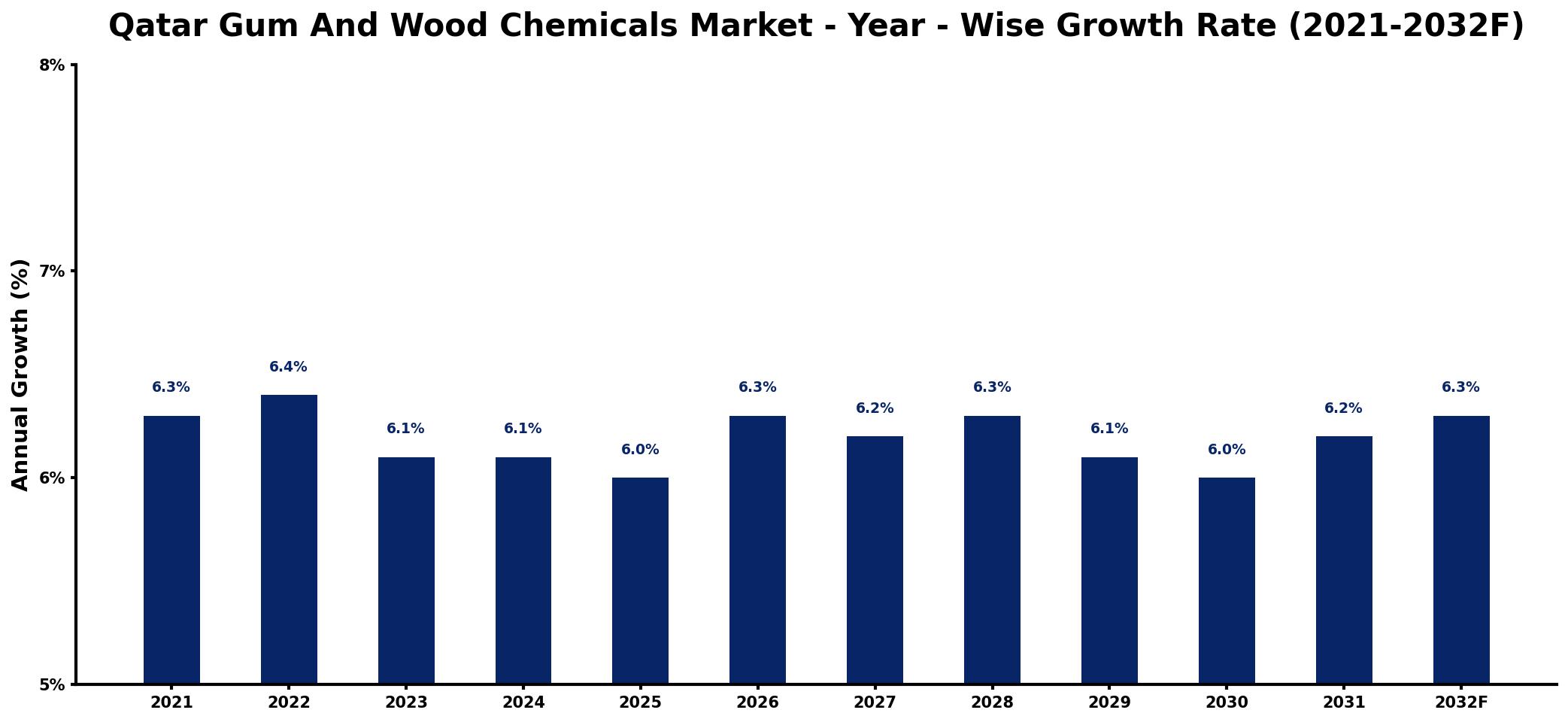
The table below presents the year‑wise growth rates along with the key drivers influencing the market
| Year | Growth Rate | Major Drivers |
| 2021 | 6.3% | Increased construction industry investments |
| 2022 | 6.4% | Rising demand from packaging sector |
| 2023 | 6.1% | Growth in automotive manufacturing applications |
| 2024 | 6.1% | Expansion of renewable energy projects |
| 2025 | 6.0% | Surge in furniture production activities |
| 2026 | 6.3% | Higher demand for sustainable materials |
| 2027 | 6.2% | increased overall sector activity |
| 2028 | 6.3% | Increased export opportunities emerging |
| 2029 | 6.1% | rising procurement volume requirements |
| 2030 | 6.0% | Rising interest in eco-friendly solutions |
| 2031 | 6.2% | increased domestic production output |
| 2032 | 6.3% | Increased focus on industrial innovation |
Note: Market size estimations and growth projections presented in this report are based on 6Wresearch's proprietary forecasting methodology, utilizing the latest available industry data, government publications, and primary research inputs.
Qatar Gum And Wood Chemicals Market Synopsis
The gum and wood chemicals market in Qatar has gained significant momentum in recent years, driven by rising industrial applications and an increasing focus on sustainability. As businesses seek environmentally friendly alternatives, the market is expected to evolve further, catering to both traditional and innovative uses of these natural resources.
Currently, the market is characterized by its diverse product range, encompassing resins, adhesives, and other compounds. The construction industry remains a pivotal sector, leveraging these chemicals for various applications such as coatings and sealants. Meanwhile, sectors like food and beverage are propelling the use of gum chemicals as stabilizers, enhancing the market's growth trajectory.
Qatar Gum And Wood Chemicals Market Key Takeaways
- The Qatar gum and wood chemicals market is benefiting from growing demand in construction, food, and beverage sectors.
- Increasing adoption of bio-based alternatives is shaping market dynamics and offering sustainable solutions.
- Challenges related to raw material availability may impact market stability but innovative practices can mitigate these risks.
- COVID-19 disruptions have led to a reshaping of market strategies, focusing on resilience and diversification.
- Key local players are committed to enhancing product quality and offering innovative chemical solutions.
Evaluation of Restraints in Qatar Gum And Wood Chemicals Market
Despite the optimistic growth outlook, the Qatar gum and wood chemicals market is confronted by significant restraints. One major hurdle is the sustainability of raw materials, particularly as the extraction and sourcing of these chemicals can fluctuate based on environmental factors. Additionally, the stringent regulatory landscape surrounding environmental impacts poses compliance challenges for businesses. Companies must navigate these regulations while striving to innovate and expand their offerings, which may require substantial investment in sustainable practices.
Qatar Gum And Wood Chemicals Market Trends
Key trends influencing the Qatar gum and wood chemicals market include a pronounced shift towards sustainable and bio-based products. Increasing awareness about environmental sustainability is prompting consumers and manufacturers alike to prefer alternatives derived from natural sources. Moreover, the ongoing digital transformation in the chemical sector is facilitating improved efficiency and innovation, leading to the development of new products that cater to emerging industrial needs.
Qatar Gum And Wood Chemicals Market Opportunities
There exists a plethora of growth opportunities within the Qatar gum and wood chemicals market, particularly in the context of the booming construction sector. With an emphasis on sustainable building practices, there is an increasing demand for environmentally friendly adhesives and sealants. Furthermore, tapping into the food and beverage industry's need for stabilizers and thickening agents presents a substantial avenue for investment and product development. As businesses innovate, there is a compelling need for products that not only meet performance standards but also align with global sustainability goals.
Government Initiatives in the Qatar Gum And Wood Chemicals Market
The Qatari government has been proactive in supporting the development of the gum and wood chemicals sector through various initiatives aimed at promoting sustainable practices. This includes funding programs that encourage research and development of eco-friendly alternatives and incentivizing industries to adopt green technologies. Public spending on infrastructure projects further enhances demand for wood chemicals, underscoring the governments role in stimulating market growth.
Future Insights of the Qatar Gum And Wood Chemicals Market
Looking ahead to 2026-2032, the Qatar gum and wood chemicals market is set to expand significantly, driven by continuous innovation and a strong focus on sustainability. The integration of advanced technologies will likely streamline production processes, allowing manufacturers to create more effective and environmentally friendly products. As global trends continue to shift towards sustainable materials, Qatar's commitment to sustainable sourcing practices will play a crucial role in shaping its market landscape.
Qatar Gum And Wood Chemicals Market Latest Developments (2025 - 2026)
Recent developments in the Qatar gum and wood chemicals market indicate a shift towards enhancing product portfolios with sustainable offerings. Companies are increasingly investing in R&D to develop innovative solutions that meet the demands of both local and international markets. Collaborative initiatives among key industry stakeholders are also emerging, aimed at sharing best practices in sustainable sourcing and production methodologies.
Qatar Gum And Wood Chemicals Market - Key Attractiveness of the Report
- 10 Years of Market Numbers
- Historical Data Starting from 2022 to 2025
- Base Year: 2025
- Forecast Data until 2032
- Key Performance Indicators Impacting the Market
- Major Upcoming Developments and Projects
Key Highlights of the Report:
- Qatar Gum And Wood Chemicals Market Outlook
- Market Size of Qatar Gum And Wood Chemicals Market, 2025
- Forecast of Qatar Gum And Wood Chemicals Market, 2032
- Historical Data and Forecast of Qatar Gum And Wood Chemicals Revenues & Volume for the Period 2022-2032F
- Qatar Gum And Wood Chemicals Market Trend Evolution
- Qatar Gum And Wood Chemicals Market Drivers and Challenges
- Qatar Gum And Wood Chemicals Price Trends
- Qatar Gum And Wood Chemicals Porter's Five Forces
- Qatar Gum And Wood Chemicals Industry Life Cycle
- Historical Data and Forecast of Qatar Gum And Wood Chemicals Market Revenues & Volume By Product Type for the Period 2022-2032F
- Historical Data and Forecast of Qatar Gum And Wood Chemicals Market Revenues & Volume By Gum Arabic for the Period 2022-2032F
- Historical Data and Forecast of Qatar Gum And Wood Chemicals Market Revenues & Volume By Guar Gum for the Period 2022-2032F
- Historical Data and Forecast of Qatar Gum And Wood Chemicals Market Revenues & Volume By Wood Chemicals for the Period 2022-2032F
- Historical Data and Forecast of Qatar Gum And Wood Chemicals Market Revenues & Volume By Charcoal for the Period 2022-2032F
- Historical Data and Forecast of Qatar Gum And Wood Chemicals Market Revenues & Volume By Tannic Acid for the Period 2022-2032F
- Historical Data and Forecast of Qatar Gum And Wood Chemicals Market Revenues & Volume By End-User for the Period 2022-2032F
- Historical Data and Forecast of Qatar Gum And Wood Chemicals Market Revenues & Volume By Commercial for the Period 2022-2032F
- Historical Data and Forecast of Qatar Gum And Wood Chemicals Market Revenues & Volume By Industrial for the Period 2022-2032F
- Historical Data and Forecast of Qatar Gum And Wood Chemicals Market Revenues & Volume By Household for the Period 2022-2032F
- Historical Data and Forecast of Qatar Gum And Wood Chemicals Market Revenues & Volume By Sales Channel for the Period 2022-2032F
- Historical Data and Forecast of Qatar Gum And Wood Chemicals Market Revenues & Volume By Direct Sales for the Period 2022-2032F
- Historical Data and Forecast of Qatar Gum And Wood Chemicals Market Revenues & Volume By Distributor for the Period 2022-2032F
- Qatar Gum And Wood Chemicals Import Export Trade Statistics
- Market Opportunity Assessment By Product Type
- Market Opportunity Assessment By End-User
- Market Opportunity Assessment By Sales Channel
- Qatar Gum And Wood Chemicals Top Companies Market Share
- Qatar Gum And Wood Chemicals Competitive Benchmarking By Technical and Operational Parameters
- Qatar Gum And Wood Chemicals Company Profiles
- Qatar Gum And Wood Chemicals Key Strategic Recommendations






































