Qatar Home Furniture and Bedding Market Size, Share & Growth Rate
The Qatar Home Furniture and Bedding Market was estimated at USD 151 Million in 2025 and is projected to reach USD 211 Million by 2032, growing at a CAGR of 4.9% from 2026 to 2032. This growth trajectory is being propelled by increasing disposable incomes among consumers, alongside a strong urbanization trend that has resulted in a surge in both residential construction and interior design interest. As Qatar's economy continues to strengthen, spending on home décor, particularly luxury furniture, is expected to rise significantly.
Qatar Home Furniture and Bedding Market Year-wise Growth Rate and Key Drivers
This graph highlights how the Qatar Home Furniture and Bedding Market has steadily grown over the years, supported by major growth factors.
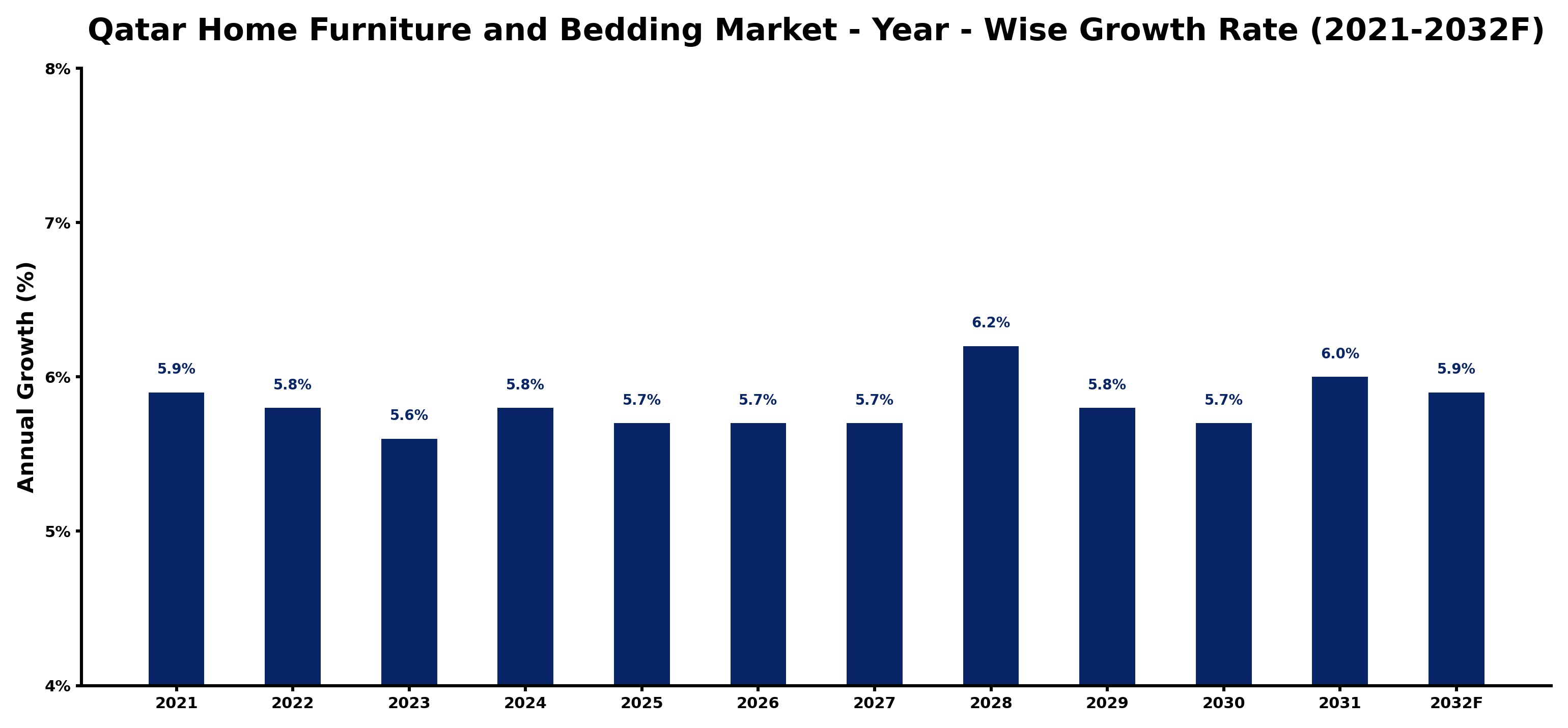
The table below presents the year‑wise growth rates along with the key drivers influencing the market
| Year | Growth Rate | Major Drivers |
| 2021 | 5.9% | Increased urbanization drives demand |
| 2022 | 5.8% | Rising disposable incomes support spending |
| 2023 | 5.6% | Home renovation trends boost sales |
| 2024 | 5.8% | E-commerce growth enhances accessibility |
| 2025 | 5.7% | Sustainable furniture popularity rises sharply |
| 2026 | 5.7% | Smart home integration attracts consumers |
| 2027 | 5.7% | Luxury furniture market expands rapidly |
| 2028 | 6.2% | Design innovation captivates consumers |
| 2029 | 5.8% | Local craftsmanship gains market traction |
| 2030 | 5.7% | Health-conscious bedding options emerge |
| 2031 | 6.0% | Collaborative design experiences flourish |
| 2032 | 5.9% | Cultural influences shape furniture styles |
Note - Market size estimations and growth projections presented in this report are based on 6Wresearch's advanced forecasting approach, validated with industry datasets as of June 2026.
Qatar Home Furniture and Bedding Market Synopsis
Urbanization is the primary force shaping the Qatar Home Furniture and Bedding Market today. The influx of both local residents and expatriates is driving demand for a diverse range of stylish and functional furniture options that complement modern living spaces. This dynamic is further fueled by a heightened focus on aesthetic appeal and comfort in home environments.
Moreover, the evolving consumer preferences for bespoke and luxury items are reshaping the competitive landscape. As residents seek to personalize their living spaces, there is a growing inclination towards high-quality, innovative designs that marry comfort with sophistication, positioning the market for sustained growth.
Qatar Home Furniture and Bedding Market Key Takeaways
- Urbanization and increased disposable incomes are key growth drivers in the market.
- The market is evolving due to changing consumer preferences for stylish and sustainable furniture.
- Demand for ergonomic and comfortable products has surged post-COVID-19.
- Expatriate population growth significantly influences furniture and bedding purchases.
- Key players in the market are adapting to new trends, focusing on both quality and aesthetics.
Evaluation of Restraints in Qatar Home Furniture and Bedding Market
While the market displays promising growth, certain factors impose limitations on its potential. Economic fluctuations can deter consumers from making substantial investments in furniture, particularly luxury items. Additionally, the rapid pace of design changes requires companies to stay ahead of trends, necessitating ongoing investment in innovation and adaptation. This pressure for constant evolution can strain resources and hinder competitiveness, particularly for smaller manufacturers aiming to capture market share.
Qatar Home Furniture and Bedding Market Trends
Several trends are currently shaping the Qatar Home Furniture and Bedding Market. A strong focus on sustainability is emerging, with consumers increasingly preferring products made from eco-friendly materials. Additionally, there is a noticeable shift toward online shopping, driven by technological advancements and changing shopping behaviors. Virtual consultations and augmented reality tools are also becoming prevalent, enhancing the customer experience in furniture selection. Furthermore, multifunctional furniture designed for space optimization is gaining traction as urban living spaces become more compact.
Qatar Home Furniture and Bedding Market Opportunities
The Qatar Home Furniture and Bedding Market presents significant growth opportunities, particularly in the realm of online retail. E-commerce platforms can tap into a wider customer base, especially among the tech-savvy younger generation. Additionally, there are potential avenues for luxury and bespoke furniture lines as affluent consumers seek personalized solutions. With the growing expatriate population, companies that offer culturally relevant designs can leverage this demographic for further market penetration. Innovative marketing strategies that highlight sustainability and customization are likely to resonate well with consumers and encourage higher spending.
Government Initiatives in the Qatar Home Furniture and Bedding Market
The Qatari government is actively promoting initiatives aimed at enhancing the residential sector, which indirectly supports the home furniture and bedding market. Investments in urban development and infrastructure projects encourage homeownership and improve living conditions, fostering a demand for furniture. Moreover, government policies aimed at diversifying the economy and promoting tourism can create a favorable environment for home décor industries, leading to increased opportunities for local and international businesses alike.
Future Insights of the Qatar Home Furniture and Bedding Market
Looking ahead to 2026-2032, the Qatar Home Furniture and Bedding Market is poised for robust growth. As the economy stabilizes and consumer confidence returns, the demand for high-quality, aesthetically appealing products is expected to increase significantly. Innovations in design, coupled with a surge in online shopping and a heightened emphasis on sustainability, will continue to drive consumer interest. The market's future will largely depend on its ability to adapt to changing trends and consumer needs, ensuring that it remains relevant in an increasingly competitive landscape.
Qatar Home Furniture and Bedding Market Latest Developments (May 2025 - June 2026)
Recent industry developments in the Qatar home furniture and bedding sector reflect a strong adaptation to consumer preferences, particularly in the wake of the pandemic. Companies are enhancing their online platforms to cater to changing shopping behaviors, and many are incorporating sustainable practices into their operations. Collaborative ventures between local artisans and global brands are emerging, introducing unique design elements that appeal to the luxury market. Furthermore, customer engagement strategies, such as virtual showrooms and tailored consultations, are becoming increasingly prevalent.
Qatar Home Furniture and Bedding Market - Key Attractiveness of the Report
- 10 Years of Market Numbers
- Historical Data Starting from 2022 to 2025
- Base Year: 2025
- Forecast Data until 2032
- Key Performance Indicators Impacting the Market
- Major Upcoming Developments and Projects
Key Highlights of the Report:
- Qatar Home Furniture and Bedding Market Outlook
- Market Size of Qatar Home Furniture and Bedding Market, 2025
- Forecast of Qatar Home Furniture and Bedding Market, 2032
- Historical Data and Forecast of Qatar Home Furniture and Bedding Revenues & Volume for the Period 2022-2032F
- Qatar Home Furniture and Bedding Market Trend Evolution
- Qatar Home Furniture and Bedding Market Drivers and Challenges
- Qatar Home Furniture and Bedding Price Trends
- Qatar Home Furniture and Bedding Porter's Five Forces
- Qatar Home Furniture and Bedding Industry Life Cycle
- Historical Data and Forecast of Qatar Home Furniture and Bedding Market Revenues & Volume By Product Type for the Period 2022-2032F
- Historical Data and Forecast of Qatar Home Furniture and Bedding Market Revenues & Volume By Sofa for the Period 2022-2032F
- Historical Data and Forecast of Qatar Home Furniture and Bedding Market Revenues & Volume By Bed for the Period 2022-2032F
- Historical Data and Forecast of Qatar Home Furniture and Bedding Market Revenues & Volume By Chair for the Period 2022-2032F
- Historical Data and Forecast of Qatar Home Furniture and Bedding Market Revenues & Volume By Cupboard for the Period 2022-2032F
- Historical Data and Forecast of Qatar Home Furniture and Bedding Market Revenues & Volume By Others for the Period 2022-2032F
- Historical Data and Forecast of Qatar Home Furniture and Bedding Market Revenues & Volume By Sales Channel for the Period 2022-2032F
- Historical Data and Forecast of Qatar Home Furniture and Bedding Market Revenues & Volume By Online for the Period 2022-2032F
- Historical Data and Forecast of Qatar Home Furniture and Bedding Market Revenues & Volume By Offline for the Period 2022-2032F
- Qatar Home Furniture and Bedding Import Export Trade Statistics
- Market Opportunity Assessment By Product Type
- Market Opportunity Assessment By Sales Channel
- Qatar Home Furniture and Bedding Top Companies Market Share
- Qatar Home Furniture and Bedding Competitive Benchmarking By Technical and Operational Parameters
- Qatar Home Furniture and Bedding Company Profiles
- Qatar Home Furniture and Bedding Key Strategic Recommendations






































