Qatar Iron chloride Market Size, Share & Growth Rate
The Qatar Iron chloride Market was estimated at USD 362 Million in 2025 and is projected to reach USD 476 Million by 2032, growing at a CAGR of 4.0% from 2026 to 2032. This growth trajectory is largely fueled by increasing investment in water treatment infrastructure and industrial developments in Qatar. As the demand for effective flocculants in wastewater treatment and industrial processes rises, so does the consumption of iron chloride, driving market expansion.
Qatar Iron chloride Market Year-wise Growth Rate and Key Drivers
This graph highlights how the Qatar Iron chloride Market has steadily grown over the years, supported by major growth factors.
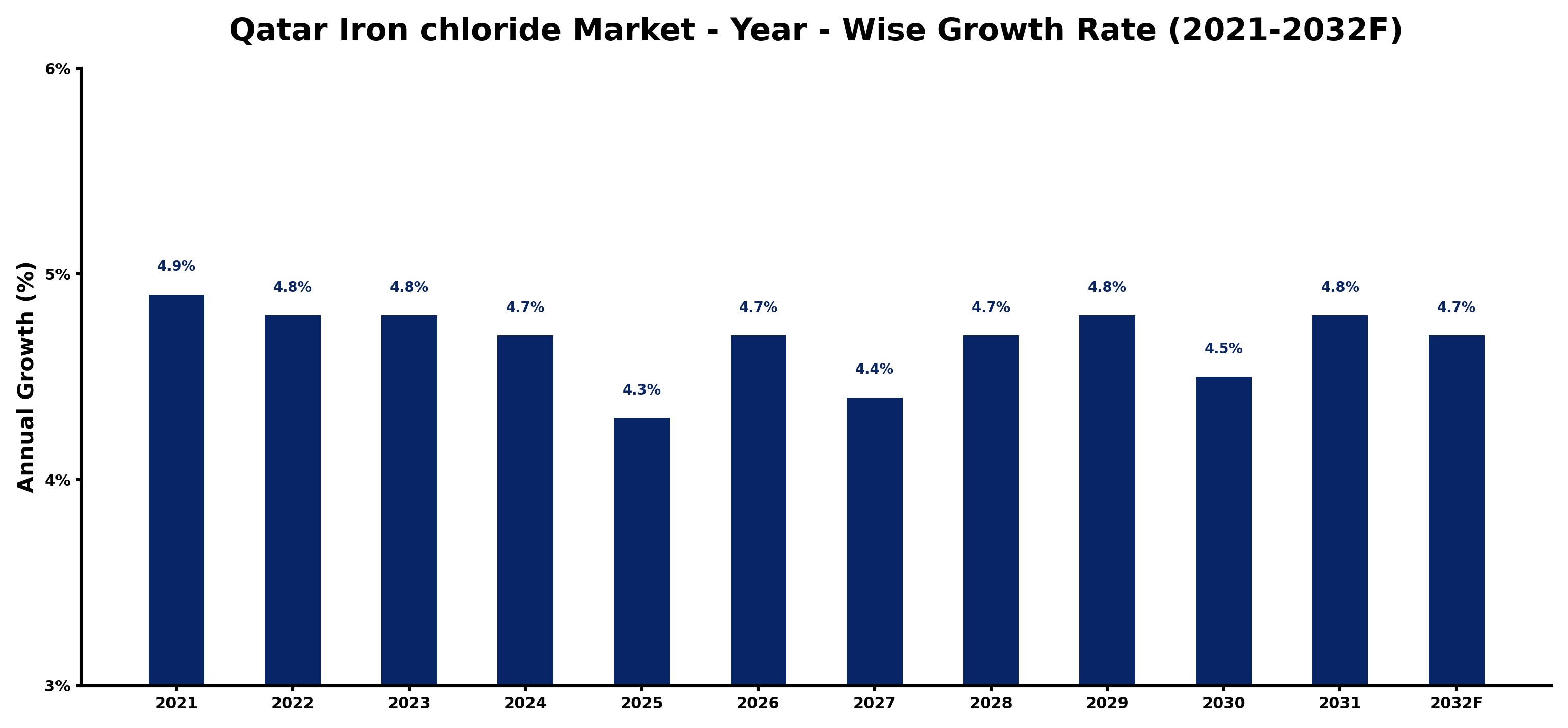
The table below presents the year‑wise growth rates along with the key drivers influencing the market
| Year | Growth Rate | Major Drivers |
| 2021 | 4.9% | Increased LNG infrastructure projects boost iron chloride production capacity |
| 2022 | 4.8% | Technology integration in LNG infrastructure boosts iron chloride demand |
| 2023 | 4.8% | LNG infrastructure projects boost demand for specialty iron chloride formulations |
| 2024 | 4.7% | LNG infrastructure projects boosted demand for iron chloride applications |
| 2025 | 4.3% | LNG infrastructure expansion drives demand for iron chloride applications |
| 2026 | 4.7% | Domestic refinery maintenance boosted demand for iron chloride applications |
| 2027 | 4.4% | Strengthened construction modernization drives demand for iron chloride applications |
| 2028 | 4.7% | LNG infrastructure upgrades boost demand for iron chloride production |
| 2029 | 4.8% | Export driven manufacturing investments boost iron chloride production capacity |
| 2030 | 4.5% | Construction modernization drives demand for iron chloride in Qatar |
| 2031 | 4.8% | LNG infrastructure projects drove demand for iron chloride supply |
| 2032 | 4.7% | Technology integration in construction boosts iron chloride production efficiency |
Note - Market size estimations and growth projections presented in this report are based on 6Wresearch’s advanced forecasting approach, validated with industry datasets as of June 2026.
Qatar Iron chloride Market Synopsis
The primary force shaping the Qatar Iron chloride market is the growing emphasis on water management and industrial efficiency. As Qatar continues to invest heavily in these sectors, iron chloride's role as a critical agent for coagulating impurities in water treatment applications becomes increasingly vital. This development is further propelled by regulatory frameworks promoting environmental sustainability in industrial operations.
Additionally, the construction of wastewater treatment plants and heightened industrial activities contribute to the robust demand for iron chloride. As companies strive to meet both domestic and international environmental standards, the necessity for effective treatment solutions drives the adoption of iron chloride across various applications.
Qatar Iron chloride Market Key Takeaways
- The market is set to grow significantly due to increased demand from the water treatment and construction sectors.
- Investment in infrastructure development will be a key driver of iron chloride consumption in Qatar.
- Safe handling and disposal practices will remain crucial as regulatory scrutiny on environmental impacts heightens.
- Emerging technologies and innovative applications are anticipated to create new growth avenues within the market.
- COVID-19 disruptions have affected the market dynamics, but recovery is expected as economic activities normalize.
Evaluation of Restraints in Qatar Iron chloride Market
Despite the promising growth outlook, the Qatar Iron chloride market faces significant restraints related to safety and environmental impacts. The handling and disposal of iron chloride solutions pose environmental risks if not managed correctly. There are concerns about potential contamination and health hazards associated with improper practices. Market stakeholders must prioritize the establishment of safe handling guidelines and invest in training and resources to mitigate these risks, ensuring sustainable growth in the industry.
Qatar Iron chloride Market Trends
Current trends in the Qatar Iron chloride market indicate a shift towards more sustainable and innovative applications. The push for greener industrial processes is prompting manufacturers to seek alternatives that reduce environmental impact. Simultaneously, advancements in water treatment technologies are making iron chloride an attractive solution for both urban and rural applications. The increased focus on efficiency and regulatory compliance is driving the demand for high-purity grades of iron chloride, which can enhance treatment effectiveness.
Qatar Iron chloride Market Opportunities
The market presents several opportunities, particularly in the realm of water treatment solutions and industrial applications. As Qatar focuses on expanding its water management capabilities, there is potential for significant growth in iron chloride use. Moreover, with the government emphasizing infrastructure development, industries such as construction and manufacturing are likely to increase their reliance on iron chloride for various processes, creating robust avenues for investment and partnership.
Government Initiatives in the Qatar Iron chloride Market
The Qatari government is actively promoting policies aimed at sustainable industrial practices and water conservation. Public spending on infrastructure projects, particularly in water treatment and waste management, has increased significantly. Additionally, initiatives supporting environmental compliance and enhancing industrial efficiency are expected to foster growth in the iron chloride market. These governmental priorities create a conducive environment for market expansion and innovation.
Future Insights of the Qatar Iron chloride Market
Looking ahead to 2026-2032, the Qatar Iron chloride market is poised for steady growth, fueled by ongoing investments in water treatment and industrial sectors. As technology continues to evolve and sustainability becomes a central theme in industrial operations, the demand for effective treatment solutions like iron chloride will only intensify. Furthermore, addressing environmental concerns and implementing robust safety measures will be critical in shaping the future landscape of the market.
Qatar Iron chloride Market Latest Developments (May 2025 - June 2026)
Recent developments in the Qatar Iron chloride market indicate a growing trend towards sustainability and innovation. Companies are exploring advanced methods for the production and application of iron chloride to enhance its efficiency and reduce environmental footprints. Alongside this, increasing collaborations and partnerships among industry players are expected to drive research and development efforts focused on expanding the utility of iron chloride in various applications.
Qatar Iron chloride Market - Key Attractiveness of the Report
- 10 Years of Market Numbers
- Historical Data Starting from 2022 to 2025
- Base Year: 2025
- Forecast Data until 2032
- Key Performance Indicators Impacting the Market
- Major Upcoming Developments and Projects
Key Highlights of the Report:
- Qatar Iron chloride Market Outlook
- Market Size of Qatar Iron chloride Market, 2025
- Forecast of Qatar Iron chloride Market, 2032
- Historical Data and Forecast of Qatar Iron chloride Revenues & Volume for the Period 2022-2032F
- Qatar Iron chloride Market Trend Evolution
- Qatar Iron chloride Market Drivers and Challenges
- Qatar Iron chloride Price Trends
- Qatar Iron chloride Porter's Five Forces
- Qatar Iron chloride Industry Life Cycle
- Historical Data and Forecast of Qatar Iron chloride Market Revenues & Volume By Type for the Period 2022-2032F
- Historical Data and Forecast of Qatar Iron chloride Market Revenues & Volume By Ferric Chloride for the Period 2022-2032F
- Historical Data and Forecast of Qatar Iron chloride Market Revenues & Volume By Ferrous Chloride for the Period 2022-2032F
- Historical Data and Forecast of Qatar Iron chloride Market Revenues & Volume By Application for the Period 2022-2032F
- Historical Data and Forecast of Qatar Iron chloride Market Revenues & Volume By Water and Sewage Treatment Industry for the Period 2022-2032F
- Historical Data and Forecast of Qatar Iron chloride Market Revenues & Volume By Metal Surface Treatment Industry for the Period 2022-2032F
- Historical Data and Forecast of Qatar Iron chloride Market Revenues & Volume By PCB Industry for the Period 2022-2032F
- Historical Data and Forecast of Qatar Iron chloride Market Revenues & Volume By Pigment Industry for the Period 2022-2032F
- Qatar Iron chloride Import Export Trade Statistics
- Market Opportunity Assessment By Type
- Market Opportunity Assessment By Application
- Qatar Iron chloride Top Companies Market Share
- Qatar Iron chloride Competitive Benchmarking By Technical and Operational Parameters
- Qatar Iron chloride Company Profiles
- Qatar Iron chloride Key Strategic Recommendations






































