Qatar Malt Beverages Market Summary
The qatar malt beverages market was estimated at USD 407 Million in 2025 and is projected to reach USD 732 Million by 2032, growing at a CAGR of 10.1% from 2026 to 2032.
Qatar Malt Beverages Market Year-wise Growth Rate and Key Drivers
This graph highlights how the Qatar Malt Beverages Market has steadily grown over the past five years, supported by major growth factors.
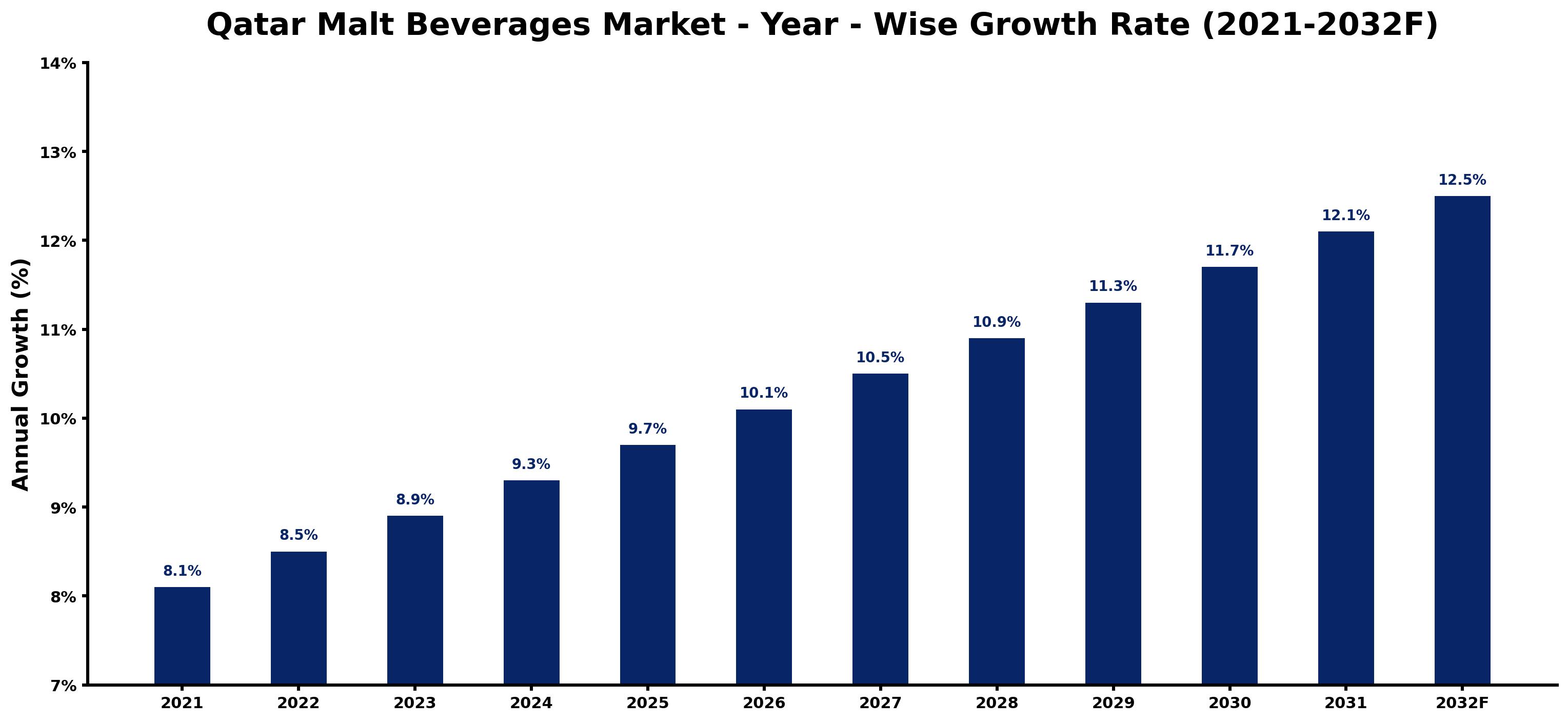
The table below presents the year wise growth rates along with the key drivers influencing the market
| Year | Growth Rate | Major Drivers |
| 2021 | 8.1% | Consumer preferences shifted towards non-alcoholic beverages amid health trends. |
| 2022 | 8.5% | Premiumization occurred as brands launched innovative flavored malt beverages. |
| 2023 | 8.9% | Increased local production capacity met growing demands for Qatari malt drinks. |
| 2024 | 9.3% | Young consumers are increasingly seeking unique beverage experiences and flavors. |
| 2025 | 9.7% | Local festivals and events featured malt beverages, boosting brand visibility and sales. |
| 2026 | 10.1% | Collaborations between local breweries and international brands enhanced product offerings. |
| 2027 | 10.5% | Rising tourism in Qatar expanded market opportunities for malt beverages. |
| 2028 | 10.9% | Health-conscious consumers drove demand for lower-calorie malt beverage options. |
| 2029 | 11.3% | Sustainable packaging initiatives attracted environmentally aware buyers to malt products. |
| 2030 | 11.7% | Distribution channels diversified, making malt beverages more accessible in remote areas. |
| 2031 | 12.1% | E-commerce platforms grew significantly, facilitating direct-to-consumer malt sales. |
| 2032 | 12.5% | Strong community engagement efforts by brands fostered loyalty among consumers. |
Note - Market size estimations and growth projections presented in this report are based on 6Wresearch's advanced forecasting approach, validated with industry datasets as of June 2026.
Qatar Malt Beverages Market Synopsis
The Qatar Malt Beverages Market is projected to reach 10.1% and witness significant growth during the forecast period (2026-2032). Since 2018, Qatar has established itself as a burgeoning hub for malt beverages, characterized by sustained increases in production, consumption, and sales. The rise in popularity can be attributed to the inherent versatility of malt beverages and the growing awareness of their health benefits. Moreover, the expanding tourism sector has spurred demand among visitors eager to experience local flavors, contributing to a vibrant marketplace for malt beverages.
Qatar Malt Beverages Market Growth Drivers
The growth of the Qatar Malt Beverages Market is primarily driven by several factors:
- The increase in Qatar's population has created a larger consumer base, leading to heightened demand for various beverage options, including malt beverages.
- Urbanization has accelerated the exposure of the local populace to emerging food trends, notably the rise of craft beers that have captivated both residents and tourists.
- Government initiatives aimed at promoting healthier lifestyles have fostered demand for non-alcoholic beer options, which typically feature lower sugar and alcohol content.
- The growing interest in local flavors among tourists has resulted in increased sales for malt beverages, with establishments eager to cater to diverse preferences.
- Despite challenging economic factors, the convenience and appeal of malt beverages have propelled their consumption, creating further opportunities for market participants.
Qatar Malt Beverages Market Challenges and Restraints
While the Qatar Malt Beverages Market presents several growth opportunities, it is not without challenges:
- High tax rates imposed on production and sales can hinder the competitiveness of local brewers against international players, impacting pricing strategies.
- The lack of robust distribution networks complicates logistics for sourcing raw materials and delivering finished products to consumers.
- Limited marketing budgets constrain promotional efforts, making it difficult for smaller brands to enhance visibility in an increasingly competitive marketplace.
- A lack of consumer education surrounding craft beers can pose challenges, as many potential customers remain unaware of the variety and quality available within the sector.
- Ongoing fluctuations in global supply chains can disrupt the availability of ingredients, affecting production schedules and overall market stability.
Qatar Malt Beverages Market Covid-19 Impact
The Covid-19 pandemic has profoundly influenced the dynamics of the Qatar Malt Beverages Market. Heightened restrictions led to significant declines in sales and revenue, particularly in the hospitality sector, which is a primary consumer of malt beverages. Social distancing measures and attendance limitations at venues have further curtailed consumption. Additionally, supply chain disruptions have delayed product deliveries, compounding the challenges faced by businesses. Overall, these factors have resulted in decreased demand across various channels, including retail outlets, bars, and restaurants, ultimately affecting sales volume and revenue generation within the market.
Qatar Malt Beverages Market Government Investment and Initiatives
The Qatari government has been proactive in fostering an environment conducive to the growth of the malt beverage sector through various initiatives. Efforts to attract foreign investment in local breweries have been paramount, aiming to strengthen the domestic market while enhancing product diversity. Regulatory reforms promoting healthy lifestyle choices have also played a crucial role in shaping consumer preferences towards low-alcohol and non-alcoholic beverages. The government's commitment to improving infrastructure, including logistics and distribution channels, is also intended to facilitate the smooth operation of malt beverage production and sales. Such investments are expected to catalyze future growth and innovation within the sector.
Qatar Malt Beverages Market Latest Developments (May 2025 - June 2026)
Recent developments in the Qatar Malt Beverages Market from May 2025 to June 2026 have indicated a continuing trend towards diversification and innovation. Industry players are increasingly focusing on health-conscious options to meet the changing preferences of consumers. Moreover, there has been a noticeable rise in collaborations between brewers and local tourism businesses to enhance product visibility and facilitate unique tasting experiences for visitors. With increasing awareness of local flavors, more craft malt beverages are entering the market, promoting regional characteristics. Additionally, logistical improvements and investments in digital marketing strategies are emerging as key focus areas for businesses aiming to expand their reach within the local market.
Qatar Malt Beverages Market - Key Attractiveness of the Report
- 10 Years of Market Numbers
- Historical Data Starting from 2022 to 2025
- Base Year: 2025
- Forecast Data until 2032
- Key Performance Indicators Impacting the Market
- Major Upcoming Developments and Projects
Key Highlights of the Report:
- Qatar Malt Beverages Market Outlook
- Market Size of Qatar Malt Beverages Market, 2025
- Forecast of Qatar Malt Beverages Market, 2032
- Historical Data and Forecast of Qatar Malt Beverages Revenues & Volume for the Period 2022-2032F
- Qatar Malt Beverages Market Trend Evolution
- Qatar Malt Beverages Market Drivers and Challenges
- Qatar Malt Beverages Price Trends
- Qatar Malt Beverages Porter's Five Forces
- Qatar Malt Beverages Industry Life Cycle
- Historical Data and Forecast of Qatar Malt Beverages Market Revenues & Volume By Product Type for the Period 2022-2032F
- Historical Data and Forecast of Qatar Malt Beverages Market Revenues & Volume By Flavored for the Period 2022-2032F
- Historical Data and Forecast of Qatar Malt Beverages Market Revenues & Volume By Unflavored for the Period 2022-2032F
- Historical Data and Forecast of Qatar Malt Beverages Market Revenues & Volume By Applications for the Period 2022-2032F
- Historical Data and Forecast of Qatar Malt Beverages Market Revenues & Volume By Alcoholic for the Period 2022-2032F
- Historical Data and Forecast of Qatar Malt Beverages Market Revenues & Volume By Non-Alcoholic for the Period 2022-2032F
- Qatar Malt Beverages Import Export Trade Statistics
- Market Opportunity Assessment By Product Type
- Market Opportunity Assessment By Applications
- Qatar Malt Beverages Top Companies Market Share
- Qatar Malt Beverages Competitive Benchmarking By Technical and Operational Parameters
- Qatar Malt Beverages Company Profiles
- Qatar Malt Beverages Key Strategic Recommendations






































