Qatar Microprocessor Market Size, Share & Growth Rate
The Qatar Microprocessor Market was estimated at USD 391 Million in 2025 and is projected to reach USD 553 Million by 2032, growing at a CAGR of 5.1% from 2026 to 2032. This growth trajectory is driven by Qatar's commitment to digital transformation across various sectors, including telecommunications and finance. As the country invests in technological advancements, the demand for efficient and high-performance microprocessors is expected to surge, reflecting a broader trend towards automation and smart technologies.
Qatar Microprocessor Market Year-wise Growth Rate and Key Drivers
This graph highlights how the Qatar Microprocessor Market has steadily grown over the years, supported by major growth factors.
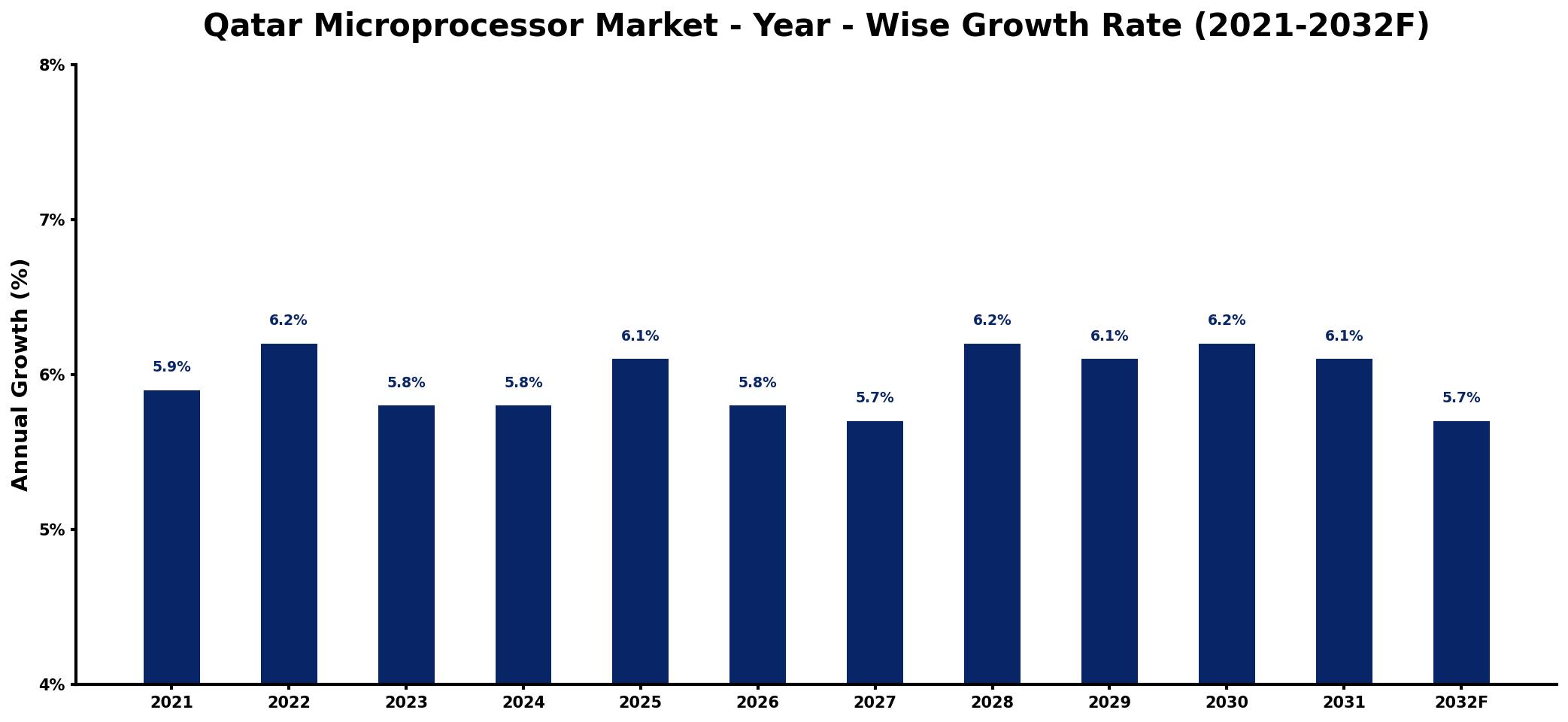
The table below presents the year‑wise growth rates along with the key drivers influencing the market
| Year | Growth Rate | Major Drivers |
| 2021 | 5.9% | Rising demand for smart devices |
| 2022 | 6.2% | Expansion of local tech startups |
| 2023 | 5.8% | Increased investments in innovation |
| 2024 | 5.8% | Growing adoption of AI solutions |
| 2025 | 6.1% | Surge in cloud computing services |
| 2026 | 5.8% | Boost in data center operations |
| 2027 | 5.7% | Heightened focus on sustainability initiatives |
| 2028 | 6.2% | Emergence of 5G technology applications |
| 2029 | 6.1% | Strengthening of regional tech partnerships |
| 2030 | 6.2% | Growth in automotive electronics sector |
| 2031 | 6.1% | Advancements in IoT infrastructure |
| 2032 | 5.7% | Rising consumer electronics demand |
Note: Market size estimations and growth projections presented in this report are based on 6Wresearch's proprietary forecasting methodology, utilizing the latest available industry data, government publications, and primary research inputs.
Qatar Microprocessor Market Synopsis
Currently, Qatar's microprocessor market is characterized by rapid technological advancements and a burgeoning demand for high-performance computing solutions. Driven by increasing digitalization, industries are seeking innovative microprocessor technologies to enhance their capabilities in both consumer electronics and industrial applications.
As Qatar continues its journey towards becoming a regional technology hub, the market for microprocessors is poised for significant expansion. With a growing focus on research and development, local and international players are strategically positioning themselves to capitalize on the country's ambitious technological goals.
Qatar Microprocessor Market Key Takeaways
- The Qatar Microprocessor Market is experiencing robust growth fueled by increased demand for digital transformation.
- Technological advancements and automation in various sectors are driving the need for high-performance microprocessors.
- Import reliance poses challenges in ensuring stable microprocessor supply chains.
- Investment in R&D and smart technologies is crucial for market participants.
- Key industry players are actively engaged in providing innovative microprocessor solutions to meet rising demands.
Evaluation of Restraints in Qatar Microprocessor Market
Despite its promising growth, the Qatar microprocessor market faces significant constraints that could limit its potential. The reliance on imported electronics and technology components introduces vulnerability to price fluctuations and potential supply chain disruptions. Such volatility can hinder the timely availability of microprocessors needed for various industries, particularly electronics manufacturing and data centers. Additionally, the market contends with a shortage of skilled professionals capable of microprocessor programming and maintenance, which can further strain growth prospects. Navigating these challenges requires strategic industry partnerships and investment in local talent development.
Qatar Microprocessor Market Trends
Several key trends are shaping the Qatar microprocessor market. The rise of Internet of Things (IoT) devices is driving demand for energy-efficient microprocessors that can support a myriad of smart applications. Moreover, the shift towards edge computing is fostering interest in microprocessors that offer low latency and real-time processing capabilities. Additionally, as Qatar focuses on enhancing its technological infrastructure, there's a marked trend towards adopting AI-driven microprocessor technologies to improve efficiency and performance across sectors.
Qatar Microprocessor Market Opportunities
Genuine growth opportunities abound in the Qatar microprocessor market, particularly in sectors aligned with the nations digital transformation agenda. As industries such as telecommunications, finance, and healthcare prioritize automation and smart technology adoption, there is an escalating demand for cutting-edge microprocessor solutions. Furthermore, with government incentives to enhance R&D initiatives, market participants can explore partnerships and collaborations aimed at developing localized solutions tailored to meet specific market needs.
Government Initiatives in the Qatar Microprocessor Market
The Qatari government has implemented several initiatives aimed at fostering growth in the microprocessor market. Key policies are focused on promoting technological innovation and digital infrastructure development. Public investments in smart technologies, coupled with support for research and development, create an enabling environment for local enterprises to thrive. These initiatives not only encourage domestic capabilities but also aim to attract foreign investments in high-tech sectors, ultimately enhancing the overall competitiveness of Qatar's microprocessor market.
Future Insights of the Qatar Microprocessor Market
Looking ahead to 2026-2032, the Qatar microprocessor market is set to embark on a significant growth trajectory. With ongoing investments in digital infrastructure, particularly in smart cities and IoT applications, the demand for advanced microprocessors is expected to escalate. As the nation progresses towards becoming a technology hub, industry participants will likely focus on developing innovative solutions that cater to emerging trends, such as AI integration and energy efficiency. The convergence of these factors will shape a dynamic and competitive landscape, positioning Qatar as a leader in microprocessor technology within the region.
Qatar Microprocessor Market Latest Developments (2025 - 2026)
In the recent months, the Qatar microprocessor market has seen significant developments as industry players continue to innovate and respond to evolving market needs. Efforts have been directed towards enhancing microprocessor efficiency and integrating advanced technologies such as AI and machine learning. Additionally, collaborative initiatives between government entities and private sector players are gaining momentum, aimed at fostering local capabilities and reducing reliance on imports. These directions signal a commitment to establishing a robust ecosystem for microprocessor technology in Qatar.
Qatar Microprocessor Market - Key Attractiveness of the Report
- 10 Years of Market Numbers
- Historical Data Starting from 2022 to 2025
- Base Year: 2025
- Forecast Data until 2032
- Key Performance Indicators Impacting the Market
- Major Upcoming Developments and Projects
Key Highlights of the Report:
- Qatar Microprocessor Market Outlook
- Market Size of Qatar Microprocessor Market, 2025
- Forecast of Qatar Microprocessor Market, 2032
- Historical Data and Forecast of Qatar Microprocessor Revenues & Volume for the Period 2022-2032F
- Qatar Microprocessor Market Trend Evolution
- Qatar Microprocessor Market Drivers and Challenges
- Qatar Microprocessor Price Trends
- Qatar Microprocessor Porter's Five Forces
- Qatar Microprocessor Industry Life Cycle
- Historical Data and Forecast of Qatar Microprocessor Market Revenues & Volume By Technology for the Period 2022-2032F
- Historical Data and Forecast of Qatar Microprocessor Market Revenues & Volume By CISC for the Period 2022-2032F
- Historical Data and Forecast of Qatar Microprocessor Market Revenues & Volume By RISC for the Period 2022-2032F
- Historical Data and Forecast of Qatar Microprocessor Market Revenues & Volume By ASIC for the Period 2022-2032F
- Historical Data and Forecast of Qatar Microprocessor Market Revenues & Volume By Superscalar for the Period 2022-2032F
- Historical Data and Forecast of Qatar Microprocessor Market Revenues & Volume By DSP for the Period 2022-2032F
- Historical Data and Forecast of Qatar Microprocessor Market Revenues & Volume By Application for the Period 2022-2032F
- Historical Data and Forecast of Qatar Microprocessor Market Revenues & Volume By Smartphones for the Period 2022-2032F
- Historical Data and Forecast of Qatar Microprocessor Market Revenues & Volume By Personal Computers for the Period 2022-2032F
- Historical Data and Forecast of Qatar Microprocessor Market Revenues & Volume By Servers for the Period 2022-2032F
- Historical Data and Forecast of Qatar Microprocessor Market Revenues & Volume By Tablets for the Period 2022-2032F
- Historical Data and Forecast of Qatar Microprocessor Market Revenues & Volume By Embedded Devices for the Period 2022-2032F
- Historical Data and Forecast of Qatar Microprocessor Market Revenues & Volume By Others for the Period 2022-2032F
- Qatar Microprocessor Import Export Trade Statistics
- Market Opportunity Assessment By Technology
- Market Opportunity Assessment By Application
- Qatar Microprocessor Top Companies Market Share
- Qatar Microprocessor Competitive Benchmarking By Technical and Operational Parameters
- Qatar Microprocessor Company Profiles
- Qatar Microprocessor Key Strategic Recommendations






































