Qatar Mineral Oil Market Size, Share & Growth Rate
The Qatar Mineral Oil Market was estimated at USD 346 Million in 2025 and is projected to reach USD 473 Million by 2032, growing at a CAGR of 4.6% from 2026 to 2032. This growth trajectory is propelled by the burgeoning oil and gas sector in Qatar, which serves as a backbone for mineral oil demand. The expansion of industrialization, coupled with rising GDP per capita and increased consumer confidence, further fuels the market's growth potential.
Qatar Mineral Oil Market Growth Rate Analysis (2021-2032)
The Qatar mineral oil market has exhibited steady growth, highlighted by a 5.8% increase in 2023, following slightly lower rates of 5.2% in 2021 and 5.3% in 2022. This trend is supported by robust industrial activity and heightened consumer demand, driven by the country's ongoing investments in infrastructure and energy transition initiatives. While the growth rates see slight fluctuations, such as a dip to 5.3% in 2025, the underlying demand remains resilient. Factors like technological advancements and favorable government policies continue to bolster market confidence, culminating in an anticipated growth of 5.8% by 2032. This stable trajectory underscores Qatar's commitment to diversifying its economy and enhancing its industrial capabilities.
Qatar Mineral Oil Market Year-wise Growth Rate and Key Drivers
This graph highlights how the Qatar Mineral Oil Market has steadily grown over the past five years, supported by major growth factors.
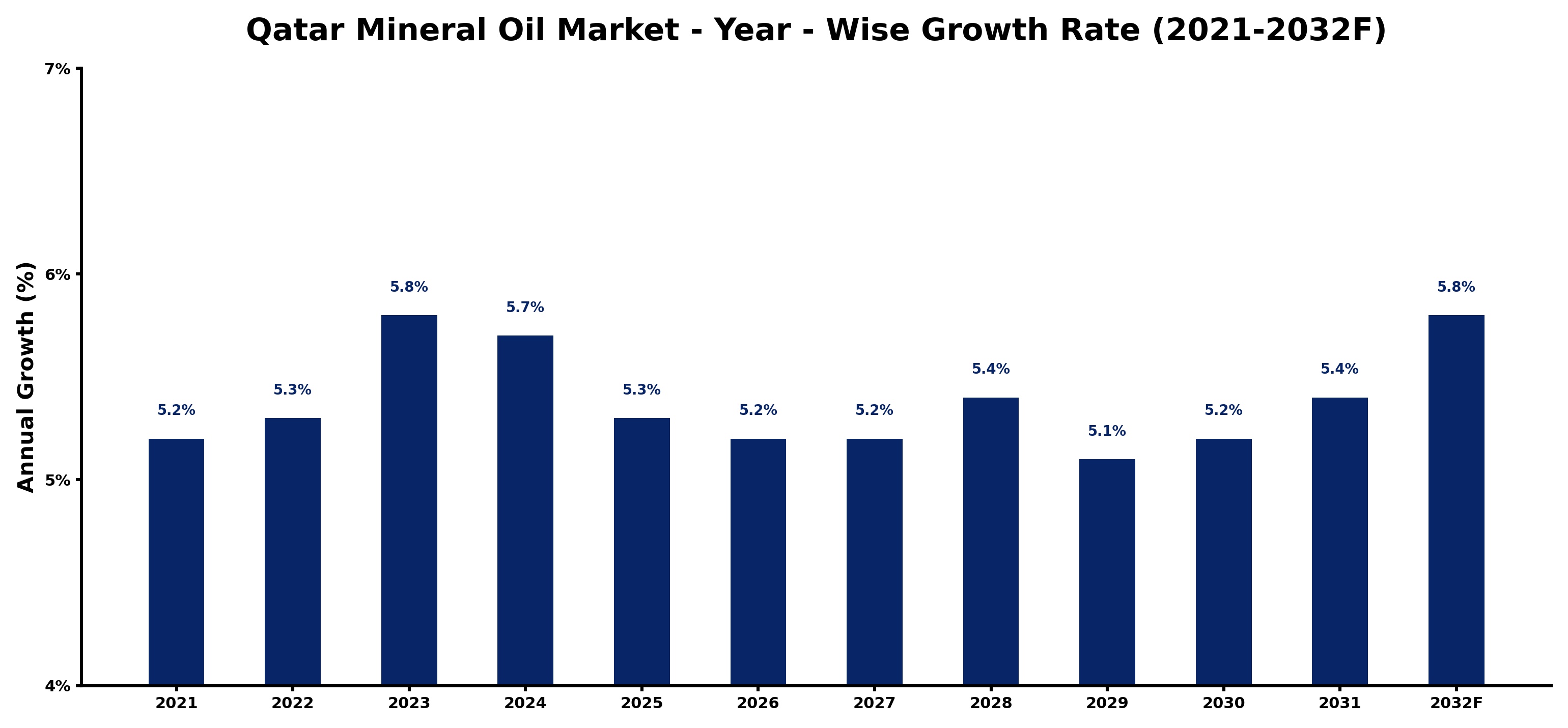
The table below presents the year‑wise growth rates along with the key drivers influencing the market
| Year | Growth Rate | Major Drivers |
| 2021 | 5.2% | Growing urbanization and commercial development |
| 2022 | 5.3% | Rising electricity demand across industries |
| 2023 | 5.8% | Growing renewable energy integration projects |
| 2024 | 5.7% | Expansion of commercial construction activities |
| 2025 | 5.3% | Growing renewable energy integration projects |
| 2026 | 5.2% | Growing renewable energy integration projects |
| 2027 | 5.2% | Rapid growth in telecom and data center sectors |
| 2028 | 5.4% | Rapid growth in telecom and data center sectors |
| 2029 | 5.1% | Increasing industrial infrastructure investments |
| 2030 | 5.2% | Increasing smart city development projects |
| 2031 | 5.4% | Increasing industrial infrastructure investments |
| 2032 | 5.8% | Growing renewable energy integration projects |
Note - Market size estimations and growth projections presented in this report are based on 6Wresearch's advanced forecasting approach, validated with industry datasets as of June 2026.
Qatar Mineral Oil Market Synopsis
Recently, the Qatar mineral oil market has shown strong momentum thanks to heightened investments and increasing production capabilities. However, the market is poised for further evolution as it grapples with shifting global energy dynamics and the region's emphasis on sustainability.
While the immediate outlook remains positive, longer-term challenges such as fluctuating oil prices and a growing inclination towards renewable energy may shape the future landscape of the mineral oil sector in Qatar. In this context, companies must adapt strategically to maintain their competitive edge.
Qatar Mineral Oil Market Key Takeaways
- Significant growth driven by Qatar's robust oil and gas sector and rising industrial activities.
- Increased investments from international oil companies are expanding production capabilities.
- Regulatory compliance and sustainability initiatives are shaping operational frameworks.
- Emerging technologies are enhancing the upstream value chain processes.
- Long-term market stability hinges on diversifying away from oil dependency.
Evaluation of Restraints in Qatar Mineral Oil Market
The Qatar mineral oil market faces notable restraints that could impede its growth. Price volatility on the global oil market directly affects the stability and confidence of local producers, making investment decisions precarious. Environmental regulations continue to increase, imposing additional operational costs and necessitating compliance measures that challenge existing frameworks. Furthermore, Qatar's strategic plan to transition towards a more diversified economy adds an element of uncertainty, compelling companies to seek alternative sectors while balancing their core mineral oil operations.
Qatar Mineral Oil Market Trends
Several trends are shaping the Qatar mineral oil market. A marked increase in demand for high-performance lubricants is evident, driven by both industrialization and enhanced automotive manufacturing. Additionally, the focus on technological advancements is reshaping production processes, optimizing efficiency, and minimizing environmental impacts. There's also a rising emphasis on sustainability practices as companies adapt to regulatory frameworks and consumer expectations for cleaner energy solutions. The convergence of these trends not only addresses immediate demands but also positions the market for future growth.
Qatar Mineral Oil Market Opportunities
Opportunities abound within the Qatar mineral oil market, particularly in the segments of bio-lubricants and specialty products that cater to niche industrial applications. As local and foreign investments intensify, the potential for innovation in refining technologies is substantial. Furthermore, partnerships with global leaders in energy and technology could facilitate knowledge transfer and enhance local capabilities, thereby solidifying Qatar's position as a key player in the mineral oil sector. Exploring alternative markets and export opportunities also represents a crucial avenue for growth.
Government Initiatives in the Qatar Mineral Oil Market
The Qatari government has undertaken several initiatives to bolster the mineral oil market, including public spending on infrastructure and research aimed at enhancing production efficiency. Regulatory frameworks are being developed to ensure compliance with environmental standards while promoting sustainability in oil extraction and production processes. Additionally, investment in renewable energy and diversification of the economy underscores a long-term vision that seeks to balance traditional oil dominance with modern energy solutions.
Future Insights of the Qatar Mineral Oil Market
Looking ahead to 2026-2032, the Qatar mineral oil market is expected to evolve dynamically, driven by ongoing investments in technology and infrastructure. As global energy landscapes shift, the market's adaptability will be crucial in navigating both opportunities and challenges. The emphasis on sustainability will likely dictate new practices within production and consumption patterns, urging companies to innovate while remaining compliant. A balanced approach between leveraging existing oil wealth and exploring alternative energy avenues will shape the strategic direction of the market moving forward.
Qatar Mineral Oil Market Latest Developments (May 2025 - June 2026)
In the latest developments, the Qatar mineral oil market has seen increased activity in research and development as companies seek to enhance product offerings through technological upgrades. Collaborative efforts between local enterprises and international partners are on the rise, aimed at optimizing operations and implementing best practices in sustainability. Furthermore, regulatory bodies are revising compliance standards to ensure they align with global benchmarks, reflecting Qatar's commitment to maintaining its competitive edge in the energy sector.
Qatar Mineral Oil Market - Key Attractiveness of the Report
- 10 Years of Market Numbers
- Historical Data Starting from 2022 to 2025
- Base Year: 2025
- Forecast Data until 2032
- Key Performance Indicators Impacting the Market
- Major Upcoming Developments and Projects
Key Highlights of the Report:
- Qatar Mineral Oil Market Outlook
- Market Size of Qatar Mineral Oil Market, 2025
- Forecast of Qatar Mineral Oil Market, 2032F
- Historical Data and Forecast of Qatar Mineral Oil Revenues & Volume for the Period 2022-2032F
- Qatar Mineral Oil Market Trend Evolution
- Qatar Mineral Oil Market Drivers and Challenges
- Qatar Mineral Oil Price Trends
- Qatar Mineral Oil Porter's Five Forces
- Qatar Mineral Oil Industry Life Cycle
- Historical Data and Forecast of Qatar Mineral Oil Market Revenues & Volume By Grade for the Period 2022-2032F
- Historical Data and Forecast of Qatar Mineral Oil Market Revenues & Volume By Technical Oil for the Period 2022-2032F
- Historical Data and Forecast of Qatar Mineral Oil Market Revenues & Volume By White Oil for the Period 2022-2032F
- Historical Data and Forecast of Qatar Mineral Oil Market Revenues & Volume By Application for the Period 2022-2032F
- Historical Data and Forecast of Qatar Mineral Oil Market Revenues & Volume By Baby Oil for the Period 2022-2032F
- Historical Data and Forecast of Qatar Mineral Oil Market Revenues & Volume By Cosmetics for the Period 2022-2032F
- Historical Data and Forecast of Qatar Mineral Oil Market Revenues & Volume By Skin Care Products for the Period 2022-2032F
- Historical Data and Forecast of Qatar Mineral Oil Market Revenues & Volume By Hair Care Products for the Period 2022-2032F
- Historical Data and Forecast of Qatar Mineral Oil Market Revenues & Volume By Consumer Goods for the Period 2022-2032F
- Historical Data and Forecast of Qatar Mineral Oil Market Revenues & Volume By Others for the Period 2022-2032F
- Qatar Mineral Oil Import Export Trade Statistics
- Market Opportunity Assessment By Grade
- Market Opportunity Assessment By Application
- Qatar Mineral Oil Top Companies Market Share
- Qatar Mineral Oil Competitive Benchmarking By Technical and Operational Parameters
- Qatar Mineral Oil Company Profiles
- Qatar Mineral Oil Key Strategic Recommendations






































