Qatar Nickel Mining Market Size, Share & Growth Rate
The Qatar Nickel Mining Market was estimated at USD 434 Million in 2025 and is projected to reach USD 597 Million by 2032, growing at a CAGR of 4.7% from 2026 to 2032. This growth trajectory is largely driven by the increasing global demand for nickel in stainless steel production and battery technologies, despite Qatars limited nickel reserves. The market's expansion reflects a broader effort to diversify the economy away from oil and gas dependency, aiming to integrate nickel mining into Qatar's industrial fabric.
Qatar Nickel Mining Market Year-wise Growth Rate and Key Drivers
This graph highlights how the Qatar Nickel Mining Market has steadily grown over the years, supported by major growth factors.
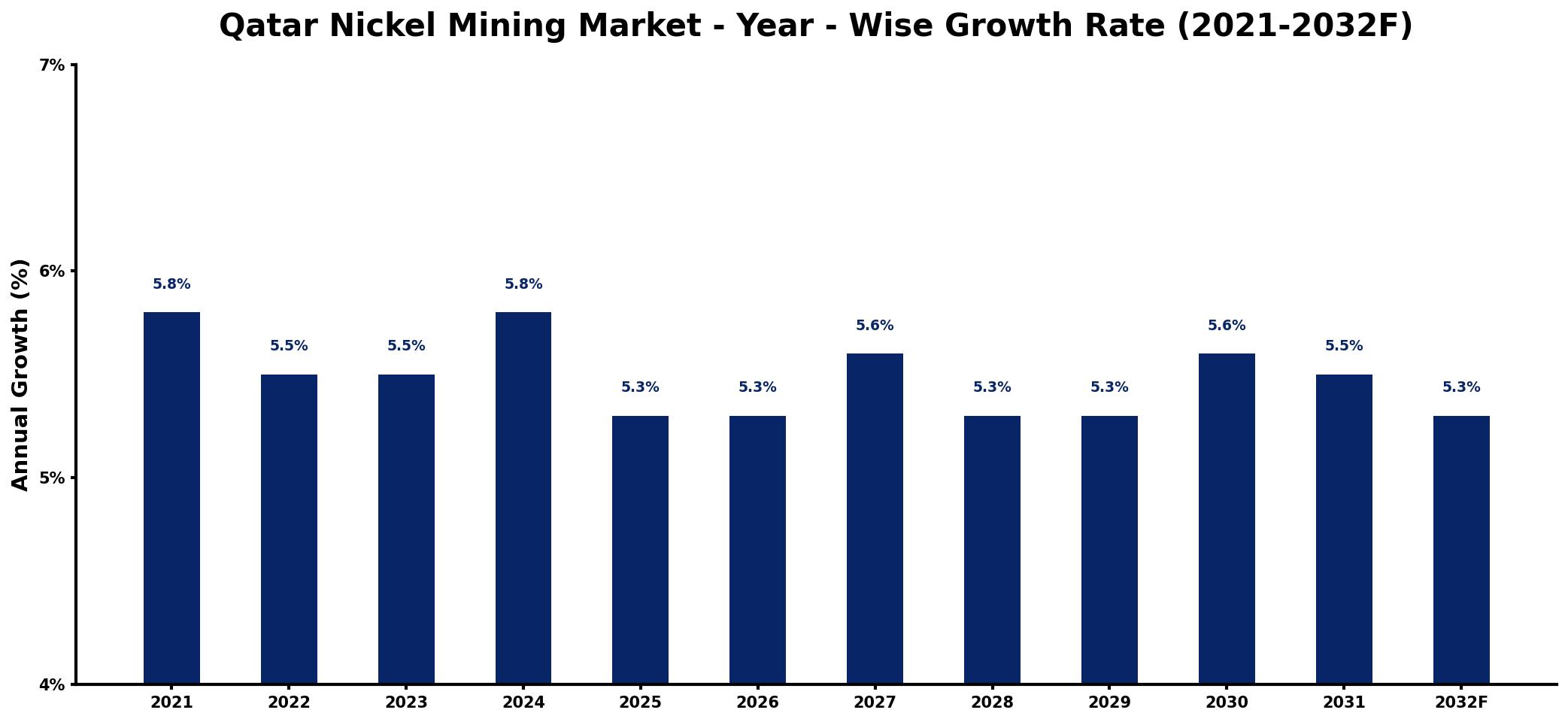
The table below presents the year‑wise growth rates along with the key drivers influencing the market
| Year | Growth Rate | Major Drivers |
| 2021 | 5.8% | Rising industrial manufacturing activities |
| 2022 | 5.5% | Increased electric vehicle production |
| 2023 | 5.5% | Growing demand for batteries |
| 2024 | 5.8% | Expansion of renewable energy projects |
| 2025 | 5.3% | Higher investments in infrastructure |
| 2026 | 5.3% | Surge in construction activities |
| 2027 | 5.6% | Boost in aerospace sector growth |
| 2028 | 5.3% | Advancements in technology applications |
| 2029 | 5.3% | Strengthened global supply chains |
| 2030 | 5.6% | Growing automotive sector requirements |
| 2031 | 5.5% | Increased focus on sustainability |
| 2032 | 5.3% | Rising consumer electronics production |
Note: Market size estimations and growth projections presented in this report are based on 6Wresearch's proprietary forecasting methodology, utilizing the latest available industry data, government publications, and primary research inputs.
Qatar Nickel Mining Market Synopsis
Recent developments in Qatar's mining landscape have revealed a cautious momentum in nickel mining, with local firms exploring sustainable practices and advanced technologies. However, the market still faces significant constraints, largely stemming from geological challenges and the overall scarcity of viable nickel deposits.
As Qatar positions itself as a strategic player in the mineral resource arena, the nickel mining sector may benefit from emerging global trends in industrial metals. While still small, its role in economic diversification and enhancing resource security is increasingly recognized within the broader context of the national development agenda.
Qatar Nickel Mining Market Key Takeaways
- Limited natural reserves pose a significant challenge to the scalability of nickel mining in Qatar.
- Qatar is actively pursuing economic diversification, positioning nickel mining as a strategic component of this initiative.
- Global demand for nickel in technology and manufacturing is influencing local market dynamics and pricing.
- Innovations in mining technology and sustainable practices are crucial for Qatar's nickel sector.
- Collaboration between private enterprises and governmental bodies is key to advancing mining operations and regulatory frameworks.
Evaluation of Restraints in Qatar Nickel Mining Market
The primary restraints affecting the Qatar nickel mining market stem from geological and technological challenges. The nations geology limits the presence of significant nickel deposits, making large-scale mining operations less feasible. Moreover, environmental regulations and the need for sustainable practices add complexity to the establishment and operation of mining sites. These challenges culminate in a market that is not only constrained by resource availability but also hindered by the high costs associated with advanced mining technology and environmental compliance.
Qatar Nickel Mining Market Trends
Current trends in the Qatar nickel mining market reveal a shift toward more sustainable mining practices. Companies are investing in technology to minimize environmental impact while optimizing extraction processes. Additionally, there is a growing emphasis on local sourcing of materials to reduce reliance on imports, aligning with Qatar's national goals. Furthermore, as global demand for nickel in battery technologies rises, Qatar may adapt its mining strategies to capture emerging market opportunities.
Qatar Nickel Mining Market Opportunities
Amidst the challenges, several opportunities for growth exist within the Qatar nickel mining sector. The integration of innovative technologies presents prospects for improving extraction efficiency and reducing costs. Furthermore, the increasing demand for nickel in high-tech industries, particularly in electric vehicle production, signifies a potential avenue for investment. By enhancing its capabilities and focusing on sustainable practices, Qatar can position itself as a key player in the regional and global nickel supply chain.
Government Initiatives in the Qatar Nickel Mining Market
The Qatari government has implemented a range of initiatives aimed at enhancing the mining sector, including the nickel mining market. Through various programs, the government seeks to stimulate investment in mining technology and promote sustainable practices. Regulatory frameworks are being established to support responsible mining operations while encouraging public-private partnerships. These initiatives are pivotal for ensuring that Qatar's mineral resources are developed in alignment with national economic diversification goals.
Future Insights of the Qatar Nickel Mining Market
Looking ahead to 2026-2032, the Qatar nickel mining market is poised for gradual growth, shaped by both local initiatives and global trends. As the demand for nickel continues to rise, particularly in battery and steel production, Qatar's mining sector may adapt to focus more on these lucrative applications. The ongoing government support for innovation and sustainable practices will likely play a significant role in determining the success of nickel mining operations, ultimately shaping the market's evolution in the coming years.
Qatar Nickel Mining Market Latest Developments (2025 - 2026)
In recent months, developments in Qatar's nickel mining sector have highlighted a shift towards integrating advanced mining technologies and practices aimed at enhancing sustainability. Local enterprises have started engaging in international collaborations to share expertise and resources, particularly in areas of processing and export. Moreover, regulatory updates from government bodies have laid the groundwork for improved operational frameworks, which are expected to support future investment in the nickel sector.
Qatar Nickel Mining Market - Key Attractiveness of the Report
- 10 Years of Market Numbers
- Historical Data Starting from 2022 to 2025
- Base Year: 2025
- Forecast Data until 2032
- Key Performance Indicators Impacting the Market
- Major Upcoming Developments and Projects
Key Highlights of the Report:
- Qatar Nickel Mining Market Outlook
- Market Size of Qatar Nickel Mining Market, 2025
- Forecast of Qatar Nickel Mining Market, 2032
- Historical Data and Forecast of Qatar Nickel Mining Revenues & Volume for the Period 2022-2032F
- Qatar Nickel Mining Market Trend Evolution
- Qatar Nickel Mining Market Drivers and Challenges
- Qatar Nickel Mining Price Trends
- Qatar Nickel Mining Porter's Five Forces
- Qatar Nickel Mining Industry Life Cycle
- Historical Data and Forecast of Qatar Nickel Mining Market Revenues & Volume By Type for the Period 2022-2032F
- Historical Data and Forecast of Qatar Nickel Mining Market Revenues & Volume By Pentlandite (Sulfide Ore) for the Period 2022-2032F
- Historical Data and Forecast of Qatar Nickel Mining Market Revenues & Volume By Laterite for the Period 2022-2032F
- Qatar Nickel Mining Import Export Trade Statistics
- Market Opportunity Assessment By Type
- Qatar Nickel Mining Top Companies Market Share
- Qatar Nickel Mining Competitive Benchmarking By Technical and Operational Parameters
- Qatar Nickel Mining Company Profiles
- Qatar Nickel Mining Key Strategic Recommendations






































