Qatar Oil & Gas Pumps Market Size, Share & Growth Rate
The Qatar Oil & Gas Pumps Market was estimated at USD 337 Million in 2025 and is projected to reach USD 442 Million by 2032, growing at a CAGR of 4.0% from 2026 to 2032. This growth trajectory is primarily fueled by Qatar's unwavering commitment to enhancing its oil and gas production capabilities. The expansion of infrastructure projects and a strong focus on technological advancements in pumping systems further underpin this positive outlook.
Qatar Oil & Gas Pumps Market Year-wise Growth Rate and Key Drivers
This graph highlights how the Qatar Oil & Gas Pumps Market has steadily grown over the years, supported by major growth factors.
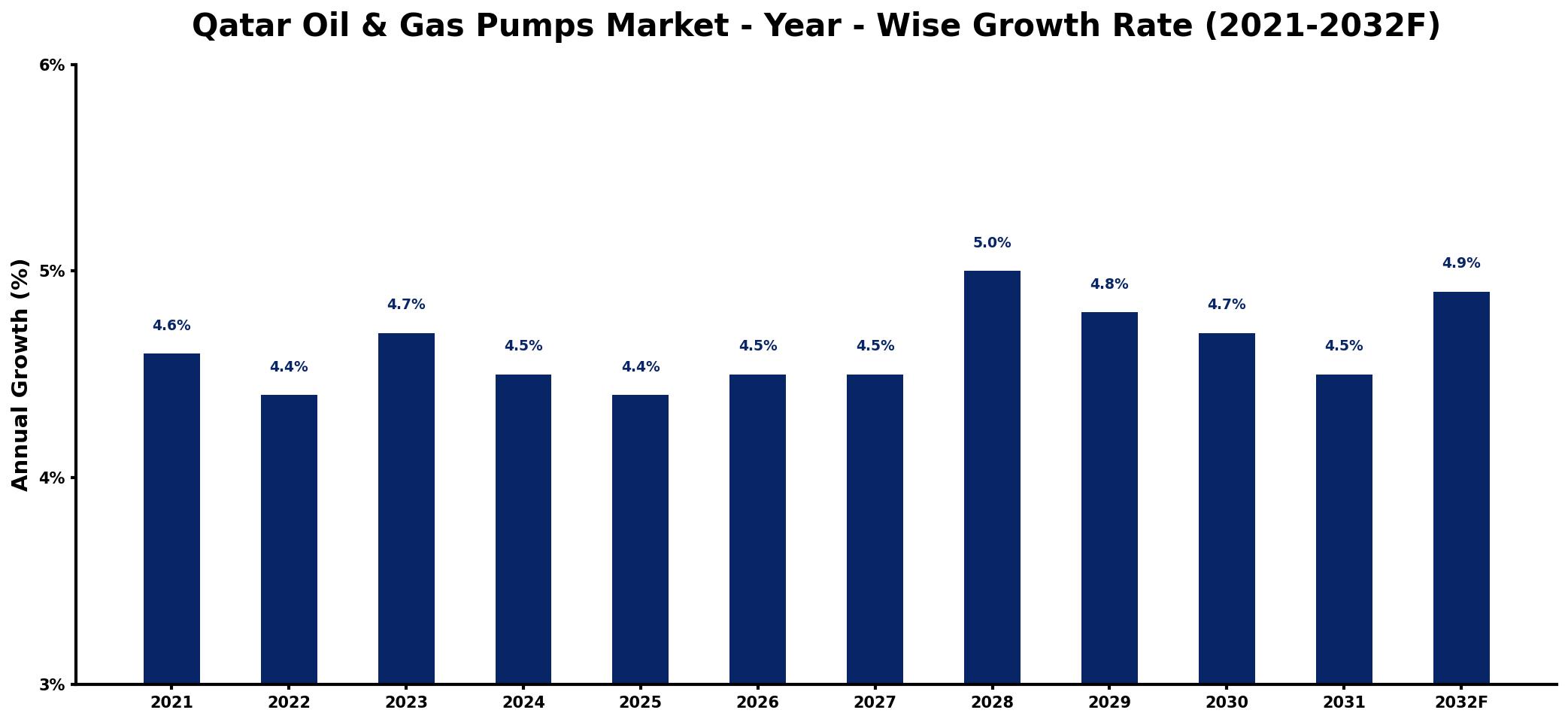
The table below presents the year‑wise growth rates along with the key drivers influencing the market
| Year | Growth Rate | Major Drivers |
| 2021 | 4.6% | Increased infrastructure development projects |
| 2022 | 4.4% | Growing industrial manufacturing activities |
| 2023 | 4.7% | Rising energy sector investments |
| 2024 | 4.5% | Expansion of renewable energy initiatives |
| 2025 | 4.4% | Higher demand for automation solutions |
| 2026 | 4.5% | Increased urbanization and population growth |
| 2027 | 4.5% | Growth in transportation sector needs |
| 2028 | 5.0% | Emergence of green technology adoption |
| 2029 | 4.8% | Rising focus on energy efficiency |
| 2030 | 4.7% | Increased focus on sustainability practices |
| 2031 | 4.5% | Growing demand for maintenance services |
| 2032 | 4.9% | growing automotive sector requirements |
Note: Market size estimations and growth projections presented in this report are based on 6Wresearch's proprietary forecasting methodology, utilizing the latest available industry data, government publications, and primary research inputs.
Qatar Oil & Gas Pumps Market Synopsis
In Qatar, the oil and gas pumps market is pivotal to ensuring the efficiency and reliability of hydrocarbon extraction and transportation. The countrys geographical advantages and substantial reserves necessitate a constant demand for high-performance pumps that can withstand challenging operational conditions.
Furthermore, the market is supported by ongoing investments in infrastructure and technology, reflecting Qatar's strategic aim to maintain its leadership in the global energy sector. As new projects are initiated, the demand for innovative pumping solutions tailored to the unique challenges of this environment continues to rise.
- The Qatar oil and gas pumps market is expected to grow significantly, driven by ongoing investments in energy infrastructure.
- Technological advancements are key to enhancing pump efficiency and reducing environmental impacts.
- Market resilience remains strong despite global oil price fluctuations, ensuring steady demand.
- The need for skilled maintenance personnel is critical for minimizing downtime and ensuring reliability.
- Opportunities for sustainable and energy-efficient pumping technologies are increasingly important for market growth.
The Qatar oil and gas pumps market faces several constraints that could impact growth. A primary concern is the markets dependence on fluctuating global oil prices, which can directly influence investment levels in pumping infrastructure. Additionally, ensuring the availability of high-quality spare parts and skilled maintenance personnel poses significant challenges, particularly in remote operational areas. As the industry shifts towards sustainability, manufacturers must invest in research and development to create energy-efficient technologies that meet both environmental regulations and operational needs.
Current trends in the Qatar oil and gas pumps market indicate a shift towards automation and digitalization. Companies are increasingly adopting smart pump technologies that leverage data analytics for real-time monitoring and predictive maintenance. Additionally, there is a growing emphasis on environmental sustainability, leading to the development of pumps that reduce emissions and optimize energy consumption. These trends signify a proactive approach by market stakeholders to align with global best practices while enhancing operational efficiency.
With Qatars ongoing energy sector expansions, significant opportunities exist for suppliers of advanced pump technologies. The transition towards greener solutions presents an avenue for innovation, as companies are called upon to deliver energy-efficient and environmentally-friendly products. Collaborations with research institutions can drive the development of next-generation pumping systems, providing firms with competitive advantages in a rapidly evolving market landscape.
The Qatari government plays a vital role in the development of the oil and gas pumps market through strategic initiatives aimed at enhancing the overall energy sector. Public spending on infrastructure projects, including those focused on upgrading pumping systems, is a cornerstone of the national agenda. Furthermore, regulatory frameworks that encourage innovation and environmental sustainability are being implemented, fostering a conducive environment for manufacturers and service providers.
Looking ahead to 2026-2032, the Qatar oil and gas pumps market is expected to navigate a dynamic landscape characterized by technological advancements and environmental demands. As the nation continues to diversify its energy portfolio, there will be a concurrent focus on improving the efficiency of existing operations through state-of-the-art pumping technologies. This future orientation will not only ensure Qatars competitive position in the global market but also enhance its sustainability efforts, thereby solidifying the sector's long-term viability.
Recent developments in the Qatar oil and gas pumps market have centered around the introduction of innovative pumping solutions aimed at enhancing operational efficiency. The market is witnessing significant advancements in automation technologies, allowing for improved monitoring and predictive maintenance capabilities. Additionally, collaborations between local enterprises and international firms are fostering knowledge transfer and driving the development of eco-friendly pumping systems.
- 10 Years of Market Numbers
- Historical Data Starting from 2022 to 2025
- Base Year: 2025
- Forecast Data until 2032
- Key Performance Indicators Impacting the Market
- Major Upcoming Developments and Projects
Key Highlights of the Report:
- Qatar Oil & Gas Pumps Market Outlook
- Market Size of Qatar Oil & Gas Pumps Market, 2025
- Forecast of Qatar Oil & Gas Pumps Market, 2032
- Historical Data and Forecast of Qatar Oil & Gas Pumps Revenues & Volume for the Period 2022-2032F
- Qatar Oil & Gas Pumps Market Trend Evolution
- Qatar Oil & Gas Pumps Market Drivers and Challenges
- Qatar Oil & Gas Pumps Price Trends
- Qatar Oil & Gas Pumps Porter's Five Forces
- Qatar Oil & Gas Pumps Industry Life Cycle
- Historical Data and Forecast of Qatar Oil & Gas Pumps Market Revenues & Volume By Type for the Period 2022-2032F
- Historical Data and Forecast of Qatar Oil & Gas Pumps Market Revenues & Volume By Submersible Pumps for the Period 2022-2032F
- Historical Data and Forecast of Qatar Oil & Gas Pumps Market Revenues & Volume By Non-submersible Pumps for the Period 2022-2032F
- Historical Data and Forecast of Qatar Oil & Gas Pumps Market Revenues & Volume By Pump Type for the Period 2022-2032F
- Historical Data and Forecast of Qatar Oil & Gas Pumps Market Revenues & Volume By Centrifugal Pump for the Period 2022-2032F
- Historical Data and Forecast of Qatar Oil & Gas Pumps Market Revenues & Volume By Positive Displacement Pump for the Period 2022-2032F
- Historical Data and Forecast of Qatar Oil & Gas Pumps Market Revenues & Volume By Cryogenic Pump for the Period 2022-2032F
- Historical Data and Forecast of Qatar Oil & Gas Pumps Market Revenues & Volume By Application for the Period 2022-2032F
- Historical Data and Forecast of Qatar Oil & Gas Pumps Market Revenues & Volume By Upstream for the Period 2022-2032F
- Historical Data and Forecast of Qatar Oil & Gas Pumps Market Revenues & Volume By Midstream for the Period 2022-2032F
- Historical Data and Forecast of Qatar Oil & Gas Pumps Market Revenues & Volume By Downstream for the Period 2022-2032F
- Qatar Oil & Gas Pumps Import Export Trade Statistics
- Market Opportunity Assessment By Type
- Market Opportunity Assessment By Pump Type
- Market Opportunity Assessment By Application
- Qatar Oil & Gas Pumps Top Companies Market Share
- Qatar Oil & Gas Pumps Competitive Benchmarking By Technical and Operational Parameters
- Qatar Oil & Gas Pumps Company Profiles
- Qatar Oil & Gas Pumps Key Strategic Recommendations






































