Qatar Perfumes & Deodorants Market Summary
The qatar perfumes & deodorants market was estimated at USD 286 Million in 2025 and is projected to reach USD 392 Million by 2032, growing at a CAGR of 5.4% from 2026 to 2032.
Qatar Perfumes & Deodorants Market Year-wise Growth Rate and Key Drivers
This graph highlights how the Qatar Perfumes & Deodorants Market has steadily grown over the past five years, supported by major growth factors.
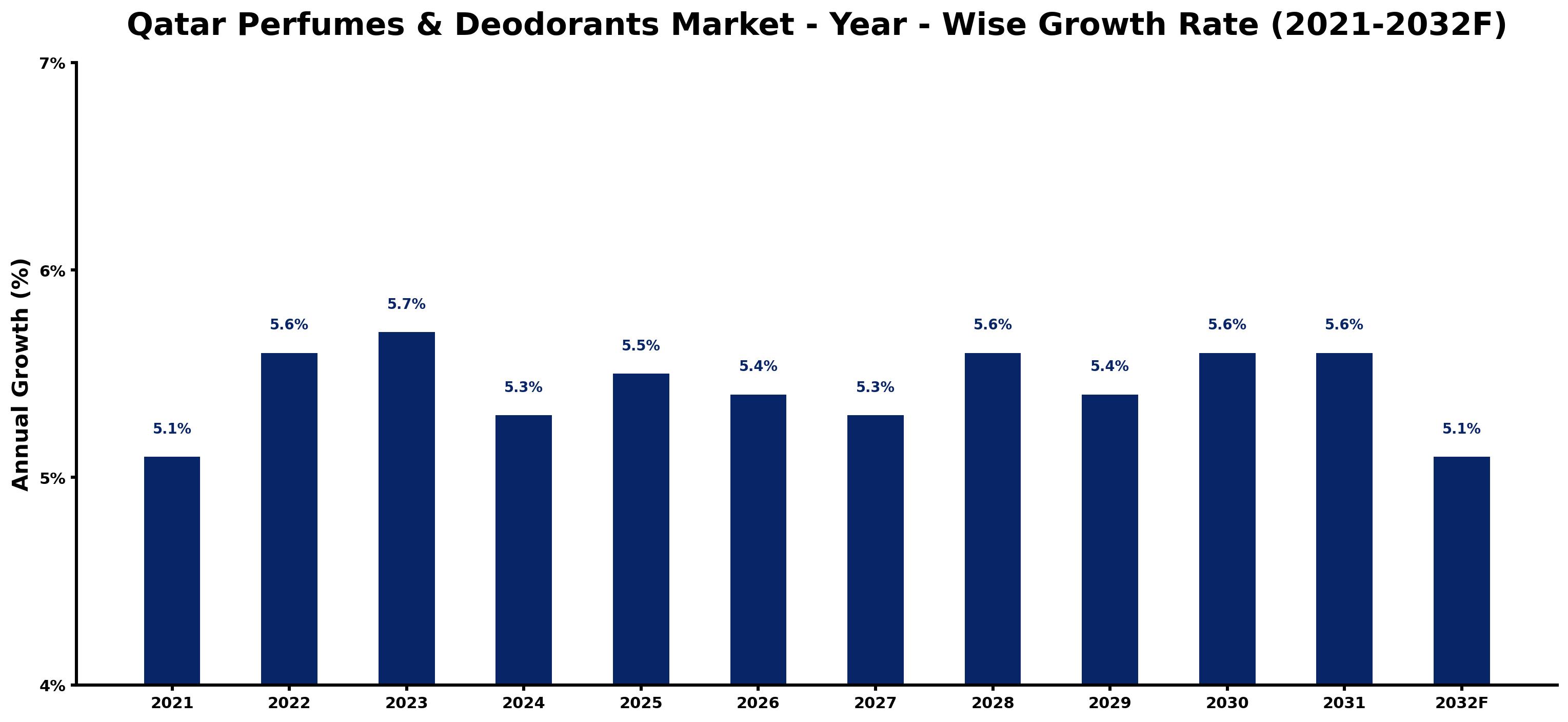
The table below presents the year wise growth rates along with the key drivers influencing the market
| Year | Growth Rate | Major Drivers |
| 2021 | 5.1% | Post-lockdown retail projects saw a resurgence in consumer interest for fragrances. |
| 2022 | 5.6% | Local brands gained traction, reflecting the cultural significance of traditional scents. |
| 2023 | 5.7% | Increased tourism provided a boost to luxury perfume sales in high-end boutiques. |
| 2024 | 5.3% | Online retail platforms expanded, making niche fragrance brands more accessible. |
| 2025 | 5.5% | Sustainability trends encouraged brands to introduce eco-friendly packaging options. |
| 2026 | 5.4% | Collaboration with local artisans enhanced brand authenticity in the perfume segment. |
| 2027 | 5.3% | Growing social media influence reshaped marketing strategies for perfume promotions. |
| 2028 | 5.6% | Luxury events and expos began showcasing international perfume innovations and trends. |
| 2029 | 5.4% | Consumer preferences shifted towards personalized fragrance experiences and custom blends. |
| 2030 | 5.6% | Regional expansion of international brands increased competition among local players. |
| 2031 | 5.6% | Emerging middle-class demographics drove demand for premium and affordable scents. |
| 2032 | 5.1% | Innovative scent technology, such as AI-assisted fragrance creation, transformed the market. |
Note - Market size estimations and growth projections presented in this report are based on 6Wresearch's advanced forecasting approach, validated with industry datasets as of June 2026.
Qatar Perfumes & Deodorants Market Synopsis
The Qatar Perfumes Deodorants Market is projected to reach 5.4% and witness significant growth during the forecast period (2026-2032). The market is expected to grow at a compound annual growth rate (CAGR) of 6.5%, driven by an increase in disposable income and a rising demand for personal care products. Factors such as rapid urbanization and evolving lifestyle trends are further propelling the adoption of perfumes and deodorants in Qatar. Additionally, a growing awareness regarding the health benefits of naturally derived ingredients over synthetic alternatives is influencing consumer preferences across sectors such as cosmetics and skincare.
Qatar Perfumes & Deodorants Market Growth Drivers
The market is witnessing a surge in demand for perfumes and deodorants due to several key drivers:
- The increase in disposable income levels among Qatar's population has enabled consumers to spend more on luxury personal care products like perfumes and deodorants.
- Urbanization trends are accelerating, leading to lifestyle changes that encourage the purchase of grooming products, thus driving market growth.
- Fashion consciousness has evolved, with consumers increasingly prioritizing their appearance and opting for high-quality grooming solutions that enhance their aesthetic appeal.
- Growing awareness of the potential side effects of synthetic fragrances is prompting a shift towards organic and naturally derived perfumes and deodorants, thus expanding product offerings in the market.
- The cultural significance of fragrance in Qatar, as a part of social customs and hospitality, further fuels the demand for premium and luxury fragrances.
Qatar Perfumes & Deodorants Market Challenges and Restraints
Despite the growth prospects, the Qatar Perfumes & Deodorants Market faces challenges that could impede progress:
- High price points associated with luxury branded perfumes and deodorants can restrict accessibility, particularly for lower-income segments of the population.
- The volatility of certain fragrances can lead to frequent replenishment needs, resulting in higher long-term costs for consumers.
- The impact of economic fluctuations can affect consumer spending on non-essential items, including perfumes and deodorants.
- The global supply chain disruptions post-COVID-19 continue to affect product availability, potentially leading to unmet consumer demand.
- Competition from alternative personal care products, such as body sprays and natural deodorants, may challenge traditional perfume and deodorant sales.
Qatar Perfumes & Deodorants Market COVID-19 Impact
The COVID-19 pandemic resulted in a significant downturn for the Qatar Perfumes & Deodorants Market. Lockdowns and the closure of retail outlets led to a decrease in consumer purchasing behaviors for non-essential products. Additionally, a shift in consumer priorities towards essentials and hygiene products reduced the demand for traditional perfumes and deodorants. Companies adapted their marketing strategies to align with the changing landscape, focusing on digital sales channels and promoting products that emphasized hygiene benefits.
Qatar Perfumes & Deodorants Market Government Investment and Initiatives
The Qatari government has been implementing various initiatives to support the growth of the personal care sector, which includes perfumes and deodorants. Investments in public infrastructure, coupled with attractive policies aimed at encouraging international brands to enter the market, are critical components of the government's strategy. Furthermore, the Qatar National Vision 2030 outlines plans to diversify the economy, which includes promoting the retail sector. These initiatives not only bolster local production capabilities but also enhance the overall market landscape for perfumes and deodorants.
Qatar Perfumes & Deodorants Market Latest Developments (May 2025 - June 2026)
Recent developments in the Qatar Perfumes & Deodorants Market indicate a trend towards increased consumer interest in natural and organic products. Companies are responding by reformulating older products to include more natural ingredients and tapping into the eco-conscious consumer base. Additionally, there has been heightened marketing efforts focusing on digital platforms to reach consumers who prefer shopping online. Retail channels are also evolving, with more emphasis on experiences that enhance customer engagement, such as interactive fragrance workshops and personalized scent consultations.
Qatar Perfumes & Deodorants Market - Key Attractiveness of the Report
- 10 Years of Market Numbers
- Historical Data Starting from 2022 to 2025
- Base Year: 2025
- Forecast Data until 2032
- Key Performance Indicators Impacting the Market
- Major Upcoming Developments and Projects
Key Highlights of the Report:
- Qatar Perfumes & Deodorants Market Outlook
- Market Size of Qatar Perfumes & Deodorants Market, 2025
- Forecast of Qatar Perfumes & Deodorants Market, 2032
- Historical Data and Forecast of Qatar Perfumes & Deodorants Revenues & Volume for the Period 2022-2032F
- Qatar Perfumes & Deodorants Market Trend Evolution
- Qatar Perfumes & Deodorants Market Drivers and Challenges
- Qatar Perfumes & Deodorants Price Trends
- Qatar Perfumes & Deodorants Porter's Five Forces
- Qatar Perfumes & Deodorants Industry Life Cycle
- Historical Data and Forecast of Qatar Perfumes & Deodorants Market Revenues & Volume By Product Types for the Period 2022-2032F
- Historical Data and Forecast of Qatar Perfumes & Deodorants Market Revenues & Volume By Deodorants for the Period 2022-2032F
- Historical Data and Forecast of Qatar Perfumes & Deodorants Market Revenues & Volume By Perfumes for the Period 2022-2032F
- Historical Data and Forecast of Qatar Perfumes & Deodorants Market Revenues & Volume By Consumer Group for the Period 2022-2032F
- Historical Data and Forecast of Qatar Perfumes & Deodorants Market Revenues & Volume By Men for the Period 2022-2032F
- Historical Data and Forecast of Qatar Perfumes & Deodorants Market Revenues & Volume By Women for the Period 2022-2032F
- Historical Data and Forecast of Qatar Perfumes & Deodorants Market Revenues & Volume By Unisex for the Period 2022-2032F
- Historical Data and Forecast of Qatar Perfumes & Deodorants Market Revenues & Volume By Distribution Channel for the Period 2022-2032F
- Historical Data and Forecast of Qatar Perfumes & Deodorants Market Revenues & Volume By Online for the Period 2022-2032F
- Historical Data and Forecast of Qatar Perfumes & Deodorants Market Revenues & Volume By Offline for the Period 2022-2032F
- Historical Data and Forecast of Qatar Perfumes & Deodorants Market Revenues & Volume By Price Segment for the Period 2022-2032F
- Historical Data and Forecast of Qatar Perfumes & Deodorants Market Revenues & Volume By Premium for the Period 2022-2032F
- Historical Data and Forecast of Qatar Perfumes & Deodorants Market Revenues & Volume By Mass for the Period 2022-2032F
- Qatar Perfumes & Deodorants Import Export Trade Statistics
- Market Opportunity Assessment By Product Types
- Market Opportunity Assessment By Consumer Group
- Market Opportunity Assessment By Distribution Channel
- Market Opportunity Assessment By Price Segment
- Qatar Perfumes & Deodorants Top Companies Market Share
- Qatar Perfumes & Deodorants Competitive Benchmarking By Technical and Operational Parameters
- Qatar Perfumes & Deodorants Company Profiles
- Qatar Perfumes & Deodorants Key Strategic Recommendations






































