Qatar Plant-based Meat Market Size, Share & Growth Rate
The Qatar Plant-based Meat Market was estimated at USD 161 Million in 2025 and is projected to reach USD 212 Million by 2032, growing at a CAGR of 4.0% from 2026 to 2032. This growth trajectory is fueled by an evolving consumer landscape that increasingly values health-conscious and sustainable eating options. As traditional dietary habits shift and awareness regarding environmental issues grows, the demand for plant-based alternatives is expected to gain even more traction in the region.
Qatar Plant-based Meat Market Year-wise Growth Rate and Key Drivers
This graph highlights how the Qatar Plant-based Meat Market has steadily grown over the years, supported by major growth factors.
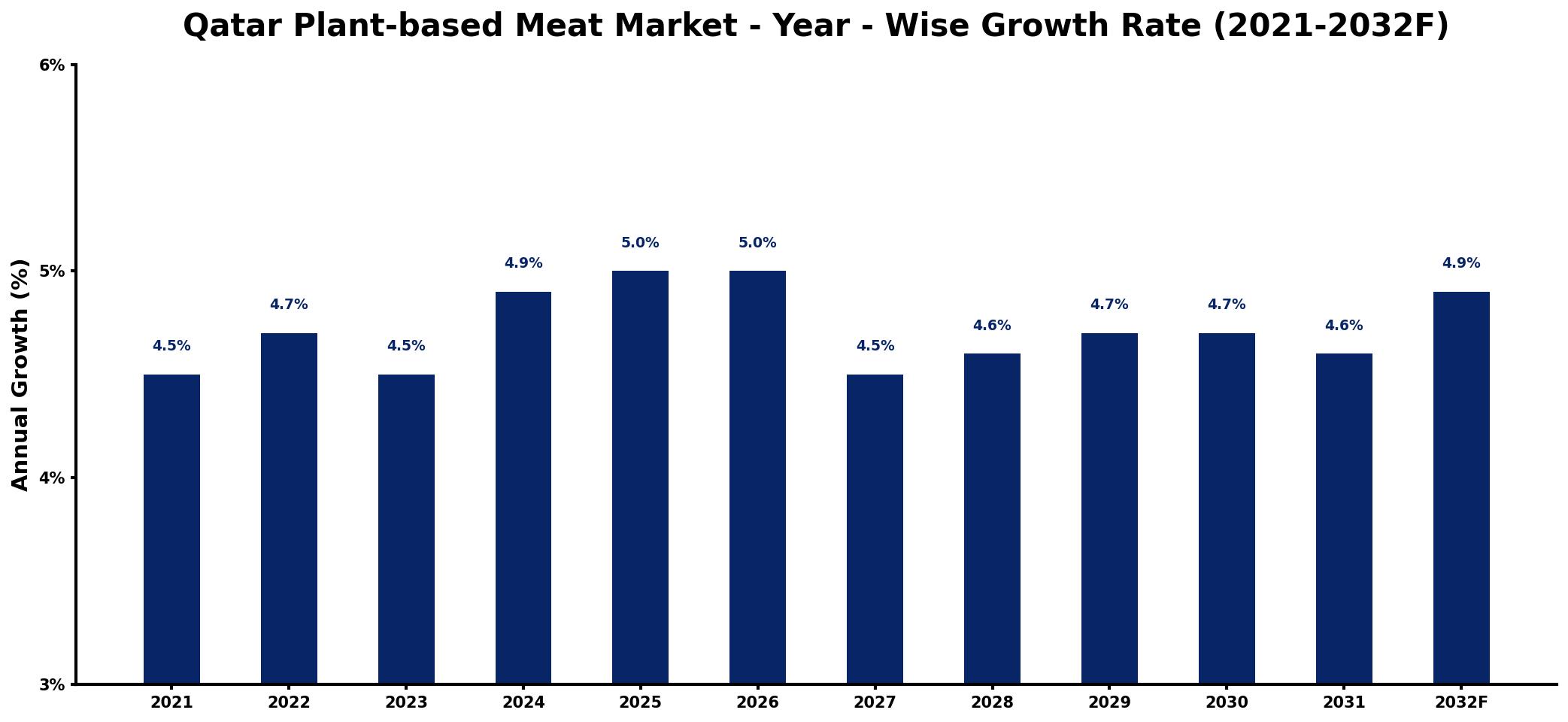
The table below presents the year‑wise growth rates along with the key drivers influencing the market
| Year | Growth Rate | Major Drivers |
| 2021 | 4.5% | Rising health consciousness among consumers |
| 2022 | 4.7% | Increased investment in alternative proteins |
| 2023 | 4.5% | Growing popularity of flexitarian diets |
| 2024 | 4.9% | Expansion of retail distribution channels |
| 2025 | 5.0% | Surge in culinary innovation trends |
| 2026 | 5.0% | Increased consumer awareness campaigns |
| 2027 | 4.5% | Development of innovative food technologies |
| 2028 | 4.6% | Growing environmental sustainability initiatives |
| 2029 | 4.7% | Rising demand from foodservice industry |
| 2030 | 4.7% | increased pharmaceutical industry usage |
| 2031 | 4.6% | Increased focus on food security |
| 2032 | 4.9% | Growth in online grocery shopping |
Note: Market size estimations and growth projections presented in this report are based on 6Wresearch's proprietary forecasting methodology, utilizing the latest available industry data, government publications, and primary research inputs.
Qatar Plant-based Meat Market Synopsis
The Qatar Plant-based Meat Market has seen significant momentum recently, driven by an increasing number of consumers embracing plant-based diets for health and sustainability reasons. However, this initial phase of growth is just the beginning; the market is poised for substantial expansion as education and innovation play a crucial role in consumer acceptance.
With rising local production capabilities and ongoing government initiatives aimed at promoting healthier food choices, the future looks promising. Additionally, international companies are eager to tap into the potential of the Qatari market, bringing new products and innovation that align with local tastes.
Qatar Plant-based Meat Market Key Takeaways
- Growing consumer health consciousness is shifting preferences towards plant-based protein sources.
- Government initiatives are fostering an environment conducive to sustainable food production.
- Supply chain disruptions from the COVID-19 pandemic created both challenges and opportunities in the market.
- International brands are increasingly entering the Qatari market, enhancing product availability.
- Consumer education and marketing efforts are vital for increasing acceptance of plant-based alternatives.
Evaluation of Restraints in Qatar Plant-based Meat Market
While the plant-based meat market in Qatar is on a positive trajectory, several constraints still limit its growth. The traditional Qatari diet, which predominantly centers around meat consumption, poses a significant challenge. For many consumers, the shift towards plant-based options necessitates not only a change in food preferences but also a re-evaluation of cultural practices and culinary traditions. Furthermore, ensuring the affordability and consistent availability of high-quality plant-based products remains a critical barrier for market players, necessitating strategic partnerships and local sourcing initiatives.
Qatar Plant-based Meat Market Trends
Several trends are shaping the Qatar Plant-based Meat Market. The growing influence of social media is amplifying awareness and demand for plant-based products, particularly among younger consumers. Additionally, the integration of innovative food technology is leading to the development of more palatable and versatile plant-based meat options. This trend aligns with a broader global movement toward healthier eating and sustainability, thus positioning the Qatari market favorably within a rapidly evolving food landscape.
Qatar Plant-based Meat Market Opportunities
Opportunities within the Qatar Plant-based Meat Market are significant, particularly in the realms of product innovation and education. Companies can capitalize on the increasing demand for local, high-quality plant-based options by investing in R&D to create unique offerings tailored to Qatari tastes. Additionally, educational campaigns highlighting the health and environmental benefits of plant-based diets can further accelerate consumer adoption. Collaborations with local chefs and restaurants could also enhance market presence and diversify product visibility.
Government Initiatives in the Qatar Plant-based Meat Market
The Qatari government is actively involved in promoting healthier dietary practices, recognizing the need for sustainable food production systems. Various initiatives aim to encourage local agricultural practices, reducing reliance on imports while simultaneously raising awareness about nutrition and environmental sustainability. Such efforts can significantly bolster the plant-based meat market, aligning public health objectives with economic growth opportunities.
Future Insights of the Qatar Plant-based Meat Market
Looking ahead to 2026-2032, the Qatar Plant-based Meat Market is set to experience transformative growth. As consumers become increasingly informed about the implications of their dietary choices, the shift towards plant-based alternatives is expected to deepen. Innovations in product development will continue to enhance taste and texture, making plant-based options more appealing to a broader audience. Furthermore, sustained governmental support and changing cultural perceptions will be critical in establishing a resilient market framework conducive to long-term success.
Qatar Plant-based Meat Market Latest Developments (2025 - 2026)
Recent developments in the Qatar Plant-based Meat Market have focused on enhancing product variety and availability. The introduction of new plant-based products tailored to local preferences has been notable, alongside growing collaborations between local producers and international brands. As consumer demand continues to rise, ongoing innovations are expected to further influence product offerings, aligning with the market's evolving dynamics.
Qatar Plant-based Meat Market - Key Attractiveness of the Report
- 10 Years of Market Numbers
- Historical Data Starting from 2022 to 2025
- Base Year: 2025
- Forecast Data until 2032
- Key Performance Indicators Impacting the Market
- Major Upcoming Developments and Projects
Key Highlights of the Report:
- Qatar Plant-based Meat Market Outlook
- Market Size of Qatar Plant-based Meat Market, 2025
- Forecast of Qatar Plant-based Meat Market, 2032
- Historical Data and Forecast of Qatar Plant-based Meat Revenues & Volume for the Period 2022-2032F
- Qatar Plant-based Meat Market Trend Evolution
- Qatar Plant-based Meat Market Drivers and Challenges
- Qatar Plant-based Meat Price Trends
- Qatar Plant-based Meat Porter's Five Forces
- Qatar Plant-based Meat Industry Life Cycle
- Historical Data and Forecast of Qatar Plant-based Meat Market Revenues & Volume By Source for the Period 2022-2032F
- Historical Data and Forecast of Qatar Plant-based Meat Market Revenues & Volume By Soy for the Period 2022-2032F
- Historical Data and Forecast of Qatar Plant-based Meat Market Revenues & Volume By Pea for the Period 2022-2032F
- Historical Data and Forecast of Qatar Plant-based Meat Market Revenues & Volume By Wheat for the Period 2022-2032F
- Historical Data and Forecast of Qatar Plant-based Meat Market Revenues & Volume By Others for the Period 2022-2032F
- Historical Data and Forecast of Qatar Plant-based Meat Market Revenues & Volume By Product for the Period 2022-2032F
- Historical Data and Forecast of Qatar Plant-based Meat Market Revenues & Volume By Burgers for the Period 2022-2032F
- Historical Data and Forecast of Qatar Plant-based Meat Market Revenues & Volume By Sausages for the Period 2022-2032F
- Historical Data and Forecast of Qatar Plant-based Meat Market Revenues & Volume By Patties for the Period 2022-2032F
- Historical Data and Forecast of Qatar Plant-based Meat Market Revenues & Volume By Nuggets, for the Period 2022-2032F
- Historical Data and Forecast of Qatar Plant-based Meat Market Revenues & Volume By Tenders & Cutlets for the Period 2022-2032F
- Historical Data and Forecast of Qatar Plant-based Meat Market Revenues & Volume By Grounds for the Period 2022-2032F
- Historical Data and Forecast of Qatar Plant-based Meat Market Revenues & Volume By Others for the Period 2022-2032F
- Historical Data and Forecast of Qatar Plant-based Meat Market Revenues & Volume By Type for the Period 2022-2032F
- Historical Data and Forecast of Qatar Plant-based Meat Market Revenues & Volume By Chicken for the Period 2022-2032F
- Historical Data and Forecast of Qatar Plant-based Meat Market Revenues & Volume By Pork for the Period 2022-2032F
- Historical Data and Forecast of Qatar Plant-based Meat Market Revenues & Volume By Beef for the Period 2022-2032F
- Historical Data and Forecast of Qatar Plant-based Meat Market Revenues & Volume By Fish for the Period 2022-2032F
- Historical Data and Forecast of Qatar Plant-based Meat Market Revenues & Volume By Others for the Period 2022-2032F
- Historical Data and Forecast of Qatar Plant-based Meat Market Revenues & Volume By End-user for the Period 2022-2032F
- Historical Data and Forecast of Qatar Plant-based Meat Market Revenues & Volume By Retail for the Period 2022-2032F
- Historical Data and Forecast of Qatar Plant-based Meat Market Revenues & Volume By HORECA (Hotel/Restaurant/Caf) for the Period 2022-2032F
- Historical Data and Forecast of Qatar Plant-based Meat Market Revenues & Volume By Storage for the Period 2022-2032F
- Historical Data and Forecast of Qatar Plant-based Meat Market Revenues & Volume By Refrigerated Plant-based Meat for the Period 2022-2032F
- Historical Data and Forecast of Qatar Plant-based Meat Market Revenues & Volume By Frozen Plant-based Meat for the Period 2022-2032F
- Historical Data and Forecast of Qatar Plant-based Meat Market Revenues & Volume By Shelf-stable Plant-based Meat for the Period 2022-2032F
- Qatar Plant-based Meat Import Export Trade Statistics
- Market Opportunity Assessment By Source
- Market Opportunity Assessment By Product
- Market Opportunity Assessment By Type
- Market Opportunity Assessment By End-user
- Market Opportunity Assessment By Storage
- Qatar Plant-based Meat Top Companies Market Share
- Qatar Plant-based Meat Competitive Benchmarking By Technical and Operational Parameters
- Qatar Plant-based Meat Company Profiles
- Qatar Plant-based Meat Key Strategic Recommendations






































