Qatar Ploughing and Cultivating Machinery Market Size, Share & Growth Rate
The Qatar Ploughing and Cultivating Machinery Market was estimated at USD 409 Million in 2025 and is projected to reach USD 571 Million by 2032, growing at a CAGR of 4.9% from 2026 to 2032. This growth trajectory is fueled by the increasing demand for efficient agricultural practices, as Qatar seeks to enhance its food security and self-sufficiency. The rising adoption of precision farming techniques and advancements in eco-friendly machinery are further expected to propel market expansion.
Qatar Ploughing and Cultivating Machinery Market Year-wise Growth Rate and Key Drivers
This graph highlights how the Qatar Ploughing and Cultivating Machinery Market has steadily grown over the years, supported by major growth factors.
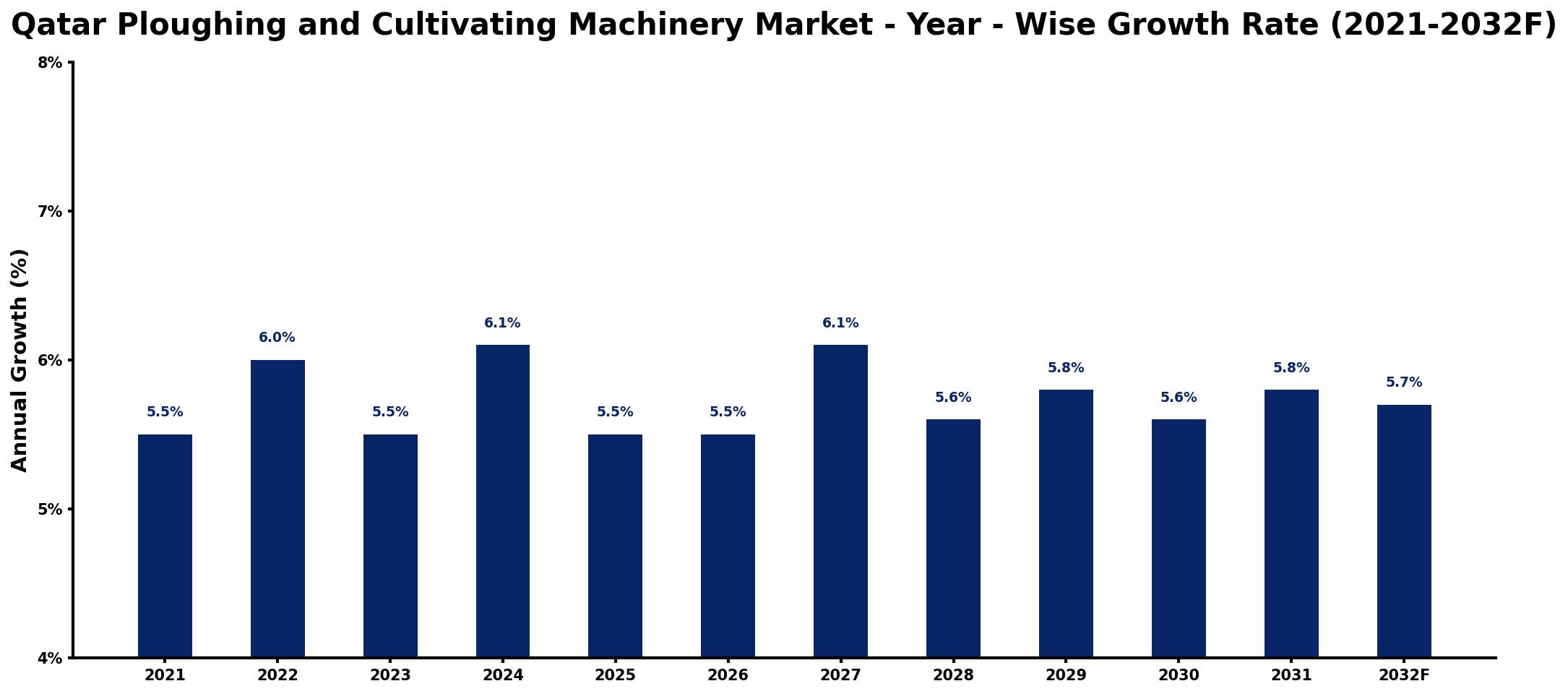
The table below presents the year‑wise growth rates along with the key drivers influencing the market
| Year | Growth Rate | Major Drivers |
| 2021 | 5.5% | Rising agricultural technology adoption |
| 2022 | 6.0% | Increased investment in farming |
| 2023 | 5.5% | Growing demand for efficiency |
| 2024 | 6.1% | Expansion of agricultural exports |
| 2025 | 5.5% | Technological advancements in farming |
| 2026 | 5.5% | Emerging sustainable farming practices |
| 2027 | 6.1% | Increased focus on food security |
| 2028 | 5.6% | Growth in organic agriculture sector |
| 2029 | 5.8% | Rising population driving demand |
| 2030 | 5.6% | Boost in rural development initiatives |
| 2031 | 5.8% | Enhanced training for farmers |
| 2032 | 5.7% | Increase in climate-resilient crops |
Note: Market size estimations and growth projections presented in this report are based on 6Wresearch's proprietary forecasting methodology, utilizing the latest available industry data, government publications, and primary research inputs.
Qatar Ploughing and Cultivating Machinery Market Synopsis
In recent years, the Qatar ploughing and cultivating machinery market has experienced steady growth, reflecting a transition toward modern agricultural practices. However, as the country intensifies its efforts to boost agricultural productivity, the market is poised for significant advancements in technology and sustainability.
As Qatar grapples with challenges such as arid land and water scarcity, there is a clear focus on developing innovative solutions in farming machinery. Manufacturers are increasingly prioritizing the creation of advanced, environmentally friendly equipment to meet the demands of a rapidly evolving agricultural landscape.
Qatar Ploughing and Cultivating Machinery Market Key Takeaways
- The market is poised for steady growth driven by government initiatives focused on enhancing food security.
- Technological advancements in machinery are critical in supporting sustainable farming practices.
- Environmental considerations are increasingly shaping product development in the machinery sector.
- The reliance on imported food remains a significant factor influencing domestic machinery demand.
- Investments in precision agriculture are likely to redefine operational efficiencies in the market.
Evaluation of Restraints in Qatar Ploughing and Cultivating Machinery Market
The growth of the Qatar ploughing and cultivating machinery market is constrained by several significant factors. The arid climate and limited arable land present major challenges, impacting both the demand and the practicality of deploying advanced machinery extensively. Furthermore, the agriculture sector's heavy reliance on imported food products affects the local machinery market's dynamics and development. The need for sustainable farming practices in water-scarce environments adds another layer of complexity, making it essential for industry players to innovate while maintaining profitability amid these restrictions.
Qatar Ploughing and Cultivating Machinery Market Trends
Current trends indicate a shift towards precision farming techniques, which are reshaping the agricultural landscape in Qatar. This approach emphasizes data-driven decision-making and efficient resource allocation, relying on advanced machinery that integrates technology. Additionally, sustainability is becoming a priority, with an increasing demand for machinery designed to minimize environmental impact. The popularity of smart farming technologies, which combine machine learning and automation, is also on the rise, allowing farmers to optimize operations significantly.
Qatar Ploughing and Cultivating Machinery Market Opportunities
Opportunities for growth in the Qatar ploughing and cultivating machinery market are tied to the increasing investment in agricultural innovation and infrastructure. As the government aims to diversify its economy and enhance food security, there is potential for new entrants to establish a foothold with innovative products. The integration of digital solutions, such as IoT devices and AI applications in farming, presents avenues for businesses looking to meet the evolving needs of local farmers.
Government Initiatives in the Qatar Ploughing and Cultivating Machinery Market
The Qatari government is actively implementing policies to promote agricultural sustainability and enhance food security, which directly impacts the ploughing and cultivating machinery market. Public spending on research and development initiatives, along with incentives for adopting advanced farming technologies, underscores the commitment to strengthen the agricultural sector. Initiatives aimed at supporting local farmers and encouraging the use of eco-friendly machinery highlight the governments drive toward achieving self-sufficiency in food production.
Future Insights of the Qatar Ploughing and Cultivating Machinery Market
Looking ahead, from 2026 to 2032, the Qatar ploughing and cultivating machinery market is expected to continue its upward trajectory. The emphasis on enhancing agricultural productivity and sustainability will drive demand for innovative machinery. As new technologies emerge and awareness of sustainable practices grows, the market will likely see increasing investments in eco-friendly solutions. Additionally, greater collaboration between public and private sectors could foster further advancements, establishing a robust ecosystem for agricultural development in Qatar.
Qatar Ploughing and Cultivating Machinery Market Latest Developments (2025 - 2026)
Recent industry developments indicate a growing focus on integrating digital technologies into traditional farming practices. Numerous initiatives promoting advanced farming equipment have been launched, emphasizing sustainability and efficiency. Additionally, efforts to enhance local manufacturing capabilities for agricultural machinery are underway, with the aim of reducing dependence on imports. Public discussions surrounding innovative farming methods are gaining traction, reflecting the sector's evolution toward modernization and sustainable practices.
Qatar Ploughing and Cultivating Machinery Market - Key Attractiveness of the Report
- 10 Years of Market Numbers
- Historical Data Starting from 2022 to 2025
- Base Year: 2025
- Forecast Data until 2032
- Key Performance Indicators Impacting the Market
- Major Upcoming Developments and Projects
Key Highlights of the Report:
- Qatar Ploughing and Cultivating Machinery Market Outlook
- Market Size of Qatar Ploughing and Cultivating Machinery Market, 2025
- Forecast of Qatar Ploughing and Cultivating Machinery Market, 2032
- Historical Data and Forecast of Qatar Ploughing and Cultivating Machinery Revenues & Volume for the Period 2022-2032F
- Qatar Ploughing and Cultivating Machinery Market Trend Evolution
- Qatar Ploughing and Cultivating Machinery Market Drivers and Challenges
- Qatar Ploughing and Cultivating Machinery Price Trends
- Qatar Ploughing and Cultivating Machinery Porter's Five Forces
- Qatar Ploughing and Cultivating Machinery Industry Life Cycle
- Historical Data and Forecast of Qatar Ploughing and Cultivating Machinery Market Revenues & Volume By Type for the Period 2022-2032F
- Historical Data and Forecast of Qatar Ploughing and Cultivating Machinery Market Revenues & Volume By Ploughs for the Period 2022-2032F
- Historical Data and Forecast of Qatar Ploughing and Cultivating Machinery Market Revenues & Volume By Harrows for the Period 2022-2032F
- Historical Data and Forecast of Qatar Ploughing and Cultivating Machinery Market Revenues & Volume By Others for the Period 2022-2032F
- Historical Data and Forecast of Qatar Ploughing and Cultivating Machinery Market Revenues & Volume By Application for the Period 2022-2032F
- Historical Data and Forecast of Qatar Ploughing and Cultivating Machinery Market Revenues & Volume By Soil Loosening for the Period 2022-2032F
- Historical Data and Forecast of Qatar Ploughing and Cultivating Machinery Market Revenues & Volume By Clod Size Reduction for the Period 2022-2032F
- Historical Data and Forecast of Qatar Ploughing and Cultivating Machinery Market Revenues & Volume By Clod Sorting for the Period 2022-2032F
- Historical Data and Forecast of Qatar Ploughing and Cultivating Machinery Market Revenues & Volume By Others for the Period 2022-2032F
- Qatar Ploughing and Cultivating Machinery Import Export Trade Statistics
- Market Opportunity Assessment By Type
- Market Opportunity Assessment By Application
- Qatar Ploughing and Cultivating Machinery Top Companies Market Share
- Qatar Ploughing and Cultivating Machinery Competitive Benchmarking By Technical and Operational Parameters
- Qatar Ploughing and Cultivating Machinery Company Profiles
- Qatar Ploughing and Cultivating Machinery Key Strategic Recommendations






































