Qatar Radioactive Waste Management Market Size, Share & Growth Rate
The Qatar Radioactive Waste Management Market was estimated at USD 217 Million in 2025 and is projected to reach USD 291 Million by 2032, growing at a CAGR of 4.3% from 2026 to 2032. This growth trajectory is largely driven by Qatar's expanding nuclear sector, necessitating robust management solutions for radioactive waste. The increasing commitment to safety standards and regulatory compliance further amplifies the demand for advanced technologies in waste disposal and management.
Qatar Radioactive Waste Management Market Year-wise Growth Rate and Key Drivers
This graph highlights how the Qatar Radioactive Waste Management Market has steadily grown over the years, supported by major growth factors.
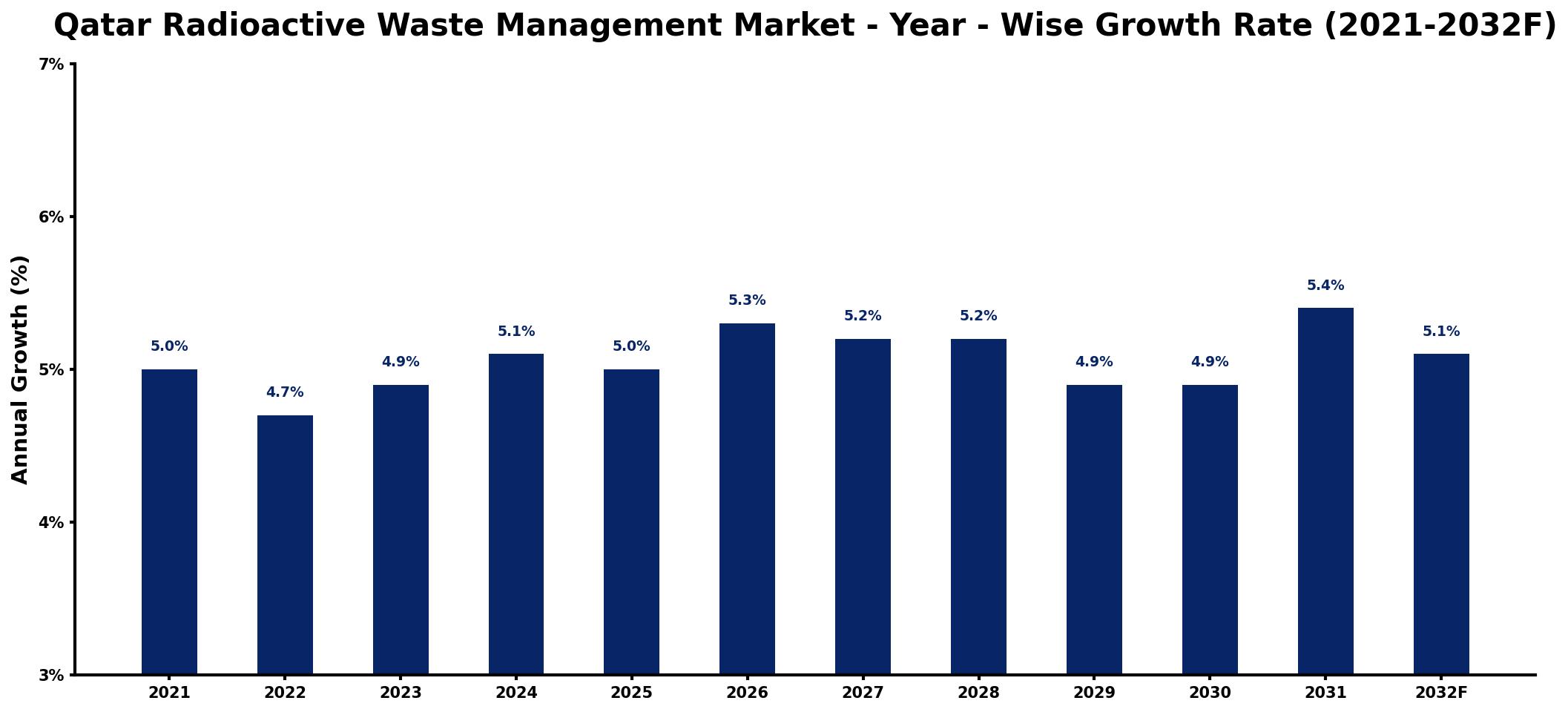
The table below presents the year‑wise growth rates along with the key drivers influencing the market
| Year | Growth Rate | Major Drivers |
| 2021 | 5.0% | Increased investments in infrastructure projects |
| 2022 | 4.7% | Growing public awareness on safety |
| 2023 | 4.9% | Expansion of energy sector initiatives |
| 2024 | 5.1% | Rising regulatory compliance requirements |
| 2025 | 5.0% | Emergence of sustainable disposal technologies |
| 2026 | 5.3% | Strengthening international collaboration efforts |
| 2027 | 5.2% | Increased focus on environmental sustainability |
| 2028 | 5.2% | Growth in industrial sector demand |
| 2029 | 4.9% | Development of innovative recycling solutions |
| 2030 | 4.9% | Enhanced research and development activities |
| 2031 | 5.4% | Rising government funding allocations |
| 2032 | 5.1% | Strengthened community engagement programs |
Note: Market size estimations and growth projections presented in this report are based on 6Wresearch's proprietary forecasting methodology, utilizing the latest available industry data, government publications, and primary research inputs.
Qatar Radioactive Waste Management Market Synopsis
The primary force shaping the Qatar Radioactive Waste Management Market is the burgeoning interest in nuclear energy as a sustainable power source. As Qatar looks to diversify its energy portfolio, the need for efficient and safe radioactive waste management practices becomes critical in minimizing environmental impact and ensuring public safety.
In tandem with industrial growth in sectors such as healthcare and research, Qatar is increasingly acknowledging the importance of responsible radioactive waste disposal. This acknowledgment not only enhances compliance with international norms but also paves the way for investment in innovative management technologies.
Qatar Radioactive Waste Management Market Key Takeaways
- Qatar is focusing on robust frameworks for the management of radioactive waste as part of its nuclear energy initiatives.
- The commitment to international safety standards positions the market for significant future growth.
- Public engagement and education are becoming central to the success of radioactive waste management strategies.
- Investment in advanced waste management technologies is essential for regulatory compliance and environmental safety.
- Operational challenges due to external factors, such as the COVID-19 pandemic, have prompted revisions in management protocols.
Evaluation of Restraints in Qatar Radioactive Waste Management Market
While the prospects for the Qatar Radioactive Waste Management Market appear strong, there are notable restraints to consider. First and foremost, the establishment of comprehensive disposal methods for radioactive materials poses intricate technical and logistical challenges. The region's geopolitical sensitivity adds another layer of complexity, requiring meticulous planning to ensure safety and compliance. Moreover, there's a pressing need for public education on safety measures, which is essential for maintaining trust and support for radioactive waste management initiatives.
Qatar Radioactive Waste Management Market Trends
Current trends highlight the increasing adoption of innovative waste management technologies in Qatar, focusing on sustainable practices. Enhanced data analytics and monitoring systems are emerging to optimize waste disposal processes. Additionally, the integration of smart technologies in radioactive waste management is being explored to improve efficiency and safety. The importance of public-private partnerships is also becoming evident, facilitating investment and resource-sharing for more effective waste management solutions.
Qatar Radioactive Waste Management Market Opportunities
There are substantial opportunities for growth within the Qatar Radioactive Waste Management Market, particularly as the nation diversifies its energy sources. Investment in advanced waste processing technologies can yield significant returns while promoting environmental sustainability. Furthermore, collaboration with international firms specializing in waste management can introduce best practices and innovative solutions. The ongoing expansion of the healthcare and research sectors presents additional avenues for targeted waste management services.
Government Initiatives in the Qatar Radioactive Waste Management Market
The Qatari government is actively developing policies and frameworks aimed at improving radioactive waste management. Public spending is increasingly directed towards infrastructure that ensures safe disposal and compliance with international standards. Programs focused on training and certification for waste management professionals are being implemented to bolster industry capabilities. Incentives for adopting innovative waste management technologies are also under consideration to stimulate growth in this sector.
Future Insights of the Qatar Radioactive Waste Management Market
Looking ahead to 2026-2032, the Qatar Radioactive Waste Management Market is expected to evolve significantly. With increased nuclear power generation, the demand for effective waste management solutions will heighten. Innovations in waste treatment and disposal technologies will likely emerge, driven by both regulatory requirements and market competition. Qatar's commitment to sustainability and safety will shape its regulatory environment, creating a landscape ripe for investment and development in radioactive waste management practices.
Qatar Radioactive Waste Management Market Latest Developments (2025 - 2026)
Recent developments in the Qatar Radioactive Waste Management Market indicate a strengthened focus on sustainable practices. Efforts are underway to upgrade existing waste management facilities to meet new safety standards. Collaborative projects involving both public and private sectors are being launched, aiming to enhance operational efficiency in waste processing. Additionally, ongoing training initiatives for professionals in the field are expected to elevate industry standards and public confidence in safety measures.
Qatar Radioactive Waste Management Market - Key Attractiveness of the Report
- 10 Years of Market Numbers
- Historical Data Starting from 2022 to 2025
- Base Year: 2025
- Forecast Data until 2032
- Key Performance Indicators Impacting the Market
- Major Upcoming Developments and Projects
Key Highlights of the Report:
- Qatar Radioactive Waste Management Market Outlook
- Market Size of Qatar Radioactive Waste Management Market, 2025
- Forecast of Qatar Radioactive Waste Management Market, 2032
- Historical Data and Forecast of Qatar Radioactive Waste Management Revenues & Volume for the Period 2022-2032F
- Qatar Radioactive Waste Management Market Trend Evolution
- Qatar Radioactive Waste Management Market Drivers and Challenges
- Qatar Radioactive Waste Management Price Trends
- Qatar Radioactive Waste Management Porter's Five Forces
- Qatar Radioactive Waste Management Industry Life Cycle
- Historical Data and Forecast of Qatar Radioactive Waste Management Market Revenues & Volume By Type for the Period 2022-2032F
- Historical Data and Forecast of Qatar Radioactive Waste Management Market Revenues & Volume By Exempt Waste and Very Low-Level Waste(VLLW) for the Period 2022-2032F
- Historical Data and Forecast of Qatar Radioactive Waste Management Market Revenues & Volume By Low-Level Waste(LLW) for the Period 2022-2032F
- Historical Data and Forecast of Qatar Radioactive Waste Management Market Revenues & Volume By Intermediate-Level Waste(ILW) for the Period 2022-2032F
- Historical Data and Forecast of Qatar Radioactive Waste Management Market Revenues & Volume By High-Level Waste(HLW) for the Period 2022-2032F
- Historical Data and Forecast of Qatar Radioactive Waste Management Market Revenues & Volume By Application for the Period 2022-2032F
- Historical Data and Forecast of Qatar Radioactive Waste Management Market Revenues & Volume By Industrial for the Period 2022-2032F
- Historical Data and Forecast of Qatar Radioactive Waste Management Market Revenues & Volume By Utility for the Period 2022-2032F
- Qatar Radioactive Waste Management Import Export Trade Statistics
- Market Opportunity Assessment By Type
- Market Opportunity Assessment By Application
- Qatar Radioactive Waste Management Top Companies Market Share
- Qatar Radioactive Waste Management Competitive Benchmarking By Technical and Operational Parameters
- Qatar Radioactive Waste Management Company Profiles
- Qatar Radioactive Waste Management Key Strategic Recommendations






































