United States (US) Radioactive Waste Management Market Size, Share & Growth Rate
The United States (US) Radioactive Waste Management Market was estimated at USD 181 Million in 2025 and is projected to reach USD 212 Million by 2032, growing at a CAGR of 2.3% from 2026 to 2032. This trajectory is fueled by an increase in radioactive waste generated from diverse sectors, including nuclear energy and healthcare, prompting a heightened need for efficient management solutions. Furthermore, ongoing advancements in waste treatment technologies and regulatory compliance requirements are set to drive market growth over the forecast period.
United States (US) Radioactive Waste Management Market Year-wise Growth Rate and Key Drivers
This graph highlights how the United States (US) Radioactive Waste Management Market has steadily grown over the years, supported by major growth factors.
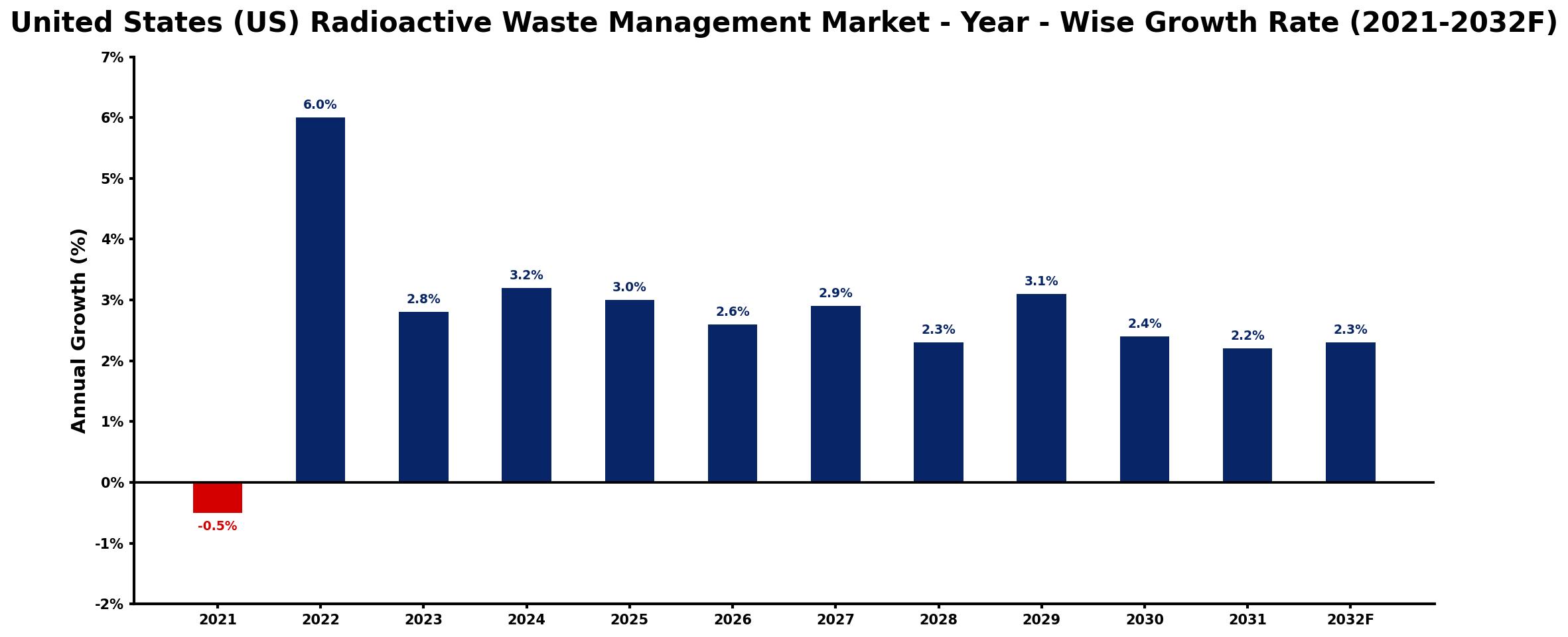
The table below presents the year‑wise growth rates along with the key drivers influencing the market
| Year | Growth Rate | Major Drivers |
| 2021 | -0.5% | decrease in disposal facilities |
| 2022 | 6.0% | increased regulatory compliance investments |
| 2023 | 2.8% | growth in nuclear energy sector |
| 2024 | 3.2% | expansion of recycling technologies |
| 2025 | 3.0% | rising public awareness initiatives |
| 2026 | 2.6% | advancements in safety protocols |
| 2027 | 2.9% | surge in government funding projects |
| 2028 | 2.3% | enhanced community engagement programs |
| 2029 | 3.1% | development of innovative solutions |
| 2030 | 2.4% | growing emerging market penetration |
| 2031 | 2.2% | increased private sector partnerships |
| 2032 | 2.3% | enhanced product quality standards |
Note: Market size estimations and growth projections presented in this report are based on 6Wresearch's proprietary forecasting methodology, utilizing the latest available industry data, government publications, and primary research inputs.
United States (US) Radioactive Waste Management Market Synopsis
In recent years, the United States Radioactive Waste Management Market has gained momentum due to the pressing demands of safe waste disposal and the complexities of regulatory frameworks. As the landscape evolves, the focus is shifting towards integrating advanced technologies and innovative practices that enhance safety and efficiency in managing radioactive materials.
Looking ahead, the market is poised for growth as industry players adapt to emerging trends and invest in sustainable waste management practices. This dynamic shift highlights the importance of collaboration among stakeholders, including regulatory bodies and waste management firms, to navigate challenges and capitalize on new opportunities.
United States (US) Radioactive Waste Management Market Key Takeaways
- The market is driven by increasing radioactive waste generation from nuclear power and healthcare sectors.
- Investment in advanced waste treatment technologies is essential for regulatory compliance and environmental safety.
- Stakeholder collaboration is critical for addressing public concerns and optimizing waste management solutions.
- The demand for innovative disposal methods is escalating due to decommissioning activities in aging nuclear facilities.
- Regulatory frameworks are evolving to address safety and sustainability in waste management practices.
Evaluation of Restraints in United States (US) Radioactive Waste Management Market
The US Radioactive Waste Management Market faces several significant restraints that hinder its progress. A primary limitation is the absence of a permanent disposal solution for high-level radioactive waste, which has led to growing public apprehension regarding new facility siting. Regulatory complexities also pose challenges, with intricate compliance processes creating hurdles for industry players. Furthermore, the costs associated with the transportation and storage of radioactive materials are substantial, straining budgets and resources while necessitating careful planning and execution. These factors contribute to an environment where balancing public acceptance, economic feasibility, and safety requirements remains paramount.
United States (US) Radioactive Waste Management Market Trends
The US Radioactive Waste Management Market is witnessing a trend toward adopting cutting-edge technologies that enhance the safe disposal and storage of radioactive materials. Notably, there is a growing emphasis on developing innovative reprocessing techniques and underground storage facilities. These advancements are complemented by an increasing focus on environmental sustainability, pushing industry players to prioritize eco-friendly practices in waste management. Additionally, heightened investment in research and development is paving the way for more efficient, cost-effective solutions that address the evolving landscape of radioactive waste management.
United States (US) Radioactive Waste Management Market Opportunities
The market presents a wealth of investment opportunities across various segments, including waste transportation, treatment, and disposal. With a persistent increase in the volume of radioactive waste generated, the need for innovative containment systems and transportation solutions is more critical than ever. Companies that focus on developing advanced recycling technologies and state-of-the-art disposal facilities are well-positioned for growth. Moreover, investments in regulatory compliance services and digital solutions for monitoring and tracking radioactive waste are expected to yield promising returns, as stakeholders seek to enhance transparency and efficiency in waste management practices.
Government Initiatives in the United States (US) Radioactive Waste Management Market
In the US, the management of radioactive waste is subject to stringent regulations set forth by key agencies such as the Nuclear Regulatory Commission (NRC) and the Environmental Protection Agency (EPA). The NRC is responsible for licensing nuclear facilities, ensuring adherence to safety standards for waste disposal. The EPA, on the other hand, establishes guidelines for the safe handling and disposal of radioactive materials to protect public health and the environment. Additionally, the Department of Energy (DOE) plays a crucial role in managing high-level radioactive waste from nuclear power generation and defense activities. Policies like the Nuclear Waste Policy Act further underline the governments commitment to addressing long-term disposal challenges, particularly in relation to projects like the Yucca Mountain repository.
Future Insights of the United States (US) Radioactive Waste Management Market
Looking towards the future, the United States Radioactive Waste Management Market is anticipated to grow steadily from 2026 to 2032. Factors such as the increasing generation of nuclear power and the decommissioning of obsolete facilities will drive demand for advanced waste management technologies. Moreover, an increased emphasis on regulatory compliance and environmental sustainability is likely to further propel the market forward. As industry stakeholders invest in innovative solutions and sustainable practices, the market is set to evolve, meeting the pressing need for safe and effective radioactive waste management in a changing energy landscape.
United States (US) Radioactive Waste Management Market Latest Developments (2025 - 2026)
Recent developments in the United States Radioactive Waste Management Market indicate a significant shift toward adopting advanced technologies that enhance waste treatment and disposal processes. Regulatory bodies are increasingly prioritizing safety and environmental sustainability in their guidelines, which has led to the exploration of innovative disposal methodologies. Additionally, collaborative efforts among industry stakeholders are focused on addressing public concerns and optimizing the management of radioactive materials, paving the way for more effective solutions in the near future.
United States (US) Radioactive Waste Management Market - Key Attractiveness of the Report
- 10 Years of Market Numbers
- Historical Data Starting from 2022 to 2025
- Base Year: 2025
- Forecast Data until 2032
- Key Performance Indicators Impacting the Market
- Major Upcoming Developments and Projects
Key Highlights of the Report:
- United States (US) Radioactive Waste Management Market Outlook
- Market Size of United States (US) Radioactive Waste Management Market, 2025
- Forecast of United States (US) Radioactive Waste Management Market, 2032
- Historical Data and Forecast of United States (US) Radioactive Waste Management Revenues & Volume for the Period 2022-2032F
- United States (US) Radioactive Waste Management Market Trend Evolution
- United States (US) Radioactive Waste Management Market Drivers and Challenges
- United States (US) Radioactive Waste Management Price Trends
- United States (US) Radioactive Waste Management Porter's Five Forces
- United States (US) Radioactive Waste Management Industry Life Cycle
- Historical Data and Forecast of United States (US) Radioactive Waste Management Market Revenues & Volume By Type for the Period 2022-2032F
- Historical Data and Forecast of United States (US) Radioactive Waste Management Market Revenues & Volume By Exempt Waste and Very Low-Level Waste(VLLW) for the Period 2022-2032F
- Historical Data and Forecast of United States (US) Radioactive Waste Management Market Revenues & Volume By Low-Level Waste(LLW) for the Period 2022-2032F
- Historical Data and Forecast of United States (US) Radioactive Waste Management Market Revenues & Volume By Intermediate-Level Waste(ILW) for the Period 2022-2032F
- Historical Data and Forecast of United States (US) Radioactive Waste Management Market Revenues & Volume By High-Level Waste(HLW) for the Period 2022-2032F
- Historical Data and Forecast of United States (US) Radioactive Waste Management Market Revenues & Volume By Application for the Period 2022-2032F
- Historical Data and Forecast of United States (US) Radioactive Waste Management Market Revenues & Volume By Industrial for the Period 2022-2032F
- Historical Data and Forecast of United States (US) Radioactive Waste Management Market Revenues & Volume By Utility for the Period 2022-2032F
- United States (US) Radioactive Waste Management Import Export Trade Statistics
- Market Opportunity Assessment By Type
- Market Opportunity Assessment By Application
- United States (US) Radioactive Waste Management Top Companies Market Share
- United States (US) Radioactive Waste Management Competitive Benchmarking By Technical and Operational Parameters
- United States (US) Radioactive Waste Management Company Profiles
- United States (US) Radioactive Waste Management Key Strategic Recommendations






































