Qatar Revenue Assurance Market Size, Share & Growth Rate
The Qatar Revenue Assurance Market was estimated at USD 1183 Million in 2025 and is projected to reach USD 2224 Million by 2032, growing at a CAGR of 9.4% from 2026 to 2032. This growth trajectory is driven by the increasing complexity of telecommunications networks and the escalating demand for high-quality service delivery. As telecom operators seek to enhance customer satisfaction and optimize their network performance, revenue assurance solutions are becoming indispensable.
Qatar Revenue Assurance Market Year-wise Growth Rate and Key Drivers
This graph highlights how the Qatar Revenue Assurance Market has steadily grown over the years, supported by major growth factors.
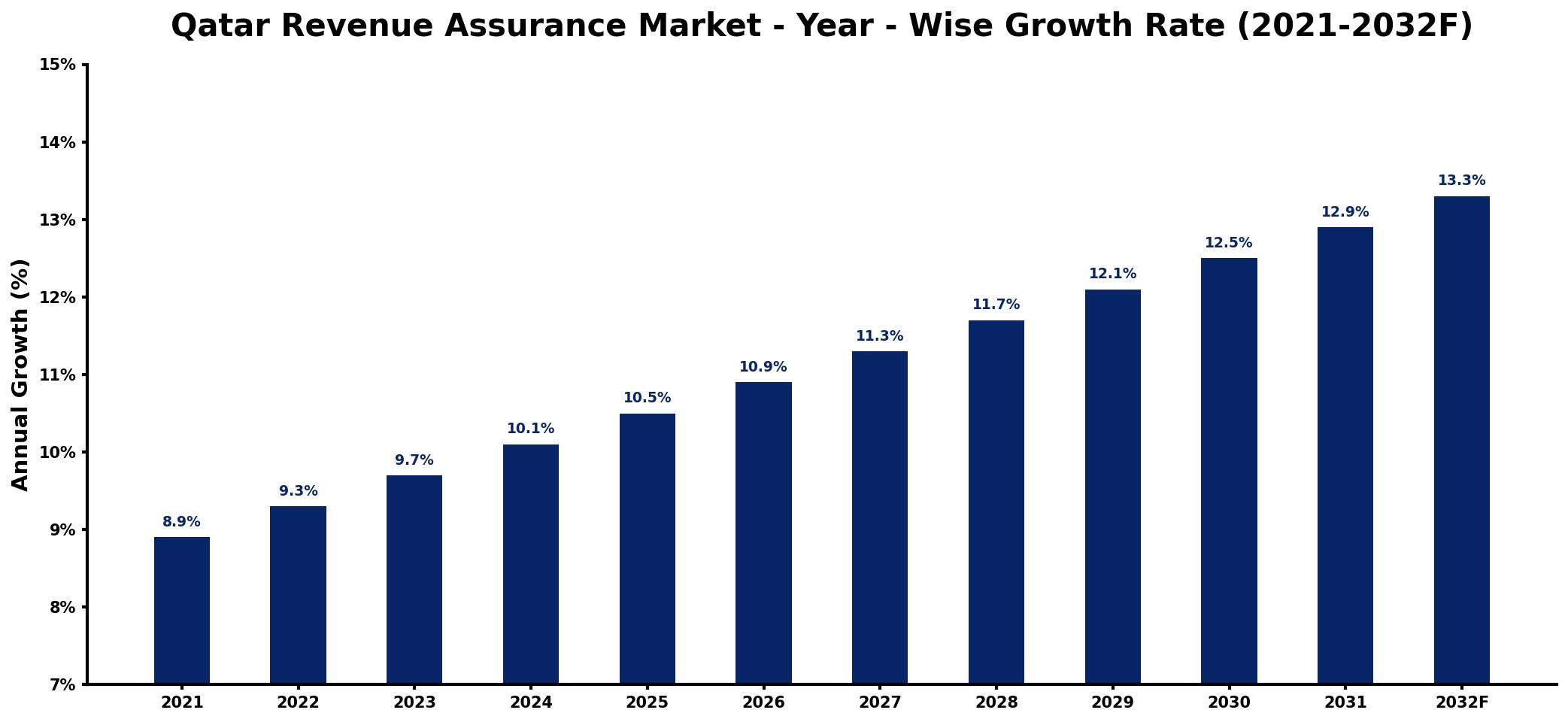
The table below presents the year‑wise growth rates along with the key drivers influencing the market
| Year | Growth Rate | Major Drivers |
| 2021 | 8.9% | Increased digital transformation initiatives |
| 2022 | 9.3% | Growing demand for data analytics |
| 2023 | 9.7% | Expansion of telecommunications infrastructure |
| 2024 | 10.1% | Rise in regulatory compliance requirements |
| 2025 | 10.5% | Investment in cybersecurity technologies |
| 2026 | 10.9% | Emergence of smart city projects |
| 2027 | 11.3% | Adoption of cloud-based solutions |
| 2028 | 11.7% | Focus on operational efficiency improvements |
| 2029 | 12.1% | Strengthened partnerships with technology providers |
| 2030 | 12.5% | Increased integration of AI technologies |
| 2031 | 12.9% | Heightened consumer protection regulations |
| 2032 | 13.3% | Growth in mobile payment solutions |
Note: Market size estimations and growth projections presented in this report are based on 6Wresearch's proprietary forecasting methodology, utilizing the latest available industry data, government publications, and primary research inputs.
Qatar Revenue Assurance Market Synopsis
In Qatar, the demand for robust revenue assurance measures is particularly critical as telecom operators navigate a rapidly evolving digital landscape. The convergence of various technologies and services necessitates sophisticated monitoring and analytics capabilities to prevent revenue leakages and ensure service reliability.
As mobile and internet services continue to expand, particularly in the context of smart city initiatives, the need for comprehensive revenue assurance frameworks will intensify. These frameworks not only bolster operational efficiencies but also enhance the user experience, serving as a foundation for sustainable growth in the sector.
Qatar Revenue Assurance Market Key Takeaways
- The market is anticipated to experience a significant growth rate, driven by technological advancements in analytics and automation.
- Collaborations between telecom operators and solution providers are expected to shape the strategic landscape of revenue assurance.
- There is a pressing need for integrated solutions that ensure end-to-end visibility across complex network structures.
- The implementation of AI and machine learning technologies is poised to revolutionize monitoring processes and service quality assurance.
- Government initiatives supporting digital transformation will further catalyze growth in the revenue assurance domain.
Evaluation of Restraints in Qatar Revenue Assurance Market
The Qatar Revenue Assurance Market faces several restraints that can hinder its growth. One significant challenge is the growing complexity of modern telecommunications infrastructures. As networks evolve towards virtualization and cloud-based technologies, maintaining service quality becomes increasingly intricate. Operators must integrate assurance practices across various layers of technology while ensuring seamless service delivery. Additionally, the rapid pace of technological change means that revenue assurance solutions must continually adapt, which can strain resources and complicate implementation processes.
Qatar Revenue Assurance Market Trends
A notable trend in the Qatar Revenue Assurance Market is the integration of artificial intelligence (AI) and machine learning (ML) into revenue assurance systems. These technologies enhance predictive analytics, allowing operators to identify potential issues before they escalate, thereby protecting revenue streams. Furthermore, there is an increased focus on end-user experience, driving the demand for solutions that provide comprehensive visibility across network operations.
Qatar Revenue Assurance Market Opportunities
The market is ripe with opportunities, particularly in the area of predictive analytics and automated monitoring systems. As operators look to optimize their operations, solutions that incorporate real-time data insights and advanced analytics will be in high demand. Additionally, the emphasis on digital transformation across sectors in Qatar is likely to spur investments in innovative revenue assurance solutions, leading to enhanced operational efficiencies and improved customer satisfaction.
Government Initiatives in the Qatar Revenue Assurance Market
The Qatari government is actively promoting the digital transformation of its telecommunications sector as part of its National Vision 2030 initiative. This includes investments in infrastructure and technologies that enhance service delivery. By fostering an environment conducive to innovation, government policies are expected to play a crucial role in advancing revenue assurance practices, ensuring that operators can effectively manage and safeguard their revenue streams.
Future Insights of the Qatar Revenue Assurance Market
Looking ahead to 2026-2032, the Qatar Revenue Assurance Market is expected to evolve significantly. The increasing adoption of 5G technology will require more sophisticated revenue assurance strategies to accommodate the associated complexities. Furthermore, as telecom operators face rising customer expectations, the need for comprehensive assurance solutions will become even more pronounced, driving continuous innovation in the market.
Qatar Revenue Assurance Market Latest Developments (2025 - 2026)
Recent developments within the Qatar Revenue Assurance Market indicate a growing trend toward collaboration between telecom operators and technology providers. This is primarily aimed at creating integrated solutions that address the unique challenges posed by the dynamic telecommunications landscape. Innovations in data analytics and automation are also being prioritized, as operators aim to enhance service reliability and customer satisfaction.
Qatar Revenue Assurance Market - Key Attractiveness of the Report
- 10 Years of Market Numbers
- Historical Data Starting from 2022 to 2025
- Base Year: 2025
- Forecast Data until 2032
- Key Performance Indicators Impacting the Market
- Major Upcoming Developments and Projects
Key Highlights of the Report:
- Qatar Revenue Assurance Market Outlook
- Market Size of Qatar Revenue Assurance Market, 2025
- Forecast of Qatar Revenue Assurance Market, 2032
- Historical Data and Forecast of Qatar Revenue Assurance Revenues & Volume for the Period 2022-2032F
- Qatar Revenue Assurance Market Trend Evolution
- Qatar Revenue Assurance Market Drivers and Challenges
- Qatar Revenue Assurance Price Trends
- Qatar Revenue Assurance Porter's Five Forces
- Qatar Revenue Assurance Industry Life Cycle
- Historical Data and Forecast of Qatar Revenue Assurance Market Revenues & Volume By Component for the Period 2022-2032F
- Historical Data and Forecast of Qatar Revenue Assurance Market Revenues & Volume By Software for the Period 2022-2032F
- Historical Data and Forecast of Qatar Revenue Assurance Market Revenues & Volume By Services for the Period 2022-2032F
- Historical Data and Forecast of Qatar Revenue Assurance Market Revenues & Volume By Planning and Consulting for the Period 2022-2032F
- Historical Data and Forecast of Qatar Revenue Assurance Market Revenues & Volume By Implementation and Customization for the Period 2022-2032F
- Historical Data and Forecast of Qatar Revenue Assurance Market Revenues & Volume By Support and Maintenance for the Period 2022-2032F
- Historical Data and Forecast of Qatar Revenue Assurance Market Revenues & Volume By Managed Services for the Period 2022-2032F
- Historical Data and Forecast of Qatar Revenue Assurance Market Revenues & Volume By End-User for the Period 2022-2032F
- Historical Data and Forecast of Qatar Revenue Assurance Market Revenues & Volume By TSPs for the Period 2022-2032F
- Historical Data and Forecast of Qatar Revenue Assurance Market Revenues & Volume By Enterprises for the Period 2022-2032F
- Historical Data and Forecast of Qatar Revenue Assurance Market Revenues & Volume By Deployment Mode for the Period 2022-2032F
- Historical Data and Forecast of Qatar Revenue Assurance Market Revenues & Volume By Cloud for the Period 2022-2032F
- Historical Data and Forecast of Qatar Revenue Assurance Market Revenues & Volume By On-premises for the Period 2022-2032F
- Historical Data and Forecast of Qatar Revenue Assurance Market Revenues & Volume By Vertical for the Period 2022-2032F
- Historical Data and Forecast of Qatar Revenue Assurance Market Revenues & Volume By Telecom for the Period 2022-2032F
- Historical Data and Forecast of Qatar Revenue Assurance Market Revenues & Volume By Utilities for the Period 2022-2032F
- Historical Data and Forecast of Qatar Revenue Assurance Market Revenues & Volume By BFSI for the Period 2022-2032F
- Historical Data and Forecast of Qatar Revenue Assurance Market Revenues & Volume By Hospitality for the Period 2022-2032F
- Historical Data and Forecast of Qatar Revenue Assurance Market Revenues & Volume By Others for the Period 2022-2032F
- Qatar Revenue Assurance Import Export Trade Statistics
- Market Opportunity Assessment By Component
- Market Opportunity Assessment By End-User
- Market Opportunity Assessment By Deployment Mode
- Market Opportunity Assessment By Vertical
- Qatar Revenue Assurance Top Companies Market Share
- Qatar Revenue Assurance Competitive Benchmarking By Technical and Operational Parameters
- Qatar Revenue Assurance Company Profiles
- Qatar Revenue Assurance Key Strategic Recommendations






































