Qatar Rubber Compound Market Size, Share & Growth Rate
The Qatar Rubber Compound Market was estimated at USD 492 Million in 2025 and is projected to reach USD 706 Million by 2032, growing at a CAGR of 5.3% from 2026 to 2032. This promising trajectory is primarily fueled by the robust expansion of the construction and automotive sectors, which increasingly rely on rubber compounds for essential applications, including tires, seals, and insulation materials. Furthermore, the ongoing investment in infrastructure projects across the nation amplifies the demand for high-performance rubber compounds, underlining the market's growth potential.
Qatar Rubber Compound Market Year-wise Growth Rate and Key Drivers
This graph highlights how the Qatar Rubber Compound Market has steadily grown over the years, supported by major growth factors.
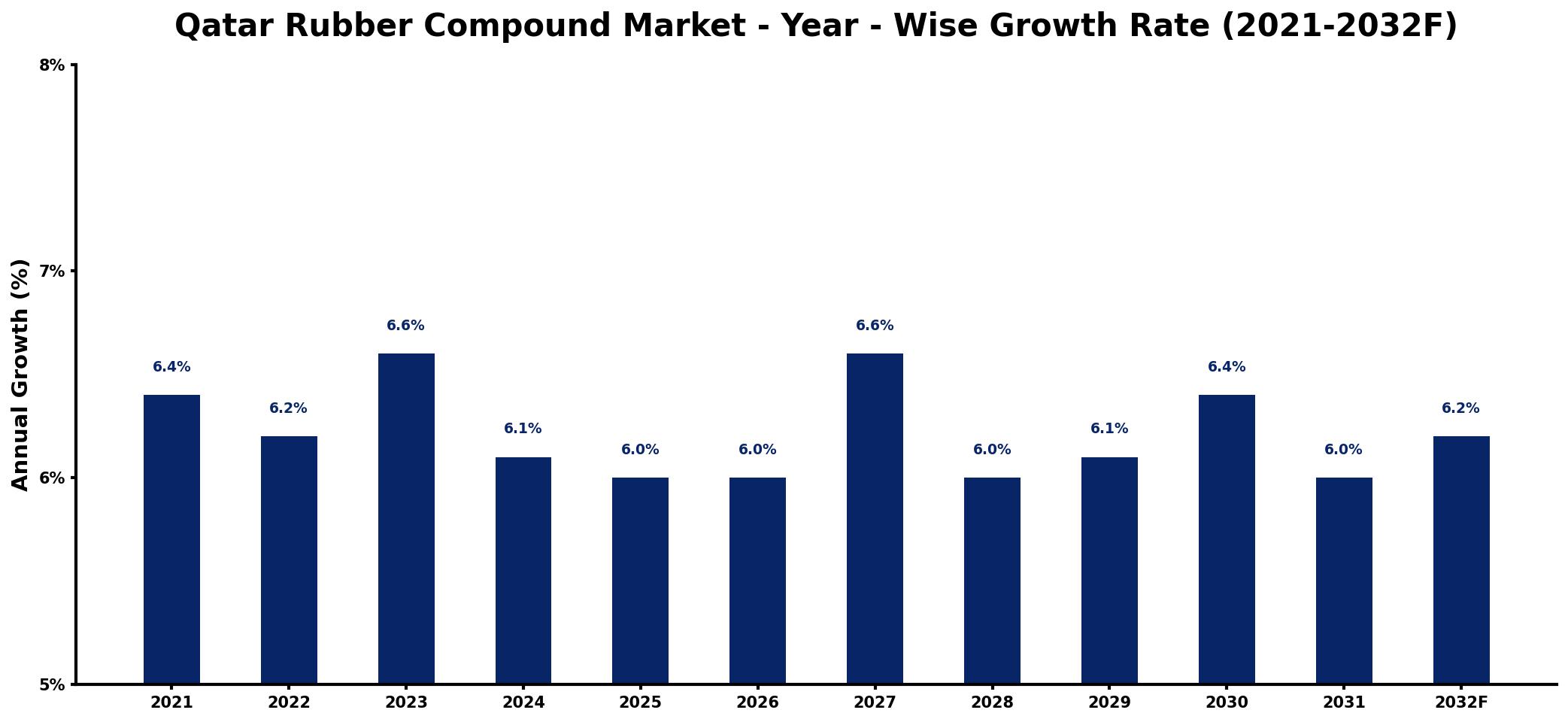
The table below presents the year‑wise growth rates along with the key drivers influencing the market
| Year | Growth Rate | Major Drivers |
| 2021 | 6.4% | Rising automotive industry demands |
| 2022 | 6.2% | Growing construction sector investments |
| 2023 | 6.6% | Increased consumer electronics production |
| 2024 | 6.1% | Boost in renewable energy projects |
| 2025 | 6.0% | Expansion of transportation infrastructure |
| 2026 | 6.0% | Surge in healthcare equipment needs |
| 2027 | 6.6% | Growth in aerospace manufacturing sector |
| 2028 | 6.0% | Increasing demand for consumer goods |
| 2029 | 6.1% | Emerging markets driving innovation |
| 2030 | 6.4% | Heightened focus on sustainability initiatives |
| 2031 | 6.0% | Rising urbanization and housing demands |
| 2032 | 6.2% | enhanced product quality standards |
Note: Market size estimations and growth projections presented in this report are based on 6Wresearch's proprietary forecasting methodology, utilizing the latest available industry data, government publications, and primary research inputs.
Qatar Rubber Compound Market Synopsis
In Qatar, the rubber compound market plays a pivotal role in supporting the construction industry's evolving needs, particularly for high-quality products that withstand the region's harsh climate. The demand for durable and resilient rubber compounds is rising, especially in applications like gaskets, seals, and industrial components, ensuring long-term performance and reliability.
Additionally, the automotive sector in Qatar is experiencing significant growth, further catalyzing the requirement for specialized rubber compounds for tire manufacturing and automotive parts. With increased production activities expected to rebound in the post-COVID era, the market is set to witness a strong resurgence, bolstered by a focus on sustainable solutions.
Qatar Rubber Compound Market Key Takeaways
- The market is set for growth driven by the construction and automotive industries.
- Investment in infrastructure development is a critical demand driver for high-quality rubber compounds.
- Increasing awareness of the benefits of rubber compounds is propelling their adoption across various sectors.
- Domestic producers face challenges from fluctuating raw material prices and international competition.
- The focus on sustainable and eco-friendly rubber compounds is shaping future innovations.
Evaluation of Restraints in Qatar Rubber Compound Market
Despite the promising outlook, the Qatar rubber compound market is not without its constraints. Volatility in the prices of essential raw materials, including natural and synthetic rubber, poses a significant challenge for manufacturers, impacting profitability and production planning. Furthermore, the competitive landscape, characterized by international entrants, raises the stakes for domestic producers who must focus on quality control and compliance with global standards. Maintaining consistent product quality is imperative for securing contracts and meeting the stringent requirements of end-users.
Qatar Rubber Compound Market Trends
Several trends are currently shaping the Qatar rubber compound market. Notably, the shift towards sustainable materials is gaining momentum, with manufacturers exploring eco-friendly formulations that align with global environmental standards. Technological advancements are also playing a crucial role, as companies invest in innovative processing methods to enhance the performance of rubber compounds. Additionally, there is a growing emphasis on customization, with clients seeking tailored solutions that meet specific application requirements, further driving market diversification.
Qatar Rubber Compound Market Opportunities
The Qatar rubber compound market is ripe with opportunities for both local and international players. The ongoing investments in infrastructure development, particularly in the run-up to significant events and economic diversification initiatives, present a prime avenue for growth. Furthermore, as the automotive industry pivots towards electric vehicles, the demand for specialized rubber components is expected to surge. Companies that innovate and adapt to these trends can carve out substantial market share, especially by offering sustainable alternatives that meet emerging regulatory requirements.
Government Initiatives in the Qatar Rubber Compound Market
The Qatari government is actively fostering growth in the rubber compound sector through various initiatives aimed at enhancing industrial capability. Investments in public infrastructure and financial incentives for local manufacturers are being prioritized, encouraging innovation and competitiveness. Additionally, policies promoting sustainability and environmental compliance are shaping the market landscape, signaling a commitment to aligning with global best practices.
Future Insights of the Qatar Rubber Compound Market
Looking ahead to the period between 2026 and 2032, the Qatar rubber compound market is expected to gain considerable momentum, buoyed by economic recovery post-COVID and ongoing infrastructure investments. As industries rebound and adapt to new market conditions, demand for high-quality rubber compounds will likely remain strong. Emphasis on sustainability and innovation will also drive market dynamics, positioning the sector for transformative growth in the coming years.
Qatar Rubber Compound Market Latest Developments (2025 - 2026)
Recent industry developments in the Qatar rubber compound market indicate a shift towards more sustainable production methods and materials. Companies are increasingly focusing on creating eco-friendly products that align with both local and international environmental standards. Innovations in rubber processing technologies are also emerging, aimed at enhancing product durability and performance. These developments suggest a proactive approach to meeting the evolving demands of the automotive and construction sectors.
Qatar Rubber Compound Market - Key Attractiveness of the Report
- 10 Years of Market Numbers
- Historical Data Starting from 2022 to 2025
- Base Year: 2025
- Forecast Data until 2032
- Key Performance Indicators Impacting the Market
- Major Upcoming Developments and Projects
Key Highlights of the Report:
- Qatar Rubber Compound Market Outlook
- Market Size of Qatar Rubber Compound Market, 2025
- Forecast of Qatar Rubber Compound Market, 2032
- Historical Data and Forecast of Qatar Rubber Compound Revenues & Volume for the Period 2022-2032F
- Qatar Rubber Compound Market Trend Evolution
- Qatar Rubber Compound Market Drivers and Challenges
- Qatar Rubber Compound Price Trends
- Qatar Rubber Compound Porter's Five Forces
- Qatar Rubber Compound Industry Life Cycle
- Historical Data and Forecast of Qatar Rubber Compound Market Revenues & Volume By Rubber Type for the Period 2022-2032F
- Historical Data and Forecast of Qatar Rubber Compound Market Revenues & Volume By Silicone Rubber for the Period 2022-2032F
- Historical Data and Forecast of Qatar Rubber Compound Market Revenues & Volume By Fluoro Rubber for the Period 2022-2032F
- Historical Data and Forecast of Qatar Rubber Compound Market Revenues & Volume By Butyronitrile Rubber for the Period 2022-2032F
- Historical Data and Forecast of Qatar Rubber Compound Market Revenues & Volume By EPDM Rubber for the Period 2022-2032F
- Historical Data and Forecast of Qatar Rubber Compound Market Revenues & Volume By Chloroprene Rubber for the Period 2022-2032F
- Historical Data and Forecast of Qatar Rubber Compound Market Revenues & Volume By Others for the Period 2022-2032F
- Historical Data and Forecast of Qatar Rubber Compound Market Revenues & Volume By End-User for the Period 2022-2032F
- Historical Data and Forecast of Qatar Rubber Compound Market Revenues & Volume By Tires for the Period 2022-2032F
- Historical Data and Forecast of Qatar Rubber Compound Market Revenues & Volume By Hose & Belting for the Period 2022-2032F
- Historical Data and Forecast of Qatar Rubber Compound Market Revenues & Volume By Roofing & Geo Membranes for the Period 2022-2032F
- Historical Data and Forecast of Qatar Rubber Compound Market Revenues & Volume By Footwear for the Period 2022-2032F
- Historical Data and Forecast of Qatar Rubber Compound Market Revenues & Volume By Wire & Cable Insulation for the Period 2022-2032F
- Historical Data and Forecast of Qatar Rubber Compound Market Revenues & Volume By Others for the Period 2022-2032F
- Qatar Rubber Compound Import Export Trade Statistics
- Market Opportunity Assessment By Rubber Type
- Market Opportunity Assessment By End-User
- Qatar Rubber Compound Top Companies Market Share
- Qatar Rubber Compound Competitive Benchmarking By Technical and Operational Parameters
- Qatar Rubber Compound Company Profiles
- Qatar Rubber Compound Key Strategic Recommendations






































