Qatar Spinning Machinery Market Size, Share & Growth Rate
The Qatar Spinning Machinery Market was estimated at USD 1309 Million in 2025 and is projected to reach USD 1887 Million by 2032, growing at a CAGR of 5.4% from 2026 to 2032. This growth trajectory is driven by Qatar's concerted efforts to enhance its domestic textile production capabilities, supported by substantial investments in textile infrastructure. The rising demand for high-quality textiles and sustainable manufacturing processes further fuels the expansion of the spinning machinery sector.
Qatar Spinning Machinery Market Year-wise Growth Rate and Key Drivers
This graph highlights how the Qatar Spinning Machinery Market has steadily grown over the years, supported by major growth factors.
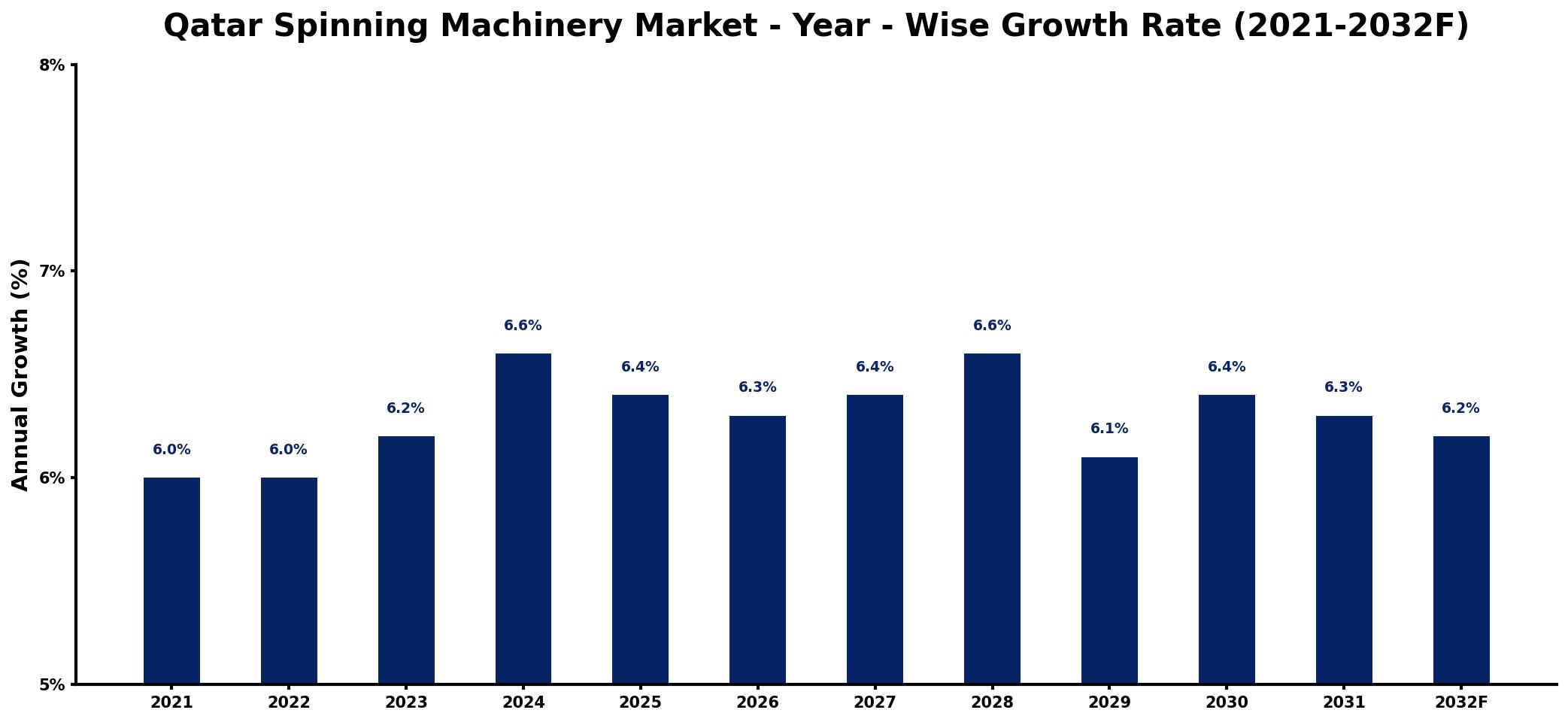
The table below presents the year‑wise growth rates along with the key drivers influencing the market
| Year | Growth Rate | Major Drivers |
| 2021 | 6.0% | Rising textile production capacity |
| 2022 | 6.0% | Increased investment in automation |
| 2023 | 6.2% | Growing demand for sustainable textiles |
| 2024 | 6.6% | Expansion of regional manufacturing facilities |
| 2025 | 6.4% | Higher consumer spending on apparel |
| 2026 | 6.3% | Technological advancements in processes |
| 2027 | 6.4% | Strengthened supply chain networks |
| 2028 | 6.6% | Emerging markets boosting exports |
| 2029 | 6.1% | Diversification of textile applications |
| 2030 | 6.4% | Government support for local industries |
| 2031 | 6.3% | Collaboration with international partners |
| 2032 | 6.2% | Focus on eco-friendly production methods |
Note: Market size estimations and growth projections presented in this report are based on 6Wresearch's proprietary forecasting methodology, utilizing the latest available industry data, government publications, and primary research inputs.
Qatar Spinning Machinery Market Synopsis
The Qatar Spinning Machinery Market has gained momentum recently, spurred by the countrys strategic focus on industrialization and economic diversification. As the textile and apparel sector evolves, there is a heightened urgency to boost local production capabilities, leading to increased investments in spinning technology.
Looking ahead, the market is poised for significant transformation as manufacturers adapt to new demands and explore innovative machinery solutions. This evolution not only positions Qatar as a competitive player in the regional textile industry but also aligns with global trends towards sustainability and efficiency in production.
Qatar Spinning Machinery Market Key Takeaways
- The market is on a growth path, fueled by government initiatives and investments in textile manufacturing.
- Rising demand for sustainable and high-quality fabrics is reshaping machinery requirements.
- Local manufacturers are collaborating with international players to enhance technological capabilities.
- Modernization and automation will be crucial to improving productivity and efficiency in production.
- The market is responding positively to post-pandemic recovery efforts, highlighting resilience and adaptability.
Evaluation of Restraints in Qatar Spinning Machinery Market
Despite its growth, the Qatar Spinning Machinery Market is challenged by several restraints that hinder its full potential. The necessity for modernization and automation remains critical; many facilities still rely on traditional methods that can hinder productivity. Additionally, competition from well-established global manufacturers intensifies the pressure on local producers to innovate and optimize their operations. Fluctuating raw material prices pose a risk, affecting the cost structure of spinning machinery manufacturing. Furthermore, balancing environmental sustainability with production processes is a pressing challenge that the industry must address to ensure long-term viability and compliance with emerging global standards.
Qatar Spinning Machinery Market Trends
Current trends in the Qatar Spinning Machinery Market reflect a shift towards sustainable practices and advanced technology integration. There is a growing demand for eco-friendly production methods, prompting manufacturers to invest in machines that minimize waste and energy consumption. Additionally, innovations such as automation and smart technology are becoming increasingly popular as businesses look to enhance operational efficiency. The trend towards customization in fabric production is also shaping demand for specialized machinery capable of producing diverse and high-quality textiles.
Qatar Spinning Machinery Market Opportunities
The Qatar Spinning Machinery Market presents numerous growth and investment opportunities, particularly in the realm of sustainable manufacturing solutions. Companies can explore partnerships to develop state-of-the-art machinery that incorporates energy-efficient technologies. Additionally, there is a significant opportunity for local firms to enhance their research and development capabilities to cater to the increasing consumer demand for innovative textiles. Expanding export markets for Qatari textiles also offers avenues for growth, as international demand for unique and high-quality products continues to rise.
Government Initiatives in the Qatar Spinning Machinery Market
The Qatari government has actively promoted the growth of the textile manufacturing sector through various initiatives aimed at enhancing industrial capabilities. Efforts include funding programs, tax incentives for local manufacturers, and investments in training and development programs to build a skilled workforce. These initiatives reflect a broader strategy to diversify the economy and reduce reliance on hydrocarbons, positioning the textile industry as a vital component of future economic growth.
Future Insights of the Qatar Spinning Machinery Market
Looking towards 2026-2032, the Qatar Spinning Machinery Market is expected to witness robust growth driven by continued government support and an evolving textile landscape. As manufacturers increasingly embrace automation and sustainable practices, they will enhance their competitiveness on both regional and global scales. The integration of advanced technologies, such as artificial intelligence and data analytics, is anticipated to further revolutionize production processes. In this environment, the focus will likely shift to producing high-quality, innovative fabrics that meet the changing preferences of consumers worldwide.
Qatar Spinning Machinery Market Latest Developments (2025 - 2026)
Recent developments within the Qatar Spinning Machinery Market highlight a renewed commitment to modernization and sustainability. Manufacturers are actively exploring new partnerships and collaborations to enhance their technological capabilities and improve production efficiency. Initiatives aimed at upgrading existing machinery to more energy-efficient models are gaining traction, reflecting a broader industry shift toward environmental responsibility. As companies respond to market demands for high-quality textiles, the introduction of innovative spinning solutions is expected to accelerate.
Qatar Spinning Machinery Market - Key Attractiveness of the Report
- 10 Years of Market Numbers
- Historical Data Starting from 2022 to 2025
- Base Year: 2025
- Forecast Data until 2032
- Key Performance Indicators Impacting the Market
- Major Upcoming Developments and Projects
Key Highlights of the Report:
- Qatar Spinning Machinery Market Outlook
- Market Size of Qatar Spinning Machinery Market, 2025
- Forecast of Qatar Spinning Machinery Market, 2032
- Historical Data and Forecast of Qatar Spinning Machinery Revenues & Volume for the Period 2022-2032F
- Qatar Spinning Machinery Market Trend Evolution
- Qatar Spinning Machinery Market Drivers and Challenges
- Qatar Spinning Machinery Price Trends
- Qatar Spinning Machinery Porter's Five Forces
- Qatar Spinning Machinery Industry Life Cycle
- Historical Data and Forecast of Qatar Spinning Machinery Market Revenues & Volume By Type for the Period 2022-2032F
- Historical Data and Forecast of Qatar Spinning Machinery Market Revenues & Volume By Ring for the Period 2022-2032F
- Historical Data and Forecast of Qatar Spinning Machinery Market Revenues & Volume By Rotor Spinning for the Period 2022-2032F
- Historical Data and Forecast of Qatar Spinning Machinery Market Revenues & Volume By Material for the Period 2022-2032F
- Historical Data and Forecast of Qatar Spinning Machinery Market Revenues & Volume By Natural for the Period 2022-2032F
- Historical Data and Forecast of Qatar Spinning Machinery Market Revenues & Volume By Synthetic for the Period 2022-2032F
- Historical Data and Forecast of Qatar Spinning Machinery Market Revenues & Volume By Others for the Period 2022-2032F
- Historical Data and Forecast of Qatar Spinning Machinery Market Revenues & Volume By End-Use Industry for the Period 2022-2032F
- Historical Data and Forecast of Qatar Spinning Machinery Market Revenues & Volume By Clothing for the Period 2022-2032F
- Historical Data and Forecast of Qatar Spinning Machinery Market Revenues & Volume By Textile for the Period 2022-2032F
- Historical Data and Forecast of Qatar Spinning Machinery Market Revenues & Volume By Other Industry for the Period 2022-2032F
- Qatar Spinning Machinery Import Export Trade Statistics
- Market Opportunity Assessment By Type
- Market Opportunity Assessment By Material
- Market Opportunity Assessment By End-Use Industry
- Qatar Spinning Machinery Top Companies Market Share
- Qatar Spinning Machinery Competitive Benchmarking By Technical and Operational Parameters
- Qatar Spinning Machinery Company Profiles
- Qatar Spinning Machinery Key Strategic Recommendations






































