United States (US) Spinning Machinery Market Size, Share & Growth Rate
The United States (US) Spinning Machinery Market was estimated at USD 199 Million in 2025 and is projected to reach USD 235 Million by 2032, growing at a CAGR of 2.4% from 2026 to 2032. This growth trajectory is being propelled by technological innovations that enhance efficiency and reduce operational costs. Additionally, the increasing demand for high-quality textile products across various industries is shaping investment decisions in this sector.
United States (US) Spinning Machinery Market Year-wise Growth Rate and Key Drivers
This graph highlights how the United States (US) Spinning Machinery Market has steadily grown over the years, supported by major growth factors.
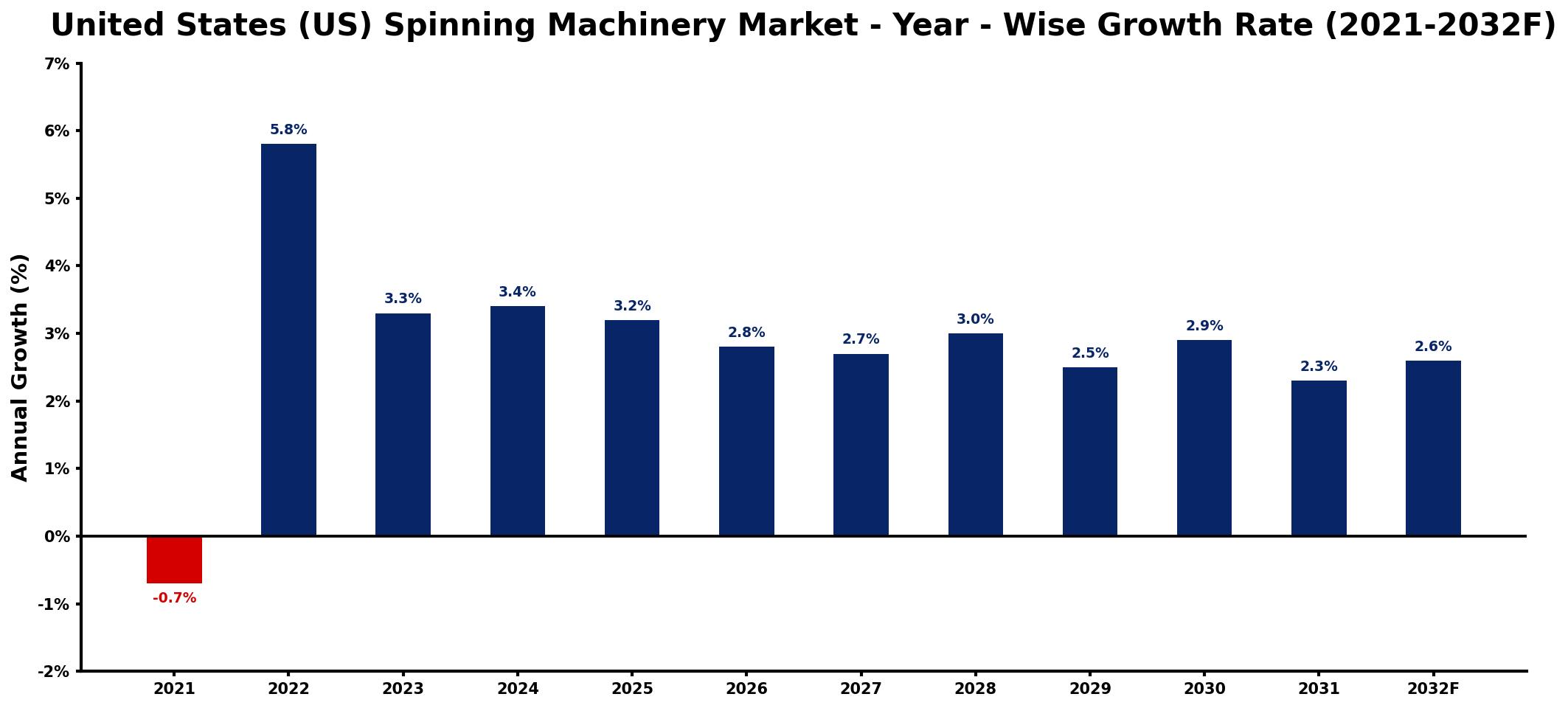
The table below presents the year‑wise growth rates along with the key drivers influencing the market
| Year | Growth Rate | Major Drivers |
| 2021 | -0.7% | decreased industrial production rates |
| 2022 | 5.8% | rising demand from textile industry |
| 2023 | 3.3% | increased investment in automation |
| 2024 | 3.4% | expansion of manufacturing facilities |
| 2025 | 3.2% | growing consumer goods demand |
| 2026 | 2.8% | technological advancements in production |
| 2027 | 2.7% | enhanced supply chain efficiencies |
| 2028 | 3.0% | broadening applications in fashion |
| 2029 | 2.5% | strengthening export market opportunities |
| 2030 | 2.9% | increased focus on sustainability |
| 2031 | 2.3% | growing customization in production |
| 2032 | 2.6% | new market entrants driving innovation |
Note: Market size estimations and growth projections presented in this report are based on 6Wresearch's proprietary forecasting methodology, utilizing the latest available industry data, government publications, and primary research inputs.
United States (US) Spinning Machinery Market Synopsis
The landscape of the United States spinning machinery market is rapidly evolving, driven by advancements in technology and a robust demand for textile products. Companies are increasingly investing in automation and digitization, which not only streamline production but also contribute to sustainability efforts.
Amidst intense competition, manufacturers are compelled to innovate and diversify their offerings to stay relevant. This dynamic environment underscores the necessity for spinning machinery that caters to a wide array of fibers while also adhering to environmental standards.
United States (US) Spinning Machinery Market Key Takeaways
- The market is set to grow steadily, with a focus on technological advancements and sustainability.
- Automation and digital technologies are increasingly integrated to enhance productivity and operational efficiency.
- Competition is intensifying, with manufacturers innovating to maintain a competitive edge in the global market.
- Investment opportunities are robust, particularly in eco-friendly spinning machinery solutions.
- Government policies significantly influence the operational landscape, focusing on safety and sustainability.
Evaluation of Restraints in United States (US) Spinning Machinery Market
Despite the positive outlook, the United States spinning machinery market faces several restraints. Rapid technological advancements necessitate continual upgrades and innovations, which can strain R&D budgets. Additionally, rising raw material costs place pressure on manufacturers, affecting profitability. The need for compliance with stringent sustainability standards further complicates operational planning. Moreover, competition from lower-cost overseas manufacturers could potentially impact market share and pricing strategies, making it imperative for US manufacturers to adopt agile business models to navigate these challenges.
United States (US) Spinning Machinery Market Trends
Key trends in the US spinning machinery market indicate a shift towards advanced technology solutions, with a notable emphasis on automation and data analytics. Real-time monitoring and predictive maintenance are becoming standard features, enabling manufacturers to maximize efficiency. In parallel, sustainability is taking center stage, with many companies seeking machinery that minimizes energy consumption and reduces waste. The growing preference for versatile machines that accommodate various fiber types reflects the evolving demands of the textile industry, paving the way for innovative spinning solutions.
United States (US) Spinning Machinery Market Opportunities
The US spinning machinery market is ripe with investment opportunities, particularly for those focusing on advanced technological solutions. As manufacturers strive for increased efficiency and quality, there is a notable demand for state-of-the-art machinery that integrates sustainability into the production process. Additionally, businesses investing in R&D for cutting-edge spinning technologies that offer both performance and environmental benefits are well-positioned to capture significant market share. The evolving consumer preferences for high-quality and sustainable textile products will further drive the demand for innovative spinning machinery solutions.
Government Initiatives in the United States (US) Spinning Machinery Market
Government initiatives play a critical role in shaping the US spinning machinery market. Regulations focused on workplace safety, enforced by the Occupational Safety and Health Administration (OSHA), ensure safe operational standards within manufacturing facilities. The Environmental Protection Agency (EPA) regulates emissions and waste, promoting eco-friendly practices within the industry. Additionally, trade agreements like the US-Mexico-Canada Agreement (USMCA) impact market dynamics through import and export regulations. Programs encouraging innovation and sustainability are also crucial, fostering a competitive landscape for US manufacturers.
Future Insights of the United States (US) Spinning Machinery Market
Looking ahead to 2026-2032, the United States spinning machinery market is anticipated to continue its steady growth. The increasing demand for textiles, coupled with ongoing technological advancements, will play a pivotal role in market expansion. As automation and digitization become more prevalent, manufacturers will gain access to enhanced efficiency, significantly improving production capabilities. The focus on high-quality yarn production that meets diverse consumer preferences is expected to fuel investment in innovative machinery. However, maintaining competitiveness in light of fluctuating raw material costs and international competition will be critical for sustained growth.
United States (US) Spinning Machinery Market Latest Developments (2025 - 2026)
Recent developments in the US spinning machinery market indicate a clear trend towards greater automation and the integration of digital technologies. Many manufacturers are exploring partnerships with tech companies to enhance their machinery with advanced monitoring capabilities. Additionally, industry stakeholders are increasingly focusing on sustainability, aligning product development with eco-friendly practices to cater to the growing environmentally conscious market. This strategic shift is expected to foster collaboration and innovation within the industry.
United States (US) Spinning Machinery Market - Key Attractiveness of the Report
- 10 Years of Market Numbers
- Historical Data Starting from 2022 to 2025
- Base Year: 2025
- Forecast Data until 2032
- Key Performance Indicators Impacting the Market
- Major Upcoming Developments and Projects
Key Highlights of the Report:
- United States (US) Spinning Machinery Market Outlook
- Market Size of United States (US) Spinning Machinery Market, 2025
- Forecast of United States (US) Spinning Machinery Market, 2032
- Historical Data and Forecast of United States (US) Spinning Machinery Revenues & Volume for the Period 2022-2032F
- United States (US) Spinning Machinery Market Trend Evolution
- United States (US) Spinning Machinery Market Drivers and Challenges
- United States (US) Spinning Machinery Price Trends
- United States (US) Spinning Machinery Porter's Five Forces
- United States (US) Spinning Machinery Industry Life Cycle
- Historical Data and Forecast of United States (US) Spinning Machinery Market Revenues & Volume By Type for the Period 2022-2032F
- Historical Data and Forecast of United States (US) Spinning Machinery Market Revenues & Volume By Ring for the Period 2022-2032F
- Historical Data and Forecast of United States (US) Spinning Machinery Market Revenues & Volume By Rotor Spinning for the Period 2022-2032F
- Historical Data and Forecast of United States (US) Spinning Machinery Market Revenues & Volume By Material for the Period 2022-2032F
- Historical Data and Forecast of United States (US) Spinning Machinery Market Revenues & Volume By Natural for the Period 2022-2032F
- Historical Data and Forecast of United States (US) Spinning Machinery Market Revenues & Volume By Synthetic for the Period 2022-2032F
- Historical Data and Forecast of United States (US) Spinning Machinery Market Revenues & Volume By Others for the Period 2022-2032F
- Historical Data and Forecast of United States (US) Spinning Machinery Market Revenues & Volume By End-Use Industry for the Period 2022-2032F
- Historical Data and Forecast of United States (US) Spinning Machinery Market Revenues & Volume By Clothing for the Period 2022-2032F
- Historical Data and Forecast of United States (US) Spinning Machinery Market Revenues & Volume By Textile for the Period 2022-2032F
- Historical Data and Forecast of United States (US) Spinning Machinery Market Revenues & Volume By Other Industry for the Period 2022-2032F
- United States (US) Spinning Machinery Import Export Trade Statistics
- Market Opportunity Assessment By Type
- Market Opportunity Assessment By Material
- Market Opportunity Assessment By End-Use Industry
- United States (US) Spinning Machinery Top Companies Market Share
- United States (US) Spinning Machinery Competitive Benchmarking By Technical and Operational Parameters
- United States (US) Spinning Machinery Company Profiles
- United States (US) Spinning Machinery Key Strategic Recommendations






































